Executive Voice Preservation
Refinement shaped around supplied voice examples and approved tone.

Turn approved financial and business inputs into a coherent executive narrative across shareholder letters, earnings communication, CEO/CFO prepared remarks, investor presentations, Q&A and related stakeholder materials—while preserving executive voice and keeping claims anchored to the source material you provide.
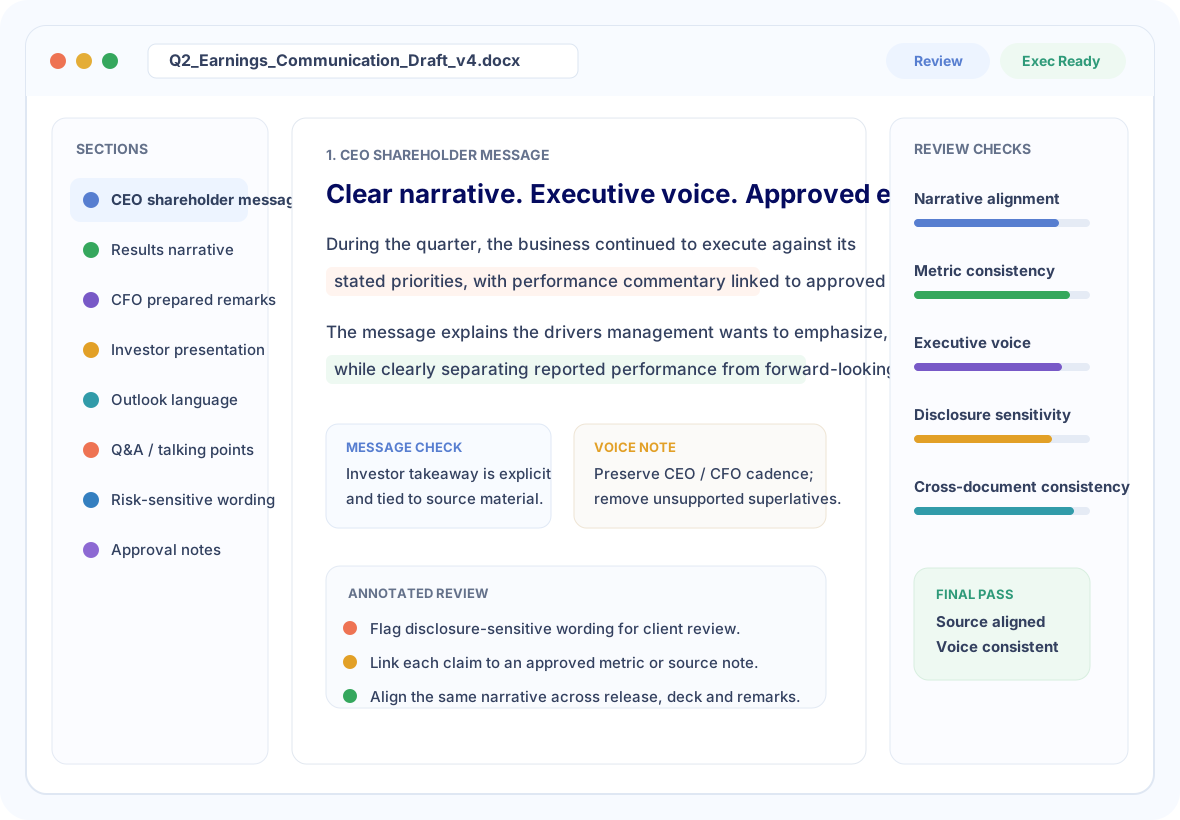
Refinement shaped around supplied voice examples and approved tone.
Unpublished drafts and source materials treated as confidential service information.
Narrative, source alignment, consistency, voice and reviewer-readiness checked in sequence.
Annotated and clean versions, with agreed notes or talking points where included in scope.
Executive messaging is priced around the number of leadership messages and the evidence they must reconcile, because strategic framing requires more judgment than routine copy polishing.
Suitable for: Leadership teams preparing shareholder letters, CEO/CFO remarks, outlook language, or Q&A messaging around a defined reporting period.
Multiple executives, extensive interview synthesis, several communication channels, or major late-stage changes to approved facts can expand the scope.
Common communication issues are easier to resolve before the approval cycle becomes crowded. We help surface messaging gaps, inconsistencies and unclear wording before material reaches final executive review.
The communication reports information but does not make the intended management narrative or audience takeaway easy to follow.
Performance commentary and approved figures appear side by side without a clear explanation of the drivers management wants to emphasize.
Superlatives, causal language or broad claims may need qualification or stronger linkage to the source material supplied by the client.
The release, shareholder letter, prepared remarks and deck may sound as if they were written by different teams rather than one leadership group.
Forward-looking, comparative or certainty-heavy wording may require careful client-side legal, compliance or investor-relations review.
Late stakeholder comments, missing source references or unclear ownership can create avoidable revision loops near a reporting deadline.
The engagement can be scoped around one communication asset or a connected earnings package. The workflow below shows the major messaging dimensions we can help develop, refine or review.
The goal is not to add corporate jargon. It is to make the executive message more precise, source-aware, consistent and easier for shareholders or investors to understand.
“This was another great quarter and the business performed strongly everywhere. Our strategy is clearly working and investors should be confident in the future.”
During the quarter, the business continued to execute against its stated priorities.
Link the next sentence to the approved results and identify the driver management wants the audience to understand.
Separate reported outcomes from any forward-looking commentary or outlook statement.
“During the quarter, the business continued to execute against its stated priorities. The shareholder message links performance commentary to approved results, explains the drivers management wants to emphasize, and clearly separates reported performance from outlook.”
Executive shareholder and earnings communication requires more than correct grammar. It also requires a coherent narrative, consistent leadership voice and disciplined alignment between the words and the approved information supplied by the client.
| Support Dimension | Proofreading Final-stage correctness |
Language Editing Clarity & style improvement |
Full Executive Messaging Support End-to-end communication development |
|---|---|---|---|
| Narrative framing & audience takeaway | × | △ | ✓ |
| CEO / CFO voice alignment | × | △ | ✓ |
| Metric-to-message alignment | × | × | ✓ |
| Cross-document narrative consistency | × | △ | ✓ |
| Q&A / talking-point development | × | × | ✓ |
| Disclosure-sensitive wording flags | × | △ | ✓ |
| Grammar, syntax & readability | ✓ | ✓ | ✓ |
| Formatting & presentation consistency | ✓ | ✓ | ✓ |
| Reviewer-focused refinements | × | △ | ✓ |
Scope can focus on one asset or a coordinated communication set. Select only the materials relevant to your reporting or stakeholder-engagement requirement.
A structured workflow keeps message development tied to approved facts, executive voice, the audience takeaway and the reporting calendar.
Share drafts, source packs, approved figures, prior communications and deadline.
Confirm assets, communication objective, decision audience and review depth.
Match the work to the required executive, business and communication context.
Define key message, evidence flow, executive emphasis and audience takeaway.
Draft or refine the shareholder letter, remarks, deck copy or related assets.
Check claims against supplied sources and align messages across connected assets.
Standardise presentation, comments, document structure and reviewer action points.
Provide the agreed annotated and clean files with supporting notes where in scope.
Better source material produces a stronger, more traceable executive message. Share only what is relevant to the engagement and the agreed communication scope.
Deliverables vary by agreed scope; the service does not assume that every engagement includes every item above.
A multi-stage review checks whether the communication is clear, source-aware, consistent in executive voice and practical for the client’s internal approval process.
Check narrative order, audience takeaway and message hierarchy.
Improve concision, readability and executive-level expression.
Trace material claims to the approved inputs supplied for the engagement.
Align terminology, emphasis and narrative across related communication assets.
Surface wording that may need investor-relations, legal or compliance review.
Confirm agreed edits, presentation consistency and clean final files.
The service can be adapted to different reporting and stakeholder contexts while keeping unpublished materials within the designated service workflow.
The published starting price above covers the defined entry scope for Executive Earnings Messaging. Larger, deeper, or faster-turnaround requirements are quoted after the actual materials and deliverables are reviewed.
For the published starting scope, typical delivery is 4–5 business days.
A personalised quote is based on the agreed communication scope, not on a copied Editing, Writing or Proofreading plan.
Share the communication assets, source-pack status, executive audience, review deadline and the areas that need the most attention. We will use those details to assess scope, delivery feasibility and quote requirements.
You do not need to prepare a perfect brief. A concise summary of the communication package and the review calendar is enough to start.
List the shareholder letter, earnings release, prepared remarks, deck, Q&A or other files in scope.
Tell us whether approved results, source notes and performance metrics are available.
Share prior communication examples if CEO or CFO voice needs to be preserved closely.
Include the required delivery time and any executive, IR, legal or compliance review milestones.
Highlight narrative clarity, source alignment, tone, consistency, Q&A, presentation or other focus areas.
Important: Contentxprtz provides communication and editorial support. The client remains responsible for financial accuracy, disclosure decisions, legal/regulatory compliance, investor-relations approval and final publication. This service is not accounting, audit, legal, securities or investment advice.
Share your contact details and a concise description of the communication package. Do not place highly sensitive information in this form; detailed files can be shared through the designated process after scope review.
Turn approved financial and business inputs into a clearer, more consistent executive narrative across the communication assets that matter to your reporting cycle.