Course & Module Writing
Structured lessons with objectives, explanations, examples, practice, summaries, and learner progression.

Turn subject-matter input, source documents, policies, product knowledge, or existing training material into structured learner-facing content that is easier to teach, learn, review, and reuse across delivery formats.
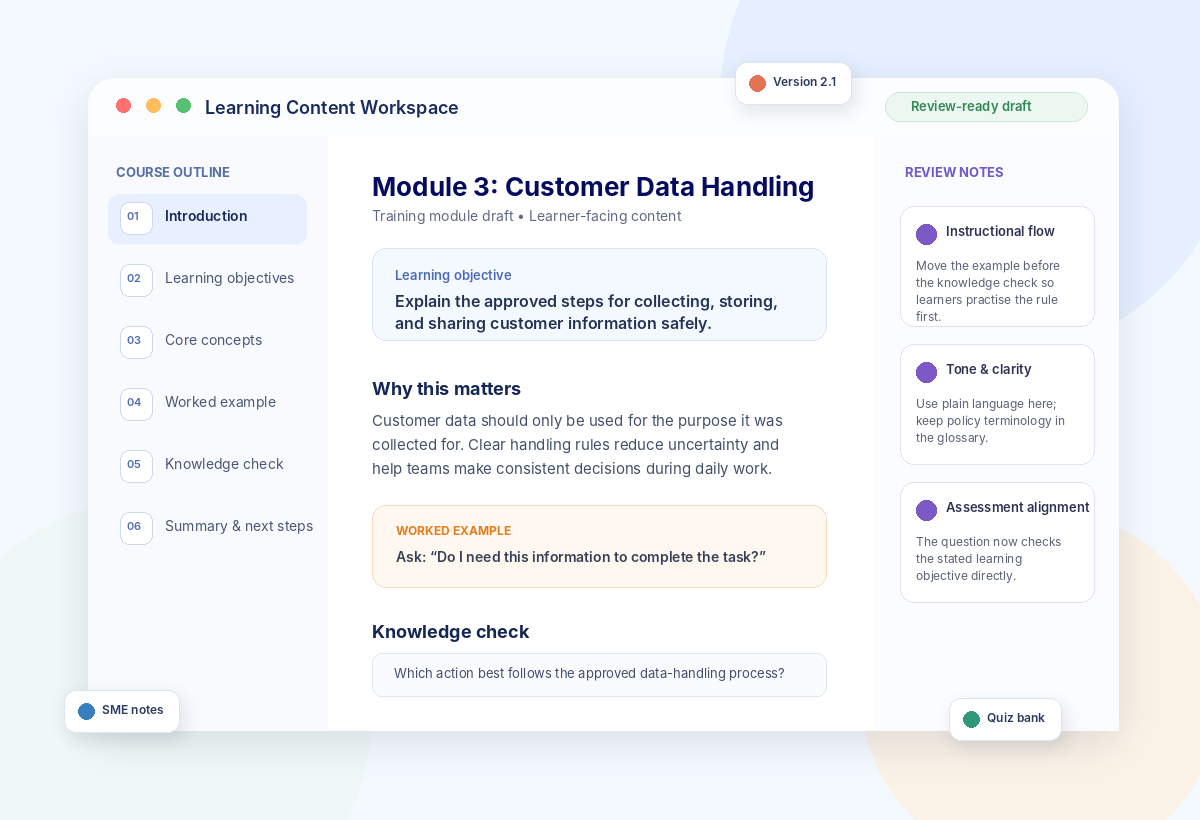
A short-module starting price makes training writing easy to understand while preserving custom scope for manuals, facilitator kits, scenarios, assessments, and larger programme builds.
Suitable for: A defined module, guide section, microlearning set, or training unit built from approved source documents, SME input, and stated learning goals.
Full curriculum design, deep specialist research, visual presentation design, e-learning authoring, video production, voiceover, and facilitation delivery are quoted separately.
Training content writing support for complete courses, individual modules, facilitator materials, assessments, scripts, and performance-support content.
Structured lessons with objectives, explanations, examples, practice, summaries, and learner progression.
Screen text, narration, interactions, scenarios, feedback, and on-screen guidance for digital learning.
Learner guides, handbooks, reference manuals, SOP-based training material, and structured support documents.
Knowledge checks, scenarios, multiple-choice items, activities, answer keys, and feedback aligned to the module.
Facilitator notes, discussion prompts, participant worksheets, practice activities, and session-support content.
Compact learning bites, checklists, quick-reference guides, process reminders, and point-of-need support content.
A clear writing workflow keeps the learning purpose, source accuracy, content structure, review points, and final handoff visible from the start.
Review audience, learning goals, source material, delivery format, constraints, and reviewer expectations.
Define module flow, headings, learning sequence, examples, practice, assessment approach, and content depth.
Develop learner-facing content in the agreed voice, format, terminology, reading level, and instructional structure.
Check clarity, learning flow, consistency, objective alignment, assessment fit, and supplied SME or stakeholder feedback.
Provide the agreed final content format with incorporated revisions and a clean handoff for authoring, publishing, or facilitation.
Training writing needs to do more than explain a topic. It must help a defined audience follow, practise, apply, and review the material in the format they will actually use.
The same subject can require different writing depending on whether learners read, listen, watch, discuss, practise, or refer back to the material during work.
Session content, facilitator notes, learner guides, activities, and classroom support.
Screen text, narration, interactions, examples, feedback, and knowledge checks.
Coordinated content across live sessions, self-study, practice, and reinforcement.
Voiceover, scene narration, on-screen text, demonstrations, and concise teaching scripts.
Short, focused content units for quick learning and point-of-need reinforcement.
Exercises, case prompts, reflection questions, worksheets, and guided practice materials.
Training content can be adapted to the subject, audience, risk level, terminology, and practical decisions learners need to make.
A training content writing workflow can support teams that need to turn expert knowledge, processes, policies, products, or curricula into structured learning material.
The service is not just copy polishing. Training writing changes the way information is organised and presented so a learner can understand what matters and what to do next.
Customer information must be processed only for authorised operational purposes in accordance with the applicable handling procedure.
Use customer information only for the approved task. Before you collect or share it, check that the action is required by the process you are following.
Different content needs may call for different writing and review functions. The exact team configuration depends on the scope rather than a fixed staffing model.
Develops clear learner-facing explanations, examples, activities, and module text.
Shapes module hierarchy, sequencing, learning flow, headings, and content architecture.
Organises supplied expert input and identifies areas that need clarification or source confirmation.
Develops questions, scenarios, practice, answer keys, feedback, and checks aligned to objectives.
Checks language, consistency, instructions, flow, labels, formatting, and review feedback.
Use only the roles needed for the agreed content scope and review workflow.
In place of unsupported testimonials or ratings, this section shows the concrete review areas applied to the content itself.
Check whether the content supports the stated audience, goal, scope, and expected learner action.
Check sequencing, transitions, examples, practice placement, recap, and cognitive load.
Check plain language, sentence clarity, instructions, terminology, voice, and reading level guidance.
Check whether questions and practice activities reflect the objective and taught content.
Check labels, headings, formatting, references to assets, reviewer notes, and agreed file presentation.
Choose a project shape that matches the volume, content maturity, review process, and level of writing support required. Specific pricing and turnaround are scoped after the brief is reviewed.
Focused writing or rewriting for one module, guide, script, assessment, or job aid.
Discuss Scope →Coordinated writing for multiple modules and related learner, facilitator, or assessment assets.
Request a Quote →Recurring content development for teams with a continuing training calendar or content backlog.
Discuss Workflow →Review existing training content, identify structural issues, and rewrite selected material for better learning use.
Consult Now →Practical answers about source material, formats, learning objectives, assessments, editing, review, and content handoff.
The service can cover structured learner-facing content such as course modules, lesson text, facilitator notes, training manuals, eLearning scripts, video or narration scripts, job aids, knowledge checks, quizzes, and supporting learning materials. The exact scope is defined from your brief and source materials.
Yes. Training content can be developed from subject-matter expert notes, presentation decks, policies, procedures, product documentation, research material, existing courses, or other source files you provide. The writing process organises those inputs into a clearer learning sequence without changing approved meaning unnecessarily.
Yes. Content can be structured for instructor-led training, virtual instructor-led training, self-paced eLearning, blended learning, microlearning, video-led learning, workshops, and other delivery formats when those formats are part of the brief.
Yes. Assessment content such as multiple-choice questions, scenario questions, short knowledge checks, reflection prompts, practice activities, and answer rationales can be included when assessment writing is part of the agreed content scope.
The workflow starts by identifying the intended audience, learning goals, required behaviours or knowledge, source constraints, and delivery format. Module structure, examples, practice, and assessment content are then written to support those stated objectives.
Yes. Existing training material can be reorganised and rewritten for clarity, consistency, learner focus, tone, instructional flow, and format suitability while retaining the approved subject matter and key messages supplied by your team.
Training content can be developed from technical, policy, compliance, product, process, or specialist source material when adequate source information and reviewer access are provided. Your subject-matter expert remains the authority for specialised factual approval.
Helpful inputs include the target audience, learning goals, delivery format, source material, brand or style guidance, terminology preferences, compliance constraints, reviewer or SME notes, required output format, and any deadline or workflow requirements.
Editable working files can be provided when the agreed deliverable uses an editable format. The final file type should be confirmed in the brief so the content can fit your authoring, review, LMS, or publishing workflow.
Yes. If you provide tone-of-voice guidance, terminology rules, templates, examples, reading-level preferences, or a content style guide, those requirements can be incorporated into the writing and review process.
This page focuses on writing and structuring training content. Light content architecture, sequencing, objective alignment, examples, and assessment support can be included where agreed. Complex learning-experience design, authoring-tool production, animation, or LMS implementation should be scoped separately if required.
Review comments can be incorporated through a defined revision workflow based on the agreed scope. Supplying consolidated feedback from the relevant reviewers or subject-matter experts helps keep the revision cycle clear and traceable.
Share the audience, learning goal, source material, delivery format, content volume, review process, and any brand, compliance, or subject-matter constraints that should shape the writing.
Who is the learner, what should they understand or do, and what level of prior knowledge should we assume?
Provide SME notes, SOPs, policies, decks, existing courses, product documentation, references, or other approved content.
Specify instructor-led, eLearning, blended, video, microlearning, workshop, manual, job aid, or another required format.
Identify SME, compliance, brand, legal, product, or stakeholder reviewers and how consolidated feedback will be supplied.
Provide enough detail for us to understand the content type, source material, audience, and expected learning output.
Share the topic, source material, learner profile, delivery format, and review requirements. We will use those inputs to define the writing scope for your course, module, script, guide, assessment, or job aid.