Curriculum & Course Architecture
Course flow, module sequence, lesson purpose, prerequisites, learning objectives and content hierarchy.

Turn subject knowledge, source material, and training goals into clear course modules, learner-friendly lessons, meaningful activities, aligned assessments, and review-ready content for digital learning delivery.
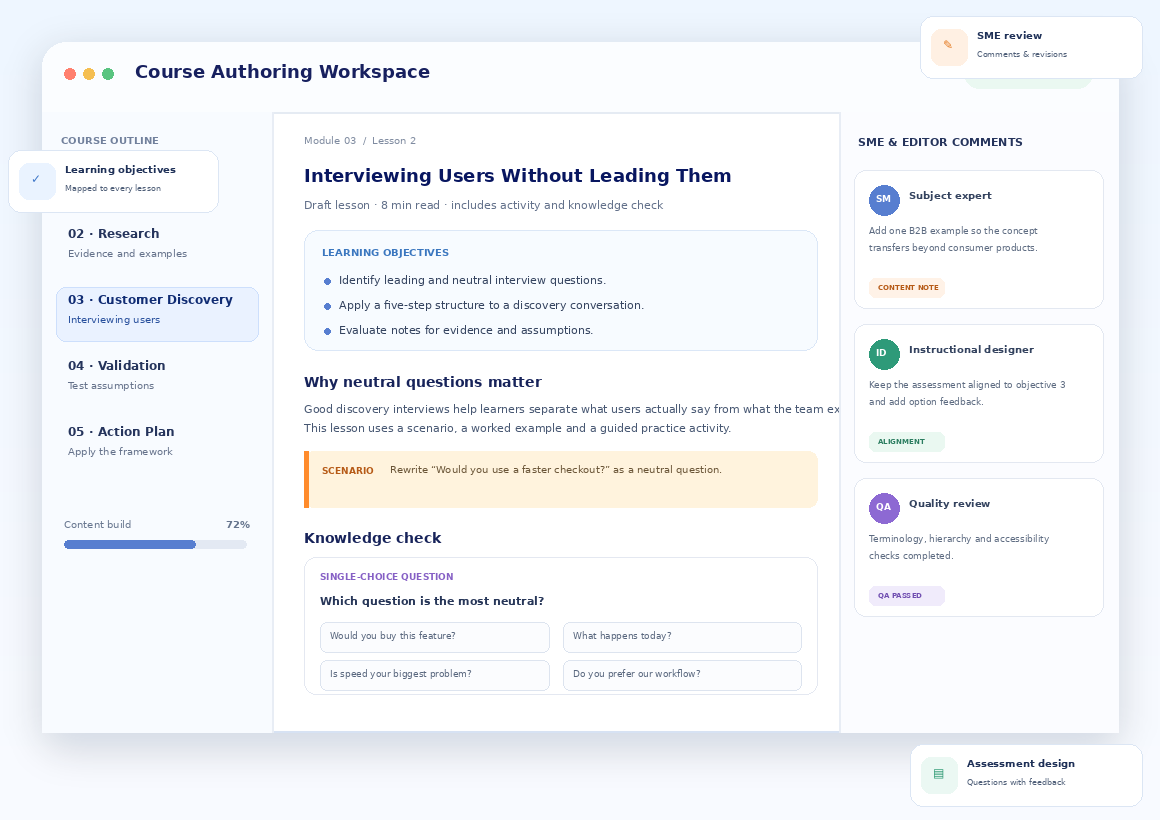
A short-module starting scope gives you a clear cost for learner-facing writing while keeping authoring, media production, and advanced instructional development separate.
Suitable for: A defined digital lesson or module based on approved source material, learning goals, and learner context.
Course authoring, SCORM packaging, custom interaction development, multimedia production, voiceover, complex research, and LMS implementation are outside the starting writing scope.
Build the parts of a digital course that learners actually read, watch, practise, answer, and apply—while keeping the content coherent across the full learning journey.
Course flow, module sequence, lesson purpose, prerequisites, learning objectives and content hierarchy.
Learner-facing explanations, examples, instructions, transitions, summaries and practical application content.
Objective alignment, chunking, practice design, learner progression and content decisions that support usable learning.
Knowledge checks, scenarios, practice tasks, answer rationales, feedback text and activity instructions.
Explainer scripts, voice-over copy, presenter notes, scene guidance and concise on-screen learning text.
Organised module copy, screen-level text, quiz data, media notes and file structures prepared for implementation teams.
A practical five-stage workflow from learning goals and source material to review-ready course content and organised final handoff.
Clarify target learners, course goals, source material, required formats, reviewer roles and constraints.
Define module sequence, lesson purpose, learning objectives, content depth and assessment approach.
Develop lessons, examples, activities, scripts, learner instructions, quizzes and answer feedback.
Route drafts through SME, stakeholder and editorial review, then incorporate agreed revisions.
Provide organised final content, version clarity, supporting notes and handoff-ready implementation files.
Consistent modules, lessons, headings and learner instructions.
Content and assessments point back to intended learning.
Structured for SME comments, revisions and version control.
Content organised to support practical authoring workflows.
Different delivery modes need different pacing, instructions, activity design and content density. The writing can be shaped around the learning experience you intend to build.
Screen-ready lessons, learner instructions, activities, checks and summaries.
Facilitator notes, participant workbooks, activity prompts and session content.
Connected self-study, live-session and practice content that works as one journey.
Narration scripts, scene notes, presenter prompts and supporting on-screen text.
Short, focused learning units with concise explanations, examples and checks.
Practice sheets, checklists, templates, reference guides and performance-support content.
The service can support organisations that need structured learning content but do not want every lesson, activity and assessment to be written internally.
This example shows the type of transformation the service can perform. It is not a customer testimonial or performance claim.
Plan and conduct a structured one-to-one conversation using an agreed agenda.
Explain preparation, listening, question types, action capture and follow-up.
Compare two manager conversations and identify which behaviours improve the discussion.
Scenario-based questions with answer feedback linked to the learning objective.
Depending on scope, course content can require more than one writing skill. These role types reflect the capabilities commonly needed across an e-learning content workflow.
Objectives, sequencing, chunking, activity and assessment alignment.
Lesson copy, examples, explanations, learner instructions and summaries.
Source synthesis, evidence organisation and background content development.
Knowledge checks, scenarios, feedback text and objective-linked questions.
Narration, presenter scripts, scene notes and concise on-screen copy.
Clarity, consistency, terminology, structure and final content checks.
Use visible review checkpoints so your team can inspect structure, instructional alignment, consistency and handoff readiness before final delivery.
Check module sequence, lesson purpose, content chunking and whether the course moves logically from one topic to the next.
Confirm explanations, activities and assessments support what learners are expected to know or do.
Review tone, terminology, grammar, heading hierarchy, instructions, repeated language and cross-module consistency.
Make sure the final files identify lesson order, quiz content, feedback, media notes and other items needed by the implementation team.
Course-writing projects vary by size and complexity, so the engagement is scoped around course length, source material, design depth, review needs and required deliverables.
End-to-end content support for one defined course, programme or learning pathway.
Discuss Scope →Ongoing writing support for internal learning teams producing multiple modules or courses.
Request a Discussion →Structured content development for academic, training or professional learning programmes.
Share Your Brief →Review existing material, identify content gaps and define a practical writing or redesign plan.
Consult on Content →Common questions about scope, source material, instructional design, assessments, review, LMS handoff and quoting.
The service can cover course architecture, learning objectives, module and lesson writing, activities, assessments, feedback text, video or narration scripts, facilitator notes, learner-facing instructions, and structured handoff content. The exact scope is defined from your brief and source material before writing begins.
Yes. A project can begin with a topic brief, curriculum outline, SME notes, existing training material, or a more detailed instructional design document. The writing workflow then turns that input into structured modules and lessons with clear learning objectives and practice opportunities.
Yes. Course drafts can be prepared for SME review, with review checkpoints built into the writing process. Comments, factual clarifications, terminology updates, and requested revisions can be incorporated before final delivery.
Assessment writing can be included where required. This may include multiple-choice questions, scenario questions, short knowledge checks, practice activities, answer rationales, and learner feedback that is aligned to the stated learning objectives.
Yes. The scope can include concise narration scripts, explainer-video scripts, scene or visual notes, presenter prompts, and supporting on-screen text so the written content can move into video production or authoring workflows.
Content can be structured for a practical LMS or authoring-tool handoff, including module hierarchy, lesson labels, screen-level copy where needed, quiz data, feedback text, media notes, and clear file organisation. Platform implementation or SCORM packaging should be scoped separately if required.
Useful inputs include your course goal, target learners, source documents, SME notes, brand or style guidance, required learning outcomes, module plan, examples, references, platform constraints, and any compliance or terminology requirements relevant to the content.
Yes. Existing lessons can be reworked for clearer structure, more consistent tone, better objective alignment, stronger examples, improved practice activities, and more useful assessments while retaining material that is already accurate and effective.
A shared course structure, terminology list, style rules, objective framework, and repeatable lesson pattern can be established early in the project. Editing and quality review then check consistency across headings, instructions, examples, activities, assessments, and feedback.
Yes. The tone, assumed knowledge, explanation depth, examples, practice difficulty, and terminology can be adjusted for audiences such as beginners, working professionals, internal teams, students, specialists, or mixed-ability cohorts.
Instructional design support can be included where the project requires help with course flow, learning objectives, module sequence, activity choices, assessment alignment, or content chunking. The enquiry stage is used to define how much design support is needed alongside writing.
The project can use defined review checkpoints so your team or SME can comment on structure, accuracy, tone, examples, activities, and assessment content. Revision scope is agreed with the project brief so expectations are clear before production starts.
This page does not publish a fixed package price because course-writing scope can vary substantially. A quote can be prepared after reviewing factors such as course length, number of modules, source-material quality, research needs, instructional-design depth, assessment volume, scripting requirements, review cycles, and delivery format.
Use the enquiry form on this page and share your target learners, course topic, approximate module or lesson count, available source material, expected deliverables, platform or format needs, and any deadline requirements. That information provides the basis for a scope review.
Share enough project detail for the course-content scope to be reviewed accurately. Course scope is reviewed before a quote and delivery schedule are proposed.
Who the learners are, what they should know or do, and the context in which the course will be used.
Approximate modules or lessons, available SME notes, references, existing training material, or curriculum documents.
Lesson writing, assessments, video scripts, workbooks, facilitator notes, job aids, media notes, or LMS-oriented handoff.
SME reviewers, brand or style requirements, platform needs, compliance context, revision expectations, and deadline requirements.
Provide your contact details and project brief so the course scope, deliverables, review needs and implementation requirements can be assessed.
Bring the subject knowledge. Use the enquiry to define the course, writing scope, review process and deliverables.