
Help & Support Content
Help & Support Content Simplification Service for Clearer Customer Guidance
Turn dense, repetitive, or difficult support content into guidance that is easier to scan, understand, and act on. We simplify help-centre articles, FAQs, troubleshooting steps, product instructions, and support templates while preserving the meaning of your source content.
- Rewrite dense support content in plain language without unnecessary jargon.
- Turn complex instructions into task-led steps, headings, and decision points.
- Keep terminology and message meaning consistent across related support articles.
- Deliver review-ready simplification while preserving approved policy and product intent.
Pricing & Delivery
Help & Support Content Simplification Service Pricing
This service is priced for reducing friction in content that is technically correct but too dense, repetitive or difficult for customers to follow.
Starting price
From ₹4,000
for up to 4 support articles or 3,000 words
Suitable for: A compact batch of support content that needs simpler language and clearer action sequencing.
What the starting scope includes
- Simplification of up to 4 articles or 3,000 words
- Shorter, more direct sentences and instructions
- Removal of avoidable repetition and jargon
- Improved step order, headings and action cues
- Terminology preserved against supplied product language
- Clean final version plus revision notes where useful
What can increase the quote
- Substantial fact-finding or source reconciliation
- Complex policy, legal or technical subject matter
- Content that requires full rewriting instead of simplification
- Large structured help libraries or multiple output formats
Outside the starting scope: Fact verification that requires new research and full content strategy are not included in the entry scope.
Faster delivery: A faster turnaround may be possible for shorter material with stable source content.
Contentxprtz help and support content simplification starts from ₹4,000 for up to four support articles or 3,000 words, with clearer language, improved step flow and two revision rounds.
Who We Help
1
Our Help & Support Content Simplification Services
We simplify the content users rely on when they need an answer, need to complete a task, or need to recover from a problem. The focus is clarity, actionability, consistency, and preservation of the source meaning.
Content We Can Simplify
Help Centre & Knowledge Base
Rewrite long or inconsistent articles into clearer support content organised around the reader's task.
- Article structure
- Scannable headings
- Clear action sequence
FAQs & Troubleshooting
Turn broad, repetitive answers into concise guidance with useful decision points and next steps.
- Question clarity
- Error guidance
- Escalation paths
Product & Account Instructions
Make setup, account, feature, billing, permissions, and self-service instructions easier to follow.
- Prerequisites
- Step sequencing
- Confirmation cues
Customer Service Templates
Simplify standard replies so agents can communicate consistently without sounding rigid or overly technical.
- Email templates
- Chat responses
- Resolution messages
Policy & Process Guidance
Translate approved internal or customer-facing process text into clearer explanations without changing the underlying requirement.
- Definitions
- Process steps
- Warnings & exceptions
Onboarding & In-Product Help
Condense guidance for onboarding, contextual help, prompts, and instructional microcopy where users need quick direction.
- Microcopy hierarchy
- Action labels
- Progress guidance
Ready to start with a defined scope?Buy Help & Support Content Simplification Service using the published starting scope and delivery details.
Buy Service Now
Why Simplify Support Content
Make Important Guidance Easier to Find, Understand, and Use
Support content often becomes harder to use as products, policies, exceptions, and internal terminology accumulate. Simplification reduces unnecessary cognitive load while keeping the source meaning, required conditions, and important warnings intact.
- User-first structure based on the task or question
- Shorter sentences and clearer verbs where the source allows
- Consistent product names, labels, and support terminology
- Clear prerequisites, warnings, exceptions, and escalation points
- Reusable structures that make related content easier to govern
- Transparent handling of ambiguity instead of guessing at missing meaning
2
Help & Support Content Simplification Examples
These illustrative examples show the type of intervention this service can make. They are examples of editing depth and structure, not client case studies or performance claims.
Help Article
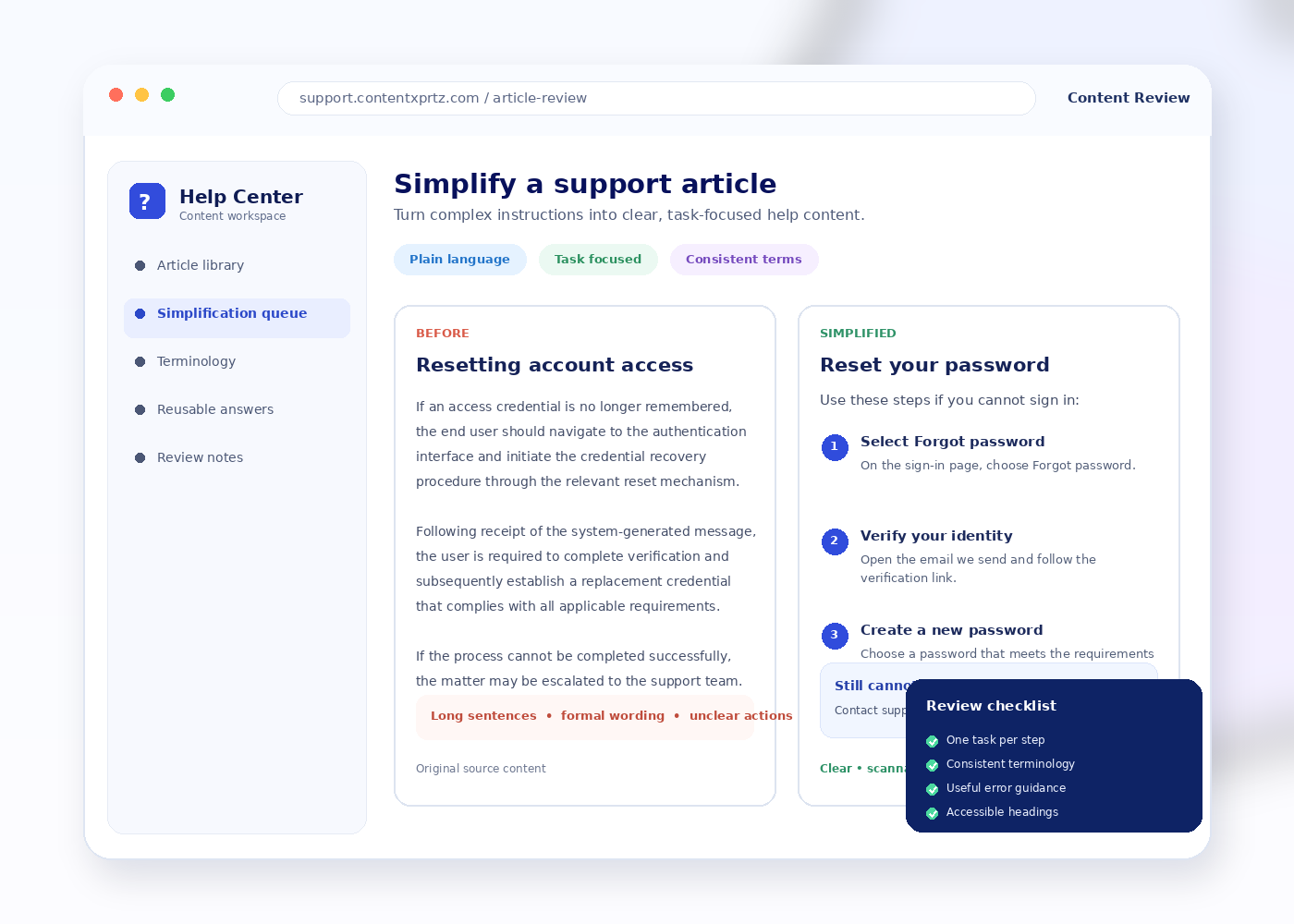
Before: “In the event that a user is unable to remember their authentication credential, the credential-recovery mechanism should be initiated.”
After: “Forgot your password? Select Forgot password on the sign-in page and follow the verification link we send you.”
Password Reset Guidance
Replaces formal wording with direct action, identifies the interface label, and tells the user what happens next.
Direct actionClear sequence
Troubleshooting
Before: “If the issue persists after the standard resolution process, further investigation may be required by the appropriate support team.”
After: “Still seeing the error? Contact support and include the error code, the time it occurred, and the step you were completing.”
Error Escalation
Turns a vague escalation statement into a clear next step and tells the user what information to provide.
Useful escalationBetter context
FAQ
Before: “You may be eligible for a refund subject to the applicable refund conditions and any exclusions that may apply in your circumstances.”
After: “You may be eligible for a refund. Check the refund conditions and exclusions that apply to your purchase before you submit a request.”
Policy Explanation
Separates the answer from the condition, keeps the qualification, and gives the reader a practical next action.
Qualification retainedScannable answer
In-Product Help
Before: “Submission cannot proceed because one or more mandatory attributes have not been populated in the required manner.”
After: “Complete the required fields before you continue. Fields that still need information are marked in red.”
Validation Message
Explains the problem in plain language and tells the user exactly how to identify and fix it.
Plain languageActionable fix
Want this level of work applied to your content?Buy Help & Support Content Simplification Service using the published starting scope and delivery details.
Buy Service NowEngagement Models
Fixed Scope
A defined set of articles, FAQs, templates, or support flows with agreed review requirements.
Content Batch
Simplify a larger group of related support content using common terminology and structural patterns.
Ongoing Content Stream
Recurring simplification for new or updated support content, subject to an agreed workflow and scope.
Content Pattern Build
Create repeatable article, FAQ, troubleshooting, or support-response patterns for future content teams to follow.
Input & Delivery Formats
Documents
Content Inventories
Help-Centre Exports
CMS-Ready Copy
Rewrite Tables
Style & Terminology Guides
Final format is confirmed during scoping so the output fits the way your team reviews, approves, and publishes support content.
Industries & Service Environments
SaaS
Fintech
Healthcare
Ecommerce
Education
Logistics
Travel
Media
Real Estate
On-Demand Services
Ready to move from review to delivery?Buy Help & Support Content Simplification Service using the published starting scope and delivery details.
Buy Service Now
3
What Good Simplified Support Content Looks Like
Use the review criteria below to evaluate clarity, task focus, consistency, and support readiness.
The answer appears before unnecessary background
Users should not have to read several paragraphs before discovering the action, requirement, condition, or next step that resolves their question.
Simpler wording still reflects the approved source
Conditions, exclusions, warnings, technical details, and policy meaning should remain intact. Where the source is unclear, the uncertainty is surfaced for review.
Related content follows repeatable patterns
Consistent headings, labels, terminology, callouts, and step structures help users recognise how support content works and help teams maintain it more reliably.
Make Your Help Content Easier to Use
Share the content you want to simplify and the user task it needs to support. We can assess the scope and recommend a suitable simplification approach.
Discuss Your RequirementScope-led assessment
No invented fixed pricing
Source meaning preserved
Review-ready output
4
Help & Support Content Simplification FAQs
Answers to practical questions about scope, source meaning, content types, technical material, review, pricing, delivery timing, and handoff.
What is help and support content simplification?
It is the process of rewriting and restructuring support information so users can understand the issue, find the relevant action, and complete a task with less reading effort. The work can include plain-language rewriting, step sequencing, headings, terminology consistency, troubleshooting logic, and clearer calls to action.
What types of support content can be simplified?
The service can be used for help-centre articles, knowledge-base content, FAQs, troubleshooting guides, onboarding instructions, product or account guidance, customer-service templates, policy explanations, and other user-facing support material.
Will simplification change the meaning of our support content?
The goal is to make the content easier to understand without changing the intended policy, process, product instruction, or support outcome. Ambiguous or incomplete source material is flagged for clarification rather than silently rewritten into a new meaning.
Can you work with an existing terminology or style guide?
Yes. If you provide approved terminology, product names, tone guidance, style rules, or content patterns, those materials can be used as constraints during simplification and review.
Can you simplify technical troubleshooting content?
Yes, provided the source instructions and required technical context are supplied. The simplification focuses on clearer sequencing, decision points, error guidance, terminology, and user actions while preserving technical accuracy from the source.
Do you simplify only the wording, or also the structure?
Both can be addressed. Depending on the source, the work may include sentence simplification, content grouping, heading hierarchy, step order, callouts, prerequisites, warnings, escalation guidance, and removal of unnecessary repetition.
Can you standardise multiple help articles at the same time?
Yes. A batch can be reviewed for repeated patterns, inconsistent terminology, duplicated explanations, uneven article structures, and reusable content components. Final scope depends on the number, length, and complexity of the materials.
What do you need from us to start?
Provide the source content, the intended audience, the task users are trying to complete, approved terminology or policy constraints, preferred tone, publishing format, and any known support issues or priority articles.
How is quality reviewed?
Review focuses on meaning preservation, task clarity, step sequence, terminology consistency, scannability, completeness, and whether the simplified version still reflects the supplied source and constraints.
How much does support content simplification cost?
Contentxprtz help and support content simplification starts from ₹4,000 for up to four support articles or 3,000 words. Larger or more complex content sets are quoted after the volume, channels and review requirements are assessed.
What is the turnaround time?
The displayed starting scope is typically delivered in 3 business days. Larger batches, complex subject matter and additional stakeholder review can extend the schedule.
Can the simplified content be delivered for publishing in our help centre?
The output can be structured for handoff in an agreed format, including publish-ready article copy, content inventories, rewrite tables, or other review-ready formats confirmed during scoping.
Ready to place your service order?Buy Help & Support Content Simplification Service using the published starting scope and delivery details.
Buy Service Now
Service Enquiry
Tell Us What Support Content You Want to Simplify
Share enough context for the content to be assessed properly. The more clearly you describe the source material, audience, channels, and constraints, the easier it is to define an appropriate scope.
Source content
Describe the help articles, FAQs, support templates, or guidance you want reviewed.
Audience & task
Tell us who uses the content and what they need to understand, decide, or complete.
Constraints & terminology
Include approved wording, policy limits, product labels, style guidance, or terms that must remain unchanged.
Deadline & review flow
Share your requested date and who needs to review or approve the simplified content.
Helpful to include: approximate article count or word volume, content type, intended audience, publishing channel, priority user journeys, existing style or terminology guidance, and any known points of confusion.
Help & Support Content Enquiry
Request a Content Simplification Assessment
Submit your details and requirements so the scope, delivery approach, pricing, and timing can be assessed from the information you provide.