
Weak or Slow Hook
The opening takes too long to establish why the viewer should keep watching.
Turn a topic, brief, source pack, or rough draft into a structured video script built around your audience, message, format, and production needs. We develop the hook, narrative flow, voiceover or dialogue, visual cues, on-screen text, pacing, and call to action as one coherent script.
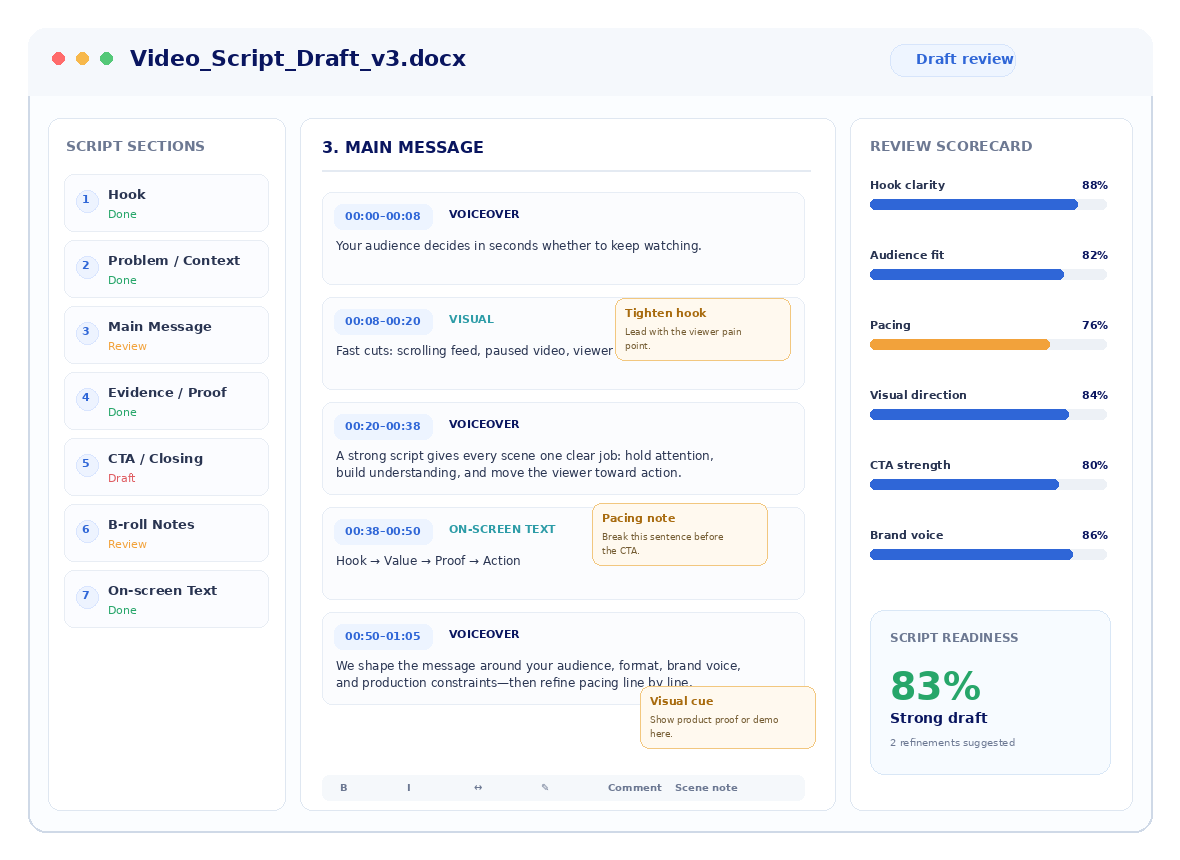
Service-specific visual: structured script draft with voiceover, visuals, pacing notes, and review comments.
A strong script is more than correct wording. It needs a clear promise, a defined audience, purposeful structure, usable visual direction, and a natural path to the final action.
The opening takes too long to establish why the viewer should keep watching.
Vocabulary, examples, depth, or tone do not fit the intended viewer.
Ideas are individually useful but do not build toward one clear message.
Sections run too long, transitions drag, or key moments arrive too late.
Voiceover and scene direction compete instead of reinforcing the same point.
The script sounds generic, or the closing action does not follow naturally from the story.
The exact sequence is adapted to your brief. These are the common layers we can develop or review when building a complete script.
We connect strategic framing with the actual words, scenes, pacing, and production cues the video needs.
A representative example of how a loose concept can be turned into a clearer, scene-aware script. This example is illustrative and not a client testimonial or performance claim.
“We need a short video explaining why teams lose time switching between too many tools. Mention our dashboard and ask viewers to book a demo.”
00:00–00:07 · VO: “Your team is not short on software. It is short on uninterrupted time.”
Visual: Fast sequence of tabs, notifications, and duplicated status updates.
00:22–00:38 · VO: “Bring project status, approvals, and next actions into one shared view.”
Visual: Product screen showing the workflow described in the voiceover.
Hook: Viewer pain established immediately.
Build: Problem → consequence → solution → proof.
Visual direction: Each scene reinforces the voiceover.
Closing: CTA follows naturally from the demonstrated value.
Use the service depth that matches your starting point. Full scriptwriting develops the story from the brief; lighter review services work primarily with wording that already exists.
| Support Dimension | Script Proofreading Final correctness check | Script Editing Improve an existing draft | Full Video Scriptwriting End-to-end script development |
|---|---|---|---|
| Audience, objective, and message framing | × | △ | ✓ |
| Hook and opening-angle development | × | △ | ✓ |
| Full narrative developed from a brief | × | × | ✓ |
| Scene-by-scene structure | × | △ | ✓ |
| Voiceover or dialogue refinement | △ | ✓ | ✓ |
| Pacing and timing guidance | × | △ | ✓ |
| Visual / B-roll / on-screen text cues | × | △ | ✓ |
| CTA and closing development | × | △ | ✓ |
| Grammar, clarity, and language polish | ✓ | ✓ | ✓ |
| Best for | Near-final script | Existing draft | Idea, brief, notes, or draft needing complete development |
The writing approach changes with platform, audience, production style, and viewing context. These are common script formats the service can be scoped around.
A clear workflow keeps the script anchored to the brief while creating room for structured revision before final delivery.
Review focuses on whether the script works as one complete viewing experience—not only whether each sentence reads well in isolation.
Objective, audience, core message, and required content.
Hook, progression, transitions, proof, and closing sequence.
Language, tone, terminology, and brand fit.
Sentence length, rhythm, scene density, and flow.
Consistency against materials supplied for the project.
Formatting, labels, scene cues, CTA, and agreed deliverables.
Your brief should contain enough detail to write the script without exposing information that is unnecessary for the assignment.
Turnaround is confirmed after the brief is reviewed so the delivery plan reflects the actual script length, research depth, complexity, and revision scope.
A quote can be prepared after reviewing:
Pricing is prepared as a custom quote after reviewing the script scope, source material, complexity, revision needs, and delivery requirements.
Depending on the brief, the service can cover audience framing, hook development, structure, voiceover or dialogue, scene and visual cues, on-screen text, pacing guidance, calls to action, revisions, and a clean final script.
Common formats include explainers, YouTube videos, product demos, corporate videos, training and e-learning content, social campaigns, webinar/event videos, and case-study style videos.
Yes. A rough idea can be developed when the objective, audience, core message, source material, format, and constraints are clear enough to define the writing scope.
Yes. Existing drafts can be reworked for structure, clarity, pacing, voice, transitions, visual alignment, on-screen text, and CTA strength according to the requested depth.
Visual or B-roll cues can be included when useful for the video format and when the brief gives enough production context to make those directions practical.
Yes, when you provide tone guidance, examples, audience information, terminology preferences, required phrases, and wording or claims that should be avoided.
Claims can be checked against materials you provide and obvious inconsistencies can be flagged. Specialist legal, medical, financial, regulatory, or technical verification should be arranged separately when required.
A custom quote can depend on script length, research depth, number of videos, technical complexity, visual-direction requirements, revision scope, and delivery constraints.
Turnaround is confirmed after scope review because length, research, technical complexity, number of versions, and revision requirements can materially change the delivery plan.
Useful inputs include the video objective, audience, platform or format, source material, brand voice, examples, required claims, desired CTA, production constraints, and deadline.
Share your objective, audience, planned format, source material, desired script length or video duration, deadline, and the level of support you need. The brief can then be assessed for scope and quote preparation.
A useful brief makes it easier to define the script structure and avoid unnecessary assumptions during drafting.
Provide enough context for the team to understand the brief, identify any missing inputs, and prepare the next step.
Share your brief and source material. We can help shape it into a clearer, more coherent script for production review.