PR Corporate Communication Service for Clear, Credible Stakeholder Messaging
★★★★★4.8 rating from Researchers, Authors, Students, and Scholars
Turn business updates, leadership messages, media announcements, issue responses, and stakeholder communications into clear, logically structured, approval-ready content aligned with your audience, brand voice, and communication objective.
Message framing, audience alignment, and corporate narrative development
Press releases, media statements, executive messages, stakeholder updates, and internal communications
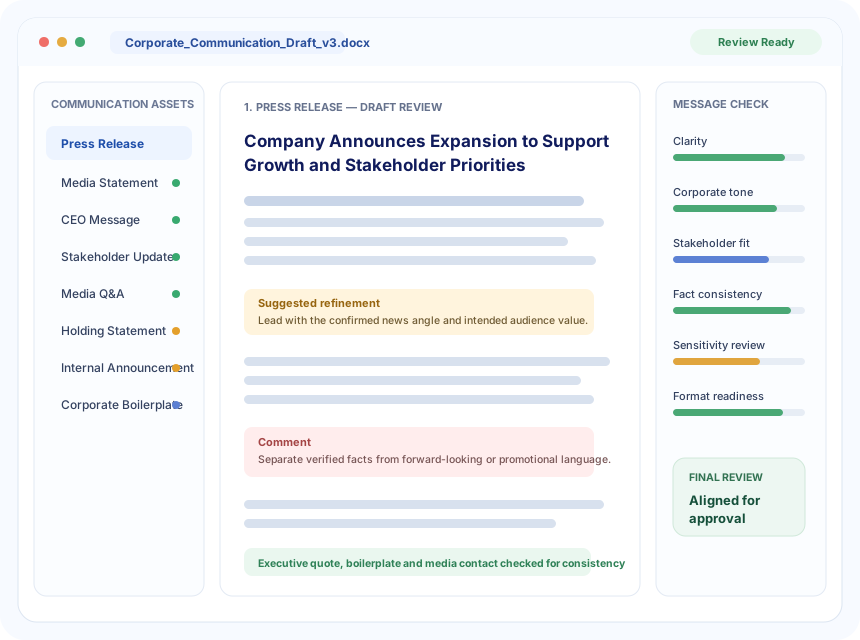
Review for clarity, factual consistency, sensitivity, tone, format, and approval-readiness
Clean deliverables with structured reviewer notes where clarification or approval is needed
Illustrative service workspace showing the communication output itself—not a generic office image.
Stakeholder-Aware MessagingAudience, context, and communication objective considered together
Confidential HandlingUnpublished communication materials treated as confidential service information
Structured ReviewClarity, tone, facts, consistency, sensitivity, and format checked in sequence
Clear DeliverablesFinal content prepared for client review, approval, and intended communication use
Project pricing · scope · delivery
PR Corporate Communication Service Project Pricing
PR Corporate Communication Service can expand significantly with research depth, source quality and deliverable count. The project minimum therefore anchors a focused starting engagement for this requirement: A focused PR/corporate communication assignment covering a defined announcement, stakeholder narrative or small communication pack.
Initial Project Scope
Projects from ₹12,000
for a defined initial engagement
Suitable for: A focused PR/corporate communication assignment covering a defined announcement, stakeholder narrative or small communication pack.
Communication objective, audience and fact review
Core narrative and approved message framework
Development of the agreed PR/corporate communication assets
Consistency of claims, quotations and supporting facts
Final editorial review before client approval
Typical deliveryTypical focused engagement: 4–7 business days
Why Corporate Communication Gets Delayed, Reworked, or Misread
Common communication problems are easier to address when they are identified before a draft reaches leadership, media, employees, investors, partners, or other stakeholders.
Common communication risks
We look for issues that can weaken clarity, credibility, consistency, or approval-readiness.
Unclear Purpose or News Angle
The draft says what happened but does not establish why the communication matters now.
Inconsistent Corporate Narrative
Different sections or assets frame the same development in conflicting ways.
Audience–Message Mismatch
Content may be accurate but not shaped for the information needs of the intended stakeholder.
Unsupported or Sensitive Claims
Promotional, forward-looking, or high-risk wording can require qualification or client approval.
Weak Executive or Brand Voice
The language may feel generic, overly promotional, defensive, or inconsistent with the organization.
Approval & Timeline Gaps
Missing inputs, late factual checks, or unclear sign-off responsibilities can create avoidable rework.
2
What This PR Corporate Communication Service Covers
A complete communication engagement can move from objective and audience definition through message development, drafting, review, and final handoff. The exact scope is confirmed for each project.
1Communication Objective
2Audience & Stakeholders
3Message Architecture
4Corporate Narrative
5News Angle & Relevance
6Press Release Drafting
7Media Statements
8Executive Messaging
9Crisis / Holding Lines
10Media Q&A
11Internal Communication
12Stakeholder Updates
13Boilerplate & Profiles
14Fact & Consistency Review
15Final Delivery Pack
Ready to move forward with PR Corporate Communication Service?Purchase the service and continue with your project brief, files, and delivery requirements.
A representative example shows how a rough communication idea can be developed into a clearer, more structured draft with explicit review logic and a cleaner final version.
Before — Rough Internal Brief
Issue
“We need to tell media about our expansion. It should sound positive and mention growth, jobs, and sustainability. Please add a leadership quote and make it newsworthy.”
No defined audience priority
News angle is not yet clear
Verified facts and approvals not separated
Executive voice and stakeholder context need definition
During — Annotated Communication Draft
Company announces an expansion of its operations, with the communication focused on confirmed capacity priorities and stakeholder relevance.
Comment: lead with the verified news angle
The draft separates confirmed facts from forward-looking or promotional statements and identifies items requiring client approval.
Suggestion: qualify unapproved claims
Executive messaging is aligned with the corporate narrative, intended audience, and supporting communication assets.
Refinement: keep one message hierarchy
After — Clean Final Draft
Company Expands Operations to Support Capacity and Responsible Growth
The final version establishes the news angle quickly, keeps verified facts distinct from claims requiring approval, and aligns the headline, opening, executive quote, boilerplate, and stakeholder message.
Focused purpose and audience
Clear message hierarchy
Consistent corporate tone
Approval-ready communication draft
4
What Makes This Different From Simple Proofreading or Standalone Copywriting
The distinction is the depth of communication thinking. Full PR corporate communication support can connect language quality with message strategy, stakeholder context, corporate narrative, review logic, and approval-readiness.
Support Dimension
Proofreading / Language Review
PR Copywriting
Full PR Corporate Communication Support
Communication objective & scope development
×
✓
✓
Audience & stakeholder mapping
×
✓
✓
Key-message hierarchy & corporate narrative
×
✓
✓
Media angle / newsworthiness framing
×
✓
✓
Executive voice & stakeholder consistency
×
✓
✓
Sensitivity / issue-response review
×
×
✓
Logical flow, tone & clarity
✓
✓
✓
Fact and terminology consistency
✓
✓
✓
Formatting & communication conventions
✓
✓
✓
Media Q&A / holding-line alignment
×
×
✓
Reviewer-focused comments & approval notes
×
×
✓
Best for
Language correctness
Individual content creation
End-to-end corporate communication development
5
Corporate Communication Assets We Can Support
The service can be scoped around one communication asset or a coordinated set of materials that must use the same facts, message hierarchy, tone, and stakeholder logic.
Press Releases
Corporate Announcements
Media Statements
Executive Messages & Speeches
Crisis & Issue Communications
Stakeholder Updates
Internal Communications
Media Kits, FAQs & Q&As
Ready to move forward with PR Corporate Communication Service?Purchase the service and continue with your project brief, files, and delivery requirements.
A structured workflow helps keep the communication objective, source facts, message architecture, approval needs, and final format aligned from the beginning.
1
Submit Brief & Materials
Share objectives, audiences, facts, drafts, references, and deadline.
2
Scope Review
We assess asset types, development depth, approvals, and project needs.
3
Message & Audience Mapping
Core messages and stakeholder priorities are organized.
4
Narrative / Angle Development
The communication logic, news angle, hierarchy, and tone are structured.
5
Drafting & Structuring
Content is developed or refined around the agreed objective.
6
Risk & Consistency Review
Facts, claims, terminology, tone, and related assets are cross-checked.
7
Formatting & Approval Check
Headings, format, boilerplate, contact details, and approval points are reviewed.
8
Final Delivery
Final content is prepared with the agreed notes and supporting deliverables.
7
What You Need to Share — and What You Receive
The quality of a corporate communication depends on reliable source material and clear approval conditions. The exact handoff package depends on the agreed scope.
What You Need to Share With Us
Communication objective and intended outcome
Primary audiences and stakeholder priorities
Verified facts, dates, data, names, and approved claims
Approved or draft executive / spokesperson inputs
Brand voice, style, boilerplate, or communication guidelines
Existing drafts, reports, source documents, or reference links
Legal, regulatory, policy, or sensitivity constraints that must be respected
Review deadline, approval process, and required formats
What You Receive
Developed or edited corporate communication draft
Clean final version prepared for review or approval
Reviewer comments or rationale where material decisions need attention
Message or structure notes where included in scope
Headline, subject-line, or opening options where relevant
Supporting media Q&A, stakeholder messaging, or holding lines where scoped
W
Ready to move forward with PR Corporate Communication Service?Purchase the service and continue with your project brief, files, and delivery requirements.
Quality Assurance / Communication Review Methodology
Multi-stage review helps reduce avoidable rework by separating message logic, language quality, stakeholder context, factual consistency, format, and final verification.
1
Message Structure Review
Objective, hierarchy, narrative flow, and communication purpose.
2
Clarity Pass
Readability, concision, directness, and logical transitions.
3
Corporate Tone Pass
Brand voice, executive tone, professionalism, and audience fit.
4
Fact & Consistency Check
Names, dates, terminology, supplied facts, quotes, and cross-asset alignment.
5
Formatting & Reference Check
Headings, boilerplate, media contact fields, labels, and supplied style requirements.
6
Final Verification
Final copy is checked against the agreed objective, scope, and review notes.
QUALITY CONFIRMED
9
Sector Context, Confidentiality, and File Handling
Corporate communication needs vary by sector and stakeholder environment. Sector matching and confidentiality requirements are confirmed against the brief before work begins.
Common Sectors We Can Support
Life Sciences & Healthcare
Finance & Business
Engineering & Technology
Software & Digital
Professional Services
Corporate & Industrial
Education & Institutions
Sustainability & Impact
Confidentiality & File Handling
Use designated submission and delivery channels for project materials
Limit working access to people assigned to the communication project
Treat unpublished announcements, drafts, executive inputs, and stakeholder materials as confidential service information
NDA requirements can be discussed before project start
Do not use client communication materials publicly without permission
Your communication brief, draft content, and unpublished materials remain part of the confidential project context.
Ready to move forward with PR Corporate Communication Service?Purchase the service and continue with your project brief, files, and delivery requirements.
Turnaround, Custom Quote, and Frequently Asked Questions
The published pricing above covers the stated entry scope; larger requirements are quoted after reviewing the actual workload. Scope and delivery are confirmed after the communication brief is reviewed.
Turnaround Options
Delivery timing depends on asset count, development depth, source material, review complexity, and the requested deadline.
STANDARD
Planned delivery for well-scoped communication work with normal review requirements.
PRIORITY
Earlier delivery window where the scope, source inputs, approvals, and capacity allow.
EXPRESS
Fast-track support for urgent communication needs, subject to feasibility review.
The confirmed delivery date is provided after the brief, files, required outputs, review path, and deadline are assessed.
Custom Scope Factors
The published pricing above covers the stated entry scope; larger requirements are quoted after reviewing the actual workload.
Number and type of communication assets
Volume, length, and existing-draft condition
Background research or source-material review
Message strategy and stakeholder complexity
Number of review or refinement rounds included
Timeline, priority, formatting, and special requirements
What does your PR Corporate Communication Service include?+
Support can include communication objectives, audience and stakeholder mapping, key-message development, corporate narrative, press releases, media statements, executive messaging, stakeholder updates, crisis or holding statements, media Q&A, internal announcements, boilerplate development, fact consistency review, and final delivery preparation depending on the agreed brief.
How is this different from copywriting or proofreading?+
Proofreading focuses mainly on language correctness, while copywriting focuses on producing persuasive content. PR corporate communication support adds message strategy, stakeholder context, corporate narrative, media or reputation considerations, approval-readiness, and multi-asset consistency where the scope requires it.
What materials should I share before the work begins?+
Useful inputs include the communication objective, target audiences, verified facts and dates, approved spokesperson information, brand or tone guidance, existing drafts, background documents, legal or compliance constraints that must be respected, and your review or approval deadline.
Can you work from rough notes or an existing draft?+
Yes. The starting point can be a rough brief, internal notes, an existing draft, a message framework, or supporting source material. The level of development is confirmed after the material and required communication outcome are reviewed.
Can you support press releases and corporate announcements?+
Yes. The service can support press releases, corporate announcements, media statements, internal announcements, and related communication assets when they are part of the agreed scope.
Do you support executive and stakeholder communication?+
Yes. Depending on the brief, support can include executive messages, leadership statements, speeches or talking points, stakeholder updates, employee communication, and message alignment across related assets.
Can you help with crisis or issue communication?+
The service can support the drafting and refinement of holding statements, issue responses, media Q&A, stakeholder messages, and consistency across crisis communication materials. Final legal, regulatory, factual, and organizational approvals remain with the client.
How do you handle facts, claims, and executive quotes?+
Client-supplied facts, dates, data, quotes, names, and approved claims are treated as source material. Drafting and review focus on clarity, consistency, context, and presentation without inventing unsupported facts or approvals.
How is turnaround determined?+
Turnaround is confirmed after reviewing the number and type of communication assets, the development depth, research or source material, stakeholder complexity, review requirements, and the requested deadline. Priority or express handling is subject to feasibility.
How is pricing determined?+
The published PR Corporate Communication Service project minimum above is ₹12,000 for a defined initial engagement; larger or more complex requirements are confirmed after scope review. The quote can reflect asset types, volume, research or background review, message-development depth, stakeholder complexity, review rounds, formatting needs, and timeline.
Will my communication materials remain confidential?+
Client briefs, drafts, unpublished announcements, stakeholder information, and supporting files should be handled as confidential service information through the designated submission and delivery process.
What will I receive at the end of the project?+
Deliverables depend on the agreed scope and can include an edited or developed draft, a clean final version, reviewer comments or rationale, message or structure notes, alternate headlines or subject lines where relevant, and supporting Q&A or stakeholder messaging where included.
11
Request a PR Corporate Communication Quote
Tell us what you need to communicate, who needs to receive it, which assets are required, what source facts are available, and when the content must be ready for internal review or release.
Helpful details to include
A clear brief makes it easier to assess the level of message development, drafting, cross-asset alignment, review depth, and delivery planning required.
Communication objective
Explain what happened, why you are communicating, and the intended outcome.
Audience & stakeholders
Identify media, employees, investors, partners, customers, regulators, communities, or other groups.
Assets & source material
List the required communication outputs and attach existing drafts, facts, reports, approved messaging, or references.
Deadline & approval path
Share the required review date, release timing, time zone, and any internal approval dependencies.
Sensitivity or compliance constraints
Flag statements, topics, claims, or stakeholder issues that require special review or client-side approval.
Corporate Communication Enquiry
Request a Scope Review
Share your contact details and communication requirements so the project can be reviewed for scope, deliverables, timeline feasibility, and quotation.
Ready to Strengthen Your Corporate Communication?
Share your brief and supporting material. We’ll help shape it into clearer, more coherent, stakeholder-aware PR and corporate communication content.