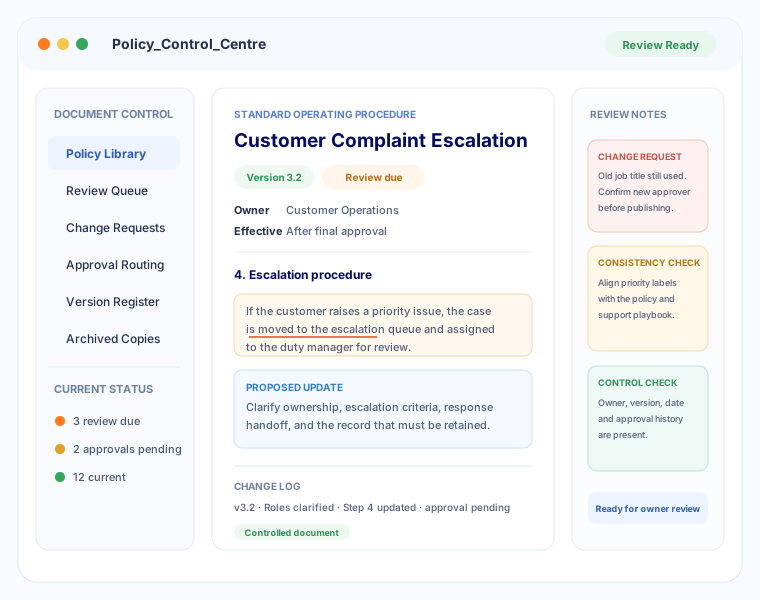
SOP Maintenance Service for Clear, Current, Controlled Procedures
★★★★★4.8 rating from Researchers, Authors, Students, and Scholars
Keep business policies and standard operating procedures aligned with current roles, systems, workflows, controls, and approval requirements. We help maintain the document set through structured review, controlled updates, version tracking, and approval-ready handover.
Review and update existing SOPs against current process information
Standardise ownership, version, review-date, approval, and change-history fields
Flag conflicting instructions, unclear responsibilities, and unresolved process decisions
Prepare controlled review copies, clean final files, and clear maintenance records
Work is defined from the document set and change requirements
Confidential File Handling
Internal procedures stay within the agreed project workflow
Version-Controlled Updates
Review copies, final files, and change records are kept distinct
Approval-Ready Handover
Documents are organised for owner review and formal approval
Pricing & delivery
SOP Maintenance Service Pricing & Delivery
A practical entry point for SOP Maintenance Service is defined for up to 5 controlled SOP updates. The starting scope works best in this situation: Operations teams with an existing SOP library that changes regularly and needs disciplined document updates without full redevelopment.
Monthly Maintenance
From ₹8,500 / month
for up to 5 controlled SOP updates
Suitable for: Operations teams with an existing SOP library that changes regularly and needs disciplined document updates without full redevelopment.
Up to five scoped SOP amendments per month
Step, role and cross-reference consistency checks
Version and change-history updates where supplied
Formatting alignment with the existing SOP template
Updated master and marked review copies
Typical delivery2–4 business days per standard update
Operational documents lose value when the process changes but the controlled documentation does not. Maintenance focuses on the gaps that make employees unsure which instruction, role, or version to follow.
Ownership Is Unclear
Documents may not show who owns the process, who reviews changes, or who approves the current version.
Duplicate Procedures
Multiple files can describe the same task differently, creating competing instructions and inconsistent execution.
Process Changes Are Missed
New systems, teams, forms, controls, or handoffs are introduced while older steps remain in the document.
Version Drift
Working copies circulate without clear version numbers, review dates, approval status, or archive controls.
Templates Become Inconsistent
Headings, numbering, control blocks, definitions, and document metadata can vary across the policy library.
Review Dates Are Missed
Without a maintained review register, documents can remain unchanged long after a scheduled owner review is due.
2
What This SOPs Maintenance Service Covers
A complete maintenance cycle connects document control, process review, content updates, owner decisions, and final handover. The sequence below can be adapted to your existing governance model.
Controlled maintenance can help you:
✓Know which version is current
✓Track what changed and why
✓Route unresolved points to owners
✓Keep the document register aligned
1Document InventoryIdentify files and current versions
2Ownership MapConfirm owners and reviewers
3Review ScheduleCheck dates and priorities
4Change RequestCapture process updates
5Gap ReviewLocate outdated or conflicting content
6Content UpdateRevise affected instructions
7Process ValidationCheck sequence and handoffs
8Control AlignmentReview roles and control points
9TerminologyHarmonise names and definitions
10Template FormattingApply document-control format
11Approval RoutingPrepare owner review points
12Version ControlUpdate version and status fields
13Change LogRecord material updates
14DistributionPrepare controlled final files
15Archive & RegisterSeparate superseded versions
3
See the Transformation From Outdated Procedure to Controlled SOP
Maintenance is more than polishing language. It identifies what no longer matches the operating environment, records the required decisions, and prepares a current controlled document.
Before — Outdated SOP
Step 4: Escalate all priority complaints to the Service Team Lead using the legacy queue.
×Old role title remains in the procedure
×Legacy system reference is still present
×No owner or review date shown
×Approval history is unclear
→
During — Maintenance Review
Change request: Replace the legacy queue with the current escalation workflow and confirm the new approver.
Consistency check: Align priority labels with the related customer-service policy.
Control check: Add document owner, version, review date, approval status, and change-history entries.
Open point: Owner confirmation required before the updated version is treated as final.
→
After — Controlled Current SOP
Step 4: Priority complaints follow the current escalation route, with ownership and handoff points stated clearly.
✓Current roles and systems reflected
✓Clear owner and approval status
✓Version and review information present
✓Change history captured for review
Ready to move forward with SOPs Maintenance Service?Purchase the service and continue with your project brief, files, and delivery requirements.
What Makes This Different From One-Off Editing or Formatting
Language editing can improve a document, but maintenance requires lifecycle control: deciding what needs review, recording changes, checking dependencies, preparing approval, and preserving a reliable version history.
Support Dimension
Language Editing
Policy / SOP Formatting Review
Full SOPs Maintenance
Grammar and clarity improvement
✓
Partial
✓
Template and formatting consistency
Partial
✓
✓
Document inventory and review prioritisation
×
×
✓
Ownership and approval-field review
×
Partial
✓
Process-change assessment
×
×
✓
Cross-document consistency check
×
Partial
✓
Version and change-history control
×
×
✓
Approval-ready review package
×
Partial
✓
Recurring review-calendar support
×
×
✓
Best for
Language polish
Presentation consistency
Ongoing document-control maintenance
5
Policy & SOP Types Supported
Maintenance can be organised around a single document type or a mixed operational library, using the client’s existing templates, owners, approval route, and document-control conventions where supplied.
Corporate Policies
Operational SOPs
HR Policies & Procedures
Finance & Admin Procedures
Customer Support SOPs
Quality Checklists & Work Instructions
IT, Data & Security SOPs
Procurement & Vendor Procedures
Ready to move forward with SOPs Maintenance Service?Purchase the service and continue with your project brief, files, and delivery requirements.
Each stage separates document work from business decisions so unresolved process questions are surfaced for the appropriate owner rather than being guessed during editing.
1Brief & File Intake
Receive the current files, templates, change notes, and priorities.
2Inventory Review
Identify document versions, owners, dates, and known dependencies.
3Owner Mapping
Confirm who can answer process questions and approve updates.
4Change Assessment
Compare current documentation with supplied operational changes.
5Redline & Update
Revise affected sections and flag decisions needing confirmation.
6Control Review
Check roles, cross-references, metadata, numbering, and consistency.
7Approval Package
Prepare review copy, change summary, and clean proposed version.
8Final Handover
Deliver agreed files and update the maintenance register package.
What You Need to Share With Us
✓Current policy and SOP files or document repository export
✓Approved templates, naming rules, and document-control conventions
✓Document owners, reviewers, and approval route where known
✓Process maps, work instructions, system changes, or operational notes
✓Known audit findings, change requests, or improvement actions
✓Review deadlines, launch dates, or internal milestones
Policy_Register.xlsxXLSX
Customer_Escalation_SOP.docxDOCX
Process_Change_Notes.pdfPDF
Approval_Matrix.docxDOCX
What You Receive
✓Updated working files in the agreed editable format
✓Clean proposed final versions prepared for owner approval
✓Tracked or redline review copies where included in scope
✓Change log or update summary for material revisions
✓Open-issues list for unresolved owner or process decisions
✓Updated document register fields or maintenance tracker where supplied
✓Review-date and ownership information aligned to the agreed control model
✓Archive-ready separation of superseded copies when part of the handover
7
Quality Assurance & Review Methodology
Maintenance quality is checked across the document itself and the control information around it. Business decisions that cannot be validated from supplied material remain visible for owner confirmation.
1Structure Review
Sections, numbering, purpose, scope, and document hierarchy.
2Clarity Pass
Plain, usable instructions with consistent terminology.
3Process Accuracy Check
Steps and handoffs checked against supplied process information.
4Roles & Controls Check
Responsibilities, approvals, evidence, and control points reviewed.
5Formatting & Reference Check
Templates, cross-references, labels, fields, and naming consistency.
6Final Verification
Version fields, clean copy, change log, and open points checked.
Maintenance Package Checked
Ready to move forward with SOPs Maintenance Service?Purchase the service and continue with your project brief, files, and delivery requirements.
✓Limit project access to the assigned working team
✓Keep working, proposed, approved, and superseded versions distinct
✓Use clear file naming and version status throughout the maintenance cycle
✓Handle unpublished operational procedures as confidential project material
✓Discuss additional NDA or file-retention requirements during scoping where needed
Maintenance Cadence Options
One-Time Baseline Review
For a current-state cleanup or controlled refresh of selected documents.
Scheduled Maintenance
For planned review cycles across an agreed policy and SOP register.
Change-Triggered Updates
For revisions tied to process, system, role, or control changes.
Delivery timing is confirmed after the document inventory and update depth are reviewed.
Custom Scope Factors
The published SOP Maintenance Service starting price above is ₹8,500 / month for up to 5 controlled SOP updates; larger or specialist requirements are confirmed after scope review. A project quote can be based on:
Scope can include document inventory review, change assessment, controlled updates, version checks, change logs, approval preparation, and maintenance tracking.
Can you maintain a whole document library?+
Yes. A library engagement can be organised by priority, owner, document family, or an agreed review calendar.
How is pricing confirmed?+
The published SOP Maintenance Service starting price above is ₹8,500 / month for up to 5 controlled SOP updates; larger or specialist requirements are confirmed after scope review. Larger maintenance requirements are quoted after the document number, length, condition, update depth, review rounds and cadence are understood.
Ready to move forward with SOPs Maintenance Service?Purchase the service and continue with your project brief, files, and delivery requirements.
Practical answers about maintenance scope, version control, review cycles, owner approvals, document libraries, pricing, turnaround, confidentiality, and the information needed to begin.
What does a SOPs Maintenance Service cover?+
It supports the ongoing upkeep of controlled policies and standard operating procedures, including review scheduling, change assessment, document updates, version control, approval preparation, change logs, and clean final files. The exact scope is agreed from the document inventory and maintenance needs.
Can you update an existing policy or SOP without rewriting it from scratch?+
Yes. Where the underlying process remains valid, maintenance can focus on targeted updates such as role names, system references, workflow steps, controls, definitions, formatting, review dates, and cross-references rather than a full rewrite.
How do you handle SOPs that conflict with each other?+
Potential conflicts are flagged for owner or subject-matter review. The maintenance process can compare related documents, identify inconsistent roles, terms, process steps, controls, or references, and record unresolved decisions instead of silently choosing one version.
Can the service maintain a whole policy and SOP library?+
Yes, the workflow is suitable for a document library as well as individual files. A library-level engagement can begin with an inventory, ownership mapping, review-priority assessment, and a controlled schedule for updating documents in agreed batches.
Do you provide legal or regulatory advice as part of maintenance?+
The maintenance service focuses on document structure, consistency, process accuracy, governance information, and controlled updates. Legal or regulatory interpretation should be supplied or approved by the responsible legal, compliance, or regulatory owner unless a separate specialist scope is agreed.
What do you need from us before maintenance begins?+
Typically, the current policy and SOP files, existing templates, document owners, approval route, known process or system changes, relevant change notices, and any review deadlines are useful. If some information is unavailable, it can be listed as an open item for owner confirmation.
Will we receive tracked changes and a clean final version?+
The maintenance package can include a review copy showing changes and a clean approval-ready copy, together with a change log or update summary where that format is part of the agreed scope.
How are versions and review dates controlled?+
The workflow can check document identifiers, version numbers, owners, effective or review dates, approval information, change-history fields, and archive status against the agreed document-control convention. Existing client conventions are followed where supplied.
How is pricing for SOPs Maintenance Service calculated?+
The published SOP Maintenance Service starting price above is ₹8,500 / month for up to 5 controlled SOP updates; larger or specialist requirements are confirmed after scope review. Final pricing for larger scope is quoted after review because the effort depends on the number and length of documents, the condition of the current files, update depth, number of review or approval rounds, formatting requirements, and whether the work is one-time or recurring.
How long does policy and SOP maintenance take?+
A delivery schedule is confirmed after the document set and change depth are reviewed. A small targeted update and a multi-document library maintenance project require different levels of review, coordination, and approval preparation, so no unsupported standard turnaround is stated.
Can maintenance be scheduled on a recurring basis?+
Yes. The engagement can be structured around an agreed review calendar or change-triggered updates, subject to the scope, document owners, approval process, and maintenance cadence agreed for the project.
How do you protect confidential internal procedures?+
The page uses the same confidential-document handling approach as the wider Contentxprtz service workflow. Access should be limited to the assigned project team and sensitive operational material should be shared only through the agreed project channel.
SOPs Maintenance Enquiry
Tell Us What Needs to Be Maintained
Share the size of your policy / SOP library, the main changes you need reflected, and any owner-review or approval deadlines. We can use those details to define a practical maintenance scope and quote.
✓Single-document updates or multi-document maintenance
✓Existing templates and document-control conventions can be retained
✓Unresolved process decisions can be captured for owner confirmation
✓The published SOP Maintenance Service starting price above is ₹8,500 / month for up to 5 controlled SOP updates; larger or specialist requirements are confirmed after scope review.
Ready to Keep Your SOPs Current and Controlled?
Share your document set and the changes you need reflected. We will use the scope to plan the maintenance workflow, review requirements, and custom quote.