Scope-Based Support
Documentation is shaped around the process, audience, and review need.

Turn process knowledge, existing notes, workflows, approvals, roles, and internal requirements into structured policies and standard operating procedures that are easier to review, follow, maintain, and implement.
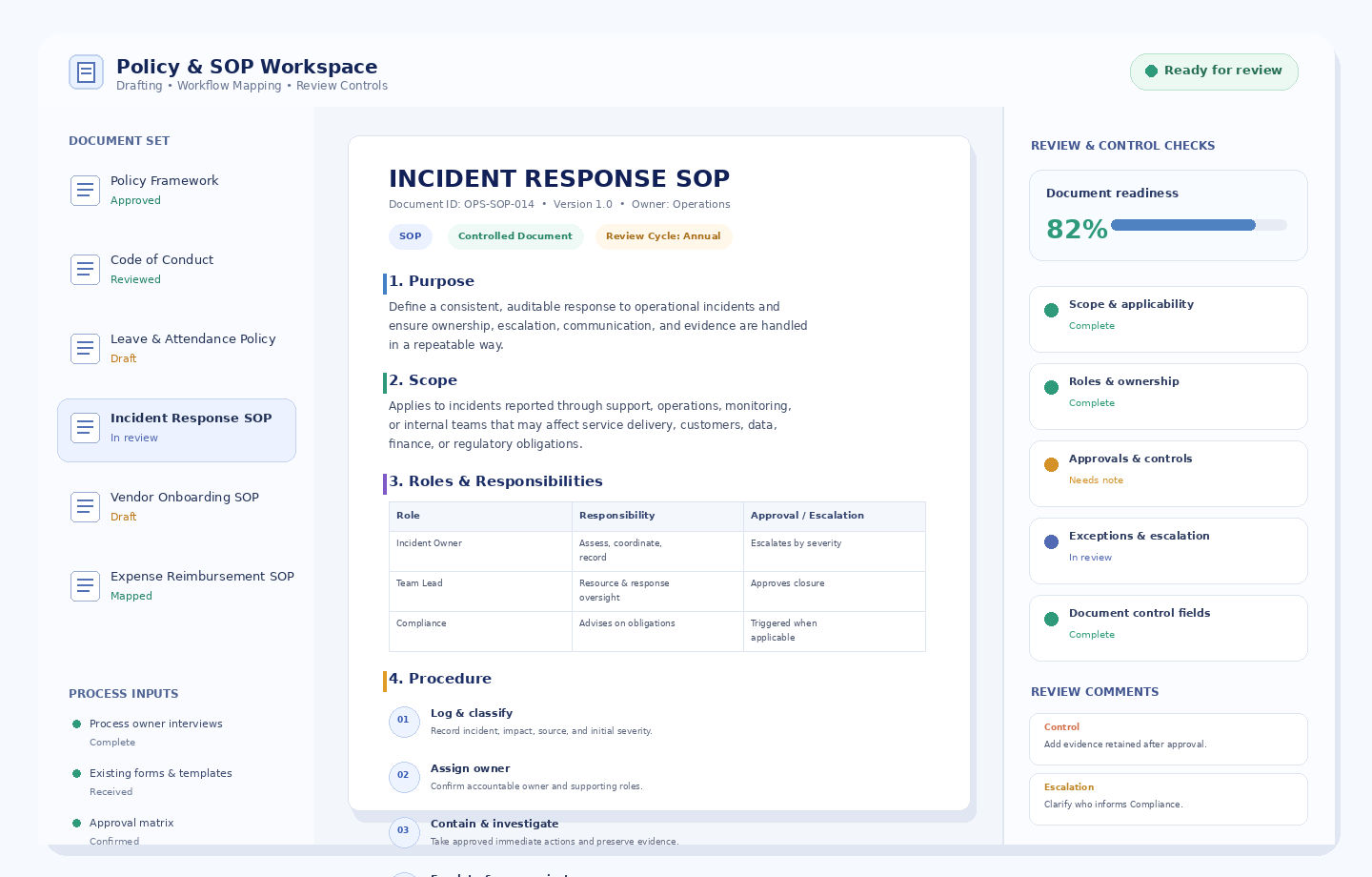
Documentation is shaped around the process, audience, and review need.
Internal documents and process information are treated as confidential service material.
Ownership, controls, exceptions, and consistency are checked against the agreed inputs.
Final outputs follow the agreed document structure, format, and review cycle.
A single fixed package would understate the variation in SOP Development Service. The minimum below gives a credible budget entry point for this kind of engagement: A focused SOP-development project for organisations that need several related procedures structured from approved process knowledge and stakeholder inputs.
Suitable for: A focused SOP-development project for organisations that need several related procedures structured from approved process knowledge and stakeholder inputs.
Policy and procedure documents fail when they are vague, detached from the actual workflow, or difficult to maintain. The development process focuses on the issues that make documentation hard to use in practice.
The document does not define who, what, where, or when it applies, creating conflicting interpretations.
Responsibilities are implied rather than assigned, so approval, execution, review, and escalation become unclear.
Instructions say what should happen without showing the actual sequence, inputs, decision points, or required evidence.
Review and approval logic is absent or inconsistent with the way the process is actually governed.
The standard flow is documented, but unusual cases, handoffs, or escalation triggers are not addressed.
Documents lack clear control fields, review ownership, change history, or a consistent maintenance structure.
The work can move from discovery and architecture through drafting, control mapping, stakeholder review, and final document governance. The exact sequence is tailored to the scope and source material available.
This representative example shows the difference between rough operational knowledge, a development-stage draft, and a cleaner review-ready procedure. It demonstrates process development rather than simple proofreading.
Applies when a complaint meets the defined operational, financial, customer-impact, or escalation criteria.
Support logs the case, the assigned owner coordinates action, and escalation moves to the designated reviewer when a trigger is met.
Required notes, decision evidence, approvals, communication, and closure status are defined in the procedure.
Purpose: Define a consistent route for classification, ownership, escalation, approval, evidence capture, and closure.
SOPs development requires process logic and document architecture, not only cleaner wording. The comparison below shows where full development work goes beyond surface-level document improvement.
| Support Dimension | Document Formatting Review Layout & consistency |
Language Editing Grammar & style improvement |
Full SOPs Development Process-to-document support |
|---|---|---|---|
| Policy architecture & scope development | × | × | ✓ |
| Process discovery & workflow mapping | × | × | ✓ |
| Roles, ownership & handoffs | × | × | ✓ |
| Controls, approvals & escalation logic | × | × | ✓ |
| Step-by-step procedure sequencing | × | × | ✓ |
| Templates, forms & checklists where in scope | △ | × | ✓ |
| Clarity, grammar & professional language | △ | ✓ | ✓ |
| Formatting & document consistency | ✓ | ✓ | ✓ |
| Version, review-cycle & document-control structure | △ | × | ✓ |
| Best for | Checking presentation | Improving wording | Developing usable policy & SOP documentation |
The service can be scoped around individual documents or related documentation sets. The exact content depends on the process, source information, approvals, and business requirements supplied for the engagement.
A structured workflow keeps the process grounded in your actual operations. Each stage is used only as needed for the engagement; requirements and review cycles are confirmed before work proceeds.
Share the process, existing documents, objectives, and available source information.
Clarify document set, audience, owners, stakeholders, review needs, and gaps.
Organise steps, handoffs, decisions, approvals, controls, and exceptions.
Set the policy/SOP structure, numbering, sections, control fields, and hierarchy.
Develop the document from the confirmed workflow and source materials.
Capture comments, clarify disputed points, and revise against confirmed decisions.
Check structure, terminology, roles, cross-references, controls, and formatting.
Deliver the agreed final files, notes, templates, or supporting material in scope.
Better source material leads to more accurate documentation. The final deliverables depend on the agreed scope, but the engagement is designed to make inputs, review responsibilities, and outputs clear from the start.
Depending on the agreed scope, the final pack can include the following document and review outputs.
A multi-stage review checks more than grammar. It looks at document logic, clarity, ownership, procedure consistency, controls, references, and final presentation against the scope and source information supplied.
Check document purpose, hierarchy, flow, section logic, and completeness against scope.
Improve readability, concision, terminology, instruction wording, and ambiguity.
Verify responsibilities, handoffs, review roles, and decision ownership are explicit.
Review sequence, approvals, escalation, evidence, exceptions, and cross-document consistency.
Check numbering, document-control fields, headings, tables, references, and presentation.
Confirm requested revisions are addressed and the final set is internally consistent.
SOPs often cross teams. The documentation approach can be applied to different business functions as long as the process information, owners, approvals, and relevant source requirements are available.
Client documents, process notes, internal instructions, and unpublished operational material should remain within the designated submission, review, and delivery workflow for the engagement.
This service does not use the Editing, Writing, or Proofreading plan catalogue. Pricing and turnaround are therefore quoted after the requested document set, process complexity, review requirements, and deadline feasibility are assessed.
No fixed delivery time is assumed. The appropriate delivery approach is confirmed after scope review.
The SOP Development Service project minimum covers the defined starter engagement above; larger procedure sets are quoted from the actual process and document workload.
Common questions about scope, inputs, review, pricing, turnaround, confidentiality, and process-based development.
The scope can include policy or SOP architecture, purpose and scope, roles and responsibilities, workflow mapping, step-by-step procedures, controls and approvals, escalation and exception handling, document control fields, templates or checklists where agreed, and structured review before final delivery.
Yes. The service can begin from process notes, interviews, forms, screenshots, system steps, existing instructions, or a combination of source materials. The amount of discovery required is confirmed during scope review.
Yes. Existing documents can be reviewed for unclear scope, missing ownership, inconsistent procedure detail, weak approval or escalation logic, document-control gaps, duplication, and readability before the agreed revisions are made.
Proofreading and language editing mainly improve correctness and wording. SOP development addresses the process itself: sequence, ownership, decision points, controls, approvals, exceptions, required evidence, and how the procedure should be structured for practical use.
Useful inputs include the business objective, process owner, current workflow, roles, systems or forms used, approval points, exceptions, existing documents, applicable internal or external requirements, review stakeholders, and the required delivery milestone.
It can, where the requested documents form a related process set. The documents, dependencies, review sequence, and delivery approach are defined during scoping rather than assumed in advance.
They can be included when they are part of the agreed process and the required information is available. Roles, approval points, escalation paths, and exceptions are documented from the supplied or confirmed workflow rather than invented.
Yes. If you provide your approved policy or SOP template, document-control fields, numbering rules, branding, or formatting guidance, the final documents can be developed to follow those requirements within the agreed scope.
Turnaround and pricing are quoted after the requested number of documents, process complexity, source-material quality, discovery needs, review cycles, formatting requirements, and deadline feasibility are assessed. The published SOP Development Service project minimum above is ₹15,000 for a defined initial engagement; larger or more complex requirements are confirmed after scope review.
Client documents, instructions, internal process information, and related project materials are handled as confidential service information through the designated submission, review, and delivery process.
The documentation can be structured around requirements and source material you provide, but the service does not replace legal, regulatory, certification, audit, or compliance advice. Specialist review should be used where formal interpretation or approval is required.
The draft can move through stakeholder review, clarification, revision, consistency checking, document-control verification, and final formatting according to the review cycle agreed for the engagement.
Share your current process notes, existing documents, required policy/SOP set, review stakeholders, and target milestone. We can help turn the available information into a structured, review-ready documentation plan.