Unclear Purpose & Audience
The document mixes detail and messaging without a clear decision, reader, or reporting objective.
Turn briefs, approved data, source documents, and stakeholder inputs into a coherent corporate report with a strong executive summary, logical section flow, evidence-led narrative, polished business language, and consistent presentation.
A report can contain the right information and still be difficult to act on. Corporate report writing brings purpose, audience, evidence, narrative, and presentation into one controlled document.
The document mixes detail and messaging without a clear decision, reader, or reporting objective.
Key findings, implications, risks, and decisions are buried instead of being prioritised for leadership.
Tables and KPIs appear in the report, but the surrounding text does not explain significance, movement, or context.
Inputs from different teams do not read as one report because structure, emphasis, and sequencing vary.
Periods, labels, definitions, acronyms, or supporting statements change from section to section.
Heading levels, tables, captions, references, and visual elements are not ready for final stakeholder circulation.
The workflow can begin with a blank page, a rough outline, or an existing report draft. The exact combination of writing, synthesis, editing, and presentation support is agreed from your source material.
Audience, purpose, outcomes, sections, constraints.
Notes, approved data, prior reports, references.
Section order, hierarchy, story, information flow.
Priority findings, implications, actions, decisions.
KPI commentary, trends, comparisons, implications.
Titles, captions, callouts, labels, cross-references.
Section-by-section business writing from supplied evidence.
Tone, clarity, repetition, terminology, logic.
Headings, tables, captions, references, brand cues.
Cross-checks before delivery for stakeholder review.
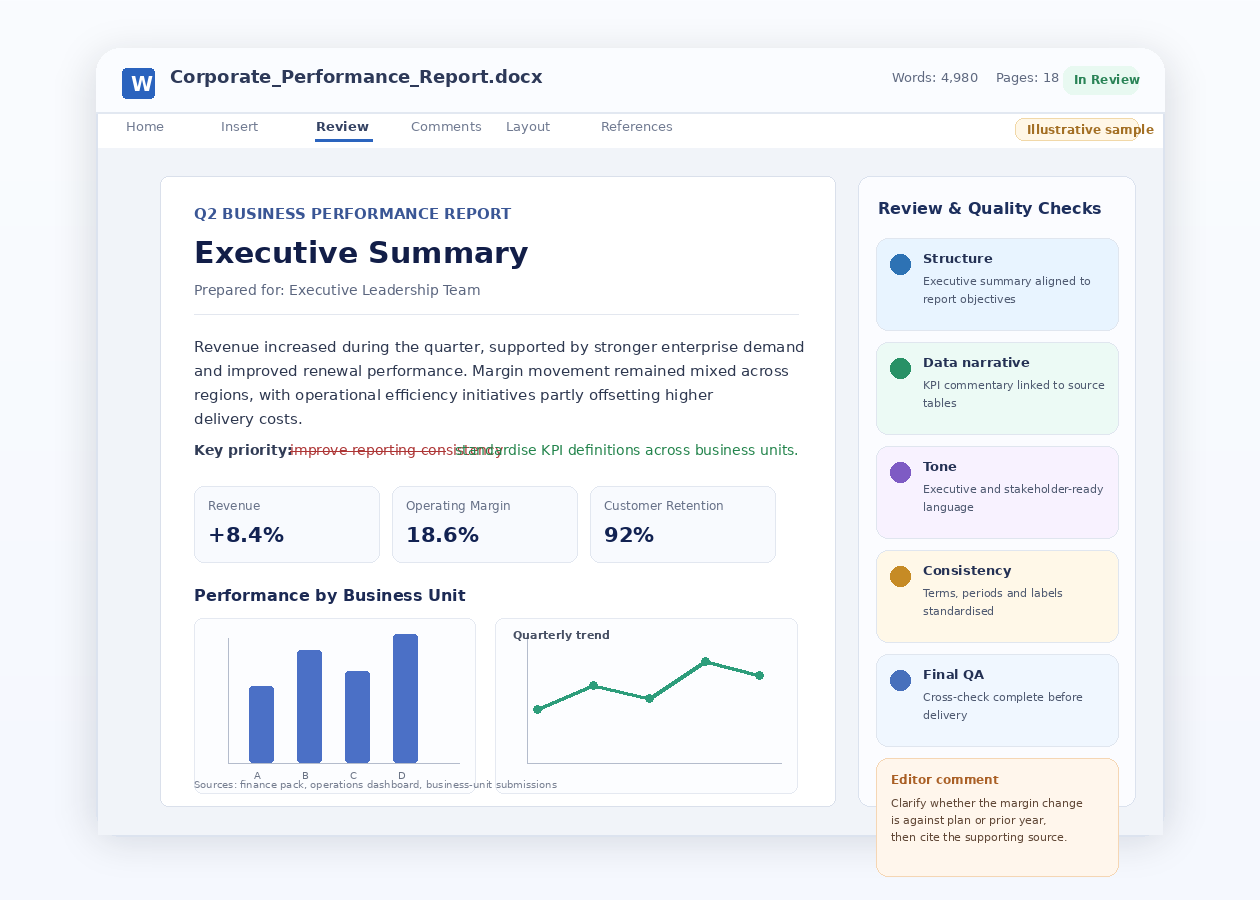
This illustrative example shows the type of change corporate report writing can make to business narrative. The content below is fictional and used only to demonstrate writing depth.
Illustrative input
Sales were better this quarter and renewals improved. Some areas were good, but costs also went up and the margin did not improve as much. Different teams used different KPI labels and some figures still need checking.
Issue: important information exists, but the message, hierarchy, and business implication are unclear.
Illustrative revision
Performance was better improved during the quarter, supported by stronger renewals. However, higher delivery costs moderated the overall margin benefit. KPI terminology should be standardised before circulation.
Illustrative final copy
Quarterly performance improved as stronger renewal activity supported top-line growth. The benefit was partly offset by higher delivery costs, limiting the margin improvement. Management reporting will use standard KPI definitions in the final pack to support consistent interpretation across business units.
Result: the message is prioritised, caveated, and connected to the reporting action without inventing unsupported facts.
Corporate report writing is different from a final proofreading pass or a light edit. Use the comparison below to match the service depth to the condition of your document.
| Service Level | Proofreading Existing Report | Report Editing | Corporate Report Writing Service | Advanced Report Development |
|---|---|---|---|---|
| Focus | Grammar, spelling, punctuation, obvious consistency issues. | Clarity, tone, flow, section consistency, and presentation. | Report planning, evidence-led drafting, executive narrative, structure, editing, and final review. | Deeper restructuring, multi-source synthesis, complex narrative development, and extensive stakeholder revision. |
| Best Starting Point | Near-final report. | Complete draft. | Brief, source pack, outline, partial draft, or mixed working materials. | Complex draft or multi-contributor reporting programme. |
| Executive Summary | Language check only. | Refined if already present. | Can be developed from approved report content. | Developed and iterated alongside the full strategic narrative. |
| Data Narrative | Checks wording around supplied data. | Improves clarity of existing interpretation. | Writes narrative around supplied KPIs, tables, trends, and findings. | Integrates multiple datasets, themes, and stakeholder inputs into a broader story. |
| Structure | No major restructuring. | Light to moderate improvement. | Section architecture and logical flow included as required. | Major reorganisation and development where needed. |
| Best For | Final language check. | Polishing an existing corporate draft. | Most clients needing a report built or substantially written from approved inputs. | High-complexity, multi-source, or heavily iterative reports. |
Not every report uses the same headings. The structure below shows common corporate-report components that can be adapted to your purpose, audience, evidence, and internal format.
Priorities, findings, implications, actions.
Background, scope, objective, reporting period.
KPIs, milestones, outcomes, trend narrative.
Approved metrics, drivers, comparisons, context.
Material concerns, dependencies, mitigations.
Environmental, social, governance, impact narrative.
Actions, priorities, owners, decision points.
Key takeaways and next-stage direction.
Supporting tables, definitions, references.
A controlled workflow helps keep the report aligned to its audience, source material, review expectations, and final handoff requirements.
Purpose, audience, deadline, source files.
Assess writing depth, evidence, complexity.
Match the project to the reporting requirement.
Confirm structure, hierarchy, narrative path.
Write sections from approved source material.
Clarity, flow, tone, evidence, consistency.
Comments, clarifications, approved changes.
Cross-check language, labels, references, handoff.
Final files and agreed post-delivery clarification.
Deliverables are matched to the project scope. The items below show the typical working and final files that can be included in a corporate report writing engagement.
Working file structured for internal review, revisions, and handoff.
Approved text with resolved edits and consistent presentation.
Transparent changes for projects that begin from an existing draft.
Titles, captions, labels, callouts, and explanatory narrative as scoped.
References, footnotes, or source-list presentation where supplied and required.
Clear headings and senior-reader narrative aligned to the agreed report purpose.
Quality review focuses on whether the report is coherent, evidence-led, internally consistent, readable for its intended audience, and ready for the next approval stage.
Confirms that the report responds to the brief, reader, purpose, and decision context.
Reviews whether statements are traceable to the supplied and approved source material.
Checks terminology, periods, claims, section flow, tone, and repeated information.
Checks headings, tables, captions, numbering, references, and cross-references as scoped.
Reviews the final file for unresolved comments, inconsistencies, and obvious handoff issues.
The service can be adapted to different corporate reporting contexts. Final scope depends on your brief, audience, source material, and required output.
Corporate reports often contain unpublished strategy, performance, financial, operational, people, customer, or project information. File handling should reflect that sensitivity throughout the writing process.
Share only the material required for the agreed scope. Where an NDA or specific handling instruction is required, raise it before sensitive files are transferred.
Corporate report timelines depend on the report length, condition of the source material, writing depth, data complexity, review rounds, and deadline. Your delivery schedule is confirmed after the project scope is reviewed.
For clearly scoped reports with organised source material and a normal review cycle.
Timeline: confirmed after scope review.For deadline-sensitive reports where availability, source readiness, and review requirements allow accelerated handling.
Timeline: quoted for the requested deadline.For long, multi-contributor, data-heavy, or highly iterative reports requiring additional planning and coordination.
Timeline: scoped to complexity and review rounds.Corporate reports vary significantly in length, source volume, data complexity, writing depth, and review requirements. Pricing is therefore based on the actual report scope rather than a one-size-fits-all package.
The report can be priced after reviewing the brief, source material, writing depth, complexity, review expectations, and requested delivery schedule.
Your quote is prepared from the work required for your report, including the available source material, writing depth, number of sections, data and formatting requirements, review cycle, and requested schedule.
Request Your Report QuoteThe service is designed around the realities of corporate reporting: multiple inputs, senior audiences, evidence-sensitive statements, tight section logic, revisions, and final handoff.
Answers to common questions about scope, source material, data narrative, confidentiality, turnaround, pricing, and deliverables for Corporate Report Writing Service.
The service can cover report planning, section structure, executive-summary development, evidence-led drafting, KPI and data narrative, tables and figure captions, tone and terminology consistency, editing, formatting review, and final quality checks. The exact scope is confirmed from your brief and source material.
Yes. A report can be developed from a clear brief together with source material such as management notes, approved data, presentations, spreadsheets, research, policies, prior reports, and stakeholder inputs. The available evidence determines what can be stated in the report.
Corporate report support can be scoped for annual and periodic business reports, management reports, performance reports, project or programme reports, governance reports, impact reports, ESG or sustainability reports, and other structured corporate documents.
Yes. If you already have a draft, the work can focus on structure, executive clarity, flow, consistency, data narrative, section balance, editing, and final presentation rather than full first-draft development.
Yes. When you provide brand, style, terminology, formatting, and audience guidance, the report can be aligned to those requirements. Existing approved reports can also be used as style references where supplied.
The writing can connect approved figures, tables, KPIs, and chart outputs to the surrounding narrative so that the report explains what the data shows and why it matters. Source values are not invented or altered without instruction.
The service checks the consistency of supplied content and how data is described, but it does not replace audit, assurance, accounting validation, legal review, or independent verification of source data unless separately agreed with an appropriately qualified provider.
The workflow is designed for confidential working material, with controlled handling and limited access to the people required for delivery. If an NDA is required, include that requirement in your enquiry so it can be addressed before sensitive material is shared.
Useful inputs include the report brief, intended audience, objective, required sections, source documents, approved data, tables or spreadsheets, prior reports, brand or style guidance, reference material, and any deadline or review-stage requirements.
Turnaround is confirmed after reviewing the report length, source-material condition, research or synthesis required, number of sections, data and table complexity, formatting needs, review rounds, and deadline. No fixed turnaround is assumed for this service page.
Corporate report writing is quoted to the actual scope. Factors can include word count or page length, writing depth, source-material volume, research and synthesis requirements, data and table work, formatting complexity, revision needs, and delivery timeline.
Delivery is scoped to the project, but it can include an editable Word report, a clean final copy, tracked revisions where relevant, structured headings, executive-summary copy, tables or figure text, source or reference notes where supplied, and a final quality-control pass.
Share enough detail for us to understand the report, source material, audience, writing depth, and deadline. We can then prepare a scope that matches the work your report actually needs.