Purpose-led profile structure
Content is organised around the audience, profile objective, and next action.

Turn scattered company information, old brochure copy, rough notes, and stakeholder inputs into a structured corporate profile that explains who you are, what you do, who you serve, and why your business matters—without inventing unsupported claims.
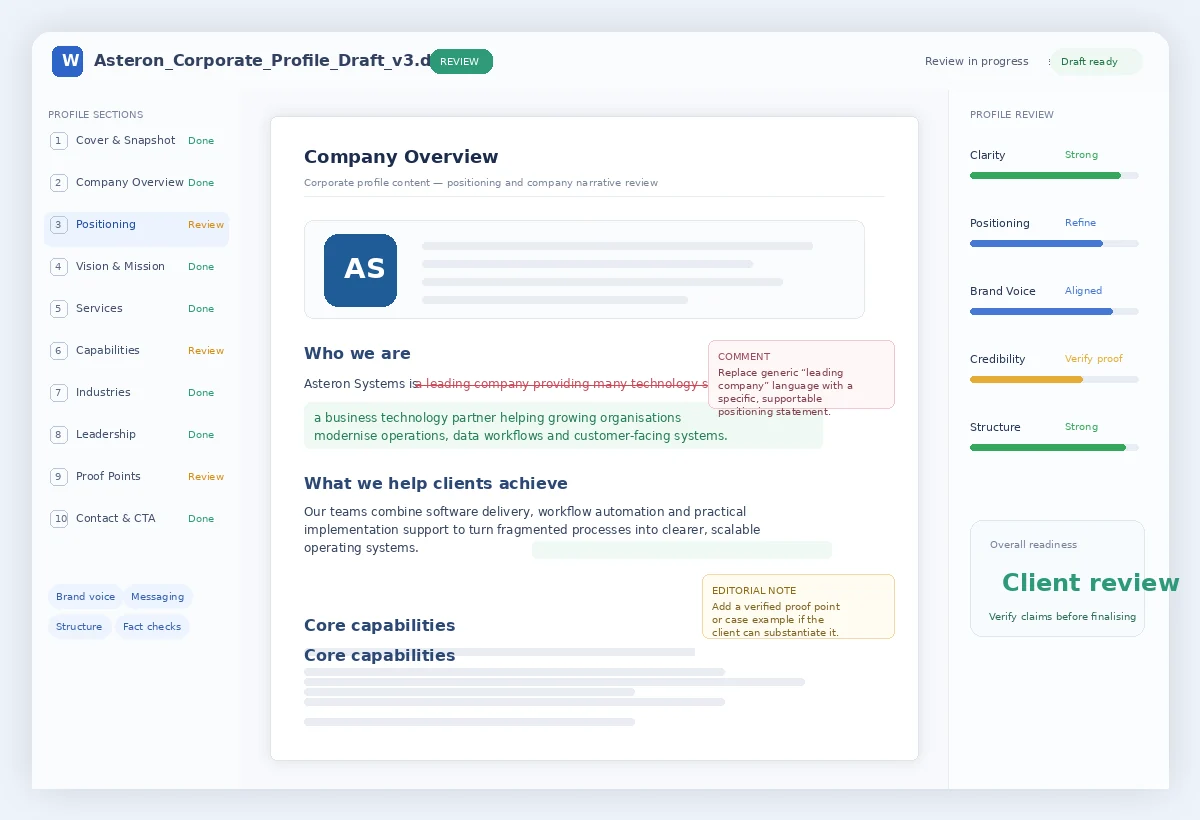
Illustrative content-development view; example company and wording are fictional.
Content is organised around the audience, profile objective, and next action.
Company material is handled as confidential service information through the agreed workflow.
Positioning, narrative, services, capabilities, proof, and consistency are reviewed together.
Receive the agreed profile content in a practical format for review, design, or publication.
The starting scope for Corporate Profile Writing Service is priced for up to 1,500 words / 6 core sections. It is designed for this requirement: Companies with source information about the business but no concise, well-structured profile narrative.
Suitable for: Companies with source information about the business but no concise, well-structured profile narrative.
Most profile problems come from weak information architecture rather than grammar alone. These are common issues a structured writing process can identify and improve.
The profile says the company is “leading” or “innovative” without clearly explaining what it does, for whom, or in what context.
History, mission, and overview sections read like interchangeable corporate text rather than a coherent business narrative.
Services are listed as labels without showing the business problem, capability, scope, or value of the work.
Numbers, achievements, rankings, certifications, client claims, or superlatives appear without an approved source or verification.
Sections sound as though different people wrote them, with mixed terminology, tone, naming, or levels of formality.
Strong capabilities are described, but the profile does not show approved evidence, examples, milestones, or context that supports them.
Readers have to work too hard to find the overview, capabilities, industries, differentiators, leadership, or contact information.
Website copy, old presentations, service sheets, and brochure content contradict each other or no longer reflect the current business.
The exact mix depends on your purpose and source material. The workflow below shows the main content-development areas that can be addressed when relevant.
We help convert source material into a clear section plan, consistent narrative, and client-reviewable draft.
Clarify why the profile is being created and who must act on it.
Organise approved website copy, decks, brochures, notes, and company facts.
Shape the origin, context, evolution, and current business narrative.
State what the company does, for whom, and how it should be understood.
Refine approved direction, purpose, and mission language without inventing claims.
Turn service lists into clear, audience-relevant descriptions.
Explain skills, resources, delivery strengths, and operating scope from supplied facts.
Present sectors, use cases, or customer contexts the company actually serves.
Structure leadership introductions and role descriptions from approved information.
Organise dates, achievements, growth points, or company history that can be verified.
Place approved numbers, clients, certifications, case facts, or evidence where relevant.
Align terminology, tone, naming, and messaging with existing brand communication.
Create a logical reading sequence for print, PDF, web, or presentation use.
Flag unsupported, inconsistent, ambiguous, or outdated statements for confirmation.
Polish clarity, consistency, grammar, flow, headings, and final business presentation.
This fictional example shows the type of structural and messaging intervention involved. It is not a customer testimonial or a claim about a real company.
The draft contains broad claims, a list of services, and little audience context or differentiation.
Positioning: define the primary business role and customer context before listing services.
Service grouping: organise capabilities into meaningful solution areas instead of a long undifferentiated list.
Evidence prompt: mark every number, certification, customer claim, geography, and milestone that requires client confirmation.
The comparison below is about typical service focus, not a claim that every provider works the same way. Your confirmed scope should always define what is included.
The profile type should match the business audience and use case. The same company may need a different emphasis for sales, procurement, partnerships, or institutional communication.
Core company story, positioning, services, capabilities, leadership, and proof.
Concise narrative for a growing business that needs a clear market and capability story.
Focused content for buyers, partners, procurement teams, or vendor evaluation.
Profile-led copy structured for a brochure, PDF, or marketing collateral.
Audience-specific version emphasising strategy, business model, opportunity, and evidence.
Structured company information for registrations, tenders, supplier reviews, and due diligence.
Expertise, service methodology, client problems, team capabilities, and differentiation.
Mission-led organisation profile with programmes, capabilities, governance, and approved impact evidence.
The process starts with source material and ends with an agreed final draft. Unsupported facts are surfaced for client confirmation rather than silently filled in.
Share the profile purpose, audience, existing content, company facts, and preferred format.
The material is reviewed to identify missing information, audience needs, and content depth.
A logical section order and key messaging priorities are established.
The corporate profile is drafted using approved facts and source material.
Company story, services, capabilities, leadership, and proof points are tightened.
Claims, terminology, brand voice, and stakeholder-sensitive wording are checked.
Clarity, flow, headings, consistency, grammar, and presentation guidance are reviewed.
The agreed final document and review notes are delivered for approval and use.
Better source material reduces ambiguity. If information is incomplete, the draft can identify the gaps that need stakeholder input before finalisation.
A multi-stage review helps keep the profile aligned with the brief, consistent across sections, and careful about claims that require evidence or client approval.
Check purpose, audience, source material, and required profile format.
Build section hierarchy and remove duplication or information gaps.
Refine positioning, value proposition, services, and company narrative.
Flag claims, numbers, credentials, dates, and proof points that need confirmation.
Check brand voice, clarity, consistency, grammar, terminology, and readability.
Confirm the agreed sections are complete and the final version is ready for client review.
Corporate profiles are used across industries and stakeholder settings. The writing should reflect the company's actual business context rather than rely on generic corporate language.
Because The published Corporate Profile Writing Service starting price above is ₹6,500 for up to 1,500 words / 6 core sections; larger or specialist requirements are confirmed after scope review.
The delivery date is confirmed after the expected length, source condition, stakeholders, and required sections are understood.
If you have a launch, tender, event, investor meeting, or other fixed date, include it in the enquiry so feasibility can be assessed.
For longer or multi-stakeholder profiles, a phased review approach can be discussed when the scope requires it.
It can cover the planning, structuring, drafting, and refinement of the core sections that explain your company: who you are, what you do, who you serve, your capabilities, leadership, differentiators, proof points, and the next action you want readers to take. The exact scope is confirmed from the brief and source material you provide.
It is suitable for companies that need a clear business profile for clients, partners, vendors, procurement teams, investors, lenders, institutions, events, websites, capability documents, or corporate presentations. The final emphasis depends on the audience and purpose.
Yes. Rough notes, website copy, brochures, presentations, service sheets, leadership information, case material, and approved company facts can be organised into a clearer profile. Missing facts are flagged rather than invented.
Yes. An existing profile can be reviewed for positioning, structure, repetition, clarity, consistency, tone, service descriptions, unsupported statements, and outdated or incomplete sections. The rewrite can retain useful material while improving the overall narrative.
No. Corporate claims should be based on information you provide or approve. Where a strong statement needs evidence, the draft can flag the point for verification instead of fabricating proof.
Yes. Share brand guidelines, approved website copy, tone examples, terminology preferences, and words or claims to avoid. These inputs help keep the profile consistent with your existing communication style.
Audience variants can be discussed when the same company needs different emphasis for sales, procurement, partnerships, investors, institutions, or other stakeholders. The scope should identify which versions or adaptations are required.
This page focuses on corporate profile writing and content structure. If visual design, layout, or brochure production is required, state that in the enquiry so the required support can be confirmed separately rather than assumed.
The published Corporate Profile Writing Service starting price above is ₹6,500 for up to 1,500 words / 6 core sections; larger or specialist requirements are confirmed after scope review. A custom quote depends on factors such as source-material condition, expected length, number of sections, stakeholder inputs, required variants, revision scope, formatting or design coordination, and deadline requirements.
Turnaround is confirmed after scope review. The delivery schedule is confirmed after reviewing the brief, available source material, expected length, review stakeholders, and deadline. Fixed deadlines should be included in the enquiry.
Useful inputs include your company overview, services, capabilities, industries, leadership details, approved facts and milestones, proof points, existing website or brochure content, target audience, purpose, brand guidelines, preferred format, and any deadline or compliance requirements.
The agreed deliverables can include a clean final corporate profile draft, an editable document, a version showing revisions or review notes where useful, a content structure or section map, and a checklist of any facts or claims that still require client confirmation.
Share enough information for the profile purpose, content condition, stakeholders, and deadline to be understood before scope, pricing, or delivery are confirmed.
You do not need a perfect brief. Provide the most reliable information you already have and identify any sections that still require internal confirmation.
Tell us who will read the profile and what you want the document to help achieve.
Describe any existing profile, website, company deck, brochure, service sheets, or brand documents.
List the sections you expect, such as overview, services, capabilities, industries, leadership, milestones, proof, and contact.
Flag statistics, certifications, clients, achievements, dates, locations, or claims that must be verified before use.
State the expected length or format, stakeholder review needs, and any fixed deadline.
Send your contact details and a short brief. Scope, quote, and delivery timing can then be assessed against the actual material and requirement.
Share your current material, company facts, audience, and profile objective. The next step is to define a clear scope for a structured, credible, and business-ready corporate profile.