Narrative First
Structure the story before polishing individual slides.

Turn scattered slides, reports, notes, and business evidence into a coherent presentation narrative. We develop the storyline before visual design—clarifying the audience, decision, core message, section flow, slide sequence, headlines, transitions, and final call to action.
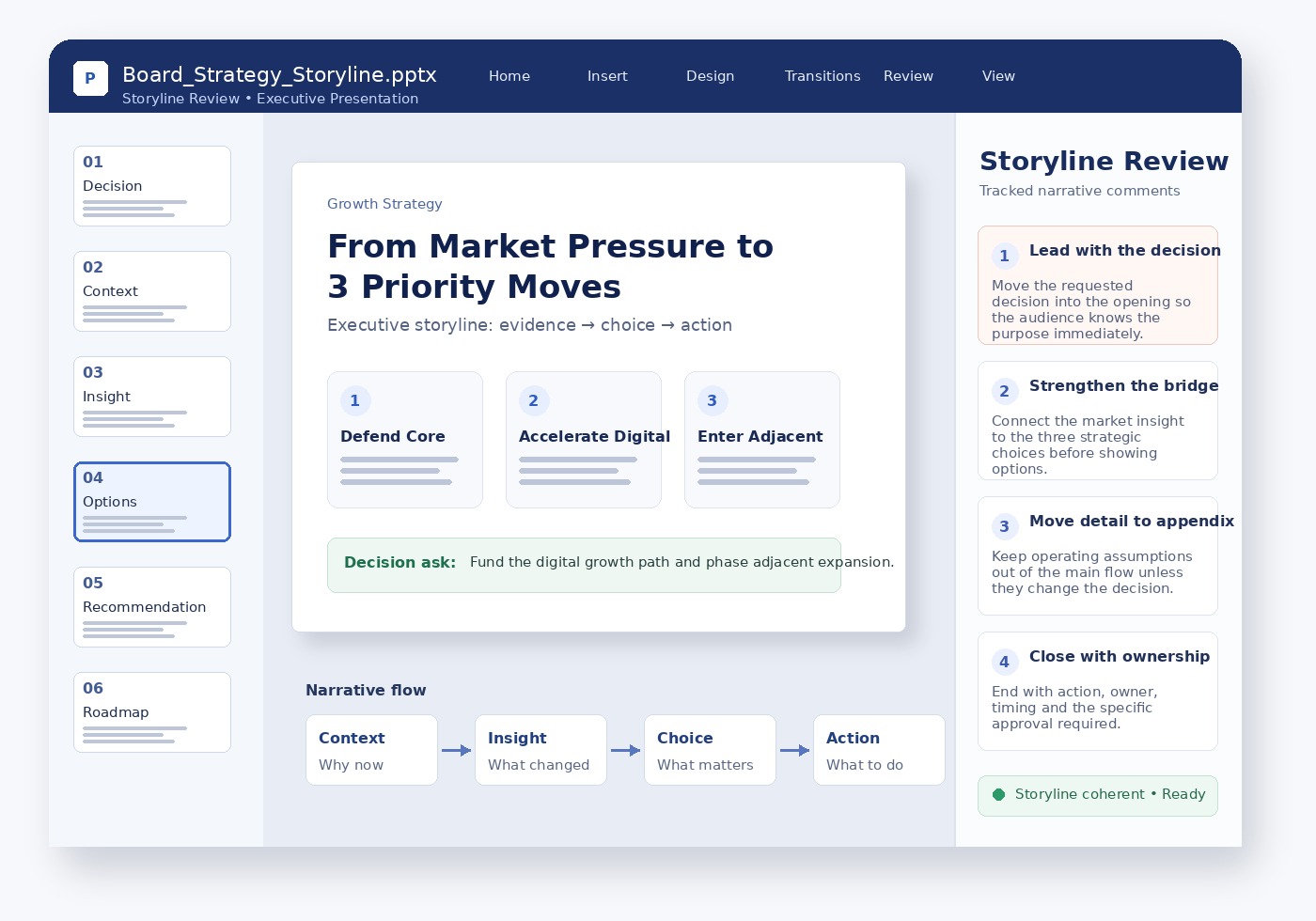
Structure the story before polishing individual slides.
Shape context, depth, and emphasis around the intended audience.
Give each slide a clear role in advancing the overall story.
Keep sensitive presentation material within a controlled workflow.
Receive a structured storyline that is easier to write, design, and present.
The starting scope for Corporate Presentation Storyline Development Service is priced for a storyline up to 15 slides. It is designed for this requirement: Existing decks or source packs that contain the right information but need a clearer sequence, argument and executive narrative before design.
Suitable for: Existing decks or source packs that contain the right information but need a clearer sequence, argument and executive narrative before design.
Presentation problems often begin before visual design. A deck can look polished and still be hard to follow when the purpose, sequence, evidence, and decision path are unclear.
The audience sees information but cannot quickly tell what the presentation is trying to explain, recommend, secure, or decide.
△ Story riskUseful slides accumulate without a narrative arc, so the deck reads like separate updates rather than one connected business argument.
△ Sequence riskHeadlines, evidence, and detail compete for attention instead of clearly separating the key message from supporting information.
△ Clarity riskCharts and facts appear without explaining what they mean, why they matter, or how they lead to the next recommendation.
△ Insight riskThe audience has to infer why one section follows another, creating friction between context, analysis, options, and action.
△ Flow riskThe deck ends with summary information but not the decision, ownership, next step, or action the audience is expected to take.
△ Decision riskWe work from the business purpose outward, connecting audience, message, evidence, slide order, and action into one coherent presentation structure.
Define the outcome the presentation must support.
Clarify who is listening and what they need to understand or decide.
Distil the central point the deck should leave behind.
Build the arc from context through insight to action.
Group ideas into sections with a clear purpose and progression.
Place slides in the order that best supports the narrative.
Turn labels into message-led headlines that advance the story.
Position facts, analysis, and charts where they support the message.
Make the recommendation, decision, ownership, or next step explicit.
Deliver a clear structure for content development and slide design.
Storyline development changes how the presentation communicates—not merely how individual sentences read.
These services solve different problems. Storyline development focuses on narrative logic and decision flow before visual polish.
| Service Level | Slide Proofreading | Storyline Development (Core Service) | Presentation Design / Visual Polish |
|---|---|---|---|
| Primary focus | Grammar, spelling, punctuation, basic wording consistency. | Narrative architecture, message hierarchy, section flow, slide sequencing, headlines, transitions, and decision clarity. | Layout, typography, imagery, charts, brand consistency, and visual execution. |
| Reorders slides | Usually no | Yes, when narrative logic requires it | Only if included in design scope |
| Reframes key messages | Light wording only | Yes — message-led headlines and stronger executive framing | May not address underlying story logic |
| Evidence placement | Not the main focus | Reviewed for relevance, sequencing, and support of the message | Expressed visually after content decisions are made. |
| Audience / decision alignment | Limited | Central to the service | Usually follows the agreed content and storyline. |
| Best for | Near-final decks needing a language check. | Presentations that contain the right information but need a clearer, more persuasive business story. | Approved content and storyline that need professional visual presentation. |
The exact structure varies by presentation, but these are common places where narrative clarity and message sequencing matter.
Purpose, audience relevance, reason for the discussion.
Top messages, recommendation, decision preview.
Only the background needed to understand the issue.
What the evidence means and why it matters now.
Choices, trade-offs, criteria, and implications.
Preferred path, rationale, and expected consequence.
Action sequence, ownership, dependencies, next steps.
Decision ask, takeaways, supporting detail, reference material.
A staged review keeps the presentation objective, narrative logic, evidence, and slide-level messages connected from brief to handoff.
Deck, notes, reports, data, brief, and constraints.
ReceivedDefine who, why, decision, and intended outcome.
Scope ReviewIdentify gaps, repetition, weak transitions, and unclear asks.
In ReviewBuild sections and the core context-to-action narrative.
Story BuildAssign each slide a role and position in the story.
StructureStrengthen slide messages, transitions, and executive framing.
Message PassCheck coherence, evidence role, consistency, and final decision path.
Quality CheckReceive the clean storyline and review notes in the agreed format.
DeliveredDeliverables are aligned to the agreed scope and can be structured around the existing deck, a storyline document, or both.
A structured view of the presentation arc, section purpose, and overall progression.
Recommended slide order with a clear role for each slide in the narrative.
Message-led slide headlines and section statements that strengthen executive clarity.
Comments on gaps, repetition, evidence placement, transition logic, and areas needing confirmation.
Direction on where charts, facts, proof points, and supporting detail best serve the argument.
A consolidated, presentation-ready narrative for writing, design, stakeholder review, or rehearsal.
The final storyline is checked across purpose, logic, message hierarchy, evidence, and handoff readiness—not just at sentence level.
Checks that the narrative supports the stated audience, purpose, and decision.
Reviews section sequence, slide dependencies, transitions, and argument progression.
Checks whether facts, analysis, and charts support the message they are used to make.
Checks terminology, headline hierarchy, repetition, and consistency between sections.
Confirms the story lands on a clear recommendation, ask, action, or next step where required.
Multi-stage review helps keep the presentation narrative aligned, coherent, audience-aware, and ready for final content or visual execution.
Storyline principles change with purpose. A decision deck, update, proposal, and pitch should not all use the same narrative structure.
Decision-focused narrative, concise context, implications, recommendation, and ask.
Performance, drivers, insights, priorities, risks, and next-step storyline.
Context, strategic choices, trade-offs, priorities, roadmap, and decision framing.
Problem, evidence, proposed approach, value, implementation, and approval ask.
Case for change, current state, future state, workstreams, roadmap, and governance.
Audience problem, differentiated value, proof, solution logic, and next action.
Status, outcomes, risks, dependencies, decisions, and upcoming milestones.
Clear change narrative, stakeholder context, key messages, actions, and ownership.
Corporate presentations can contain unpublished strategy, financial, commercial, operating, customer, or leadership information. File handling should reflect that sensitivity.
This service does not use a one-size-fits-all delivery claim. Feasibility is confirmed after reviewing the deck, source material, complexity, revision depth, and requested deadline.
For planned presentations where there is time for a full narrative diagnostic, storyline build, slide sequence review, and final quality pass.
Timing confirmed after scope review.For shorter planning windows where the scope can be prioritised around the most decision-critical sections and messages.
Availability depends on current workload and scope.For time-sensitive presentations, provide the exact meeting deadline, time zone, slide count, source status, and must-have outcomes for feasibility review.
Do not assume urgent capacity until confirmed.Corporate presentation storyline development is scoped to the actual deck and business requirement. The published Corporate Presentation Storyline Development Service starting price above is ₹8,500 for a storyline up to 15 slides; larger or specialist requirements are confirmed after scope review.
Share the current deck or source material, target audience, desired outcome, approximate slide count, deadline, and any stakeholder or format constraints. The quote can then reflect the actual level of storyline work required.
The work is centred on business communication: what the audience needs to understand, how the evidence supports the message, and what the presentation should enable next.
Questions about scope, inputs, design boundaries, rewriting, audience alignment, timing, pricing, confidentiality, and delivery.
It is the process of turning business information, evidence, recommendations, and source material into a clear presentation narrative with a defined purpose, logical sequence, strong message hierarchy, and a specific audience or decision in mind.
Storyline development focuses on what the presentation should say, in what order, and why each slide belongs. Presentation design focuses on visual execution such as layout, typography, imagery, charts, and brand styling.
Yes. An existing deck can be reviewed for objective, narrative logic, section flow, slide sequence, headline hierarchy, evidence placement, repetition, and the clarity of the final ask or recommendation.
Yes. Source materials can include notes, reports, spreadsheets, research, meeting inputs, existing slides, or a written brief. The scope is confirmed after the materials and desired outcome are reviewed.
Storyline development can include rewriting slide headlines and key messages so each slide advances the narrative and the sequence communicates a clear progression from context to insight, choice, action, or decision.
The service is intended to improve presentation logic and communication, not to invent unsupported facts or replace your business judgement. Material changes or assumptions that require confirmation should be clearly flagged.
Yes. Audience and purpose are central to storyline development. A board or leadership deck typically needs sharper prioritisation of context, implications, decision points, risks, and required actions than a detailed working-level update.
Provide the current deck if available, the presentation objective, intended audience, source material, required messages or decisions, brand or format constraints, and the target deadline.
Yes. The storyline review can identify duplication, background detail that does not advance the argument, material better placed in an appendix, and sections that can be combined or reframed.
Turnaround is confirmed after reviewing slide count, source-material quality, storyline complexity, revision depth, stakeholder requirements, and the requested deadline. This page does not claim an unsupported fixed turnaround.
Contentxprtz Corporate Presentation Storyline Development Service starts from ₹8,500 for a storyline up to 15 slides. Pricing is scoped after review of the presentation. Factors can include slide count, storyline complexity, source-material quality, required level of rewriting, stakeholder review needs, delivery format, and deadline.
Presentation files, instructions, contact details, and unpublished business material should be handled as confidential service information through the designated submission and delivery process. If an NDA or specific handling requirement is needed, include it with the enquiry.
Share the presentation objective, audience, approximate slide count, source material, deadline, and the areas where the current deck is not working. The published pricing above covers the stated entry scope; larger requirements are quoted after reviewing the actual workload.
Provide the exact meeting or handoff deadline so feasibility can be assessed.
State who the deck is for and what you want them to understand, approve, decide, or do.
Include the current presentation or describe the reports, notes, data, and other inputs available.
Highlight sequencing, executive clarity, decision framing, slide headlines, repetition, evidence, or another narrative issue.
Provide enough context for the presentation scope and delivery feasibility to be reviewed.