Process-Based Structure
Content organised around the way work is actually performed.

Turn process knowledge, rough notes, existing documents, and stakeholder inputs into well-structured policies and standard operating procedures that clearly explain purpose, ownership, rules, sequence, controls, records, and review points.
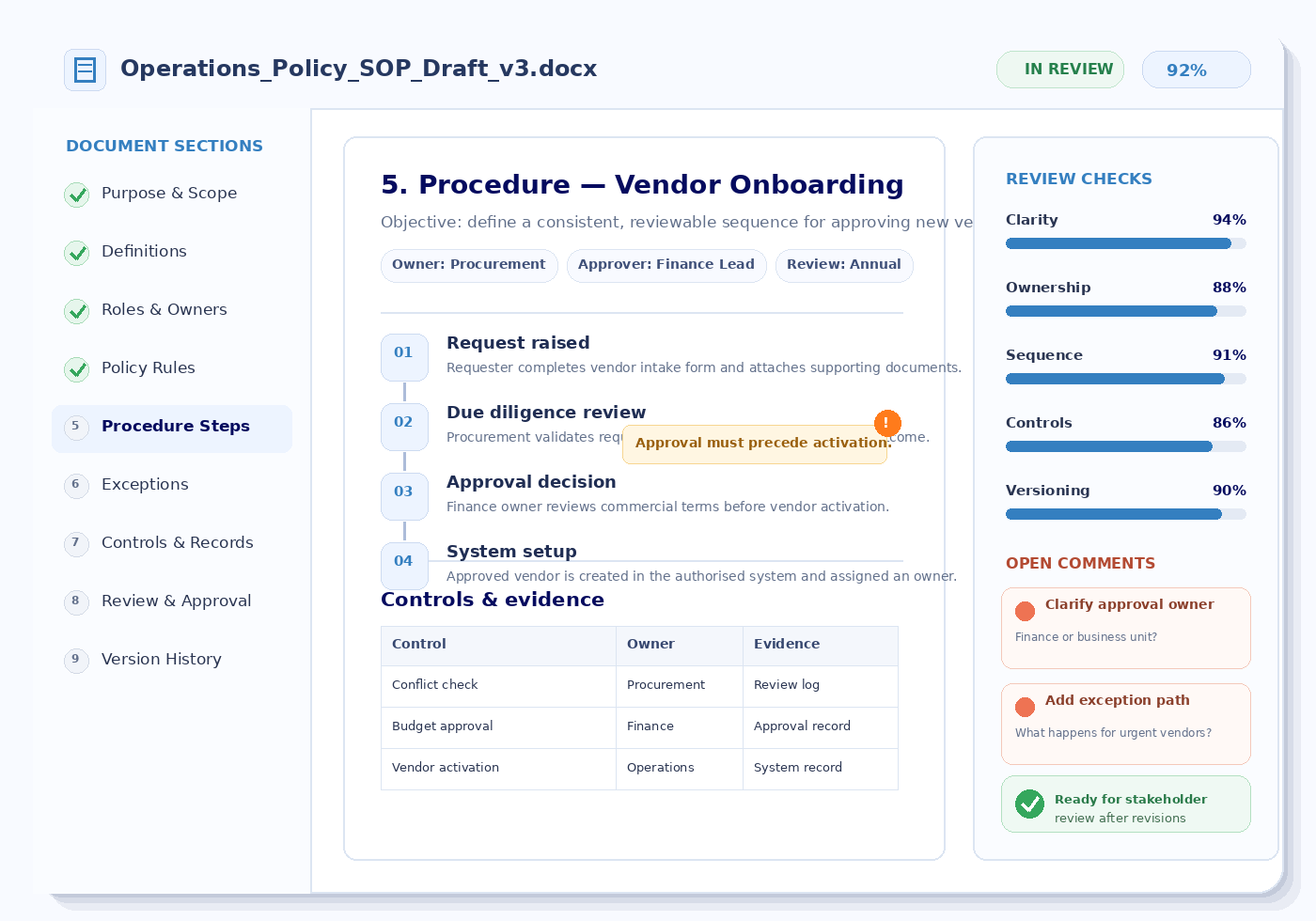
Content organised around the way work is actually performed.
Business process material stays within the designated project workflow.
Roles, approvers, responsibilities, and handoffs are made explicit.
Structured drafts and clean documents prepared for stakeholder review.
Business Policies Writing Service starts with a bounded, usable deliverable for one policy up to 2,500 words, giving a realistic budget reference for this situation: Businesses that know the policy objective, owners and internal rules and need them converted into a clear, structured corporate policy document.
Suitable for: Businesses that know the policy objective, owners and internal rules and need them converted into a clear, structured corporate policy document.
Operational documents often fail because essential process knowledge is scattered across people, emails, old templates, checklists, and undocumented habits. We help surface these gaps before turning the material into a usable document.
The document does not define what it governs, who it applies to, or where the process begins and ends.
Responsibilities, approvers, handoffs, and escalation points are not assigned clearly enough.
Steps are listed without a logical order, triggers, inputs, outputs, or clear completion criteria.
The normal path is documented, but alternative cases, approvals, exceptions, or escalation routes are absent.
The procedure does not show required checks, evidence, forms, records, or decision authority.
Document owner, approval status, revision history, and review triggers are inconsistent or missing.
The service can support the complete documentation journey—from understanding the process and defining document logic to drafting, review, consistency checks, and final handover. The exact stages used depend on the information you already have.
The goal is not simply to make sentences sound better. The document needs clear operational logic: who does what, in which order, under which rule, using which record, and what happens when the standard path changes.
“When a new vendor is needed, someone sends details to procurement. Procurement checks it and finance may need to approve. Then the vendor gets added to the system. Urgent cases can be handled differently.”
5.1 Request initiation. The requester completes the vendor intake form and submits required documents to Procurement.
5.2 Due diligence. Procurement reviews the submission, records the outcome, and confirms whether Finance approval is required before activation.
5.3 Activation. An approved vendor is created in the authorised system and assigned an operational owner.
Vendor onboarding is presented as a controlled sequence with defined ownership, approval, records, and exceptions.
A usable policy or SOP needs more than a clean layout. The service focuses on document logic, process clarity, ownership, controls, exceptions, and the operational detail that turns source information into a document people can follow.
| Support Dimension | Generic Template / Formatting | Language Proofreading | Full Business Policies Writing Support |
|---|---|---|---|
| Purpose, scope & audience definition | × | × | ✓ |
| Process discovery & source consolidation | × | × | ✓ |
| Roles, ownership & approval logic | Limited | × | ✓ |
| Step-by-step procedure development | × | × | ✓ |
| Controls, records & evidence points | × | × | ✓ |
| Exceptions & escalation paths | × | × | ✓ |
| Language clarity & consistency | Limited | ✓ | ✓ |
| Structured headings, tables & checklists | Template only | Limited | ✓ |
| Review comments for unresolved process gaps | × | × | ✓ |
| Review-ready final document | Format focus | Language focus | ✓ |
| Best for | Applying a pre-existing layout | Polishing already complete content | Developing practical policy and procedure documentation |
The exact document type should match your operational need. Some assignments require a high-level policy, others a step-by-step SOP, and some work best as a connected document set with supporting instructions, forms, or checklists.
Principles, rules, scope, ownership, and governance expectations.
Repeatable process steps, approvals, records, controls, and exceptions.
Task-level guidance for a specific activity, tool, or operating step.
Related processes grouped into a structured operational reference.
Checks, approvals, evidence, records, responsibilities, and review points.
People-process documentation based on your approved rules and workflows.
Team responsibilities, recurring workflows, controls, and operating guidance.
Supporting tools where they are needed to make the procedure usable.
A structured workflow keeps the project focused on the actual process, reduces hidden assumptions, and gives your team clear checkpoints for confirming rules, responsibilities, exceptions, and final wording.
Better source information leads to a stronger operational document. You do not need a polished draft to begin, but the underlying rules, process knowledge, and approval expectations should come from your organisation or authorised reviewers.
The review focuses on whether the document is understandable, internally consistent, and operationally complete enough for your authorised stakeholders to evaluate and approve. It does not replace specialist legal or regulatory validation.
Purpose, scope, hierarchy, sections, and information order.
Plain, precise wording; consistent definitions; readable instructions.
Triggers, sequence, handoffs, decisions, exceptions, and completion points.
Roles, approvals, records, evidence, review points, and accountability.
Terminology, numbering, references, forms, labels, and document controls.
Final file review for completeness, usability, and unresolved comments.
Policy and SOP requirements vary across teams. The document structure should reflect the function, process owner, users, risk points, records, and internal review expectations relevant to that workflow.
Share only necessary source material. Keep the assignment focused on the information required to document the process.
Use the designated project workflow. Avoid distributing unpublished internal files through unrelated channels.
Limit access to assigned participants. Identify who may review sensitive process, finance, HR, customer, or operational material.
Raise NDA or handling requirements early. Any specific confidentiality expectations should be discussed during scoping before files are exchanged.
Remove credentials and unnecessary personal data. Do not include passwords, secret keys, or irrelevant sensitive records in source documents.
The published Business Policies Writing Service starting price above is ₹6,000 for one policy up to 2,500 words; larger or specialist requirements are confirmed after scope review. Scope, quote, and delivery planning are confirmed after the document set and required level of support are reviewed.
Delivery scheduling depends on the actual documentation workload and the quality of the source information available.
The confirmed delivery date should be agreed before work starts. A shorter deadline may require a narrower scope or different sequencing.
A custom quote can be prepared after the material is reviewed. Factors may include:
The service can cover policy purpose and scope, definitions, roles and responsibilities, rules or control points, step-by-step procedures, decision points, exceptions, required records, review notes, and document structure. The exact scope is confirmed from your brief and source materials before work begins.
A policy explains the principles, rules, boundaries, or expectations that guide decisions. An SOP explains how a recurring activity should be carried out in a clear sequence, including ownership, inputs, approvals, controls, records, and exceptions where relevant.
Yes. Rough notes, process descriptions, screenshots, forms, emails, checklists, existing documents, and stakeholder comments can be organised into a structured draft. Where information is missing or ambiguous, questions are flagged for your team rather than silently assumed.
Yes. Existing documents can be reviewed for structure, clarity, duplicated or missing steps, unclear ownership, inconsistent terminology, weak controls, outdated references, and usability. The level of rewriting depends on the condition of the current document and the agreed scope.
The service can be structured around functions such as operations, HR and people processes, finance and administration, sales and customer service, procurement, IT procedures, information handling, governance, and other business workflows when suitable source information is available.
The writing service can organise and clearly document requirements, controls, clauses, or standards that you provide. It is not a substitute for legal, regulatory, tax, safety, or specialist compliance advice. Your authorised legal, compliance, or subject-matter reviewers should approve requirements that depend on professional interpretation.
Yes, when they are useful and included in the confirmed scope. SOPs can use step tables, responsibility matrices, approval checkpoints, exception notes, records lists, checklists, and simple decision structures to make the procedure easier to follow.
Useful inputs include the document objective, intended users, current process or rules, process owners, approvers, systems or forms used, exceptions, existing documents, templates or branding requirements, and any internal or external requirements your document must reflect.
Pricing is provided as a custom quote because the workload can vary by the number and length of documents, the condition of existing material, process-discovery depth, stakeholder complexity, review requirements, diagrams or supporting tools, formatting needs, and requested delivery schedule.
Turnaround is confirmed after the scope is reviewed. It depends on the number and length of documents, how complete the source information is, the complexity of the workflow, the number of review inputs, and whether the request is a new draft, rewrite, or multi-document programme.
Confidential process information should be shared only through the designated project and submission process. Access should be limited to the people working on the assignment, and confidentiality or NDA requirements can be raised during scoping so the appropriate handling expectations are clear before files are exchanged.
Yes. A related document set can be scoped as a structured programme so naming, hierarchy, ownership, terminology, document controls, and cross-references remain consistent. The final plan depends on how many documents are involved and how much source material is already available.
Tell us what you need documented, what source material already exists, who will review the content, and any timing or document-control requirements. The information is used to assess scope and prepare a suitable quote.
Provide enough detail for the document set, complexity, and review requirements to be assessed. Source files can be shared through the designated process after the enquiry moves forward.
Share your current process information and documentation goal. We can help turn it into a structured, review-ready policy or standard operating procedure.