Manuals & Handbooks Editing Service for Clear, Consistent, Usable Documents
★★★★★4.8 rating from Researchers, Authors, Students, and Scholars
Turn complex manuals, handbooks, SOPs, policy documents, training guides, and technical instructions into clearer, easier-to-navigate documents while preserving the rules, procedures, and subject-matter decisions supplied by your team.
Document-wide editing for clarity, consistency, terminology, hierarchy, and navigation
Cross-reference, numbering, list, table, callout, and formatting consistency checks
Editor comments where wording, ownership, sequence, or meaning needs author confirmation
Tracked revisions and clean-copy delivery where the source format and agreed scope support them
Process discovery, policy creation, technical validation, legal review, or writing missing procedures is quoted separately from editorial improvement.
Why Manuals & Handbooks Become Hard to Use
Common document problems we can identify and refine during editorial review.
Unclear Audience or Scope
Readers cannot tell who a rule applies to, where it starts, or which exceptions matter.
Inconsistent Terminology
The same role, form, system, or process is named differently across sections.
Fragmented Procedures
Steps, owners, conditions, and escalation points appear in an unclear or incomplete order.
Conflicting Statements
Related sections use wording that can create ambiguity about responsibilities or process.
Weak Navigation
Heading hierarchy, contents, labels, or cross-references make information difficult to find.
Formatting & Numbering Drift
Lists, tables, callouts, section numbers, capitalization, and styles vary across the document.
1
What This Service Covers
Manual and handbook editing is not only sentence correction. The review can connect language, document structure, procedures, navigation, cross-references, and presentation so readers can follow the document more reliably.
1
Purpose & Audience
2
Contents & Hierarchy
3
Section Structure
4
Policies & Procedures
5
Step-by-Step Instructions
6
Terminology & Definitions
7
Language & Tone
8
Consistency Rules
9
Cross-References
10
Tables & Forms
11
Warnings & Notes
12
Roles & Responsibilities
13
Navigation & Findability
14
Formatting & Numbering
15
Appendices & Supporting Tools
Ready to move forward with Manuals & Handbooks Editing Service?Purchase the service and continue with your project brief, files, and delivery requirements.
This representative example shows the level of intervention a handbook section may receive: unclear ownership and sequence are identified, wording is refined, and author decisions are separated from editorial decisions.
Before — Rough SectionIssues
“New employees should complete the forms and the manager will give them access after they finish. Some systems might need extra approval. Contact IT if it does not work.”
×No clear owner for each action
×Sequence is vague
דForms” and “systems” are undefined
×Escalation route is unclear
During — Annotated EditReview
Step 1: The new employee submits the required onboarding forms to HR.
Step 2: HR confirms the approvals required for each system and routes the request to the appropriate owner.
Step 3: IT provisions access through the approved access-request workflow. See Section 6.2 for exceptions and escalation.
CommentConfirm which role owns approval for each system.
SuggestionName the exact form or cross-reference the forms list.
RefinementStandardise “access-request workflow” throughout the handbook.
After — Clean SectionRefined
System access for new employees
1. The employee submits the required onboarding forms to HR. 2. HR confirms the required approvals and routes the access request to the responsible system owner. 3. IT provisions access through the approved access-request workflow. For exceptions, see Section 6.2.
✓Clear roles and action sequence
✓Defined and consistent terminology
✓Usable cross-reference
✓Reader-focused procedural wording
3
What Makes This Different From Basic Proofreading or General Language Editing
The service is designed around how a manual or handbook works as a complete reference document—not only whether individual sentences are grammatically correct.
Documents that must work as a coherent, navigable reference
4
Manual & Handbook Types Supported
The editorial approach changes with the document's audience and purpose. These are common document types that fit the service when their content is already authored and needs professional editorial refinement.
Employee Handbooks
Policies, workplace expectations, leave, conduct, benefits, and employee-facing guidance.
Policy & Procedure Manuals
Policy statements, responsibilities, exceptions, approval paths, and procedural detail.
SOP & Operations Manuals
Repeatable operating procedures, roles, sequences, handoffs, controls, and checklists.
Technical & User Manuals
Product, system, equipment, software, or technical instructions that need precise wording.
Training & Onboarding Guides
Learning materials, onboarding handbooks, facilitator guides, and role-based instructions.
Quality & Safety Manuals
Quality-system, safety, risk, incident, and control documentation supplied for editorial review.
Process & Workflow Guides
Process maps, work instructions, task sequences, decision points, and escalation guidance.
Institutional Handbooks
Departmental, academic, administrative, membership, or organisational handbooks.
Ready to move forward with Manuals & Handbooks Editing Service?Purchase the service and continue with your project brief, files, and delivery requirements.
A staged workflow helps keep document-wide decisions consistent, especially when the manual contains repeated terms, cross-references, parallel procedures, tables, forms, and multiple sections.
1
Share Files & Brief
Provide the manual or handbook, intended audience, deadline, and any style or policy requirements.
2
Scope Review
We assess document condition, length, structure, formats, and the depth of editorial work required.
3
Purpose & Audience Check
Sections are reviewed for who needs the information, what they must understand, and what action follows.
4
Structure & Navigation
Heading hierarchy, sequence, contents, cross-references, and document flow are reviewed.
5
Section Editing
Language, instructions, definitions, responsibilities, and section-level clarity are refined.
6
Terminology & Consistency
Recurring terms, labels, capitalization, numbering, abbreviations, and style choices are aligned.
7
Format & Cross-Reference Check
Lists, tables, callouts, figure labels, references, and internal pointers are checked for consistency.
8
Final Delivery
You receive the agreed edited files, clean copy, and review notes or action points where applicable.
6
What You Need to Share & What You Receive
Clear source files and editorial requirements make scope decisions more accurate and help the editor distinguish document corrections from policy, legal, or technical decisions that belong with your subject-matter owners.
What You Need to Share With Us
Latest manual, handbook, SOP, policy, guide, or related document set
Intended audience, document purpose, and priority sections
Internal style guide, template, terminology list, or controlled vocabulary if available
Existing comments, tracked changes, SME notes, or unresolved questions
Required numbering, formatting, cross-reference, or document-control conventions
Deadline, delivery format, and any review-cycle requirements
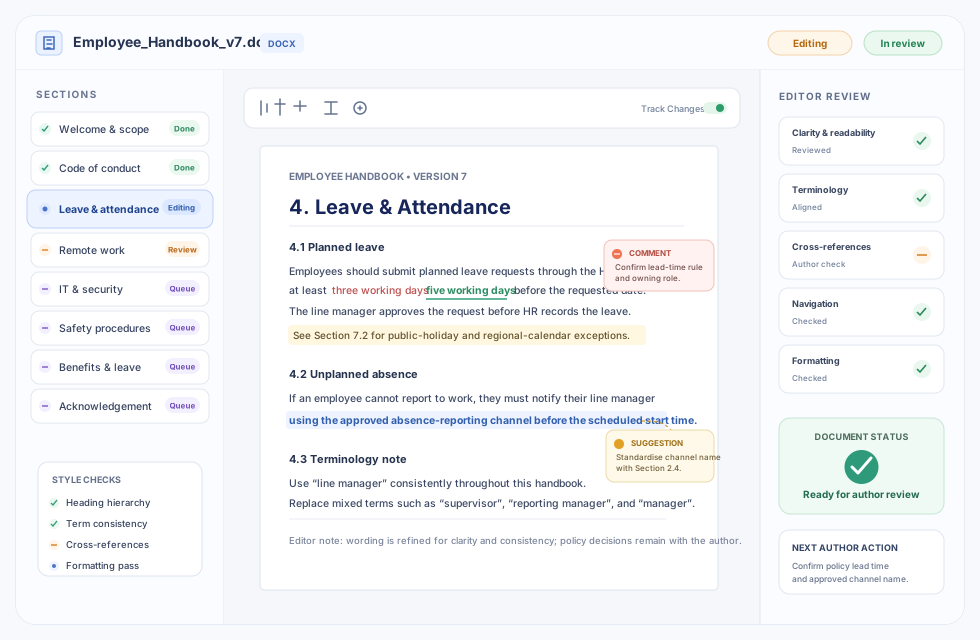
DOCXEmployee_Handbook_v7.docx
PDFDocumentation_Style_Guide.pdf
XLSXApproved_Terminology_List.xlsx
What You Receive
Edited document with visible revisions where the source format supports tracked changes
Clean edited copy when included in the agreed deliverables
Editor comments for unclear meaning, ownership, sequence, or author decisions
Consistency refinements for terminology, headings, numbering, lists, and repeated elements
Structural, navigation, cross-reference, or formatting suggestions where relevant to scope
Review notes or action points for items that require author or subject-matter confirmation
Ready to move forward with Manuals & Handbooks Editing Service?Purchase the service and continue with your project brief, files, and delivery requirements.
A multi-stage editorial pass helps keep revisions consistent across a long document instead of treating every paragraph as an isolated edit.
1
Structure Review
Check hierarchy, section order, navigation, and information flow.
2
Clarity Pass
Improve directness, readability, sentence logic, and instruction clarity.
3
Terminology Pass
Standardise recurring terms, abbreviations, labels, and defined language.
4
Procedure Consistency
Check steps, roles, sequencing, conditions, and cross-section alignment.
5
Formatting & References
Validate headings, numbering, tables, callouts, cross-references, and presentation.
6
Final Verification
Complete a final consistency pass before the edited files are prepared for handoff.
Common Teams & Content Areas We Support
HR & People Operations
Operations & Administration
Quality & Safety
Technical & Product Teams
Training & Learning
Customer Support
Finance & Internal Controls
Institutions & Departments
Confidentiality & File Handling
Secure file transfer and protected project handling
Limited access for the team assigned to the project
Unpublished, internal, and operational material treated as confidential
NDA available on request where required
Project files are not shared with third parties as part of the editing workflow
Your internal documentation remains confidential throughout the editing workflow.
Ready to move forward with Manuals & Handbooks Editing Service?Purchase the service and continue with your project brief, files, and delivery requirements.
1. What does the Manuals & Handbooks Editing Service include?+
The service can cover language, clarity, section structure, heading hierarchy, terminology, procedural wording, lists and tables, cross-references, numbering, navigation, consistency, and formatting. The exact scope is confirmed from your document and brief before work begins.
2. What kinds of manuals and handbooks can you edit?+
Suitable documents can include employee handbooks, policy and procedure manuals, SOP and operations manuals, training guides, technical and user manuals, quality or safety manuals, process guides, and institutional or departmental handbooks.
3. Is this different from proofreading?+
Yes. Proofreading is mainly a final language and typo check. Manuals and handbooks editing can go further by reviewing document-wide consistency, hierarchy, terminology, procedural clarity, navigation, cross-references, and the way related sections work together.
4. Will you rewrite our policies or procedures?+
We can improve wording, clarity, organisation, consistency, and presentation while preserving the intended policy or procedure. Decisions about policy substance, legal effect, technical requirements, or organisational rules remain with the author or responsible subject-matter owner.
5. Can you work with our existing style guide or template?+
Yes. Supply your style guide, brand terminology, formatting template, numbering rules, controlled vocabulary, or internal documentation standards and they can be used as the editorial reference for the agreed scope.
6. Do you check cross-references, numbering, and headings?+
These can be included in scope. We can check heading hierarchy, section numbering, list numbering, labels, internal cross-references, table or figure callouts, and consistency between the contents structure and the body of the document.
7. Can you edit tracked changes and comments in an existing Word file?+
Yes, an existing edited draft can be reviewed. Where the source format supports it, revisions can be returned with tracked changes and editor comments, together with a clean copy when included in the agreed deliverables.
8. How is turnaround determined?+
Turnaround depends on document length, condition, editing depth, formatting and cross-reference complexity, the number of files or versions, and the requested deadline. Standard, priority, and urgent requests are assessed for feasibility before a delivery date is confirmed.
9. How is pricing calculated?+
The published Manuals & Handbooks Editing Service plans above start at ₹4,500 for up to 10 pages; larger or specialist requirements are confirmed after scope review. Final pricing for larger scope is quoted after review rather than assumed from another editing plan. Factors can include word count or pages, document condition, editing depth, number of files, formatting complexity, cross-references, tables or appendices, supplied style requirements, and deadline.
10. Is our handbook or internal manual kept confidential?+
The supplied workflow treats unpublished and internal material as confidential. Secure file transfer and limited-access handling are used in the service presentation, and an NDA can be requested when needed.
11. Do you verify legal, regulatory, or safety compliance?+
The service is editorial, not legal, regulatory, engineering, medical, or safety certification. We can check consistency against requirements or standards you supply, flag unclear or conflicting wording, and identify places that need subject-matter confirmation.
12. What should we send for an accurate quote?+
Send the latest draft, approximate word count or page count, document type, intended audience, deadline, required file format, existing style guide or template, and any priority concerns such as terminology, navigation, procedural clarity, formatting, or cross-references.
Request a Manuals & Handbooks Editing Quote
Tell us what you are editing, who the document is for, how complete the draft is, and what needs attention. The quote can then reflect the real document scope rather than an unrelated fixed editing plan.
Document & audienceShare the manual or handbook type, intended readers, approximate length, and current format.
Editing prioritiesHighlight clarity, terminology, procedures, navigation, cross-references, formatting, or another concern.
Deadline & review cycleProvide your required delivery date and whether the file will go through an internal approval round.
Guidelines & templatesInclude style, terminology, numbering, branding, or document-control requirements that the editor should follow.
Manuals & Handbooks Editing Enquiry
Share Your Editing Requirements
Provide enough detail to assess editing depth, file complexity, deadline feasibility, and the most useful deliverables for your document.
Ready to Strengthen Your Manual or Handbook?
Share the latest draft and your editorial priorities. We can review the scope for clearer language, stronger document structure, consistent terminology, usable navigation, and professional presentation.