Source-Backed Research
Research organised around traceable, relevant evidence.

Our Industry Report Research Service helps turn broad business questions into a clear research scope, traceable source base, structured market analysis, competitive intelligence, and a professionally organised report.
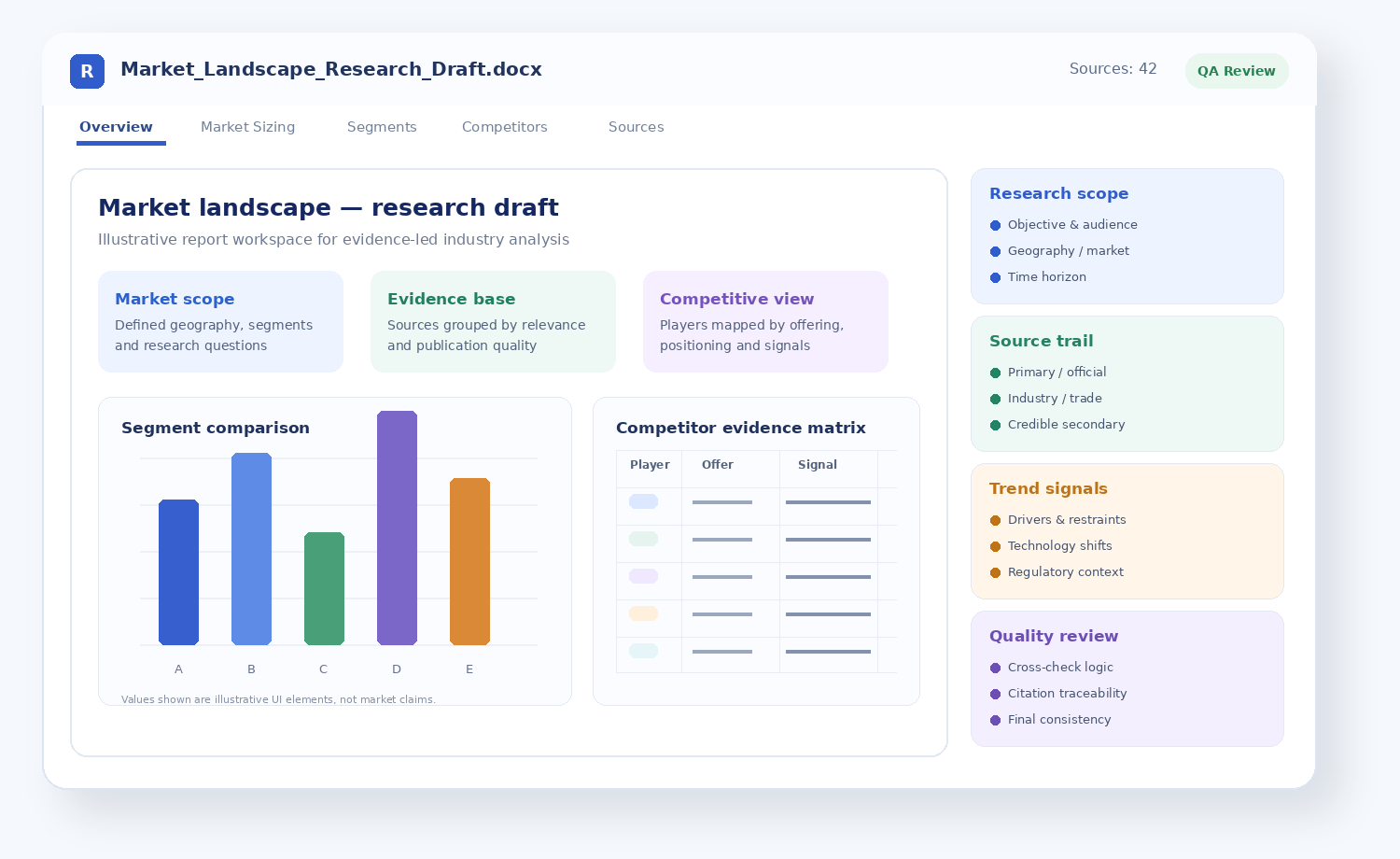
Research organised around traceable, relevant evidence.
Definitions, segments, sizing context, and analytical logic made visible.
Players compared through consistent research dimensions.
Material claims checked for logic, source support, and consistency.
A single fixed package would understate the variation in Industry Report Research Service. The minimum below gives a credible budget entry point for this kind of engagement: Focused secondary-research assignments for a clearly defined market, competitor, industry or opportunity question.
Suitable for: Focused secondary-research assignments for a clearly defined market, competitor, industry or opportunity question.
A professional report needs more than collected links and copied statistics. The research scope, evidence trail, definitions, analytical structure, and source quality all affect whether the final output is useful.
A report can become unfocused when geography, segment boundaries, audience, or decision questions are not defined at the start.
Useful evidence may be spread across company filings, official datasets, industry bodies, research papers, news, and credible trade sources.
Numbers without transparent definitions, assumptions, time periods, or cross-checks are difficult to interpret or defend.
A list of competitors is not enough when the report needs positioning, offering comparisons, strategic signals, and evidence.
Decision-makers need to understand where important statements and data points came from and how current they are.
The workflow moves from a clear research brief to structured evidence collection, analysis, report development, and final quality review.
Clarify the report objective, audience, markets, time horizon, questions, and required depth.
Identify relevant official, company, industry, academic, and credible secondary sources.
Organise available market data, definitions, segments, and sizing assumptions for review.
Break the market into meaningful product, customer, geography, channel, or use-case segments.
Compare important players, offerings, positioning, capabilities, and publicly available strategic signals.
Research demand drivers, constraints, technology shifts, regulatory context, and emerging themes.
Cross-check important claims, reconcile conflicting information, and maintain source traceability.
Turn research into a structured narrative with tables, charts, citations, and decision-useful interpretation.
Check logic, consistency, source references, formatting, and agreed delivery requirements.
The same information can become far more useful when definitions, evidence, comparisons, and implications are organised into a coherent analytical structure.
A mixed folder of links, reports, notes, figures, and competitor observations. Sources may overlap, use different market definitions, or cover different time periods.
Sources are grouped by research question, market boundaries are clarified, competitor evidence is mapped, and key numbers are cross-checked with visible assumptions.
The evidence is synthesised into a clear report with structured sections, comparison tables, source references, material assumptions, and decision-relevant interpretation.
Different projects need different depth. This comparison explains how a structured market-and-industry report differs from simple information gathering and deeper strategy-oriented support.
| Service Level | Basic Desk Research | Industry Report Research (Our Core Service) | Strategic Research Support |
|---|---|---|---|
| Focus | Collect relevant information and sources. | Build a structured, source-backed market or industry report. | Extend research into deeper decision framing, scenarios, or strategic questions. |
| Includes | Source discovery and basic summary. | Scope, source mapping, market structure, segments, competitors, trends, validation, synthesis, citations, and report development. | Everything in the research report scope plus additional analytical frameworks agreed for the project. |
| Source Traceability | ✓ Included | ✓ Core requirement | ✓ Core requirement |
| Market / Competitor Analysis | Limited | ✓ Structured | ✓ Deeper, question-led |
| Decision Framing | ✕ Not the main focus | Evidence-based implications tied to the agreed report questions. | Expanded strategic interpretation where specifically scoped. |
| Best For | Early exploration or source gathering. | Teams that need a professional market or industry report with traceable evidence. | Complex business decisions that require added analytical depth beyond the report itself. |
The exact report structure depends on the brief. These are common analytical sections that can be combined, removed, or adapted to match the business question and available evidence.
Concise findings, major signals, and key implications.
Definition, boundaries, ecosystem, and market context.
Available sizing evidence, assumptions, historical context, and forecast references where sourced.
Product, service, customer, geography, channel, or application splits.
Needs, adoption patterns, buying context, and demand-side signals.
Players, offerings, positioning, capabilities, and public strategic activity.
Technology, demand, supply, macro, and industry developments.
Constraints, policy context, barriers, and material uncertainties.
Evidence-based takeaways shaped around the agreed business question.
A staged workflow keeps the project aligned from research brief through evidence collection, analysis, quality review, and final delivery.
Share your objective, industry, geography, audience, and required outputs.
We translate the brief into research questions, inclusions, exclusions, and source priorities.
Build a source map and analysis framework before deep research begins.
Gather and organise relevant evidence with traceable source notes.
Compare, cross-check, structure, and interpret the evidence around the report questions.
Check logic, claims, source traceability, consistency, and report structure.
Provide the completed research output in the agreed format and scope.
The output is structured around the agreed scope, with emphasis on a usable report, transparent source trail, and research notes that help readers understand how conclusions were reached.
A logically organised market or industry report built around the agreed research questions and audience.
A clear evidence trail for important data points, statements, and referenced material.
Comparison tables, market frameworks, charts, or matrices where they help communicate sourced findings.
A structured view of relevant companies, offerings, positioning, and observable market signals.
Important definitions, assumptions, limitations, and areas where evidence is incomplete or conflicting.
A consistency review across narrative, figures, labels, citations, and agreed report structure.
Research quality depends on more than presentation. The review process focuses on relevance, cross-checking, analytical logic, source traceability, and final consistency.
Check whether sources directly support the research question and time period.
Compare material claims across multiple credible sources where feasible.
Review definitions, assumptions, calculations, and internal consistency.
Check source attribution, link/reference traceability, and figure/table notes.
Review terminology, formatting, headings, labels, and the final evidence-to-conclusion flow.
The research approach can be adapted to different sectors, source ecosystems, market definitions, regulatory environments, and competitor structures.
Software, cloud, AI, enterprise technology, digital platforms.
Healthcare services, medtech, diagnostics, biotechnology, life sciences.
Consumer products, retail, e-commerce, food, lifestyle, and services.
Banking, fintech, insurance, payments, capital markets, and related services.
Industrial products, equipment, materials, automation, and B2B markets.
Energy, renewables, climate solutions, utilities, and environmental markets.
Education, training, consulting, outsourcing, and knowledge services.
Transport, logistics, supply chain, automotive, and mobility services.
The published pricing above covers the stated entry scope; larger requirements are quoted after reviewing the actual workload. The quote and delivery plan are set after the research scope is understood.
Timeline depends on the breadth of the market, availability and quality of sources, number of geographies or competitors, analytical depth, report length, and any fixed deadline.
Timeline principle: the project schedule is confirmed only after the scope is reviewed; no unsupported delivery time is advertised here.
For requirements beyond the published scope, a custom quote is prepared from the actual work required rather than forcing every market-research project into the same package.
Published entry scope: the project minimum above covers the focused research engagement; broader research depth and report scope are quoted separately.
The service is designed around disciplined research structure: define the question, organise the evidence, make assumptions visible, compare consistently, and keep the final narrative traceable to its sources.
Common questions about scope, sources, market sizing, competitors, turnaround, pricing, confidentiality, and the information needed to begin.
The scope is defined around your brief and can include market mapping, source research, market sizing support, segmentation, competitor analysis, trends, drivers, risks, regulatory context, synthesis, citations, and report development.
Yes. A broad topic can be converted into a clearer research scope by defining the geography, audience, market boundaries, decision questions, and depth required before detailed research starts.
Source selection depends on the market and question. Research may draw on official data, regulator and government publications, company reports and filings, industry bodies, academic literature, credible trade sources, and other relevant public evidence.
Market-size information is used only when it can be supported by appropriate sources or a clearly stated analytical method. Definitions, time periods, assumptions, and limitations should remain visible rather than presenting unsupported numbers as fact.
Yes. The research can compare relevant competitors across agreed dimensions such as offering, positioning, target segments, capabilities, pricing information when publicly available, and observable strategic activity.
Yes. The report can include trend signals, growth drivers, restraints, technology developments, policy or regulatory context, and other external factors that materially affect the market.
The page and workflow are designed for controlled handling of client material. Share only the information required for the project, and raise any specific confidentiality or access requirements when submitting the brief.
A project timeline is set after reviewing scope, number of markets or geographies, research depth, data availability, number of competitors, expected report length, and any fixed deadline. This page does not publish a standard turnaround because requirements can vary materially.
Contentxprtz Industry Report Research Service projects start from ₹25,000 for a defined initial engagement. Pricing is quoted for the agreed scope rather than using a fixed package on this page. Factors can include research depth, geographies, number of competitors, source intensity, analysis requirements, report length, and delivery timeline.
Yes. Existing notes, datasets, reports, competitor lists, source links, or internal context can be incorporated into the research plan, while keeping supplied material distinguishable from newly researched evidence.
Yes. If you provide a preferred structure, brand template, section list, citation style, or client format, the research output can be organised around those requirements where they fit the agreed scope.
Use the enquiry form on this page and include the industry, geography, business question, target audience, required sections, preferred depth, available source material, and any fixed deadline.
Share the market, geography, research question, audience, required sections, available source material, and any fixed deadline. The scope can then be reviewed for research depth and quote preparation.
What business question, decision, or report purpose should the research support?
Specify the market definition, country or region, and any important segment boundaries.
Share known competitors or ask for a research-led shortlist based on the agreed market scope.
Include source lists, internal notes, reports, datasets, templates, or research already completed.
Provide any fixed deadline and describe the expected level of detail, length, or presentation format.
Provide enough detail for the research scope, evidence requirements, timeline, and quote to be assessed.
The strongest research brief explains the decision to support, the audience, the market boundary, and the evidence needed. The report structure can then be built around those requirements instead of forcing the project into a one-size-fits-all template.
Send the research objective and the information you already have. The scope can be converted into a clear research plan, deliverable structure, and custom quote.