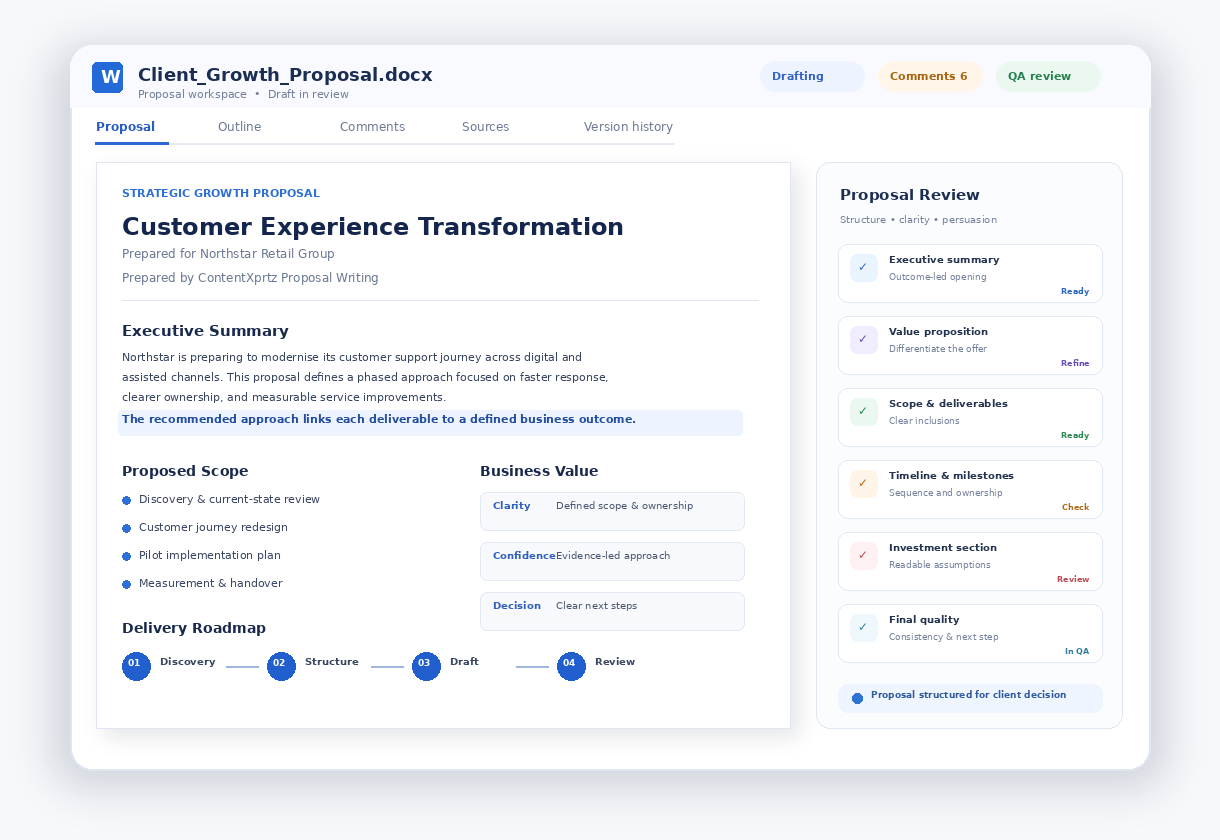
Business Proposal Writing Service for Clear, Persuasive Client Decisions
★★★★★4.8 rating from Researchers, Authors, Students, and Scholars
Turn your brief, notes, requirements, and business case into a professionally structured proposal that explains the opportunity, solution, scope, value, delivery approach, and next step in language your intended reader can follow.
Proposal structure built around the client objective, audience, and decision context
Clear executive summary, value proposition, scope, deliverables, and next-step messaging
Consistent professional tone, evidence placement, headings, tables, and proposal flow
Client review and final quality check before delivery in the agreed format
Built from your objectives, offer, source material, and requirements.
Confidential Handling
Business information is handled as project material, not promotional content.
Audience-Focused Structure
Sections are organised around what the decision-maker needs to understand.
Review-Ready Delivery
Clear versioning, comments where needed, and a final quality pass.
Pricing & delivery
Business Proposal Writing Service Pricing & Delivery
The starting scope for Business Proposal Writing Service is priced for a proposal up to 5 core pages. It is designed for this requirement: Businesses that have the offer, client requirement and supporting facts but need them turned into a persuasive, decision-ready proposal.
Starting Scope
From ₹7,500
for a proposal up to 5 core pages
Suitable for: Businesses that have the offer, client requirement and supporting facts but need them turned into a persuasive, decision-ready proposal.
Brief and source-material review
Proposal structure covering need, solution, scope and value
Client-focused narrative and calls to action
Integration of supplied proof points or case evidence
Final editable copy ready for design or submission
Why Business Proposals Lose Clarity Before the Decision Stage
A proposal can contain a strong offer and still be difficult to evaluate when the reader must work too hard to understand the problem, solution, value, scope, or commercial logic.
Unclear Executive Summary
The opening explains the company but not the buyer's need, recommendation, value, or decision.
Generic Value Proposition
Claims sound broad or interchangeable because they are not connected to the client's priorities.
Weak Evidence Placement
Capabilities, examples, metrics, or proof points appear without enough context to support the recommendation.
Scope and Deliverables Blur
The reader cannot quickly distinguish what is included, excluded, optional, or dependent on assumptions.
Commercial Logic Disconnect
Investment, milestones, or assumptions are presented without a clear link to scope, value, or decision criteria.
Inconsistent Proposal Presentation
Headings, terminology, tables, formatting, and section order make a professional offer feel fragmented.
2
What This Business Proposal Writing Service Covers
The writing process can start with a detailed brief or a rough collection of notes and supporting files. The scope is agreed first, then the proposal is developed around the intended audience and business decision.
Brief & Requirement Review
Objectives, audience, RFP questions, existing notes, and mandatory sections.
Research & Positioning
Background context, proof points, differentiators, and evidence planning where required.
Proposal Architecture
Logical section order, headings, message hierarchy, and decision flow.
Section Drafting
Executive summary, solution, scope, value, approach, deliverables, and next steps.
Formatting & Readability
Tables, bullets, callouts, captions, and visual hierarchy for easier evaluation.
Value Proposition Refinement
Benefits and differentiators connected to client needs rather than generic claims.
Evidence Integration
Case examples, data, credentials, or proof points placed where they support the message.
Timeline & Milestones
Sequence, ownership, dependencies, and delivery stages presented clearly.
Quality Review
Consistency, clarity, repetition, terminology, numbering, and obvious content gaps.
Revision & Final Delivery
Client feedback is incorporated within the agreed scope before final files are prepared.
Ready to move forward with Business Proposal Writing Service?Purchase the service and continue with your project brief, files, and delivery requirements.
See the Transformation: From Rough Notes to Decision-Ready Proposal
Business proposal writing is not just sentence correction. The work connects ideas, clarifies the recommendation, strengthens message hierarchy, and makes the proposed action easier to assess.
Before — rough internal notes
Fragmented Message
"We provide customer support consulting. We can improve service and train the team. The project may take around three months and we will look at processes."
The client gets features but no clear business case, phased approach, or outcome logic.
Issue: The reader still has to work out why the proposal matters, what will be delivered, and how the recommendation connects to the client's priorities.
Working draft — structured development
Positioned and Organised
Objective: improve customer-response consistency across digital and assisted channels.
Recommended approach: a phased engagement covering current-state review, journey redesign, pilot implementation, and handover.
Decision logic: each workstream is linked to a defined operational outcome and delivery milestone.
Writer note: Confirm the buyer's priority metrics and approved proof points before finalising the value section.
Final — clean client-facing copy
Clear Business Recommendation
We propose a phased customer-experience transformation that begins with a current-state review, converts findings into a prioritised journey redesign, tests the approach through a defined pilot, and concludes with an implementation handover. The structure gives decision-makers a clear view of scope, ownership, milestones, and the business value attached to each stage.
Final check: Message hierarchy, scope language, terminology, formatting, and next-step wording are reviewed for consistency.
4
How Business Proposal Writing Differs From a Final Proofread
Use a proofreading-only approach when the proposal is already complete and only needs a final correctness check. Use proposal writing support when the document still needs structure, message development, section drafting, or a clearer decision narrative.
Focus
Internal Drafting
Proofreading Only
Business Proposal Writing Service
Primary purpose
Capture ideas and internal content
Correct final-stage language issues
Develop a clear, persuasive client-facing proposal
Structure & hierarchy
Varies by author
Limited
✓ Proposal architecture and section flow
Executive summary
Usually self-written
Not substantially developed
✓ Built around need, recommendation, value, and next step
Value proposition
May remain generic
Not strategically reframed
✓ Connected to audience priorities and supplied evidence
Scope & deliverables
Can be incomplete or inconsistent
Presentation correction only
✓ Clarified and organised within supplied project information
Tables, callouts, readability
Basic
Correctness-focused
✓ Used to improve evaluation and scanability
Best for
Early internal working document
Near-final proposal needing a final language check
Client-facing proposals that still need writing, structure, and refinement
5
Business Proposal Sections We Can Develop
The final section set depends on the brief, proposal type, buyer instructions, and available information. These are common proposal components rather than mandatory sections for every project.
01
Executive Summary
Need, recommendation, value, and decision context.
02
Client Challenge
Problem, opportunity, context, and priority.
03
Proposed Solution
Approach, rationale, and solution narrative.
04
Scope & Deliverables
Inclusions, outputs, responsibilities, and boundaries.
05
Methodology
Workstreams, activities, and delivery approach.
06
Business Value
Benefits, differentiators, evidence, and proof points.
07
Timeline
Milestones, sequencing, dependencies, and ownership.
08
Investment
Commercial information supplied by the client, presented clearly.
09
Credentials
Relevant experience, cases, qualifications, or references supplied.
10
Assumptions
Dependencies, exclusions, terms, or operating assumptions.
11
Next Steps
Decision path, requested action, and contact point.
12
Appendices
Supporting detail, evidence, specifications, or reference material.
Ready to move forward with Business Proposal Writing Service?Purchase the service and continue with your project brief, files, and delivery requirements.
The workflow is designed to make scope, inputs, review points, and final delivery clear before writing begins.
Submit Brief
Share objectives, requirements, files, and deadline.
Received
Scope Review
We assess complexity, missing inputs, and required sections.
Reviewed
Writer Assignment
Project is matched to the agreed business-writing requirement.
Assigned
Outline & Positioning
Message hierarchy and proposal structure are developed.
In Progress
Draft Development
Sections are written using approved source material.
Drafting
Internal Review
Clarity, structure, consistency, and obvious gaps are checked.
QA
Client Review
Feedback and factual corrections are incorporated within scope.
Review
Final Delivery
Agreed files are prepared after final consistency checks.
Delivered
7
What You Receive
Deliverables are confirmed in the project scope. The final package is prepared to make client review, internal approval, and onward submission easier.
W
Structured Proposal Draft
A coherent proposal developed around the agreed brief and section plan.
Clean Final Proposal
A polished version prepared after the agreed review stage.
Writer Comments or Questions
Clarification points where a factual, commercial, or positioning decision needs client input.
Revision Summary
A concise record of significant structural or content-development changes when useful.
Tables & Structured Elements
Readable scope, timeline, comparison, or investment tables where appropriate to the proposal.
Final Handover Files
Files in the format agreed for the project, ready for your final internal or client-side use.
8
Quality Assurance Pipeline
A proposal is checked as a business document, not only as a piece of prose. Review focuses on whether the content is clear, consistent, usable, and aligned to the agreed brief.
Brief Check
Required sections, constraints, audience, and source material are checked against the scope.
Message Consistency
Terminology, offer language, claims, scope labels, and section logic are reviewed.
Formatting Review
Headings, numbering, bullets, tables, captions, spacing, and visual hierarchy are checked.
Final Verification
Cross-references, obvious contradictions, repeated copy, missing labels, and handover details are reviewed.
Delivery Preparation
Final files and agreed supporting notes are prepared for the client's review or submission process.
9
Business Contexts We Support
Proposal requirements vary by buyer, industry, and transaction. The writing process is adapted to the supplied business context rather than using a single generic template.
Professional Services
Consulting
Technology & SaaS
Healthcare
Finance & Business
Education & Training
Startups & Growth
Manufacturing & Services
10
Confidentiality & File Handling
Business proposals can contain commercially sensitive information. Share only the files and data needed for the agreed project.
Use secure transfer and storage methods available in the service workflow.
Limit project access to people involved in the agreed work.
Treat unpublished commercial, client, and proposal material as confidential project content.
Do not publish client proposals or business information as samples without permission.
Use source files only to perform the agreed writing, review, or formatting work.
Remove unnecessary sensitive information before submission where possible.
Your brief, proposal content, and supporting material remain the focus of the agreed project—not marketing collateral.
Ready to move forward with Business Proposal Writing Service?Purchase the service and continue with your project brief, files, and delivery requirements.
Turnaround is confirmed after the brief, length, complexity, source material, review stages, and requested deadline are assessed. Share the actual due date so the delivery plan can be checked before work begins.
Standard Project Scheduling
For normal planning windows where scope, source material, and review stages can be scheduled before drafting begins.
Delivery date confirmed after scope review.
Priority Deadline Review
If you have a firm client or tender deadline, share it at enquiry stage so the required work and review sequence can be assessed.
Feasibility is checked before acceptance.
Urgent Request Assessment
A shorter deadline may be possible for some projects depending on proposal length, content readiness, complexity, and writer availability.
Urgent timing is never assumed or guaranteed.
12
Scope Factors for Larger Requirements
Business proposal projects vary by scope, length, source material, research needs, formatting, review requirements, and deadline. Pricing is therefore confirmed after the project is assessed.
Custom Business Proposal Quote
Share your brief and source material so the project can be assessed before a quote is prepared. The scope should reflect the actual writing, research, restructuring, formatting, and review work required.
Your quote is based on the actual scope agreed for the proposal; no unrelated package price or generic per-word rate is applied automatically.
Ready to move forward with Business Proposal Writing Service?Purchase the service and continue with your project brief, files, and delivery requirements.
The service is designed for clients who need a proposal to do more than sound polished. It should present a coherent business recommendation, guide the reader through the offer, and make the requested decision easier to understand.
Proposal-first structure rather than a generic long-form business document template.
Writing tied to the supplied client objective, audience, decision context, and mandatory requirements.
Clear separation of problem, solution, scope, deliverables, value, assumptions, and next steps.
Professional language that avoids unnecessary jargon, vague claims, and repetitive sales copy.
Comments or clarification requests where commercial facts, evidence, or promises need client confirmation.
Formatting and information hierarchy designed to support scanning as well as detailed reading.
No invented pricing, delivery promises, client data, acceptance guarantees, or unsupported proof points.
Final quality review focused on consistency across the entire proposal rather than isolated sentence edits.
14
Business Proposal Writing Service FAQs
Practical answers about scope, inputs, proposal types, revisions, research, pricing, turnaround, confidentiality, and what professional proposal writing can and cannot promise.
What is included in a business proposal writing service?+
Scope depends on the project, but business proposal writing can cover proposal architecture, executive summary, client problem or opportunity, recommended solution, scope, deliverables, methodology, timeline, value proposition, investment presentation, assumptions, and next-step messaging.
Can you write a proposal from notes or a rough brief?+
Yes. A structured brief, meeting notes, existing documents, RFP requirements, product or service information, and supporting evidence can be used to develop a coherent proposal. Missing information is identified before drafting or flagged for client input.
Which types of business proposals can this service support?+
The service can be adapted to client-facing sales proposals, project proposals, partnership proposals, consulting proposals, service proposals, internal business proposals, and RFP- or tender-style responses where the supplied requirements are clear.
Can you respond to an RFP or tender document?+
RFP or tender support can be considered when you provide the buyer's instructions, response format, evaluation criteria if available, required schedules, source material, approved claims, and deadline. The agreed scope determines which sections are drafted or refined.
Will you create financial figures or prices for my proposal?+
Contentxprtz Business Proposal Writing Service starts from ₹7,500 for a proposal up to 5 core pages. No unsupported commercial figures should be invented. Pricing, forecasts, ROI claims, timelines, discounts, contractual terms, and other business commitments need to come from the client or an approved source. The service can help present supplied figures clearly.
Can you research evidence or background information?+
Research needs should be stated in the brief and included in the confirmed scope. When research is required, source expectations, evidence standards, and any citation or reference requirements should be agreed before drafting.
Do I need a completed outline before sending the project?+
No. An outline can be created from the brief when proposal structure is part of the scope. If the buyer has mandated headings or response questions, those should be supplied so the outline follows the required format.
How are revisions handled?+
Revision expectations should be confirmed with the project scope. Client feedback is most effective when it distinguishes factual corrections, stakeholder comments, new requirements, and changes that expand the original brief.
How long does business proposal writing take?+
Timing is confirmed after the brief, length, complexity, source material, review stages, and deadline are assessed. Share the required delivery date in the enquiry so feasibility can be confirmed before work begins.
How is business proposal writing priced?+
For requirements beyond the published scope, a custom quote is prepared after reviewing the proposal scope, length, source material, research or restructuring needs, formatting requirements, revision needs, and requested deadline. Pricing is confirmed after the proposal scope and required work are reviewed.
Will my business information remain confidential?+
Business proposals often contain unpublished commercial information. Share only what is necessary for the project and use the service's available secure workflow. Confidential material should not be used as a public sample without permission.
Do you guarantee that a proposal will win the business?+
No. Proposal writing can improve clarity, structure, relevance, and presentation, but the purchasing decision depends on factors outside the writer's control, including price, competition, buyer priorities, qualifications, procurement rules, and the strength of the underlying offer.
Proposal Enquiry
Share Your Proposal Brief for a Scope Review
Tell us what the proposal is for, who will read it, what source material you already have, and when you need it. The project can then be assessed for scope, missing inputs, delivery feasibility, and quote preparation.