Career Clarity. Authentic Stories. Stronger Applications.
Admission Essay & Personal Statement Writing Service for Clear, Authentic Applications
★★★★★4.8 rating from Researchers, Authors, Students, and Scholars
Turn your real experiences, goals, and program fit into a focused admissions narrative.
Our application-writing support helps you move from rough notes and prompts to a coherent essay or personal statement. We focus on story selection, structure, applicant voice, evidence, and program relevance—without inventing achievements, credentials, or experiences.
Plan the response around the exact prompt before drafting begins.
Keep applicant voice and factual accuracy central to every section.
Connect experience, goals, and program fit into one coherent narrative.
Review the final statement yourself before it is prepared for submission.
Pricing and delivery timing are confirmed after the application prompt, scope, word or character limits, and deadline are reviewed.
Story DiscoveryIdentify the experiences that best answer the prompt.
Program FitConnect your goals to the opportunity you are applying for.
Draft DevelopmentBuild a narrative with purpose, evidence, and progression.
Integrity CheckUse only real applicant experiences, goals, and achievements.
Confidential HandlingApplication details treated as private service information.
Applicant Voice FirstDrafting is grounded in your actual experiences and goals.
Prompt AlignmentEach response is built around the exact question and constraints.
Structured RefinementClarity, flow, emphasis, and narrative connection are reviewed.
Deadline PlanningDelivery timing is confirmed from the actual scope and deadline.
Human-Led SupportProfessional judgment applied to the selected service scope.
Scope-Aligned ServiceWork follows the service, requirements, and materials you provide.
Confidential HandlingCareer and application materials are treated as private service information.
Clear DeliverablesReceive the agreed review, edit, writing, or guidance in a usable format.
Delivery PlanningTurnaround is aligned to the selected plan, scope, and stated deadline.
Pricing & Delivery
Admission Essay & Personal Statement Writing Plans
Pricing is based on how many prompts must be developed from your verified experiences and how much cross-essay planning the application requires.
Quick pricing: Contentxprtz admission essay and personal statement writing starts from ₹3,000 for one statement up to 1,000 words, based on applicant-supplied facts and source material.
Essential
For one core application statement where you have the experiences and facts but need help shaping them into a coherent draft.
₹3,000
1 essay or personal statement, up to 1,000 words
Source-note and prompt review
Story and structure outline before drafting
One original draft based on your verified experiences and goals
Final applicant factual review built into the revision process
Additional schools, substantially different prompt sets, highly technical background research, more words, or accelerated deadlines require a custom quotation. The applicant remains responsible for verifying every fact and deciding what is ultimately submitted.
Ready to move forward?Start with Admission Essay & Personal Statement Writing Service when you are ready.
Understand the question, criteria, limits, and application context.
02
Applicant Profile
Review goals, experiences, achievements, and relevant background.
03
Story Mapping
Select the strongest evidence and define the narrative arc.
04
Outline
Plan the opening, progression, evidence, fit, and conclusion.
05
Drafting
Develop a complete response from the approved story direction.
06
Refinement
Improve clarity, flow, specificity, tone, and prompt coverage.
07
Applicant Review
Check factual accuracy, voice, emphasis, and personal fit.
08
Final Handoff
Prepare the agreed final version for your own submission review.
What We Help You Express
A clear answer to the exact admissions prompt
Your motivation through specific, relevant experiences
The connection between past choices and future goals
Program fit without generic praise or copied language
Evidence of growth, contribution, resilience, or curiosity
A focused narrative that works within the stated limit
Who We Support
Undergraduate Applicants
Postgraduate Applicants
MBA & Professional Programs
Scholarship Applicants
Working Professionals
Common Application Documents
Personal Statements
Admission Essays
Statements of Purpose
Motivation Letters
Scholarship Essays
Short-Answer Prompts
1
Our Admission Writing Services
Different applications ask for different forms of self-presentation. The service scope is shaped around the actual prompt, document type, applicant background, and information you provide.
Personal Statement Writing
Develop a clear personal narrative linking experiences, motivation, goals, and fit.
Admission Essay Writing
Build direct, engaging responses to institution-specific application prompts.
Statement of Purpose
Connect academic preparation, professional direction, program fit, and future goals.
Motivation Letter
Explain why the opportunity matters, what you bring, and what you intend to pursue.
Scholarship Essay
Frame merit, need, contribution, resilience, or community impact around the criteria.
Diversity & Background Essay
Present identity, context, perspective, or lived experience with specificity and relevance.
Transfer Essay
Explain the reason for change, learning to date, and what the next institution should enable.
Common App Essay
Shape one focused story that reveals perspective, growth, values, and self-awareness.
Short-Answer Responses
Answer compact prompts with directness, evidence, and minimal repetition across the application.
Application Narrative Review
Check consistency across essays so the overall application tells one credible, coherent story.
Ready to move forward?Start with Admission Essay & Personal Statement Writing Service when you are ready.
Strong admissions writing is not about sounding impressive everywhere. It is about selecting the right evidence, answering the prompt, and making the applicant’s reasoning easy to follow.
Our Writing Quality Checklist
Prompt CoverageThe response actually answers what was asked.
Authentic VoiceLanguage remains credible for the applicant.
Story LogicEvents and insights progress in a clear sequence.
EvidenceClaims are supported by concrete applicant details.
Clarity & EconomyEvery sentence earns its place within the limit.
IntegrityNo fabricated experience, credential, or achievement.
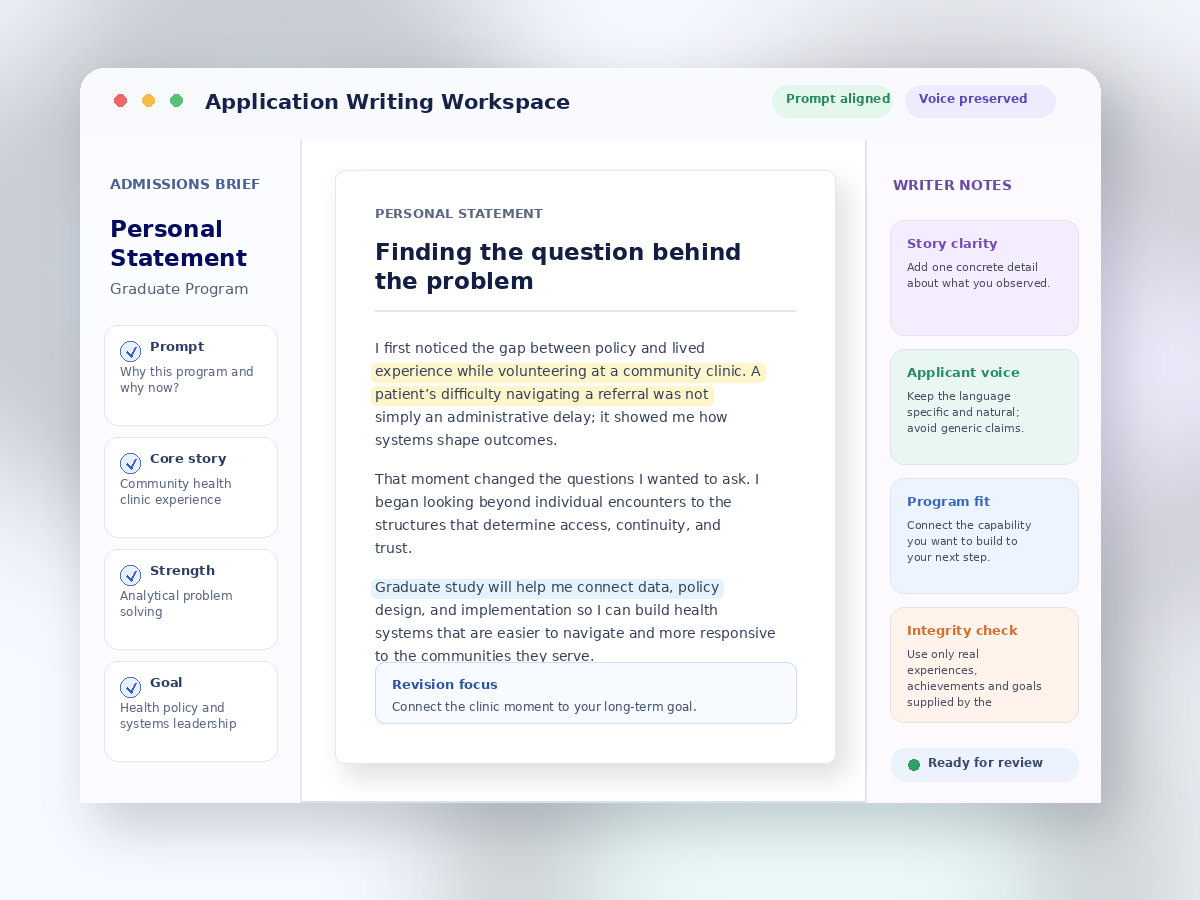
Illustrative Story Development Example
Example only — not a client submission and not a guaranteed admissions formula.
ARaw applicant notes
“Volunteered at a community clinic. Saw patients struggle with referrals. Interested in health policy. Want to improve access.”
BStory strategy
Use one observed referral problem as the opening, explain what it changed in the applicant’s thinking, then connect that insight to the skills they now want to develop.
CDraft direction
Move from a concrete moment to a larger systems question, show the applicant’s intellectual shift, and finish by connecting graduate training to a specific future contribution.
3
Why Choose This Writing Approach?
The work is organised around the applicant’s evidence and the institution’s prompt—not around generic templates, invented stories, or one-size-fits-all language.
What Guides the Work
Applicant-centred: the story starts from your real background, not a stock narrative.
Prompt-led: structure follows the actual question and stated limits.
Evidence-based: broad claims are replaced by relevant examples wherever possible.
Reviewable: you check factual accuracy, voice, emphasis, and fit before final use.
Confidential: application details are handled through the same protected service workflow used across Contentxprtz.
Our Process at a Glance
DiscoverUnderstand your prompt, story, and goal
PlanChoose evidence and build the narrative route
DraftDevelop a complete, prompt-aligned response
RefineImprove clarity, emphasis, voice, and fit
ReviewApplicant checks accuracy before final handoff
The exact workflow can be shortened or expanded depending on whether you arrive with rough notes, an outline, an existing draft, or multiple application prompts.
Prompt-AwareBuilt around the actual question
Voice-PreservingGrounded in applicant material
Structure-FirstClear narrative progression
Review-ReadyClear checkpoints before handoff
ConfidentialApplicant information handled securely
If your application already has a draft or includes supporting documents, these existing Contentxprtz services can complement the admissions-writing workflow.
Answers to common questions about scope, applicant voice, integrity, multiple prompts, delivery planning, and the information needed to begin.
What is included in the Admission Essay & Personal Statement Writing Service?+
The service can cover prompt analysis, story discovery, narrative planning, outline development, draft support, refinement for clarity and flow, program-fit alignment, and a final applicant review stage. The exact scope is confirmed from your brief.
What is the difference between an admission essay and a personal statement?+
An admission essay usually responds to a specific application prompt, while a personal statement often gives a broader account of your background, motivation, goals, and fit. Some institutions use the terms differently, so the supplied prompt always controls the final structure.
Can you help if I only have rough notes?+
Yes. Rough notes, a CV or resume, application questions, and examples of experiences can be organised into a story map and outline before drafting begins.
Will you invent achievements or experiences for my application?+
No. Admissions writing should be grounded in information you genuinely provide. The writing process can improve structure, clarity, emphasis, and narrative connection without fabricating credentials, achievements, experiences, or goals.
Can you work with a strict application word limit?+
Yes. Share the exact prompt and word or character limit. The structure and level of detail can then be planned around the space available.
Can you help with several essays for the same application?+
Yes. Multiple prompts can be mapped together so each response answers its own question while avoiding unnecessary repetition across the application.
Can you support Statements of Purpose, scholarship essays, or motivation letters?+
Yes. The same application-writing workflow can be adapted to Statements of Purpose, scholarship essays, motivation letters, transfer essays, diversity statements, and other admissions materials when they are included in your brief.
How do you keep the writing in my voice?+
The process starts from your real experiences, language preferences, goals, and examples. Drafts are structured and refined around that material, and the applicant review stage is used to correct anything that does not sound natural or accurate.
Do you guarantee admission?+
No. Admissions decisions depend on many factors outside a writing service. The service focuses on helping you present your information clearly, directly answer the prompt, and communicate your fit and goals effectively.
How are pricing and turnaround determined?+
Admission essay and personal statement writing starts from ₹3,000 for one statement up to 1,000 words. Typical delivery ranges from 4–5 business days for Essential to 7–9 business days for the Advanced multi-prompt scope; larger or urgent requirements are quoted after review.
What should I send with my enquiry?+
Send the application prompt, program or institution, word or character limit, deadline, your CV or resume if relevant, and notes about experiences, achievements, motivations, and goals you want the writing to reflect.
What happens after the first draft?+
You review the draft for factual accuracy, voice, and emphasis. Feedback is then used for the agreed refinement stage before the final version is prepared for your own submission review.
Ready to move forward?Start with Admission Essay & Personal Statement Writing Service when you are ready.
Share the prompt, application type, deadline, and the material you already have. The enquiry can then be reviewed for scope, writing depth, and delivery feasibility.
What to Include
The more specific the brief, the easier it is to determine whether you need story planning, a full draft, refinement of an existing draft, or support across several prompts.
Exact prompt & limits
Paste the question and include the word or character limit.
Program or institution
Share the course, school, scholarship, or opportunity you are applying to.
Deadline
Include the required delivery date, submission date, and time zone where relevant.
Your source material
Summarise the experiences, achievements, motivations, and goals the writing must truthfully reflect.
Admissions Writing Enquiry
Request a Scope Review
Use the form below to share enough information for the application-writing requirement to be assessed.
Your Application Story Starts With the Right Evidence
Bring your prompt, rough notes, CV or resume, and goals. We will use those materials to shape a clearer admissions narrative and identify the level of writing support your application needs.