Admission Essay & Personal Statement Editing Service for Clearer, More Authentic Applications
★★★★★4.8 rating from Researchers, Authors, Students, and Scholars
Your story, refined—not replaced.
Professional editing for applicants who already have a draft and want stronger structure, clearer language, better prompt alignment, and a polished final statement that still sounds like them. We focus on editorial improvement, not invented experiences or guaranteed outcomes.
Strengthen narrative structure and paragraph flow across the complete response.
Preserve an authentic applicant voice while improving clarity and tone.
Keep every section relevant to the exact prompt and application purpose.
Refine grammar, wording, consistency, and final presentation before submission.
Narrative StrategyClarify focus, order, and paragraph purpose
Voice PreservationRefine wording without flattening your style
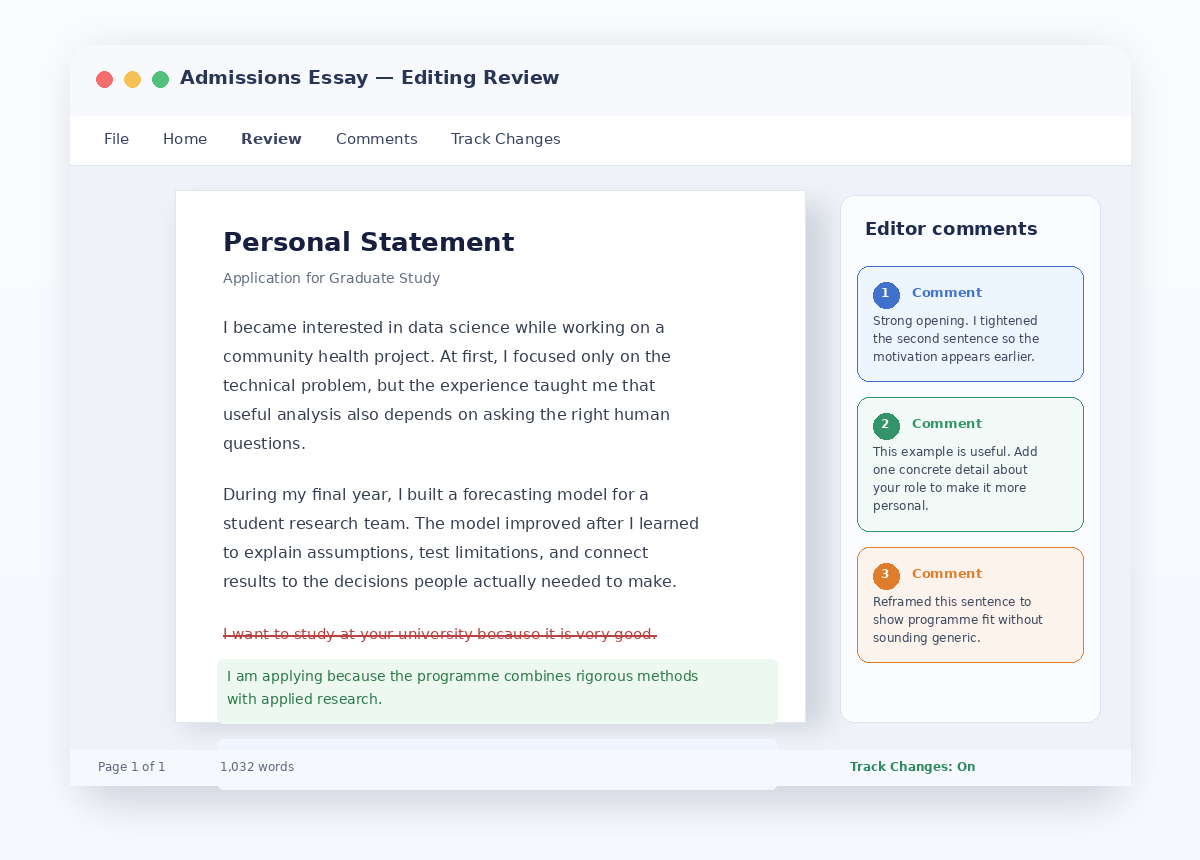
Editor CommentsClear notes where your decision or detail is needed
Final Application PolishConsistency, concision, grammar, and proofing
Admissions-Focused Review
Editing built around the prompt and application purpose
Tracked Changes
See what changed and review revisions transparently
Human Editorial Judgment
Context-sensitive revisions that preserve your meaning
Confidential Handling
Application drafts and personal details treated as private
Human-Led SupportProfessional judgment applied to the selected service scope.
Scope-Aligned ServiceWork follows the service, requirements, and materials you provide.
Confidential HandlingCareer and application materials are treated as private service information.
Clear DeliverablesReceive the agreed review, edit, writing, or guidance in a usable format.
Delivery PlanningTurnaround is aligned to the selected plan, scope, and stated deadline.
Pricing & Delivery
Admission Essay & Personal Statement Editing Plans
The plans scale by editing depth and the size of the application set, so applicants with one developed essay do not pay for the same scope as a multi-prompt application.
Quick pricing: Contentxprtz admission essay and personal statement editing starts from ₹1,500 for one developed draft up to 1,000 words.
Essential
For a developed draft that needs clearer language, smoother flow, less repetition, and final structural tightening.
₹1,500
1 essay or statement, up to 1,000 words
Clarity, concision, tone, grammar, and sentence-flow editing
Paragraph transitions and repetition control
Prompt and word-limit awareness using the instructions you provide
Applications above the stated word counts, multiple universities with materially different prompts, extensive rewriting from rough notes, or urgent deadlines may require custom scope. Editing strengthens your own content and does not invent experiences or guarantee an admissions outcome.
Ready to move forward?Start with Admission Essay & Personal Statement Editing Service when you are ready.
We read the application prompt, programme context, goals, and your editing priorities.
02
Story & Positioning Check
We identify the central message, evidence, and places where the narrative feels generic or unclear.
03
Structure & Flow
We strengthen sequencing, paragraph purpose, transitions, and the connection between experiences and goals.
04
Line Editing
We refine sentences for clarity, concision, rhythm, grammar, and natural academic or professional tone.
05
Voice Preservation
We remove awkward phrasing without flattening the personal voice or replacing your authentic story.
06
Prompt Alignment
We check that the edited draft directly responds to the stated question, criteria, or application purpose.
07
Final Proof
We review grammar, punctuation, consistency, word-limit pressure, and obvious presentation issues.
08
Tracked Delivery
You receive tracked changes, a clean edited copy, and clear comments for any points needing your decision.
What We Help You Improve
Build a clearer central message from the material already in your draft
Connect experiences, motivations, and future goals more logically
Replace vague or generic phrasing with more specific language where your facts support it
Reduce repetition and unnecessary wording when space is limited
Strengthen readability, grammar, transitions, and sentence flow
Finish with a polished draft you can review and submit with confidence in the language
Who We Support
Undergraduate applicants
Graduate & postgraduate applicants
MBA & professional programme applicants
Scholarship applicants
Applicants preparing university applications across different countries
Application Documents We Can Edit
Personal Statements
Admission Essays
Supplemental Essays
Statements of Purpose
Scholarship Essays
MBA Essays
Short-Answer Responses
Related Application Letters
1
Core Editing Services for Admissions Documents
The editorial depth is shaped by the draft you provide. We focus on the parts of an admission essay or personal statement that affect clarity, coherence, authenticity, and prompt response.
Personal Statement Editing
Strengthen narrative focus, clarity, transitions, tone, and the connection between your experiences and future goals.
Admission Essay Editing
Refine application essays so each response is direct, specific, readable, and aligned with the prompt.
Prompt Alignment Review
Check whether every paragraph earns its place and answers what the institution is actually asking.
Structure & Story Flow
Improve the order of ideas, paragraph purpose, transitions, and the overall progression of your application story.
Voice & Tone Editing
Polish wording while keeping the draft recognisably yours, with an appropriate level of confidence and formality.
Clarity & Concision
Reduce repetition, filler, vague statements, and unnecessary wording so important details have more impact.
Grammar & Style
Correct grammar, punctuation, syntax, spelling, tense, agreement, and inconsistent usage.
Opening & Closing Polish
Sharpen first impressions and conclusions without adding invented achievements or exaggerated claims.
Editor Comments
Flag unclear facts, missing context, generic claims, or places where your own additional detail could strengthen the draft.
Final Proofreading
Complete a final-stage review for remaining language and consistency issues before you submit the document.
Ready to move forward?Start with Admission Essay & Personal Statement Editing Service when you are ready.
This section shows the quality principles we apply and realistic examples of the type of editorial change an applicant may see.
Illustrative Editing Examples
These examples are created for demonstration and are not customer testimonials or real applicant submissions.
Specificity
From generic to grounded
Before: “I want to study here because the university is very good and will help my career.”
Edited: “I am applying because the programme’s applied research focus matches the way I want to develop my data-analysis work.”
Why it changed: The revision removes broad praise and makes the reason for programme fit more specific without inventing achievements.
Flow
From list-like to connected
Before: “I volunteered in a clinic. I learned teamwork. I also became interested in public health.”
Edited: “Volunteering in a clinic showed me how closely teamwork and public-health decisions shape a patient’s experience.”
Why it changed: Related facts are connected into one purposeful idea rather than presented as separate statements.
Concision
From wordy to focused
Before: “The reason why I believe this experience was very important to me is because it taught me many things about leadership.”
Edited: “The experience reshaped how I think about leadership.”
Why it changed: Unnecessary framing is removed so the sentence reaches the point faster and leaves room for the applicant’s evidence.
3
Why Choose This Editing Approach?
Admission writing needs more than grammar correction. It also needs restraint: the editor should improve communication while leaving applicant-owned facts, decisions, and personal experiences in the applicant’s control.
Why It Works for Admissions Writing
Editing is based on the exact prompt, document purpose, and draft you provide.
Your strongest evidence is prioritised instead of adding generic admissions language.
Revisions aim to sound natural and credible rather than over-polished or artificial.
Tracked changes make the editorial process visible and reviewable.
Comments can identify missing context without inventing information for you.
Final proofreading helps catch remaining language and consistency issues before submission.
Our Process at a Glance
UnderstandPrompt + draft + goals
DiagnoseStory + structure + gaps
RefineFlow + clarity + tone
VerifyPrompt + consistency + proof
DeliverTracked + clean copy + notes
We understand the task. The editor reviews your prompt, word limit, draft, and priorities before making changes.
We strengthen the narrative path. Ideas are reordered or tightened when the existing structure hides the most important message.
We refine the language. Sentences are edited for clarity, rhythm, grammar, concision, and appropriate tone.
We check prompt alignment. The revised draft is reviewed against the question and the information you supplied.
You stay in control. Comments flag places where only you can add, confirm, or choose personal details.
Ready to move forward?Start with Admission Essay & Personal Statement Editing Service when you are ready.
Practical answers about scope, authenticity, tracked changes, prompt alignment, pricing, turnaround, and what to send with your admission essay or personal statement.
What does the Admission Essay & Personal Statement Editing Service include?+
The service focuses on editorial improvement of a draft you have already prepared. Depending on the document, editing can address structure, paragraph flow, clarity, concision, grammar, punctuation, tone, prompt alignment, repetition, consistency, and reader-facing presentation. Tracked changes and editor comments can be used so you can review the revisions.
Can you edit both admission essays and personal statements?+
Yes. The page is designed for both admission essays and personal statements, including application responses where the institution asks you to explain your background, goals, motivation, experience, programme fit, or other applicant-specific information.
Will you preserve my personal voice?+
That is a central editing goal. The editor can improve clarity, flow, sentence construction, and tone while avoiding a generic rewrite that makes the statement sound detached from your own experiences and way of expressing them.
Do you write or invent experiences for applicants?+
No. Editing should work with the facts, experiences, achievements, and intentions you provide. The service can highlight where more detail may be useful, but it should not fabricate experiences, credentials, motivations, or outcomes.
Can you help if my essay is over the word limit?+
The editor can identify repetition, filler, weak transitions, and sentences that can be tightened. The aim is to reduce unnecessary wording while protecting the details that carry the strongest meaning for the application.
Do you check whether my essay answers the application prompt?+
Yes. Prompt alignment can be reviewed alongside editing. This includes checking whether the draft addresses the actual question, whether key points are sufficiently developed, and whether unrelated material is taking space away from the response.
Can you edit Statements of Purpose as well?+
A Statement of Purpose is closely related but may have a more academic or programme-focused purpose. Contentxprtz also has a dedicated SOP Editing Service, which is linked in the resources section of this page.
What files or information should I send with my draft?+
Share the editable draft, the exact application prompt or essay question, the stated word or character limit, the programme or institution context when relevant, your deadline, and any specific areas you want the editor to focus on.
Will I receive tracked changes?+
The editing workflow on this page is designed around transparent revision. A tracked version helps you see the edits, while a clean copy gives you a readable version for final review. Editor comments can be used where a decision or additional information is needed from you.
Do you provide a guaranteed admission outcome?+
No. Editing can improve the clarity and presentation of an application document, but admission decisions depend on many factors outside an editor’s control. This page does not promise acceptance, scholarships, rankings, or other outcomes.
How long will the editing take?+
Typical delivery starts at 2–3 business days for the Essential editing scope, 3–4 business days for Professional, and 5–6 business days for Advanced. Share your exact deadline if you need priority handling so feasibility can be assessed before work begins.
How much does the service cost?+
Contentxprtz admission essay and personal statement editing starts from ₹1,500 for one developed draft up to 1,000 words. Larger or more complex requirements are quoted after scope review. Send the document type, approximate word count, deadline, and required editing depth so the request can be assessed and quoted appropriately.
Ready to move forward?Start with Admission Essay & Personal Statement Editing Service when you are ready.
Share the document type, approximate word count, application prompt, deadline, and the areas you want improved. Editing starts from ₹1,500 for one developed essay or personal statement up to 1,000 words, with typical delivery in 2–3 business days; larger application sets are priced by scope.
What to Send With Your Enquiry
The more clearly you describe the application context, the easier it is to assess the editing depth your draft needs.
Draft & document type
Personal statement, admission essay, supplemental response, scholarship essay, SOP, or another application document.
Exact prompt or question
Include the wording supplied by the institution so the editor can review prompt alignment.
Word or character limit
State the official limit and your current approximate count when concision is important.
Deadline & time zone
Share the date and time you need the edited document so feasibility can be checked before work begins.
Your priority concerns
Tell us whether you need help with structure, clarity, repetition, tone, grammar, prompt alignment, or final proofreading.
Admissions Editing Enquiry
Tell Us About Your Draft
Use the form below to request an assessment for your admission essay or personal statement.
Make Your Draft Clearer Without Losing Your Voice
Share your admission essay or personal statement, the prompt, and your editing priorities so the required scope can be assessed.