Search-Aware Content Development

SEO Content Blog Writing Service for Search-Ready, Reader-Focused Articles

Turn a topic, keyword, or content brief into a clear, useful blog article built around reader intent, logical structure, natural terminology, relevant internal-link opportunities, and editorial quality checks—without reducing the page to keyword repetition.

  • Brief-led planning around audience, search intent, and page objective
  • Clear headings, useful topic coverage, examples, and reader-first flow
  • On-page SEO review, contextual internal-link planning, and CTA alignment
  • Editorial review plus a clean, publication-ready final draft
Scope-based quote Confidential handling Review-ready delivery
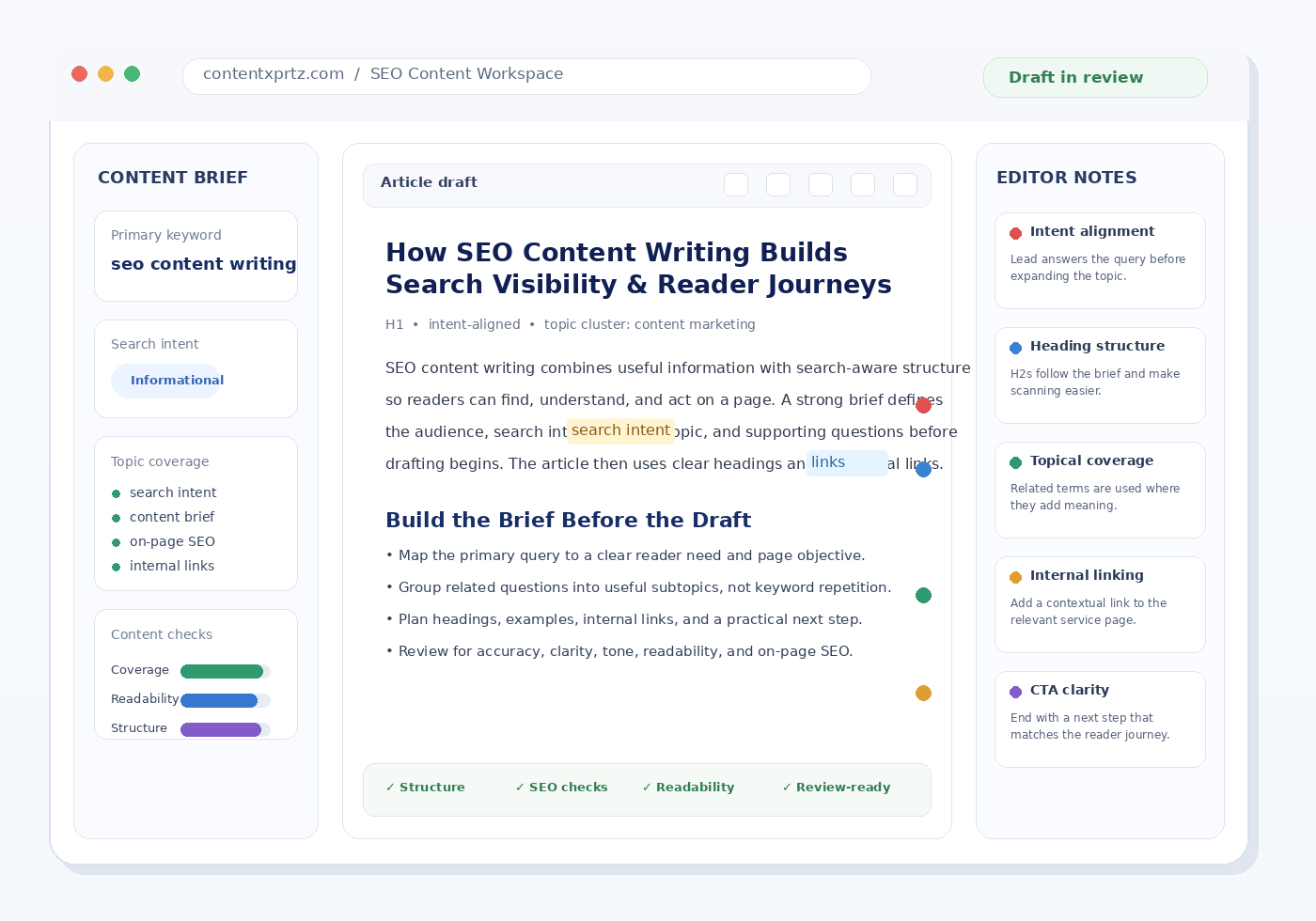
SEO content blog writing workspace showing a content brief, article draft, search-intent planning, editorial notes, and on-page SEO checks

Service visual: brief, draft, editorial notes, topic coverage, readability, and on-page SEO checks in one review workflow.

Brief-Led Writing

Purpose, audience, and intent guide the draft.

Editorial Review

Clarity, flow, structure, and consistency checks.

Search-Aware Structure

Intent, headings, coverage, and contextual links.

Confidential Handling

Briefs, drafts, and internal material stay private.

Publish-Ready Delivery

Clean final content with agreed supporting files.

1

What Problems This Service Solves

SEO content often underperforms before publication because the brief, search intent, structure, reader journey, and editorial quality are not aligned. This service turns those moving parts into one coherent draft.

Unclear Search Intent

The page answers a topic generally but does not resolve the reader’s actual question or next step.

Weak Content Structure

Headings feel disconnected, sections repeat one another, or useful information appears in the wrong order.

Forced Keyword Usage

Search terms are repeated mechanically instead of being integrated naturally into useful, readable content.

Thin Topic Coverage

The draft touches the primary phrase but misses related questions, supporting concepts, examples, or decision context.

Inconsistent Brand Voice

The article sounds generic or shifts tone because brand guidance and editorial conventions were not applied consistently.

Broken Reader Journey

The content lacks relevant internal links or a clear call to action that connects the article to the next useful page.

Sample: Improving a Draft Before Publication

A useful blog post should not begin by repeating the keyword. It should first explain what the reader is trying to accomplish, then organise the topic into clear, non-overlapping sections. Related terms such as content brief, search intent, topical coverage, and internal links can appear naturally when they help the explanation.

Editorial note:The writing is shaped around the reader’s task first; SEO signals are then integrated into the same structure instead of being added as a separate keyword layer.
2

What SEO Content Blog Writing Covers

The service can combine planning, writing, editorial refinement, and search-aware checks. The exact depth depends on your brief and the scope agreed before work begins.

Content Brief & Outline

Audience, intent, page objective, angle, section order, questions, and supporting subtopics.

Search Intent Alignment

Opening, section depth, examples, and conclusion shaped around the reader’s likely task.

Reader-Focused Drafting

Clear paragraphs, useful transitions, practical explanations, and a logical narrative from question to answer.

Heading Architecture

H1/H2/H3 structure that supports scanning, section purpose, and complete topic coverage.

Natural Terminology

Primary and related terms integrated where they add meaning instead of being inserted to hit a density target.

SEO Content Blog Draft

A single article where audience value, search intent, useful coverage, brand voice, internal links, and the final CTA work together.

Editorial Refinement

Clarity, readability, repetition, paragraph flow, consistency, grammar, and tone checked before delivery.

Internal-Link Planning

Contextual opportunities identified when you provide relevant URLs or priority pages.

On-Page Content Checks

Title, headings, opening, structure, topical completeness, readability, link placement, and CTA alignment.

Final Delivery

Clean article copy plus the agreed supporting notes, brief, or checklist for review and publication.

3

Service Demonstration: Annotated SEO Blog Excerpt

The example below shows the kinds of writing and review decisions an SEO-focused blog draft may include. It is illustrative rather than a ranking formula.

How to Turn a Search Query Into a Useful Blog Brief

A strong brief starts with the reader’s intent, not a target density. Define the question the page must answer, the audience that needs the answer, and the action that should make sense after reading.

Build headings around distinct sub-questions so each section has a clear job. Related phrases such as content brief, topic coverage, and on-page SEO should appear because the explanation needs them, not because they were added to a checklist.

When the article mentions a topic already covered elsewhere on the site, add a contextual internal-link opportunity. Finish with a next step aligned with the reader journey rather than a generic sales line.

4

From Raw Brief to Publish-Ready Blog Content

The writing process moves from the information you provide, through a structured SEO-aware draft, to a clean final article that is easier for readers and publishing teams to work with.

1Before Writing

Raw Topic / Keyword Brief

Topic: SEO content writing
Audience: marketing teams
Goal: explain the service
Notes: mention intent, headings, internal links, quality review

Need a blog article that is useful and search aware.
TopicAudienceObjectiveSource notes
2During Writing

SEO-Structured Draft

H1: SEO Content Writing That Serves Search Intent

Intro: Define the reader problem.
H2s: Brief → Intent → Structure → Coverage → Internal links → Review.

Notes: add example, link opportunity, practical CTA.
IntentStructureCoverageEditorial notes
3After Review

Clean Final Blog Article

A coherent article with a clear opening, logical section order, useful explanations, natural terminology, relevant internal links, consistent brand voice, and a conclusion that guides the reader to the next appropriate step.
ClearConsistentSearch-awarePublish-ready
5

General Blog Writing vs. SEO Content Blog Writing

Both can produce good content, but an SEO content workflow adds structured search-awareness and page-journey decisions to the writing and review process.

AspectGeneral Blog WritingSEO Content Blog Writing
Primary PlanningTopic, audience, brand voice, and editorial goal.Topic and audience plus search intent, query context, topical coverage, and page objective.
StructureEditorial outline and readable section flow.Reader-first outline with distinct H2/H3 purposes and search-aware coverage.
TerminologyNatural language based on the subject and brand.Natural language plus primary and related search terminology where useful.
Internal LinksIncluded when specifically requested.Planned as part of the reader journey when relevant URLs or page priorities are supplied.
Editorial ReviewGrammar, clarity, tone, style, and consistency.Editorial review plus intent, heading architecture, topical completeness, link placement, and CTA alignment.
Best ForEditorial publishing, thought leadership, updates, and brand communication.Search-aware blog programs, service education, topical clusters, evergreen guides, and organic-content workflows.
6

Blog Sections We Plan and Review

A strong SEO article is not only a body of text. Its individual sections must work together to answer the query, guide scanning, build understanding, and support a useful next action.

Title & H1

Clear promise, topic alignment, and reader relevance.

Opening

Intent match, context, and a direct reason to keep reading.

Core H2s

Distinct sub-questions, logical flow, and complete topic coverage.

Examples

Concrete explanations, scenarios, comparisons, or practical detail.

Internal Links

Contextual paths to relevant products, services, guides, or resources.

Evidence Notes

Source requirements, claims to verify, and client-supplied reference material.

FAQs

Useful follow-up questions when the topic naturally supports them.

CTA

A next step that matches the page objective and reader journey.

Meta Support

Suggested title/description direction when included in the scope.

Final Review

Clarity, tone, structure, consistency, readability, and on-page checks.

7

Our SEO Content Editorial Workflow

The workflow keeps planning, drafting, search-awareness, editorial review, and delivery connected so each stage can be checked before the article moves forward.

Brief Intake

Topic, audience, objective, references, brand guidance.

Scope Review

Confirm requirements, research depth, deliverables, and deadline.

Content Brief

Plan intent, angle, headings, subtopics, examples, and links.

Drafting

Develop the article section by section around the agreed brief.

SEO Review

Check intent, terminology, headings, coverage, links, and CTA.

Editorial QA

Review clarity, readability, repetition, tone, grammar, and consistency.

Delivery

Provide the clean draft and agreed supporting files.

Clarification

Resolve questions or agreed revision points within the service scope.

8

What You Receive

Delivery is organised so your team can review the article, understand the agreed SEO and editorial decisions, and move the content into publishing with minimal ambiguity.

8) Delivery Files & Notes

Final Blog DraftClean article copy in agreed format
FINAL
Content Brief / OutlineWhen brief development is included
BRIEF
SEO Content ChecklistIntent, headings, terms, links, CTA
CHECK
Editorial NotesQueries or guidance where needed
NOTES
Title & Heading StructureSuggested article hierarchy
SEO
Internal-Link NotesWhen relevant URLs are supplied
LINKS

9) Quality Assurance Methodology

Layer 1 · Brief Alignment
Layer 2 · Structure & Coverage
Layer 3 · Language & Readability
Layer 4 · On-Page Content Check
Layer 5 · Final Editorial QA
Reader objective and intended meaning remain clear.
Sections avoid unnecessary overlap and repetition.
Search terminology is integrated naturally.
Claims that require client verification are not silently treated as facts.
Final article receives a clean presentation and consistency pass.

10) Industries We Support

Technology & SaaS Finance & Accounting Ecommerce & Retail Healthcare & Life Sciences Education & Training Professional Services Marketing & Agencies Data & AI HR & Recruitment Business Operations
11

Confidentiality & File Handling

Secure SubmissionSend briefs and source material through the designated process.
Scoped AccessMaterials are used for the agreed writing and review work.
Draft DevelopmentResearch notes and drafts remain within the service workflow.
Confidential ReviewInternal URLs, product notes, and unpublished material are treated as private.
Controlled DeliveryFinal files are returned through the agreed channel.
Retention ReviewRetention needs can be discussed when the scope is confirmed.
12

Turnaround Options & Pricing Clarity

This service does not use a fixed public price or delivery promise on this page. Quotes and delivery dates are confirmed after the assignment scope, research needs, content length, and editorial requirements are reviewed.

Standard

Balanced scheduling for planned content calendars and regular publishing workflows. Availability depends on the confirmed scope.

Priority

Faster handling may be considered when capacity and the research or editorial depth allow it.

Express

Urgent requests are reviewed individually. Feasibility is confirmed before any deadline is accepted.

Custom Quote Based on Content Scope

Pricing is shaped by the work required to plan, research, write, review, and prepare the article.

Word Count
Research Depth
Topic Complexity
Briefing Needs
Editorial Depth
Deadline

A transparent, scope-based quote is provided after a brief review of the content requirement.

13

Who This Service Is For / Use Cases

The service is designed for teams that need planned, repeatable blog content connected to search intent, useful reader journeys, and a wider content or marketing program.

Founders & Startups

Build educational articles around new categories, products, or market questions.

Marketing Teams

Support content calendars, topic clusters, campaign education, and organic landing journeys.

SaaS & Tech Teams

Explain technical products, workflows, use cases, and buyer questions in accessible language.

Ecommerce Brands

Develop guides, comparisons, category education, and product-adjacent informational content.

Agencies

Add scalable writing capacity while retaining client briefs, brand rules, and editorial direction.

Professional Services

Turn expertise into useful articles that answer client questions and support service discovery.

14

SEO Content Blog Writing FAQs

Answers to common questions about scope, search intent, briefs, keywords, internal links, brand voice, pricing, turnaround, deliverables, and realistic expectations.

What is an SEO Content Blog Writing Service?

It is a writing service that develops blog content around a defined audience, search intent, topic, and page objective. The workflow can include briefing, outline development, drafting, heading structure, natural keyword use, internal-link planning, editorial review, and a clean final article.

How is SEO blog writing different from general blog writing?

General blog writing may focus mainly on the topic and brand voice. SEO blog writing adds search-aware planning such as intent alignment, topical coverage, heading structure, natural terminology, internal-link opportunities, and a review of how the article supports a wider search and content journey.

Do you guarantee rankings or traffic?

No. Search visibility depends on many factors outside the writing itself, including site authority, technical SEO, competition, indexing, links, user behaviour, and search-engine changes. This service focuses on producing useful, well-structured, search-aware content rather than promising a ranking outcome.

Can you write from my existing SEO brief?

Yes. You can provide a completed brief, target query, outline, audience notes, brand guidance, internal links, reference material, or competitor examples. The writing process can then work within those supplied requirements.

Can you create the content brief as part of the service?

Yes, when briefing is included in the agreed scope. A brief can define the primary topic, reader intent, key questions, proposed headings, supporting subtopics, content angle, internal-link opportunities, and the desired call to action.

Will keywords be repeated throughout the article?

The goal is natural, useful language rather than mechanical repetition. Primary and related terms are placed where they make sense for the reader and the topic, with clarity and coverage taking priority over forced keyword density.

Does the service include internal links?

Internal-link planning can be included when you provide the relevant site URLs or page priorities. Links are placed contextually where they help the reader continue to a useful related page.

Can you match our brand voice and editorial style?

Yes. Share tone-of-voice guidance, sample articles, terminology preferences, formatting conventions, words to avoid, preferred calls to action, and any editorial rules that should shape the draft.

What information do you need before writing starts?

Useful inputs include the topic, target audience, page objective, target query or brief, preferred length, brand voice, reference sources, internal-link targets, products or services to mention, competitor context, and any compliance or editorial restrictions.

How is pricing determined?

This page uses custom, scope-based quoting because the required work can vary by word count, research depth, briefing needs, technical complexity, content format, editorial depth, formatting requirements, and deadline. A quote is confirmed after the requirements are reviewed.

What turnaround options are available?

Standard, priority, and express handling may be considered depending on the assignment and current capacity. No fixed delivery time is promised on this page; the confirmed deadline is agreed after the topic, research requirements, length, and editorial scope are reviewed.

What will I receive at delivery?

Depending on the agreed scope, delivery can include the final blog draft, a clean publish-ready copy, editorial notes, a content brief or outline, suggested title and heading structure, and an internal-link or on-page SEO checklist. The exact deliverables are confirmed before work begins.

15

Why Choose ContentXprtz for SEO Blog Content

The service is structured around visible planning and review decisions: the brief, article architecture, reader intent, editorial quality, agreed scope, and delivery format are kept clear throughout the workflow.

Brief Transparency

The draft can be traced back to a defined audience, objective, and content brief.

Reader-First Structure

Sections are organised to answer questions clearly instead of chasing keyword repetition.

Scope-Based Delivery

Research, drafting, SEO checks, and supporting files are confirmed before work begins.

Confidential Handling

Internal plans, unpublished drafts, source notes, and business material are treated as private.

Editorial Review

Clarity, flow, tone, consistency, grammar, and readability are checked alongside SEO content factors.

Revision Support

Clarification or agreed revision points can be handled within the confirmed service scope.

16

Ready to Plan Your Next SEO Blog Article?

Share the topic, audience, target query or brief, preferred length, brand guidance, source material, internal-link priorities, and publishing deadline. The requirement can then be reviewed for scope, research depth, deliverables, and delivery feasibility.

Topic & audience

Explain what the article should cover, who it is for, and what the reader should understand or do.

SEO brief or target query

Provide the keyword, brief, search-intent notes, competitor references, or let us know if brief development is required.

Brand & source guidance

Share tone, terminology, product details, internal references, claims restrictions, and trusted source material.

Length & deadline

Include the preferred word-count range, publication date, time zone, and any scheduling constraints.

Internal links & CTA

Identify priority URLs, related pages, offers, or the next action the article should support.

Helpful to include: topic, audience, search query, content objective, desired length, brand voice, references, internal links, deadline, and any claims or topics that require special care.
SEO Content Writing Enquiry

Request a Scope Review & Quote

Provide enough detail for the team to understand the writing requirement, research depth, SEO inputs, editorial expectations, and deadline.

Security check *Loading question…

Your contact details and content requirement are used to review this enquiry. Supporting files or sensitive internal material can be shared through the appropriate follow-up process.

Strengthen Your Blog Content Before It Goes Live

Bring together the brief, search intent, reader journey, article structure, internal links, editorial quality, and publication goal in one clear writing workflow.

Content briefSearch-aware structureEditorial reviewScope-based quoteClean delivery
Discuss Your Requirement