Brand Story Service for a Clear, Credible Narrative People Remember
★★★★★4.8 rating from Researchers, Authors, Students, and Scholars
Turn scattered founder notes, company history, customer context, turning points, purpose, proof, and values into one coherent brand narrative that can guide your website, pitch materials, brand guide, PR, and company communications.
Build a story around real events, motivations, decisions, and evidence—not generic brand language.
Connect your origin, customer problem, turning point, purpose, proof, and future direction.
Preserve founder and brand voice while improving narrative clarity, flow, and memorability.
Create a reusable narrative foundation that can be adapted to agreed communication formats.
A defined starting engagement for turning founder history, company facts and customer context into a coherent story that can be reused across brand and marketing touchpoints.
Starting from
₹15,000
for one core brand narrative plus a reusable short version
✓ Origin and founding-context review
✓ Customer tension and turning-point framing
✓ Purpose, belief and values-in-action language
✓ Proof and credibility integration from supplied sources
A defined starting engagement for turning founder history, company facts and customer context into a coherent story that can be reused across brand and marketing touchpoints.
When the quote changes: Extensive interviews, multiple audience narratives, film scripting, campaign rollouts or large brand-platform work are priced separately.
Priority or express scheduling may be available when the confirmed scope and current capacity allow.
Strategy-Led Narrative
Story architecture before surface-level polish
Source-Based Writing
Built from supplied facts, notes, and context
Voice Consistency
Founder and brand language stays recognisable
Confidential Handling
Sensitive brand material handled with care
Revision-Ready Output
Clear narrative structure for review and reuse
1
What Problems This Brand Story Service Solves
A brand can have strong products, capable people, and real history yet still sound generic when the story is fragmented, overly corporate, or missing the human logic that connects past decisions to present purpose.
×Founder history exists only as scattered anecdotes.
×The About page reads like a timeline or company brochure.
!Purpose and values feel detached from actual business decisions.
!Different teams explain the company in different ways.
?The customer problem is described, but the brand's point of view is unclear.
?Claims sound polished but lack specific proof or context.
Illustrative shift: from company facts to a narrative
We were founded to provide innovative solutions for growing businesses.Too generic
The idea began after the founding team repeatedly watched small operators lose hours each week stitching together tools that were never designed to work as one system.Specific origin
That repeated friction became the turning point: instead of adding another tool, the team chose to simplify the workflow itself.Narrative logic
The brand's purpose is therefore tied to a lived problem—not a slogan added after the fact.Meaning
2
What Brand Story Development Covers
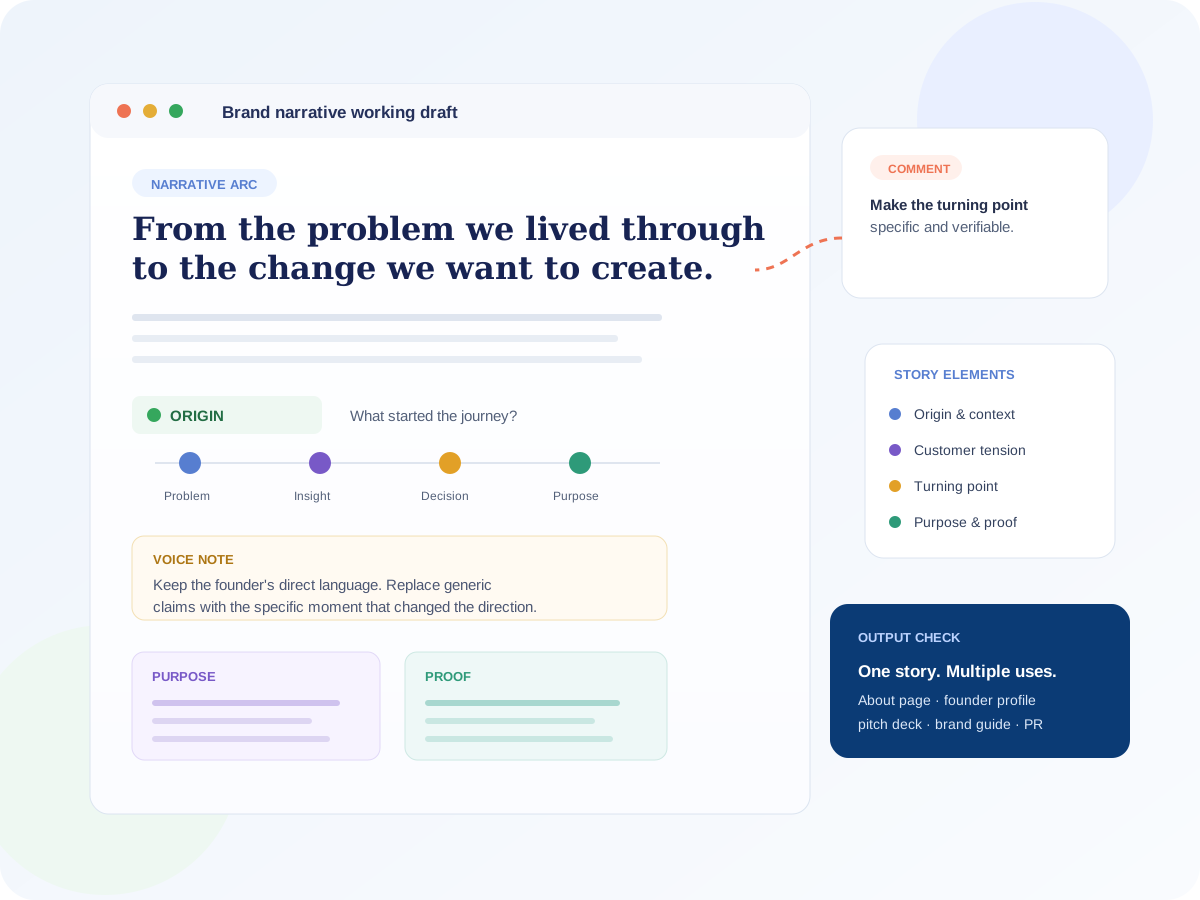
The strongest story is not a single dramatic paragraph. It is a connected set of narrative elements that explain where the brand came from, what it learned, what it believes, and why those beliefs matter to the people it serves.
Origin & Founding Context
The situation, observation, frustration, opportunity, or personal experience that made the company worth starting.
Customer Tension
The real-world problem, constraint, or unmet need that gives the story relevance beyond the founders themselves.
Turning Point & Decision
The moment or sequence of decisions that moved the business from observation to action and gave the brand its direction.
Purpose & Belief
The principle behind the work, expressed through what the brand actually chooses to do rather than through abstract slogans.
Proof & Credibility
Supplied milestones, operating choices, evidence, or examples that make the narrative concrete and defensible.
Values in Action
Behaviours and decisions that demonstrate what the brand values, avoiding generic lists that could belong to any company.
Voice & Tone
Language patterns, sentence rhythm, vocabulary, and emphasis that help the story sound like the organisation rather than a template.
Reusable Story Modules
A narrative structure that can be adapted into shorter versions for agreed channels without losing the central logic.
Ready to get started with Brand Story Service?Use the service scope above to start your order securely.
Service Demonstration: Annotated Brand Story Excerpt
This fictional example shows the type of narrative intervention involved: removing unsupported generalities, introducing specific causal links, strengthening the turning point, and clarifying why the brand's purpose follows from its history.
4
Northline was created to revolutionise how local manufacturers manage operations.
5
Northline began after its founders spent months watching small manufacturers lose production time to disconnected spreadsheets, calls, and software.
6
The problem was not a lack of tools. It was that each tool solved one task while leaving the team to connect the workflow themselves.
7
The turning point came when a missed handoff stopped an otherwise routine order. The team decided to design around the handoff rather than around another feature list.
8
That decision still shapes the brand's purpose: make everyday operations easier to see, easier to coordinate, and harder to lose between systems.
Credibility
Remove “revolutionise” unless the claim is supported. Replace it with the actual problem the founders observed.
Narrative cause
Explain why the existing tools were insufficient. The story becomes stronger when the reader can follow the reasoning.
Turning point
Use a concrete incident or decision to move the narrative from background to action.
Purpose
Connect purpose to the founding experience so it feels earned rather than appended.
Ready to get started with Brand Story Service?Use the service scope above to start your order securely.
The process separates source material, narrative architecture, and final copy so the story is not forced into polished language before the underlying logic is clear.
Before
Raw source notes
“Started in 2021. We saw teams struggling with fragmented systems. We care about simplicity, transparency, and giving small businesses better tools. We launched with three clients and learned a lot from implementation.”
FactsChronologyNo story arc yet
→
Narrative pass
Meaning and sequence
“The company did not begin with a feature idea. It began with a repeated observation: teams were spending more effort connecting their systems than serving the work those systems were supposed to support.”
TensionPoint of viewTurning point
→
Final
Brand-ready story
“That repeated friction became the reason to build differently. The brand's promise of simplicity is not a line added later; it is the operating principle that came from the problem the founders chose to solve.”
ClearCredibleReusable
10
Generic Business Copy vs. Brand Story Development
Brand story work goes beyond polishing sentences. It identifies what the narrative is actually about, decides which facts carry meaning, and creates a structure that can hold the brand's point of view without inventing drama.
Aspect
Generic Business Copy
Brand Story Service
Primary focus
Describe the company, offer, or capabilities.
Explain the human and business logic behind why the company exists and what it learned.
May prioritise clarity and persuasion at sentence level.
Builds sequence, cause and effect, turning points, tension, resolution, purpose, and future direction.
Voice
Can default to polished marketing language.
Uses supplied founder language and brand vocabulary to preserve recognisable tone.
Proof
May present claims as provided.
Separates supported proof from claims that need client confirmation.
Reuse
Usually written for one destination.
Can be structured as a core narrative with agreed shorter or channel-specific adaptations.
Final result
Clean copy.
A coherent narrative foundation plus the deliverables agreed in the service scope.
11
Brand Story Sections We Develop
Not every brand needs every element in equal depth, but these components provide a practical narrative map for deciding what belongs in the story and how each part supports the next.
01
Origin
Where the story begins and what made the problem visible.
02
Tension
The customer or market friction that gives the story relevance.
03
Insight
What the founders or team understood differently.
04
Turning Point
The decision that moved the idea into action.
05
Approach
How the brand chose to solve the problem.
06
Proof
Supplied evidence, milestones, examples, or operating choices.
07
Purpose
Why the work matters beyond the immediate product or service.
08
Values
Beliefs demonstrated through actions and trade-offs.
09
Voice
The language and tone that make the narrative recognisable.
10
Future
The direction the brand is working toward without unsupported promises.
12
Our Brand Story Workflow
The workflow moves from evidence to structure to writing. This reduces the risk of producing attractive copy that is disconnected from the company's actual experience or strategic intent.
1. Submit Brief
Share goals, audience, current materials, and intended uses.
2. Source Review
Organise notes, pages, decks, timelines, and proof points.
3. Discovery Gaps
Identify missing context, uncertain claims, and questions.
4. Story Architecture
Set the arc, emphasis, sequence, and narrative logic.
5. First Draft
Develop the core story with source-based detail and voice.
6. Fact & Voice Check
Review claims, chronology, language, and consistency.
7. Revision
Refine based on client corrections, emphasis, and approvals.
8. Final Delivery
Provide the agreed narrative outputs in review-ready form.
Ready to get started with Brand Story Service?Use the service scope above to start your order securely.
Deliverables should match the brief. The following are common outputs that can be scoped individually or together; the final combination is confirmed before work begins.
DOC
Core Brand Story
The long-form master narrative covering the agreed story arc.
Core
WEB
About Page Adaptation
A web-ready version shaped for site context and reader flow.
Optional scope
CEO
Founder Story
A related first-person or third-person narrative focused on founder motivation and decisions.
Optional scope
DECK
Pitch / Company Story
A concise narrative suitable for presentation context when included in scope.
Optional scope
VOICE
Story & Voice Notes
Guidance on narrative emphasis, language patterns, and points to preserve.
Optional scope
SHORT
Short Story Versions
Condensed variants for approved channels without changing the central facts.
Optional scope
14
Quality Assurance Methodology
Brand storytelling is most credible when every layer holds together: facts, narrative logic, voice, clarity, and consistency across the outputs included in the brief.
Layer 1 · Factual Grounding
Layer 2 · Narrative Logic
Layer 3 · Voice & Tone
Layer 4 · Clarity & Memorability
Final · Cross-Output Consistency
✓
Facts remain attributable to supplied source material
Unsupported claims are removed, softened, or flagged for confirmation.
✓
Cause and effect are easy to follow
The reader can understand what happened, what changed, and why the company chose its direction.
✓
Voice remains recognisable
Founder expressions and established brand language are retained where they help authenticity and clarity.
✓
Generic marketing language is challenged
Abstract claims are replaced with specific context whenever the source material supports it.
✓
Agreed variants stay consistent
Shorter versions preserve the same central story rather than creating conflicting explanations of the brand.
15
Common Brand Story Contexts
The service can be scoped around different business situations. The narrative emphasis changes depending on whether the central challenge is launch, growth, repositioning, founder visibility, or consistency across teams.
Startup Launch
Explain the problem, founding insight, and early direction without overclaiming maturity.
Growth-Stage Company
Connect the original story to what the business has learned and how its role has evolved.
B2B / Technology
Translate complex product context into a human business narrative without losing specificity.
Consumer / Ecommerce
Connect product choices, customer insight, and brand belief in a story people can quickly understand.
Founder-Led Brand
Balance personal motivation with the company narrative so the story can grow beyond one individual.
Professional Services
Turn experience, philosophy, and client context into a narrative rather than a credentials list.
Rebrand / Repositioning
Explain what has changed, what remains true, and how the past connects to the new direction.
Multi-Founder / Team Story
Resolve overlapping perspectives into one company narrative while preserving useful differences.
16
Confidentiality & File Handling
Founder notes, internal strategy material, unpublished positioning, customer context, and company history may be commercially sensitive. They should be treated as confidential service information throughout the working process.
Source Submission
Briefs, notes, pages, decks, and supporting context.
Controlled Access
Material is used for the service scope and review process.
Working Drafts
Narrative development remains tied to supplied information.
Fact Review
Uncertain claims are identified for confirmation rather than invented.
Final Verification
Agreed narrative and output versions are checked for consistency.
Confidential Delivery
Final materials are returned through the designated service process.
17
Who This Service Is For / Use Cases
These are illustrative scenarios rather than customer claims. They show when brand-story development may be useful and what narrative problem the work is intended to solve.
Startup Founders
Need a credible origin story for a website, deck, or early brand guide.
Established Companies
Have years of history but no clear narrative connecting then, now, and next.
Rebranding Teams
Need to explain why the brand is changing without disconnecting from its history.
Marketing Leaders
Need one narrative foundation to reduce inconsistent brand explanations across channels.
Founder Visibility Projects
Need a founder story that supports the company narrative without making the company dependent on biography alone.
Agency / Client Teams
Need a structured narrative brief before adapting the story into creative or campaign work.
FBVP
18
Frequently Asked Questions
Practical questions about what Brand Story Service does, what source material helps, how credibility is protected, and how the final narrative can be used.
What is a Brand Story Service?+
A Brand Story Service develops a coherent narrative from the facts, experiences, beliefs, customer context, turning points, purpose, and proof that explain why a brand exists and why its work matters.
How is a brand story different from an About Us page?+
An About Us page is one possible destination for the story. A brand story is the underlying narrative system that can guide an About page, founder profile, pitch deck, brand guide, PR material, sales narrative, and other company communications.
What information do you need to develop a brand story?+
Useful inputs include company background, founder notes, customer context, important milestones, the problem the brand set out to address, proof points, values, existing messaging, and any voice or positioning guidance already in use.
Can you work from rough notes rather than a finished brief?+
Yes. Rough notes, timelines, founder comments, existing pages, decks, and scattered source material can be organised into a clearer narrative structure. The quality of factual input still matters, so uncertain claims should be identified for confirmation.
Will the story sound overly dramatic or fictional?+
The service is designed around credible storytelling, not invented drama. The narrative should be engaging while remaining anchored to facts, verifiable context, and the brand's actual experience.
Can the brand story be adapted for different channels?+
The core narrative can be structured so shorter or channel-specific versions can be created for uses such as an About page, founder bio, pitch deck, sales presentation, PR backgrounder, or brand guide when those outputs are included in the agreed scope.
Do you change our brand voice?+
The aim is to clarify and strengthen the voice rather than replace it with generic marketing language. Existing founder language, brand vocabulary, and tone guidance can be used as source material.
Can you develop a founder story and company story together?+
They can be developed as related narratives when the brief requires both. The founder story focuses on personal motivation and decisions, while the company story focuses on the organisation's evolution, customer context, purpose, and proof.
How do you handle claims and proof points?+
Claims should be tied to supplied evidence or clearly marked for client confirmation. The service should not invent milestones, customer numbers, awards, results, or other credibility signals.
Is this service suitable for a rebrand or repositioning project?+
It can support a rebrand or repositioning when the business needs to articulate what has changed, what remains true, and how the brand's history connects to its current direction. Broader naming, visual identity, or full positioning strategy may require separate scope.
Will my strategy files and founder notes remain confidential?+
Sensitive brand material, founder notes, internal documents, and unpublished positioning should be handled as confidential service information through the designated submission and delivery process.
How are pricing and turnaround determined?+
Published pricing starts at ₹15,000 for one core brand narrative plus a reusable short version. Final pricing and delivery are confirmed against the agreed scope. Scope depends on the source material, research or discovery depth, number of narrative outputs, review requirements, and deadline. Submit a brief to request a scoped quote and delivery schedule.
Ready to get started with Brand Story Service?Use the service scope above to start your order securely.
A useful brand story should be clear enough for a new reader, specific enough to feel credible, flexible enough to support multiple agreed uses, and disciplined enough not to drift into invented claims.
Transparent Sources
Story decisions are tied back to supplied material and confirmed context.
Narrative Architecture
Sequence and meaning are developed before final polish.
Evidence-Led Claims
Unsupported credibility signals are not invented to make the story stronger.
Voice Preservation
The narrative is refined without replacing distinct language with generic copy.
Confidential Handling
Sensitive founder and strategy material remains part of the service workflow.
Multi-Format Thinking
The core story can be planned for agreed downstream uses without changing its facts.
Ready to Strengthen the Story Behind Your Brand?
Share the notes, history, positioning context, founder perspective, and communication goals you already have. The next step is to define the story scope before writing begins.
Tell us what you are trying to explain, who needs to understand it, what source material already exists, and where the story will be used.Published pricing starts at ₹15,000 for one core brand narrative plus a reusable short version. Final pricing and delivery are confirmed against the agreed scope.
01
Brand context
Company stage, market, audience, and the reason you need the story now.
02
Source material
Existing About page, founder notes, timeline, pitch deck, brand guide, research, or proof points.
03
Intended outputs
Core story, About page, founder narrative, deck version, short-form adaptations, or another agreed format.
04
Deadline & reviewers
Requested date, decision-makers, and any internal approval process that may affect scope.
Helpful to include: a link to the current website, 5–10 key facts or milestones, the customer problem, the founding insight, important beliefs, available proof, examples of brand voice, and any claims that must be avoided or verified.
Brand Story Enquiry
Share Your Brand Story Brief
Provide enough context to understand the narrative challenge, source material, intended deliverables, and requested deadline.

Remove “revolutionise” unless the claim is supported. Replace it with the actual problem the founders observed.
Explain why the existing tools were insufficient. The story becomes stronger when the reader can follow the reasoning.
Use a concrete incident or decision to move the narrative from background to action.
Connect purpose to the founding experience so it feels earned rather than appended.