Environmental & Sciences
Environmental Sciences Research
This sample image could not be loaded. Please try again.
Environmental & Sciences

Collaborate with specialist writers, editors, and research experts to transform your own ideas, data, sources, notes, and draft chapters into a well-structured academic thesis. The process is collaborative, milestone-based, and designed to keep you in control of the research and final content.
A defined Thesis Writing Service engagement starts at ₹12,000 per chapter up to 5,000 words. At this level, the work includes chapter brief and research-input review and chapter structure and argument mapping, plus the service-specific checks listed below.
Larger word counts, missing source material, specialist research, complex chapter coherence, methodology, analysis, cross-references and university-specific submission standards, additional outputs, or accelerated deadlines require a custom quotation. A shorter deadline for Thesis Writing Service can be assessed after the working files and requested scope are reviewed; accelerated delivery is confirmed only when feasible for that assignment.
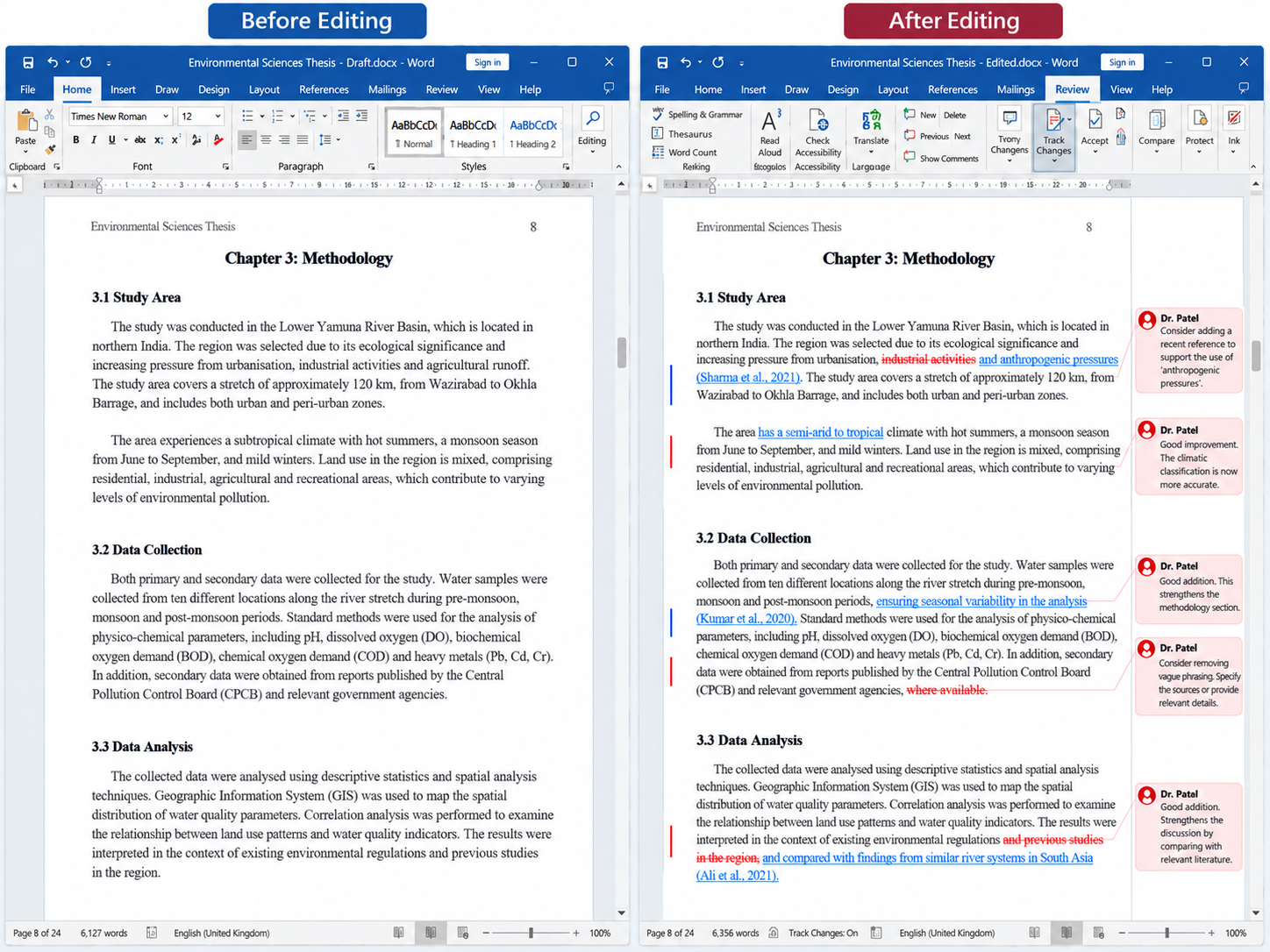
Choose a subject field on the left to view its corresponding before-and-after thesis sample. Each sample demonstrates reviewable improvements in language, structure, presentation and academic clarity while keeping the researcher’s original work and meaning central.
Environmental Sciences Research
Structured support for postgraduate students, researchers, and professionals at different stages of thesis development.
Build a clear, structured thesis from proposal to final draft.
In-depth research, analysis, and chapter-development support.
Move chapters forward with clearer structure and flow.
Design, justification, and presentation of method decisions.
Refine academic language, logic, coherence, and readability.
Formatting, references, checklist review, and final polish.
Common thesis-writing challenges become a structured collaboration plan with clear chapter goals, research inputs, review checkpoints, and defined outputs.
A modular thesis-development workflow that can be scoped around the parts you need, using your research question, evidence, sources, data, and institutional requirements.
Order and presentation aligned to supplied university requirements.
Concise summary of background, method, findings, contribution, and conclusion.
Context, problem statement, aims, research questions, and thesis significance.
Thematic synthesis, critical comparison, research gaps, and conceptual grounding.
Design, sample, instruments, procedures, justification, and limitations.
Data analysis, tables, figures, patterns, and clear reporting of findings.
Interpretation, implications, comparison with literature, and contribution.
Summary, contribution, limitations, recommendations, and future research.
Citation consistency, reference-list review, and supplied style alignment.
Supporting materials, tools, raw-data extracts, forms, and supplementary items.
Thesis co-writing is broader than editing and proofreading: it can help shape chapter plans and develop content from your supplied research inputs, while you retain direction and final approval.
| Support Area | Thesis Co-Writing | Thesis Editing | Proofreading |
|---|---|---|---|
| Research framing & scope | Yes — helps refine and strengthen | Limited — suggests improvements | No |
| Outline & structure development | Yes | Yes — structural feedback | No |
| Chapter drafting & content | Yes — based on supplied research inputs | Partial — works with existing content | No |
| Argument development | Yes — builds stronger evidence-led arguments | Yes — enhances clarity and logic | No |
| Literature synthesis | Yes — thematic and critical synthesis | Yes — improves presentation | No |
| Methodology framing support | Yes — design and justification presentation | Review and suggest | No |
| Language refinement | Yes | Yes — in depth | Yes — final polish |
| Formatting & citations | Yes — where included in scope | Yes | Yes |
| Supervisor / reviewer response | Yes — can draft structured responses | Yes — response support | No |
The collaboration connects what you already have with a clear sequence of planning, drafting, review, and finalisation.
A clear, step-by-step process keeps scope, inputs, drafts, feedback, and final checks visible throughout the project.
Share your topic, outcomes, research stage, available materials, and requirements.
Clarify what is needed, define the project scope, and confirm priorities.
Match the work with an appropriate subject, research, or methodology specialist.
Develop chapter structure, key questions, sequencing, and milestones.
Develop chapters from your research inputs, evidence, data, and source set.
Incorporate your feedback and refine structure, argument, evidence, and language.
Complete final checks for content, formatting, references, and agreed deliverables.
Project phases create clear approval points so feedback is incorporated before the next major stage begins.
Understand goals, requirements, and research depth.
Confirm chapter plan and content sequence.
Develop agreed chapter sections and integrate evidence.
Strengthen continuity between chapters and arguments.
Address author, supervisor, or committee feedback.
Final document, references, checklist, and agreed files.
A complete project package can combine the core thesis manuscript with planning, revision, reference, submission, and supporting files agreed in scope.
Subject to the agreed scope and available research inputs.
Final, polished and formatted version for author review.
Detailed chapter plan, sequence, and purpose.
Changes, feedback, decisions, and outstanding author actions.
Citation checks and standardisation against the supplied style.
University or department checks based on supplied rules.
Optional structured response to supervisor or reviewer requests.
Supporting files, figures, forms, or appendix material in scope.
Broad academic coverage with project structure adapted to subject, evidence type, thesis format, and specialist availability.
| Discipline | Original Thesis | Literature-Based Thesis | Chapter Development | Conference Paper Extraction | Grant-Linked Report |
|---|---|---|---|---|---|
| Medicine & Health Sciences | ✓ | ✓ | ✓ | ✓ | ✓ |
| Life Sciences | ✓ | ✓ | ✓ | ✓ | ✓ |
| Engineering & Technology | ✓ | ✓ | ✓ | ✓ | ✓ |
| Computer Science & IT | ✓ | ✓ | ✓ | ✓ | ✓ |
| Social Sciences | ✓ | ✓ | ✓ | ✓ | ✓ |
| Business & Economics | ✓ | ✓ | ✓ | ✓ | ✓ |
| Humanities | ✓ | ✓ | ✓ | ✓ | ✓ |
| Interdisciplinary Research | ✓ | ✓ | ✓ | ✓ | ✓ |
Multi-layered quality checks focus on argument strength, structure, evidence, references, language, formatting, and delivery against the agreed project brief.
Subject-matter review focused on argument strength and research fit.
Review logical flow, academic tone, and terminology consistency.
Check citation consistency, style presentation, and formatting requirements.
Review coherence, clarity, and completeness against the agreed checklist.
Confirm final file names, package contents, and milestone completion.
A structured, collaborative approach reduces uncertainty while helping the thesis maintain a coherent voice, evidence trail, and academic purpose.
Break large research tasks into manageable chapter goals.
Create clear chapter relationships and logical flow.
Work against supplied university or publication guidelines.
Strengthen argument and research impact without losing meaning.
Fewer back-and-forth loops through clearer milestones.
Finish with clearer formatting, references, and review checks.
Thesis projects vary significantly, so delivery planning and pricing are confirmed after reviewing scope, research stage, chapter requirements, evidence, and revision needs.
Thesis writing starts from ₹12,000 per chapter up to 5,000 words. A personalised quote is prepared for longer chapters, broader thesis stages, specialist research, or accelerated deadlines.
Practical answers about getting started, scope, revisions, confidentiality, academic integrity, project planning, and deliverables.
Share your research topic, outline if available, objectives or research questions, supervisor or university guidelines, academic papers or sources you want considered, citation style, data or results where relevant, and any chapter drafts or notes already prepared.
Yes. When you provide university, department, supervisor, template, formatting, citation, or submission requirements, the project can be planned around those supplied guidelines.
The service is designed around confidential file handling. Share only the material needed for the project, and flag any special handling requirements when you submit your brief.
Revision planning is part of the collaborative workflow. The exact number, depth, and timing of revision rounds are agreed in the project scope and depend on the work requested.
The service can support thesis and dissertation projects across medicine and health sciences, life sciences, engineering and technology, computer science and IT, social sciences, business and economics, humanities, and interdisciplinary research, subject to scope and specialist availability.
Where the project includes editing or revision of an existing draft, tracked changes, comments, revision notes, or a change summary can be included according to the agreed deliverables.
Pricing starts from ₹12,000 per chapter up to 5,000 words; larger requirements are quoted based on the scope, number of chapters, current draft quality, complexity of analysis, literature depth, data availability, revision requirements, formatting requirements, and requested delivery plan.
The project is organised around a clear collaboration plan. Depending on scope, a lead specialist may coordinate with methodology, subject, language, or reference support while maintaining one consistent project structure and review process.
Yes. The collaboration can be scoped by chapter or milestone, such as literature review, methodology, results narrative, discussion, conclusion, or revision of an existing section.
The workflow is based on your own topic, data, evidence, decisions, and supplied sources. The service does not fabricate data or citations, and you review and approve the content before final delivery.
Yes, when response-to-comments support is part of the project scope. Share the comments together with the relevant draft so each requested change can be mapped, addressed, or flagged for your decision.
Yes, these can be included when they are part of the agreed scope and you provide the required citation style, institutional formatting rules, source information, and supporting files.
Share your research stage, project scope, available materials, university requirements, and deadline needs so the team can review fit and prepare a tailored collaboration plan.
The clearer your brief, the easier it is to assess scope, identify the right specialist support, and define realistic milestones.
Tell us whether you need a full project, specific chapters, or revision of an existing draft.
Share university, department, supervisor, citation, template, and submission guidance.
Explain any submission, supervisor-review, defence, or internal review dates.
List notes, drafts, sources, data, results, figures, questionnaires, or prior feedback available.
Share your contact details and project requirements so the scope can be reviewed before a custom quote and delivery plan are prepared.
Connect this paragraph more directly to the study objective and make the evidence-to-gap transition explicit.