Environmental & Sciences
Environmental Sciences Research
This sample image could not be loaded. Please try again.
Environmental & Sciences

Polish your thesis or dissertation with a careful final-stage review for grammar, punctuation, spelling, sentence-level clarity, consistency, citations, references, captions and formatting presentation—without changing your research findings or authorship.
This study aims to investigate the effect of different factors on the performance of solar cells. The results indicate that increasing the temperature and light intensity can improve efficiency.
However, the data was inconsistent and further research is needed.
[1] Green, M. A. (2020). Solar cell efficiency. Journal of Energy, 45(2), 233–245.
[2] Smith, J., & Lee, K. (2019). Effects of temperature on PV performance. Energy Research, 78, 101–115.
The minimum practical scope for Thesis Proofreading Service is ₹7,500 per chapter up to 5,000 words. It includes grammar, punctuation and typographical correction and cross-chapter terminology consistency, so the advertised price maps to usable work rather than an open-ended estimate.
Longer documents, poor source-file condition, extensive citation correction, complex chapter coherence, methodology, analysis, cross-references and university-specific submission standards, or priority delivery are quoted separately. A shorter deadline for Thesis Proofreading Service can be assessed after the working files and requested scope are reviewed; accelerated delivery is confirmed only when feasible for that assignment.
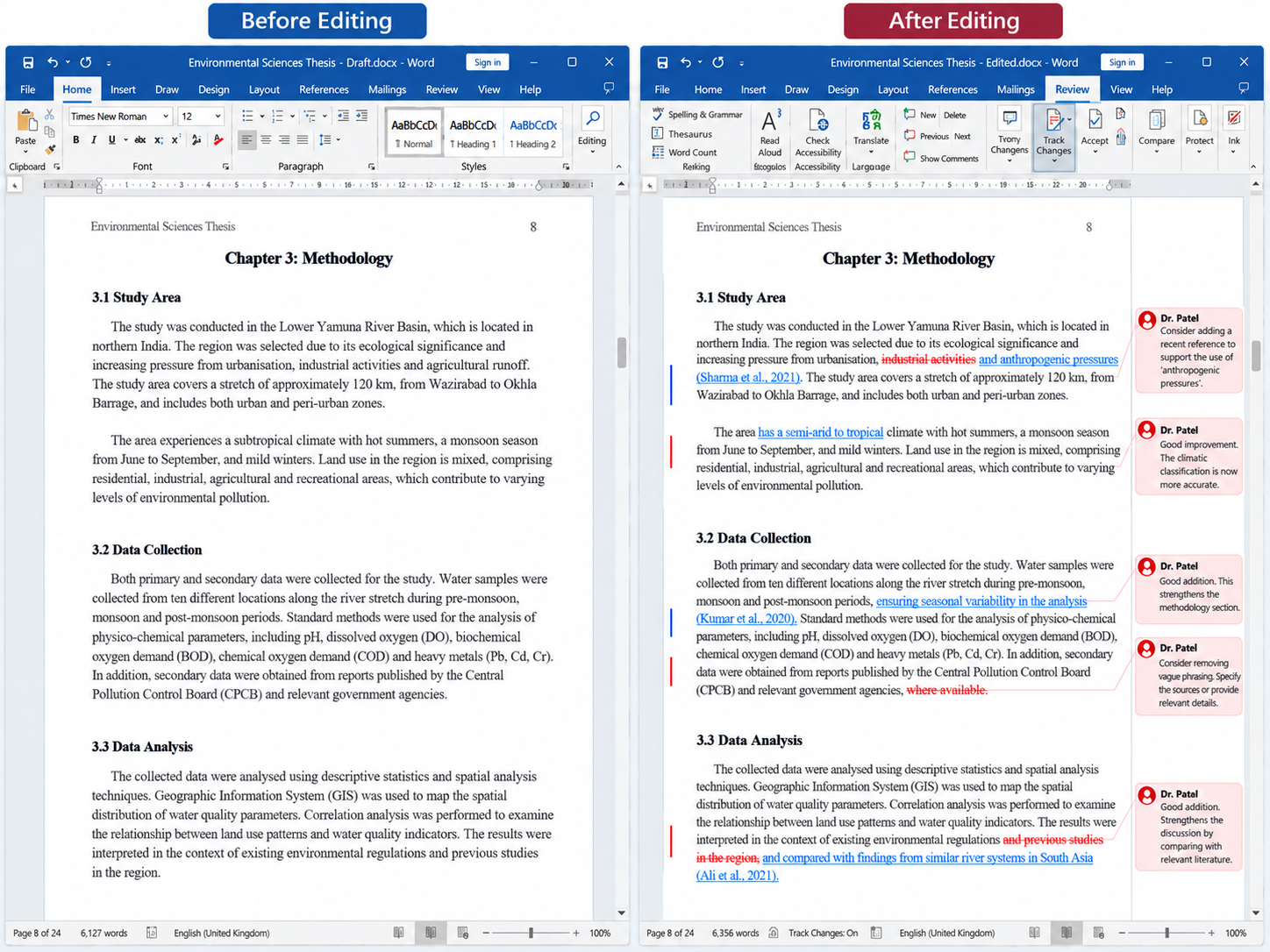
Choose a subject field on the left to view its corresponding before-and-after thesis sample. Each sample demonstrates reviewable improvements in language, structure, presentation and academic clarity while keeping the researcher’s original work and meaning central.
Environmental Sciences Research
A thesis can be academically strong yet still lose polish through inconsistent language, awkward phrasing, weak transitions, citation mismatches or formatting slips. Proofreading targets these final-stage issues rather than rewriting your research.
Sentences that sound wordy, unclear or not academically natural.
Light sentence-level transitions that interrupt readability.
Language slips that reduce clarity in a high-visibility section.
Inconsistent in-text citations, references or obvious style mismatches.
Errors that affect readability, precision and professional presentation.
Inconsistent headings, numbering, captions, spacing or reference presentation.
The service is designed for an already well-developed thesis or dissertation that needs a careful final language and presentation check before submission.
Grammar, spelling, punctuation, syntax, articles, prepositions and typographical corrections.
Light sentence-level clarity corrections plus terminology, spelling and capitalization consistency.
Checks for formal, discipline-appropriate language without substantive rewriting.
Light proofreading of transitions and sentence connections where readability is disrupted.
Checks in-text citations and reference-list presentation for obvious inconsistencies.
Focused final-stage language review for high-visibility thesis sections.
Language, labels, numbering and caption consistency across submitted content.
Headings, numbering, spacing and supplied university or institutional style requirements.
Refine dissertations and thesis chapters for final review or submission.
Polish theses and research projects for academic assessment.
Prepare academic manuscripts, reports and grant-related documents.
Maintain consistent language across team-produced academic documents.
Improve final English-language presentation with confidence.
Proofread concise academic papers, abstracts and related submissions.
Proofreading corrects the final text with a light touch. It does not replace substantive editing, developmental restructuring or author-led decisions about research content.
The results of this study shows that there is a significant increase in the efficiency of the solar cell when the temperature was increased. It can be said that the performance of the cell is better and this is because of the more light and also the other results in the future.
The results of this study show a significant increase in solar-cell efficiency as the temperature increases. Enhanced performance is associated with increased light intensity and other contributing factors. Further investigation is recommended to validate these findings in future studies.
Upload your thesis or chapter and share deadline, style guide and requirements.
We review the document and confirm scope, feasibility and the right delivery option.
A relevant academic proofreader reviews language and presentation carefully.
A final pass checks consistency, completeness and obvious presentation issues.
Receive tracked changes and a clean proofread copy for your final author review.
Final feasibility depends on thesis length, document condition and confirmed proofreading scope.
Strong command of formal academic language and final-stage correction.
Academic context is respected while language and presentation are checked.
Proofreading concentrates on final readability, consistency and presentation.
Tracked changes and editor notes make corrections easy to review.
Research documents are handled with privacy and confidentiality in mind.
Comments highlight items requiring your decision or source verification.
Grammar, spelling, punctuation, typographical errors, sentence-level clarity, consistency, headings, abbreviations, citations, references, captions and formatting presentation where applicable.
No. Proofreading is for an already well-developed document and does not include substantive rewriting, major restructuring or developmental editing.
Yes. The service includes a tracked-changes version and a clean proofread copy for final author review.
Yes, when the relevant style or university guidelines are supplied, the proofreading review can check presentation consistency against them.
Yes. The service is suitable for international researchers who need a final English-language and presentation check.
The workflow is presented as confidential and NDA-friendly, with secure handling of research documents.
Yes. The scope can include consistency checks for in-text citations, reference-list presentation and obvious formatting mismatches, but it does not replace independent source verification.
Yes. Language and consistency checks can cover captions, labels, numbering and related callouts when those items are included in the submitted document.
Yes. You may submit a complete thesis, an individual chapter or another clearly defined section for proofreading.
No. Proofreading refines language and presentation without changing research findings, core arguments or authorship.
A Word document is preferred for tracked changes. You may also provide university guidelines, reference-style instructions and supporting notes relevant to the proofreading request.
This page presents Standard 72-hour, Priority 48-hour and Express 24-hour options. Final feasibility depends on thesis length, document condition and confirmed scope.
“The editing improved clarity and flow without changing my ideas. My thesis was accepted after minor revisions.”Dr. Ananya RaoPhD Candidate, Biology
“Fast turnaround and excellent attention to detail. The editor understood my field and strengthened my arguments.”Prof. Michael TanAssistant Professor, Engineering
“Professional, reliable, and supportive. My manuscript is now much clearer and ready for a top-tier journal.”Dr. Laura ChenPostdoctoral Researcher, Medicine
Thesis proofreading starts from ₹7,500 per chapter up to 5,000 words. Share the document and requirements so any additional quote and delivery adjustments can be confirmed from thesis length, document condition, and required checks.
Provide enough information for the team to assess your document and respond with the appropriate scope and quote.