Environmental & Sciences
Environmental Sciences Research
This sample image could not be loaded. Please try again.
Environmental & Sciences

We format theses and dissertations to the university, department, or style guide you provide. From front matter and headings to pagination, tables, figures, references, and appendices, the document is checked for consistent presentation from beginning to end.
Thesis Formatting is priced from ₹6,000 for theses up to 150 pages. The entry engagement covers front matter, margins and page layout together with heading hierarchy and chapter-style consistency; work beyond that defined scope is assessed separately.
Longer theses, complex equations or tables, damaged source files, extensive citation-style conversion, or multiple university templates are quoted separately. A shorter deadline for Thesis Formatting can be assessed after the working files and requested scope are reviewed; accelerated delivery is confirmed only when feasible for that assignment.
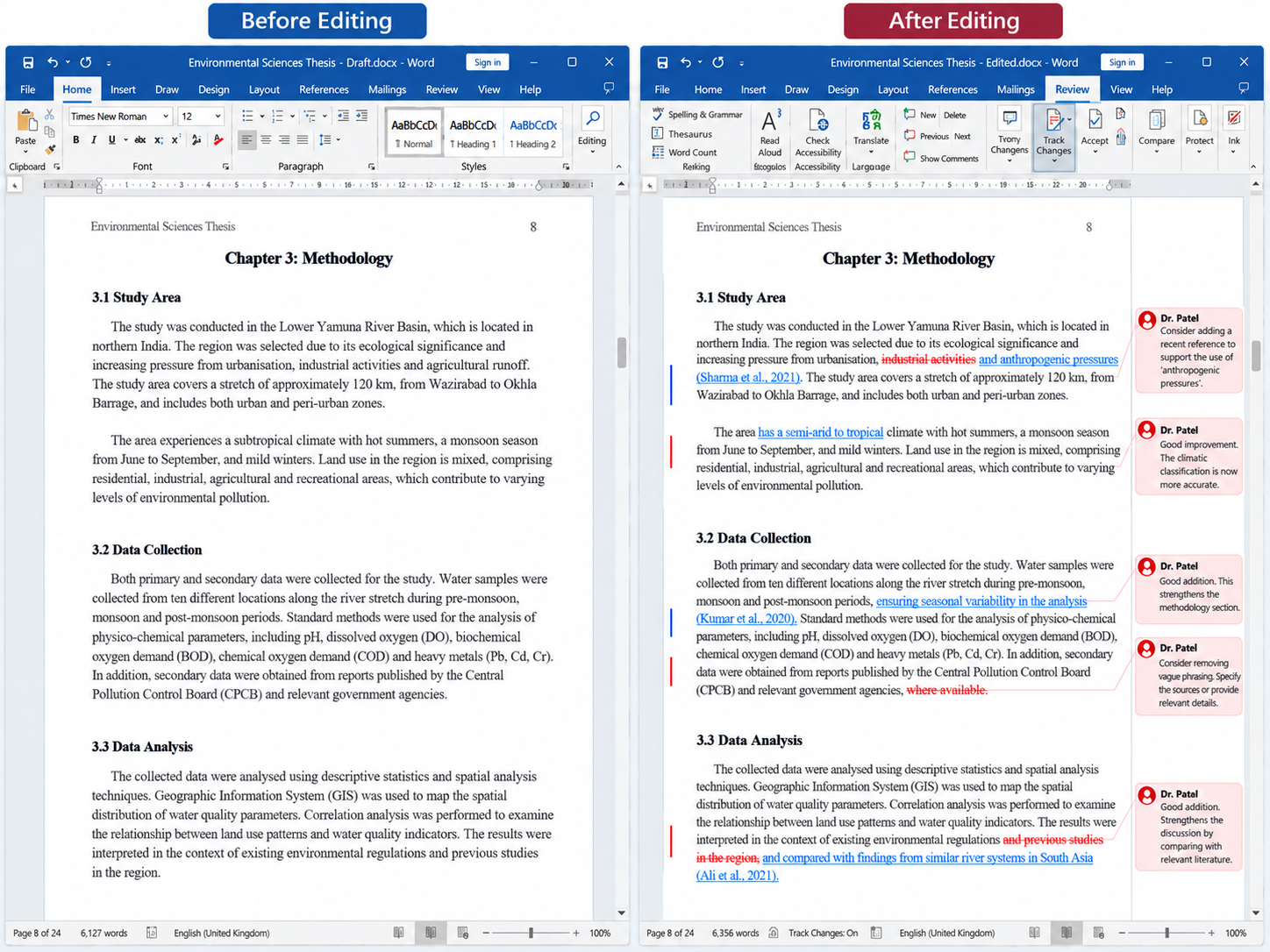
Choose a subject field on the left to view its corresponding before-and-after thesis sample. Each sample demonstrates reviewable improvements in language, structure, presentation and academic clarity while keeping the researcher’s original work and meaning central.
Environmental Sciences Research
Apply the supplied university, department, or publication rules consistently across the thesis.
Format title pages, abstracts, contents, lists, declarations, and other preliminary pages.
Standardize numbering, caption placement, labels, spacing, alignment, and cross-references.
Make reference-list presentation, citation appearance, indentation, and spacing more uniform.
Receive a coherent final layout designed for easier review against the requirements you provide.
Formatting is handled as a connected document system, so front matter, chapters, back matter, and page foundations follow the same underlying rules rather than being corrected in isolation.
Long theses often accumulate inconsistencies as chapters are written at different times. The review focuses on finding those mismatches and applying one consistent formatting logic.
| Author | Year | Finding |
|---|---|---|
| Study A | 2022 | Positive |
| Study B | 2023 | Mixed |
Inconsistent heading levels and style hierarchy across chapters.
Incorrect capitalization, punctuation, or numbering patterns in headings.
Uneven spacing before and after headings, paragraphs, lists, and quotations.
Table captions, notes, borders, and alignment not following one format.
Figure captions or labels placed inconsistently or numbered incorrectly.
Reference-list indentation, spacing, punctuation, or ordering inconsistencies.
Page numbers missing, restarting incorrectly, or using the wrong section sequence.
Margins, indentation, line spacing, and section breaks not matching the supplied guide.
A formatting pass is not just visual cleanup. It connects heading styles, page breaks, numbering, captions, and reference presentation so the document behaves consistently as a whole.
| col1 | col2 | col3 |
|---|---|---|
| a | 2 | 3 |
| b | 4 | 5 |
| Author | Year | Finding |
|---|---|---|
| Study A | 2022 | Positive |
| Study B | 2023 | Mixed |
| Author | Year | Finding |
|---|---|---|
| Study A | 2022 | Positive |
| Study B | 2023 | Mixed |
Your university or department guide controls the final format. Where it references a broader style system, that style can be applied alongside the institution-specific requirements.
| Style / Framework | Heading Structure | Reference Format | Tables / Figures | Running Elements | Front-Matter Rules |
|---|---|---|---|---|---|
| APA (7th Edition) | Heading hierarchy applied as required | Author-date presentation | Labels, titles, notes, and numbering aligned to the applicable guide | Page numbering and running elements as required | Title page, abstract, TOC, and lists where institution requires them |
| MLA (9th Edition) | Heading structure aligned to supplied requirements | Author-page presentation | Caption, label, and source presentation checked for consistency | Page numbering / header format as required | Institution-specific preliminary pages take priority |
| Chicago (17th Edition) | Heading hierarchy mapped consistently | Notes-bibliography or author-date, as supplied | Table and figure presentation aligned to the chosen system | Page numbering and note presentation as required | Front matter mapped to university instructions |
| Harvard | Institution or publisher heading levels applied | Author-date presentation | Captions, numbering, and notes standardized | Headers, footers, and page numbering as required | University rules override generic style where specified |
| IEEE | Numbered or supplied heading hierarchy | Numeric citation / reference presentation | Technical table and figure labels standardized | Page and section elements aligned to supplied rules | Front matter formatted to institutional template |
| Vancouver | Heading hierarchy aligned to supplied guide | Numeric citation / reference presentation | Tables and figures checked for consistent labels and captions | Pagination and running elements as required | Preliminary pages formatted to local requirements |
| University-Specific Guidelines | Custom to the current university or department guide | As specified by the institution | As specified by the institution | As specified by the institution | Custom title page, declarations, abstract, TOC, lists, and other required pages |
Don’t see your institution? Attach the current formatting guide or template with your thesis enquiry.
The workflow moves from requirements to structure, formatting, consistency checks, and final quality review so the whole document is handled in a controlled sequence.
Send your thesis draft and current guidelines or template.
Requirements, exceptions, and submission rules are identified.
Headings, page setup, numbering, and styles are mapped to the guide.
Front matter, chapters, tables, figures, references, and appendices are formatted.
Document-wide spacing, numbering, captions, and styles are cross-checked.
Final presentation is checked against the agreed formatting scope.
Receive the agreed formatted files and any clarification notes.
The exact scope is based on your document and guidelines. Typical thesis-formatting work covers the following connected areas.
Margins, page size, line spacing, paragraph spacing, indentation, page-number formats, section breaks, headers, footers, and consistent page setup.
Chapter titles, heading hierarchy, numbering, section sequencing, consistent heading levels, and style-linked formatting across chapters.
Table of contents, list of tables, list of figures, abbreviation lists, indentation, leader dots, page references, and alignment where applicable.
Numbering, captions, notes, placement, spacing, alignment, figure labels, cross-references, and presentation consistency.
Appendix labels, section numbering, supplementary pages, references to appendices, and a final document-wide formatting consistency check.
Formatting is checked in layers so obvious page-level issues and less visible document-wide inconsistencies are both addressed before delivery.
Apply the supplied guide to core document elements.
Cross-check repeated elements across the full document.
Review the final formatted file for visible presentation issues.
Pricing and turnaround are confirmed after scope and deadline review. The quote and feasible schedule are based on the actual document, guideline complexity, requested outputs, and deadline.
Schedule confirmed after document length and formatting scope are reviewed.
Faster scheduling may be considered where capacity and scope allow.
Urgent support is reviewed against deadline feasibility before confirmation.
Your quote is prepared after the thesis and requirements are checked so the scope reflects the work actually needed.
Request a Formatting QuoteThe same formatting system can be adapted to different document lengths, institutional requirements, and submission contexts when the current guideline is supplied.
Format a full thesis to the current university requirements before submission or supervisor review.
Standardize long, multi-chapter dissertations with complex front matter, figures, appendices, and references.
Apply institution-specific presentation rules clearly when local formatting conventions are unfamiliar.
Bring large academic documents into a consistent presentation format for review and submission workflows.
Reformat chapter material originating from article-style documents into a consistent thesis structure.
Control headings, page numbering, section breaks, cross-references, and repeated elements across long documents.
A consistent format makes a long thesis easier to navigate, review, revise, and compare against the institution’s presentation requirements.
A consistent layout reduces visual distractions and helps readers move through the thesis more easily.
Styles, numbering, captions, and section breaks behave as one connected document system.
Document-wide checks help reduce repeated manual corrections during final review.
Supervisors and examiners can focus on the academic content without avoidable formatting inconsistency.
Structured formatting reduces the need to manually revisit the same page-level rules throughout the document.
You can review a cleaner, more consistent file against the current rules before final submission.
These answers explain the typical boundaries, inputs, deliverables, and scheduling logic for a thesis-formatting request.
Yes. Provide the current university, department, or graduate-school formatting guide with your editable thesis file. The formatting work is mapped to the supplied requirements and applied consistently across the document.
Formatting can cover front matter, chapter structure, heading levels, margins, spacing, page numbering, tables, figures, captions, lists, references, appendices, section breaks, and related document-wide consistency elements.
Yes. Where the document structure allows it, heading styles can be aligned so the table of contents and related lists can be generated or corrected consistently.
Thesis formatting focuses on presentation and consistency. It does not change the research argument or substantively rewrite the content unless a separate editing service is agreed.
Formatting can be aligned to the style guide or institutional requirements you supply. University-specific rules take priority where they differ from a general citation style.
Yes. Layout, numbering, caption placement, spacing, alignment, and cross-referencing presentation can be standardized according to the supplied requirements.
Reference-list presentation can be standardized for spacing, indentation, ordering conventions, punctuation patterns, and visual consistency. Bibliographic accuracy or source verification is separate unless specifically included in another service.
Send the latest editable thesis file, the current university or department guideline, any template you were given, your submission deadline, and notes about known formatting problems or supervisor comments.
Yes. Multi-chapter documents can be reviewed section by section while maintaining document-wide consistency for styles, numbering, pagination, captions, references, and front matter.
Scheduling depends on document length, formatting complexity, the number of tables, figures, references, appendices, supplied guideline detail, requested deliverables, and your deadline. A quote and feasible schedule are confirmed after scope review.
The requested deliverables can include a clean formatted file and a review version that makes formatting changes or clarification points easy to follow, depending on the agreed scope.
No. Formatting is designed to align the document with the supplied rules and improve consistency, but the university or examining body retains final authority over acceptance and submission requirements.
Send enough information for the thesis to be reviewed for formatting scope, guideline complexity, deadline feasibility, and the most appropriate deliverables before work is confirmed.
DOC or DOCX is preferred for detailed formatting work; a PDF can also help show current presentation.
Attach the current handbook, template, checklist, or supervisor instructions that control the format.
Provide the date and any known review milestone so schedule feasibility can be assessed.
Flag TOC, pagination, captions, references, margins, heading levels, appendices, or supervisor comments.
Complete the form below and attach your current draft or guideline where available.