Essential Proofreading • Final academic check

Submit Your Short Academic Paper With Cleaner, More Accurate Language

4.8/5 from 1,250+ research and academic clients worldwide

Essential Proofreading is designed for students and researchers whose paper is already complete and well developed, but still needs a dependable final check for grammar, spelling, punctuation, consistency, and small clarity issues before submission.

  • Up to 3,000 words
  • 2 business day turnaround
  • Tracked changes included
  • Clean proofread copy included
Essential Proofreading for students reviewing a short academic document before submission
Short academic documentsBuilt around papers up to 3,000 words
Final-stage language checkFor already developed student work
Visible correctionsTracked changes for review transparency
Ready-to-review copyClean proofread file returned with markup
1

Essential Proofreading — One Clear Plan for Short Academic Work

A focused service for students and researchers who do not need rewriting or developmental editing, but want a dependable final language check before sending a short paper, essay, conference submission, or concise research document.

Essential Proofreading

Final language accuracy for a short, well-developed document

Best for: short academic papers, conference submissions, essays, and concise research documents that need a dependable final language check.

Turnaround: 2 business days
Word count: Up to 3,000 words
Suggested price ₹5,000/-

Focused proofreading for a short, already well-developed document.

Choose Essential

What this plan includes

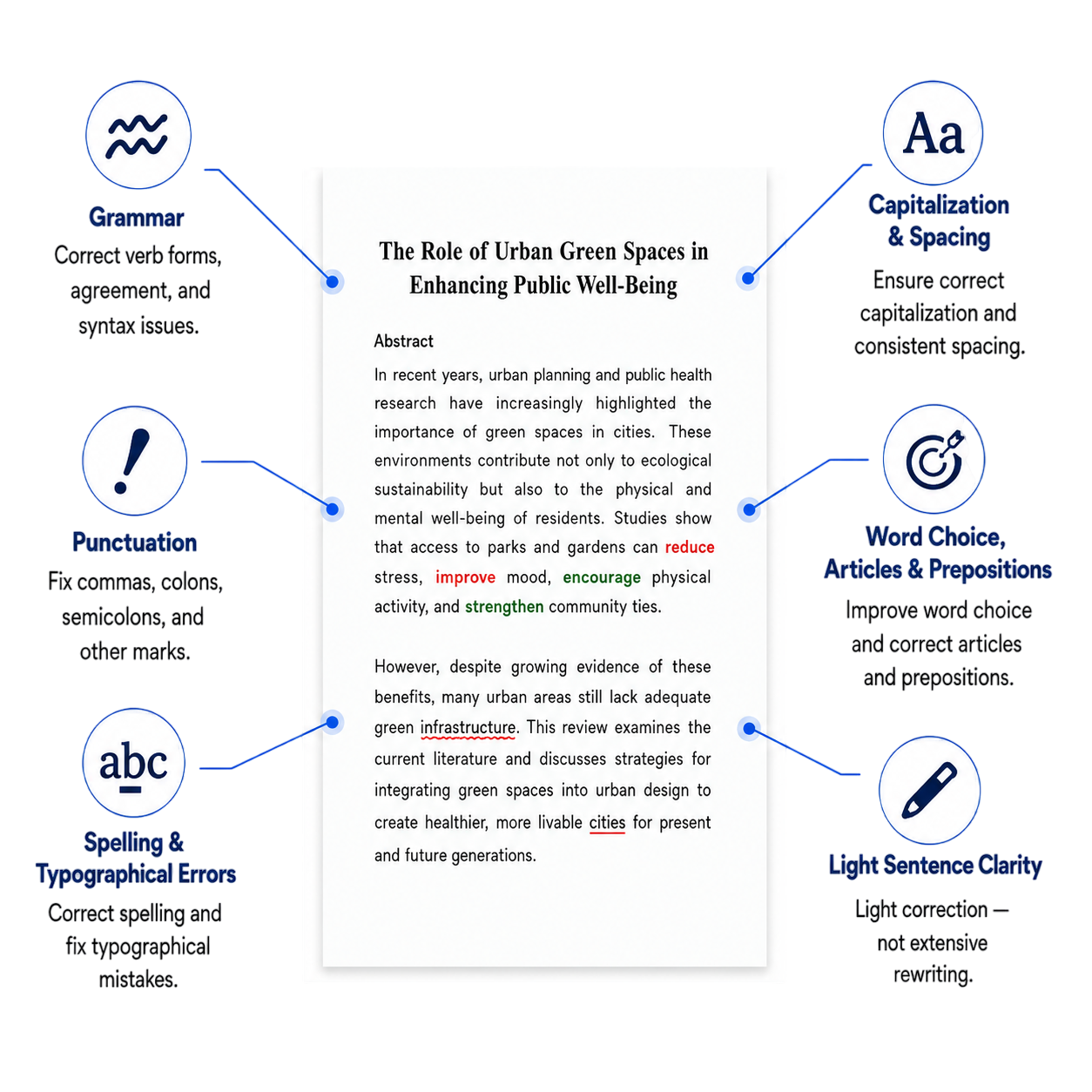
  • Grammar, spelling, punctuation, and typographical corrections
  • Capitalization, spacing, and basic consistency checks
  • Obvious word-choice and article/preposition corrections
  • Light sentence-level clarity corrections
  • Tracked changes for complete review transparency
  • Clean proofread copy ready for final author review

The plan is intended for a document that is already complete and reasonably clear. Work requiring major rewriting, restructuring, argument development, extensive referencing corrections, or content-level editing should be assessed under a broader editing service.

2

Is Essential Proofreading the Right Level for Your Draft?

The fastest way to choose the right service is to look at the condition of your document. Essential Proofreading works best when the academic thinking and structure are already finished and the remaining problems are mostly language-level details.

A good fit for Essential Proofreading

Your content is complete, your argument is in place, and you mainly want a careful final language check.

  • The document is already coherent and logically organized
  • You have completed your own substantive revisions
  • Most remaining issues involve grammar, punctuation, spelling, or consistency
  • You want small clarity fixes without changing your academic voice

Choose a broader service if the draft needs more

Essential Proofreading is intentionally conservative and should not be used as a substitute for rewriting or developmental editing.

  • ×Major sentence rewriting across multiple paragraphs
  • ×Reorganization of sections, argument, evidence, or literature review
  • ×New research, fact checking, source verification, or citation completion
  • ×Heavy journal formatting or complex reference-style conversion
3

Short Academic Documents That Suit This Plan

The 3,000-word limit makes Essential Proofreading especially practical for compact student and research documents where language accuracy matters but extensive editing is unnecessary.

Essays & Assignments

Completed coursework that needs a final check for grammar, punctuation, wording, and consistency before submission.

Conference Submissions

Short papers, extended abstracts, and concise conference documents that are already structurally complete.

Short Research Papers

Compact research documents that need a dependable language pass before supervisor, class, or journal review.

Reflective & Critical Papers

Well-developed reflective, analytical, or critical writing where the ideas are finished and the remaining task is polishing.

Research Summaries

Brief academic summaries, literature overviews, research statements, and project write-ups within the word limit.

Case Study Write-ups

Short case analyses that have already been drafted and only require a careful final language and consistency review.

Short Journal Components

Standalone abstracts, cover text, highlights, summaries, and other concise submission components when supplied as final drafts.

Academic Statements

Short statements or academic-purpose documents where the content is settled and you want final technical language corrections.

Short paper ready?

Finished the writing? Let us handle the final language check.

Send your essay, conference paper, or concise research document for focused proofreading of grammar, punctuation, wording, and consistency.

4

What the Proofreader Checks Line by Line

The review focuses on small but visible language problems that can make an otherwise strong paper look unfinished. Corrections stay close to your existing wording and meaning.

Grammar & sentence mechanics

Agreement, tense, articles, prepositions, common sentence errors, and other grammar issues that can be corrected without rewriting the argument.

Punctuation & spacing

Commas, full stops, colons, semicolons, quotation marks, brackets, hyphens, spacing, and obvious typographical issues.

Spelling & capitalization

Spelling errors, inconsistent capitalization, and basic US/UK English consistency when a preferred convention is specified.

Word choice & usage

Obvious incorrect word forms, articles, prepositions, and awkward usage that can be safely corrected from the immediate context.

Basic consistency

Repeated terms, headings, numbering, abbreviations, capitalization patterns, and other visible inconsistencies inside the document.

Light clarity corrections

Small sentence-level improvements where meaning is already clear and a limited change can remove an obvious language problem.

5

A Simple Four-Step Student Proofreading Workflow

The process is intentionally straightforward so a student can send a finished short document, review every correction, and remain in control of the final submission version.

Send the final draft

Provide the latest author-approved document, ideally in Word, plus the deadline and any language convention or formatting notes.

Line-by-line proofreading

The proofreader checks the short document for language, mechanics, consistency, and small clarity issues within the Essential scope.

Corrections are tracked

Changes remain visible in the marked file so you can see what was corrected and retain full oversight of your academic writing.

Review the clean copy

You receive a clean proofread version for final author review before you upload or submit the document to your institution or event.

6

What You Receive at Delivery

Essential Proofreading returns two practical versions of the same document so you can inspect the corrections and then review a clean reading copy.

Designed for final author control

You remain responsible for the final academic submission.

The proofreader improves language accuracy within the agreed scope. You can review every tracked correction, accept or reject changes, and complete any final content decisions yourself.

Tracked-changes version

A marked copy showing the corrections made during proofreading so you can review them transparently.

Clean proofread version

A clean reading copy with accepted proofreading corrections presented without visible markup for final author review.

Small consistency fixes

Document-level corrections for repeated spelling, capitalization, terminology, spacing, and other basic consistency issues.

Conservative language editing

Only limited clarity changes are made where the intended meaning is already clear and can be preserved.

7

See the Kind of Changes Essential Proofreading Makes

The service targets final-stage errors rather than rewriting the research. This example shows the restrained type of correction a student can expect.

Before proofreadingStudent draft

The results shows that students was more likely to complete the task when instructions were presented clearly. However the sample was small and the findings should be interpreted careful.

Essential proofreading passGrammar + punctuation + usage
After proofreadingLanguage corrected

The results show that students were more likely to complete the task when instructions were presented clearly. However, the sample was small, and the findings should be interpreted carefully.

Subject–verb agreement“shows” becomes “show”.
Verb agreement“was” becomes “were”.
PunctuationA comma is added after “However” and before the final clause.
Word form“careful” becomes the adverb “carefully”.

Illustrative example only. Actual corrections depend on the submitted document and the agreed Essential Proofreading scope.

Final-stage corrections

Want your draft checked with the same careful, conservative approach?

Essential Proofreading corrects visible language issues while keeping your argument, research, and academic voice under your control.

8

Clear Scope Boundaries Prevent the Wrong Service Choice

Essential Proofreading is deliberately limited. It works well when the draft is already strong, but it is not designed to solve content, research, structure, or major writing problems.

Included in Essential Proofreading

  • Grammar, spelling, punctuation, and typographical correction
  • Capitalization, spacing, and obvious consistency issues
  • Obvious word-choice, article, and preposition errors
  • Small clarity fixes that do not change meaning

Not included in this plan

  • ×Substantive rewriting or paragraph-level redrafting
  • ×Development of argument, evidence, interpretation, or research content
  • ×Independent source verification, plagiarism review, or research fact checking
  • ×Complex journal reformatting or full citation-style conversion
9

When Students Commonly Use Essential Proofreading

This plan is most useful at the point where the academic work is already done and the student wants a final technical language pass before a fixed submission event.

Before an assignment deadline

You have finished the essay or paper and want someone to catch small language errors you may no longer notice after repeated self-editing.

Before a conference upload

Your short submission is complete, but you want the language, punctuation, and presentation checked before uploading the final file.

After your own final revision

You have already addressed supervisor or peer feedback and now need a conservative check that does not reopen the document structurally.

For a concise research document

Your draft is short enough for the Essential word limit and does not require substantial academic editing or reference rebuilding.

When English is not your first language

The paper is already clear and complete, but you want help correcting article, preposition, grammar, and usage errors that remain in the final draft.

When you want transparent corrections

You prefer to see every language change in tracked form before deciding what to accept in your final academic submission.

10

What to Send With Your Document

A small amount of context helps the proofreader apply the right language conventions without turning the project into a broader editing assignment.

Latest Word file

Send the final author-approved document whenever possible so tracked changes can be used efficiently.

Exact deadline

Include the submission date, time, and time zone so the 2-business-day schedule can be assessed correctly.

English preference

State whether the document should follow US, UK, Australian, or another English spelling convention when relevant.

Basic style notes

Provide any brief university, conference, or journal language and formatting instructions that affect the proofreading pass.

Academic level

Tell us whether the document is undergraduate, postgraduate, doctoral, conference, or research-oriented.

Priority concerns

Mention recurring problems such as articles, prepositions, punctuation, capitalization, or spelling consistency.

11

What Students Value in a Final Proofreading Pass

The examples below reflect the type of outcome students usually look for from a conservative final-stage proofreading service: visible corrections, preserved meaning, and a cleaner document for final review.

Postgraduate student testimonial
★★★★★

“I had already revised my essay several times, so I only wanted grammar and punctuation checked. The tracked file made it easy to understand what had changed without losing my own wording.”

Postgraduate studentShort academic essay
Research student testimonial
★★★★★

“The service was useful because the paper was basically finished. Small article, spelling, and consistency errors were corrected, and the clean copy was straightforward to review before submission.”

Research studentConference paper
University student testimonial
★★★★★

“I did not need my argument rewritten. I needed a final technical language check. The proofreader kept the content intact and corrected the kinds of errors I kept overlooking.”

University studentResearch assignment
Doctoral student testimonial
★★★★★

“My abstract was already within the conference format, but I was worried about small grammar mistakes. The final pass caught them without changing the technical meaning or making the wording sound unfamiliar.”

Doctoral studentConference abstract
Master's student testimonial
★★★★★

“Seeing the edits in tracked changes was the most useful part. I could review every correction, understand the punctuation fixes, and then use the clean version for my final university submission.”

Master’s studentCritical analysis paper
Research scholar testimonial
★★★★★

“I wanted a careful last check after incorporating supervisor comments. The proofreading focused on language and consistency, so I could submit knowing the paper had been checked without reopening the research itself.”

Research scholarShort manuscript section
Ready for your final review?

Move from a finished draft to a cleaner submission copy.

Choose Essential Proofreading when your paper is already developed and you want a dependable final pass before submission.

12

Proofreading Samples by Subject Area

Explore proofreading samples across medical and health sciences, life sciences, engineering and technology, humanities and social sciences, business and management, law, environment, and interdisciplinary fields. Each link opens the corresponding proofreading sample page in a new tab.

Sample Category 01

Medical & Health Sciences

Clinical, medical, allied health, public health, and healthcare proofreading samples.

34
proofreading sample pages
Sample Category 02

Life Sciences & Biomedical Research

Biology, biomedical research, biotechnology, ecology, and laboratory science proofreading samples.

24
proofreading sample pages
Sample Category 03

Physical Sciences, Engineering & Technology

Chemistry, physics, engineering, computing, AI, data science, and technology proofreading samples.

27
proofreading sample pages
Sample Category 04

Humanities & Social Sciences

History, psychology, literature, sociology, education, communication, policy, and area studies proofreading samples.

18
proofreading sample pages
Sample Category 05

Business, Economics & Management

Finance, economics, management, marketing, operations, HR, strategy, and compliance proofreading samples.

19
proofreading sample pages
13

Essential Proofreading FAQs

Answers to the most important questions about the ₹5,000/- plan, 3,000-word limit, 2-business-day turnaround, tracked changes, and the boundary between proofreading and heavier editing.

What is Essential Proofreading designed for?
It is designed for short academic documents that are already well developed and close to submission. The service focuses on final language accuracy rather than rewriting, restructuring, or developing the content.
What is the word-count limit?
The Essential Proofreading plan covers up to 3,000 words. A longer document should be assessed separately so the scope, turnaround, and price match the actual length.
What is the suggested price?
The suggested price for Essential Proofreading is ₹5,000/- for a document within the stated 3,000-word limit and standard scope.
How long does the service take?
The standard turnaround is 2 business days, subject to confirming the document length, file condition, and final scope before work begins.
Will I receive tracked changes?
Yes. A tracked-changes version is included so you can review the proofreading corrections transparently.
Will I receive a clean copy?
Yes. The plan includes a clean proofread copy in addition to the tracked version, so you can read the corrected document without visible markup.
Does this plan include sentence rewriting?
Only light sentence-level clarity corrections are included where the intended meaning is already clear and can be preserved. Extensive rewriting is outside the Essential Proofreading scope.
Can you improve my argument or research content?
No. The service does not develop arguments, add evidence, change research findings, restructure sections, or make substantive content decisions.
Can you correct articles and prepositions?
Yes. Obvious article and preposition errors are included, along with clear word-choice issues that can be corrected confidently from the surrounding sentence.
Can you follow UK or US English?
Yes. Tell us the preferred English convention before proofreading begins so spelling and related language consistency can be checked accordingly.
Is this suitable for a rough first draft?
Usually not. A rough or poorly structured draft normally needs a broader editing service because proofreading assumes the document is already coherent, complete, and reasonably well written.
Do you verify citations and sources?
Independent source verification is not included. Essential Proofreading focuses on language and basic visible consistency, not research validation or full reference auditing.
Can I use this for a conference paper?
Yes, provided the conference submission is within the 3,000-word limit and is already structurally complete and ready for a final language check.
What file format should I send?
A Word document is preferred because it supports tracked changes. You may also supply a PDF or brief style guide as a reference where relevant.
Can proofreading guarantee a grade or acceptance?
No. Proofreading can improve language accuracy and presentation, but academic grades, conference decisions, and publication outcomes depend on factors beyond proofreading.

14

Request Essential Proofreading for Your Short Academic Document

Share the basic project details below so the team can confirm whether your document fits the Essential Proofreading scope, 3,000-word limit, and 2-business-day schedule.

Before you submit the enquiry

Include the information that affects the final proofreading pass.

You do not need a long brief. A concise set of document and deadline details is usually enough to assess whether Essential Proofreading is the correct level.

Document type: essay, conference paper, short research paper, case study, or another concise academic document.
Approximate word count: Essential Proofreading covers up to 3,000 words.
Deadline: include the exact date, time, and time zone.
Language preference: mention US, UK, or another English convention if required.
Priority issues: flag recurring grammar, punctuation, article, preposition, spelling, or consistency concerns.

Essential Proofreading Enquiry

Complete the form so your short document can be assessed against the plan scope.

Security check *Loading question…

Please do not include confidential research data in this short enquiry field. The full document and any supporting instructions can be shared through the appropriate project handoff process.