Clear Communication
Scope, priorities, deadlines, and manuscript-specific instructions are captured before editing so the depth of intervention is clear.

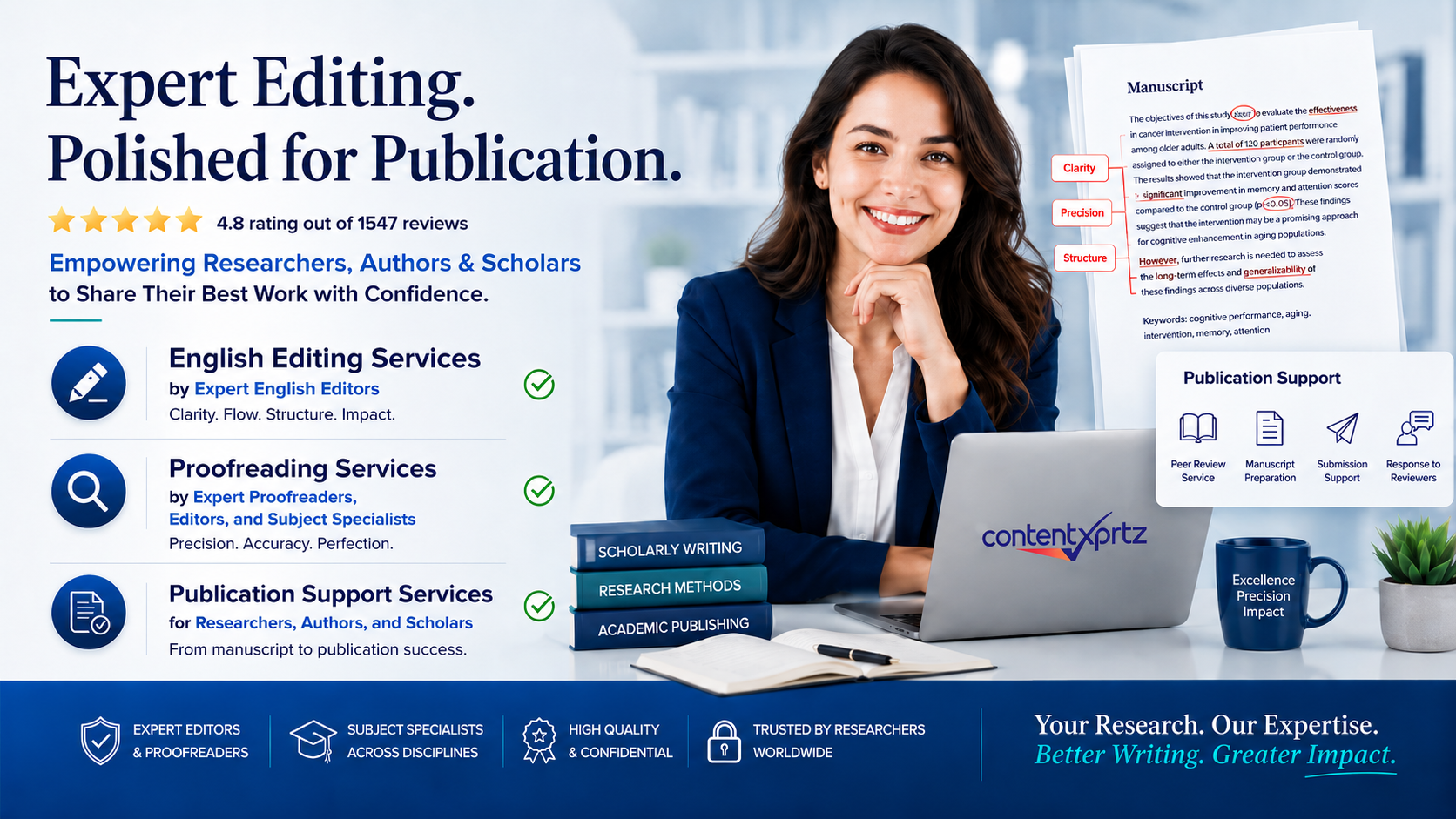
Supporting authors, researchers, students, and institutions preparing academic work for leading publishers, journals, universities, and scholarly communities worldwide.


From research manuscripts and theses to application and professional documents, ContentXprtz supports editing, proofreading, formatting, citation review, and publication-readiness needs across the document lifecycle.
The document type does not determine the editing depth by itself. professional editing is appropriate when the content is substantially developed and the remaining challenge is how clearly, consistently, and professionally that content is communicated.
ContentXprtz combines specialist expertise, clear service scopes, secure workflows, and practical publication support so researchers, students, authors, and institutions can move from draft to submission with greater confidence.

Scope, priorities, deadlines, and manuscript-specific instructions are captured before editing so the depth of intervention is clear.
Projects are matched with editors and subject specialists who understand academic conventions, disciplinary terminology, and the level of support requested.
Each service is clearly defined—from proofreading and editing to formatting, plagiarism review, publication support, and PhD guidance—so you know what is included.
Delivery planning considers document length, complexity, and requested checks so the confirmed schedule is realistic and usable.
Our support is designed to strengthen presentation and clarity while preserving your ideas, evidence, analysis, voice, and academic ownership.
Services are delivered with respect for academic integrity, responsible authorship, confidentiality, and institution or journal requirements.
Extend your core editing or proofreading service with practical research and publication support, including journal formatting, word-count reduction, expert Q&A, manuscript review, cover-letter assistance, and additional editorial checks.
Use the post-edit support period to ask why a passage was changed, clarify an editor query, or discuss a reasonable revision to wording within the confirmed Editing scope.
Request a formal editing certificate when a journal, university, supervisor, or other recipient asks for evidence that the manuscript received professional language editing.
Have the final manuscript presentation aligned to supplied journal instructions, including relevant headings, references, tables, figures, margins, and other specified elements.
Tighten repetitive or unnecessarily expanded wording to help meet a target length while retaining the manuscript’s core argument, evidence, qualifications, and academic meaning.
Receive a concise editorial overview of recurring language, flow, consistency, or presentation issues that deserve the author’s attention after the detailed edit.
Prepare or refine the language and presentation of a journal cover letter so the submission is introduced clearly and professionally without overstating the manuscript’s contribution.
Add a second editorial pass where an additional reviewer checks the edited manuscript for unresolved language problems, internal consistency, and final presentation.
Where possible, match the manuscript with an editor familiar with the relevant academic field so terminology, disciplinary conventions, and context can be handled more appropriately.
Use the available support window for reasonable questions about delivered edits, journal-facing presentation, and author revisions connected to the completed professional editing service.

Our service guarantee applies to language-quality issues that are clearly within the confirmed Editing scope. If a journal or reviewer identifies a qualifying language problem after delivery, share the relevant feedback so the issue can be reviewed against the agreed work. Editorial quality cannot guarantee acceptance, because academic decisions also depend on research quality, originality, methodology, journal fit, reviewer judgment, and institutional requirements.
Researchers, students, and authors value clear communication, subject-aware support, transparent revisions, dependable turnaround, and practical guidance across editing, proofreading, and publication workflows.
The editor did more than correct grammar. Dense sentences were reorganised, terminology became more consistent, and the comments helped me identify places where my intended meaning was not obvious.
I used professional editing before journal submission because the discussion section felt uneven. The revisions made the relationship between results and interpretation much clearer without changing my conclusions.
The tracked changes were especially useful. I could see where wording had been shortened, where transitions were improved, and where the editor had queried an ambiguous statement instead of guessing.
My dissertation chapter needed a deeper language edit after supervisor feedback. The service improved paragraph flow and academic tone while keeping my citations, examples, and core analysis in place.
The clean copy was noticeably easier to read, but it still sounded like my work. The strongest improvements were in sentence logic, repeated phrasing, and transitions between ideas.
The team helped polish my argumentative essay. They caught repeated errors, improved transitions, and made the essay sound more academic.
Common questions about our academic editing, proofreading, publication support, plagiarism checks, citation and formatting assistance, turnaround, confidentiality, and PhD guidance services.
ContentXprtz supports academic and research projects through editing, proofreading, citation and formatting review, publication preparation, plagiarism checks, manuscript support, and PhD guidance. The exact scope is confirmed before work begins.
We support journal manuscripts, research papers, theses, dissertations, literature reviews, proposals, case studies, coursework, application documents, books, reports, and selected professional content.
Proofreading is best for a near-final document that mainly needs correction of language and consistency issues. Editing is more suitable when wording, clarity, academic tone, sentence construction, paragraph flow, or presentation also need improvement.
Yes. Share the relevant journal, university, publisher, or institutional instructions and the team can apply the confirmed requirements for language, references, citations, headings, tables, figures, and formatting within the agreed scope.
Yes. Depending on the project, support may include journal formatting, cover-letter assistance, manuscript review, word-count reduction, editor Q&A, and additional editorial checks before submission.
Plagiarism-check services can be requested separately or alongside other support. The purpose is to identify similarity concerns so the author can review quotations, paraphrasing, citations, and source attribution before submission.
Yes. PhD guidance and dissertation-related support are available for researchers who need structured academic assistance, editorial guidance, or help navigating document and submission requirements while retaining responsibility for their own research.
Projects are handled through controlled workflows designed to protect client documents and information. Confidentiality and secure handling are treated as core service requirements.
Turnaround depends on word count, document complexity, service depth, subject area, formatting requirements, and requested deadline. The delivery schedule is confirmed with the project scope.
Share your document type, word count, required service, deadline, subject area, and any journal or university instructions. The team can then recommend the appropriate scope and provide a project quote.
Tell us about your manuscript, word count, deadline, academic level, citation or journal requirements, and the areas that need attention. We can help identify the editing level that best matches your document.
Share the document type, approximate word count, exact deadline, and time zone.
Describe the areas that need deeper improvement, such as paragraph flow, academic expression, organisation, repetition, terminology consistency, citations, or formatting.
Specify undergraduate, postgraduate, doctoral, journal manuscript, or another academic level.
Include APA, MLA, Harvard, Chicago, IEEE, Vancouver, or your required institutional style.
Provide university, journal, supervisor, or submission instructions that the editor should follow.
Highlight grammar, clarity, flow, academic tone, structure, references, formatting, or other focus areas.
Share your contact details and editing requirements below so your manuscript can be reviewed for scope, deadline feasibility, and the most suitable editing approach.
Our editing operations reference recognised information-security, quality-management, and translation-service standards as part of the wider controls used to handle client documents and service delivery.
Information Security
Management System
Quality Management
System
Translation service
requirements
Manuscripts and related client information are handled through controlled processes intended to protect confidential academic and unpublished material throughout the editing workflow.
We prioritize data confidentiality with robust policies, procedures, and infrastructure to secure your valuable information.
Email support is available around the clock for service questions, document-submission issues, deadline information, and follow-up connected to your editing request.
We offer 24-hour email support to provide you with accurate information and to swiftly address & resolve all your queries.
Payment options include major cards, PayPal, and bank transfer, with available pay-now or pay-later arrangements shown during the service process.
We accept payments via Paypal and all major debit/credit cards & bank transfers. Use our flexible Pay now or Pay later options.