Thesis Paper: How to Plan, Write, Edit, and Submit with Confidence
A thesis paper is not simply a longer college assignment. It is a sustained academic argument or research report in which you define a focused problem, position your work within existing scholarship, explain how you investigated the question, present evidence, and show what your findings mean. Depending on the university, degree level, discipline, and country, the terms thesis and dissertation may be used differently, and some programs allow a paper-based or article-based format. The safest starting point is therefore not a generic template but your institution’s current handbook, supervisor guidance, and submission rules.
That distinction matters because many thesis problems begin before the writing stage. A student may choose a topic that is interesting but too broad, collect sources without a clear research question, draft chapters before deciding how they connect, or leave citation and formatting decisions until the final week. PhD scholars often face a different version of the same pressure: large evidence sets, complex methods, multiple chapters, co-author expectations, language concerns, and repeated supervisor feedback. When deadlines tighten, it becomes tempting to treat editing as cosmetic cleanup. In reality, a strong thesis needs several layers of review: argument, structure, evidence, methodological clarity, consistency, citation accuracy, language, and final submission formatting.
The practical goal is to make every chapter do a defined job. Your introduction should establish the problem and research purpose. The literature review should synthesize what is known and where uncertainty remains. The methodology should explain what you did and why the approach is appropriate. Results or findings should report evidence clearly, while the discussion should interpret that evidence in relation to the research question and prior work. A conclusion should answer the central question, identify contributions and limitations, and point to sensible next steps. These sections may be combined or renamed in some disciplines, but the underlying logic remains important.
This guide shows how to move from a thesis idea to a defensible, submission-ready document without confusing legitimate academic support with replacement of the author’s intellectual work. It covers planning, chapter structure, literature synthesis, methods, drafting, revision, thesis editing, proofreading, referencing, practical examples, and an end-stage checklist. Where professional help is discussed, the emphasis is on ethical support that improves clarity and presentation while leaving research decisions, claims, data, interpretations, and final responsibility with the author.
Quick Answer: What Is a Thesis Paper?
A thesis paper is a substantial academic document that presents a focused research question, a reasoned argument or investigation, supporting evidence, and a clear conclusion. Its exact structure varies by discipline and institution, but most theses include front matter, an introduction, a review of relevant literature, a methodology or approach, findings or analysis, a discussion, a conclusion, references, and—where needed—appendices.
The best way to write one is to start from the university’s requirements, convert the topic into a researchable question, create a chapter map, build an evidence system, and draft in stages. Review the thesis at multiple levels rather than editing sentence by sentence too early: first check research logic and chapter purpose, then evidence and citations, then language and formatting.
The most important caution is that a thesis must remain the student’s or researcher’s own academic work. Editing, proofreading, formatting, and research organization can be legitimate forms of support when permitted, but the author should retain responsibility for the research design, analysis, claims, sources, and final submission.
Key Takeaways
- A thesis paper should answer a focused research question through a coherent academic argument or investigation.
- University and department rules take priority over generic online templates.
- Plan chapters by purpose before polishing sentences; structure problems are harder to fix at the end.
- A literature review should synthesize patterns, debates, methods, and gaps rather than summarize sources one by one.
- Methodology must be detailed enough for readers to understand how evidence was produced and why the approach fits the question.
- Thesis editing and proofreading are different stages: editing improves clarity and coherence, while proofreading catches final surface errors and inconsistencies.
- Authors remain responsible for the originality, evidence, citations, data, interpretations, and academic integrity of the final thesis.
What This Page Covers
- What a thesis paper means and how it differs from an ordinary term paper
- How to turn a broad topic into a workable research question and chapter plan
- Typical thesis sections and the purpose of each part
- How to write literature, methodology, findings, discussion, and conclusion chapters
- When self-editing is enough and when specialist thesis editing may be useful
- Common structural, citation, language, and submission mistakes
- A practical thesis-paper checklist plus ten detailed FAQs
Table of Contents
- Meaning and academic context
- Why students search for thesis help
- Free, low-cost, and professional options
- When expert editing is safer
- Academic ethics and author responsibility
- Thesis paper structure
- Step-by-step writing workflow
- Common mistakes
- Practical examples
- Submission-readiness checklist
- Frequently asked questions
Methodology and Academic Sources
This article is built around common thesis-writing, editing, and submission workflows and is intended as general academic guidance rather than a replacement for institution-specific rules. Thesis structures, page formats, citation styles, examination requirements, and permitted editing support can differ substantially across programs. Cornell Graduate School, for example, separates required sections, formatting standards, templates, and submission processes, illustrating why students should check their own graduate-school guidance before adopting a generic format.
For writing and formatting, consult your university handbook and the style system required by your discipline. The Cornell Graduate School thesis guidance is one example of institution-level requirements, while the APA Style paper-format guidance shows how a style authority defines manuscript presentation. For authorship and ethical responsibility, researchers can consult the Committee on Publication Ethics (COPE) authorship guidance and the ICMJE authorship recommendations. Always follow the rules that apply to your program, research area, and intended publication route.
What a Thesis Paper Means in an Academic Context
A thesis paper is a formal record of a substantial piece of academic work. At its core, it demonstrates that the author can define a meaningful question, engage critically with prior scholarship, use an appropriate method or analytical approach, and develop conclusions that are supported by evidence. The document is normally examined not only for what it says but also for how transparently the reasoning is presented.
The word thesis can refer both to the central claim of an argument and to the full research document submitted for a degree. Universities also differ in how they use the words thesis and dissertation. In some systems, a master’s project is called a thesis and a doctoral project a dissertation; elsewhere the terminology is reversed or discipline-specific. Avoid assuming that a structure found online is automatically correct for your program.
How a thesis paper differs from a term paper
| Dimension | Term paper | Thesis paper |
|---|---|---|
| Purpose | Demonstrates learning about a defined course topic | Develops or reports a sustained research contribution |
| Research question | May be assigned or relatively narrow | Usually requires explicit justification and scope |
| Evidence | Often relies mainly on existing literature | May combine literature with original data, analysis, experiments, archives, models, or other evidence |
| Structure | Usually shorter and simpler | Chapter-based, with institutional front matter and submission requirements |
| Review | Marked by course instructor | Typically supervised and formally examined or assessed |
| Revision depth | Usually limited cycles | Multiple rounds of conceptual, methodological, structural, language, and format revision |
The comparison is only a general guide. A professional or practice-based thesis may look different from an experimental science thesis, while humanities research may organize evidence through thematic or argument-led chapters rather than separate methods and results sections.
Why Students, PhD Scholars, and Researchers Search for Thesis Paper Help
Most people searching for thesis-paper guidance are not asking for a single definition; they are trying to solve a planning, writing, or submission problem. The challenge often changes as the thesis develops.
At the beginning: turning interest into a researchable problem
A broad topic such as “artificial intelligence in education” is not yet a thesis question. The researcher must decide what population, context, outcome, mechanism, period, body of theory, or evidence will make the inquiry manageable. A useful topic is broad enough to matter but narrow enough to investigate with the available time, data, skills, and ethical approvals.
In the middle: keeping chapters connected
Many drafts grow unevenly. The literature review becomes much longer than the analysis, methods are described after the fact, or findings appear that were never anticipated in the research questions. A chapter map helps prevent this drift by giving each section a purpose and showing how one chapter creates the need for the next.
Near submission: separating revision from proofreading
Late-stage writers often try to fix argument, citations, grammar, tables, page numbers, and formatting simultaneously. That increases cognitive load and makes errors easy to miss. A safer sequence is macro-revision first, then paragraph and sentence editing, then reference and formatting checks, and finally proofreading on a stable version.
Free, Low-Cost, and Professional Thesis Support Options
Different thesis problems require different kinds of support. The most expensive option is not automatically the best, and free support can be sufficient when the need is clearly defined.
| Support option | Best for | Strength | Caution |
|---|---|---|---|
| Supervisor or advisory committee | Research scope, disciplinary expectations, argument, methods, interpretation | Closest to your program and research context | Feedback cycles may be limited; prepare focused questions |
| University writing centre | Planning, paragraph structure, academic style, revision strategies | Often free and aligned with institutional policies | May not provide specialist subject editing |
| Academic librarian | Database selection, search strategies, source discovery, reference tools | Strong research-information expertise | Does not replace critical appraisal or author interpretation |
| Reference manager | Organising citations, PDFs, notes, and bibliographies | Reduces repetitive citation work | Imported metadata still requires verification |
| Peer writing group | Accountability, reader feedback, explanation of complex ideas | Low-cost and motivating | Peers may not know formal thesis rules |
| Professional thesis editing | Language, structure, consistency, formatting, final readability | Focused document-level review | Must comply with university rules and preserve author ownership |
Before paying for outside support, define the problem. If you need a research decision, your supervisor is usually the correct first contact. If your sources are disorganized, a librarian or reference-management workflow may solve more than line editing. If the research and argument are complete but the manuscript is difficult to follow, professional thesis editing services may be more relevant.
When Free Support Is Enough and When Expert Thesis Editing Is Safer
Self-editing is often enough when the thesis is well structured, the author writes confidently in the required academic register, and there is time to revise in several passes. Expert editing becomes more useful when the document is long, technically dense, written in a second language, assembled from multiple papers, or approaching a fixed submission deadline with unresolved consistency problems.
Self-edit first when the intellectual structure is still changing
Do not pay for detailed sentence editing while entire sections are likely to be deleted or reorganized. First confirm the research question, chapter sequence, major claims, methods, and evidence. Ask whether every chapter answers a necessary part of the thesis problem and whether conclusions are proportional to the data.
Consider specialist editing when the research is stable
Once the substantive content is largely settled, an editor can review transitions, paragraph logic, terminology, tense, repetition, grammar, tables, captions, cross-references, citations, and formatting consistency. For multilingual researchers, editing can also help distinguish language difficulty from conceptual difficulty without changing the author’s intended meaning.
Check what your university permits
Editing policies vary. Some programs allow language and formatting assistance but restrict substantive rewriting; others require disclosure of particular forms of help. Ask for the policy in writing if it is unclear. A responsible provider should be willing to work within those limits and should not claim to guarantee thesis approval.
Ethical Academic Editing and Author Responsibility
Ethical thesis support improves communication without taking over the intellectual work that the degree is meant to assess. The author should remain responsible for the research problem, study design, data, analysis, interpretation, claims, citations, and final submission.
This principle also matters when parts of a thesis are prepared as publishable papers. COPE and ICMJE both emphasize that authorship is tied to meaningful contribution and accountability. A thesis editor, proofreader, translator, statistician, or research assistant may deserve acknowledgement or disclosure depending on the nature of the contribution and the applicable policy, but such support does not automatically justify authorship.
Using AI tools responsibly
AI can help with brainstorming, language checking, or organization in settings where institutional rules permit it, but generated text and references require verification. AI systems can misstate sources, invent citations, flatten disciplinary nuance, or create language that sounds confident without being supported by the research. Keep a record of how tools were used if your institution requires disclosure, and never submit generated claims or references that you have not checked against authentic sources.
A good test is whether you can defend every sentence in the thesis. If an examiner asks why a method was chosen, what a source actually found, or how a conclusion follows from the data, the answer must come from your own understanding rather than from an editor or tool.
How to Structure a Thesis Paper from Front Matter to Conclusion
A thesis structure should mirror the logic of the research. The familiar introduction–literature–methods–results–discussion sequence works well in many empirical disciplines, but some theses use thematic chapters, integrated results and discussion, design portfolios, creative components, or a series of publishable papers. Start with your approved institutional model.
Front matter
Front matter commonly includes a title page, declaration or originality statement, abstract, acknowledgements, table of contents, and lists of figures, tables, abbreviations, or symbols where needed. Exact order, wording, signatures, and pagination are often institution-specific.
Introduction
The introduction should establish the research problem, context, rationale, aims or objectives, research questions or hypotheses, scope, and a concise map of the thesis. Avoid turning it into a full literature review. Readers should finish the introduction knowing what problem the thesis addresses, why it matters, and how the document will answer it.
Literature review
A strong literature review organizes scholarship around concepts, debates, methods, or evidence patterns. It should explain what is established, where findings conflict, what limitations persist, and how those observations create the need for the present study. Synthesis is more important than the number of citations.
Methodology or approach
The methodology chapter explains how the research question was investigated. Depending on the field, it may cover design, setting, participants or materials, sampling, instruments, variables, procedures, analytical methods, quality controls, reflexivity, ethics, limitations, or theoretical approach. The detail should be sufficient for readers to judge the appropriateness and credibility of the work.
Results or findings
This section presents the evidence generated by the study. Use tables, figures, quotations, themes, equations, models, or other forms of evidence as appropriate. Do not bury the key result in background explanation. Each subsection should connect clearly to the research question or analytical framework.
Discussion
The discussion interprets the findings. Explain what they mean, how they compare with prior work, why unexpected results may have occurred, what alternative interpretations exist, and what limitations constrain the conclusions. Avoid simply repeating the results chapter in different words.
Conclusion
The conclusion should answer the research question at the level supported by the evidence, summarize the contribution, acknowledge limitations, and identify practical or research implications. It is not the place to introduce major new evidence that readers have not seen earlier.
References and appendices
Use the citation style required by your institution or discipline and verify every source against the original record. Appendices can hold supporting material that is necessary for transparency but would interrupt the main argument, such as instruments, extended tables, interview guides, codebooks, or approval documentation when appropriate.
Step-by-Step Guidance for Writing a Thesis Paper
The most efficient thesis workflow separates thinking, evidence management, drafting, and editing instead of trying to perfect everything at once.
Step 1: Confirm the rules before you plan the document
Collect the current thesis handbook, formatting template, examination rules, citation requirements, ethics conditions, and any departmental guidance. Create a one-page compliance list so formal requirements do not become a last-minute surprise.
Step 2: Convert the topic into a focused research question
Write the broad topic, then specify the population or material, context, key concept or variable, method, outcome, and time frame where relevant. Test whether the question is answerable with the data and resources you can realistically obtain. A focused question prevents the literature review and methods from expanding without control.
Step 3: Build a chapter map before drafting
For every planned chapter, write one sentence answering: “What does this chapter need to prove, explain, or report?” Add two or three subsection purposes beneath it. If two chapters perform the same job, combine or differentiate them.
Step 4: Create an evidence matrix
Record each important source with its full citation, research question, method, sample or material, central finding, limitation, and relevance to your thesis. Add exact page numbers for quotations or specific claims. This reduces accidental misquotation and makes thematic synthesis easier.
Step 5: Draft the literature review as synthesis
Group studies by themes, arguments, methods, or patterns of evidence. Compare sources within paragraphs instead of writing one paragraph per paper. End major sections by explaining what the literature establishes and what remains unresolved.
Step 6: Write methods with decision logic
Do not merely state what you did. Explain why the design, sampling, instruments, analytical techniques, or interpretive framework fit the research question. Record protocol changes and limitations honestly. Where ethical approval or consent is relevant, report it according to your institutional and disciplinary requirements.
Step 7: Present findings before interpreting too broadly
Organize results around research questions, hypotheses, themes, or analytical categories. Ensure every figure and table is introduced and discussed in the text. Check that labels, units, sample sizes, statistical notation, quotations, or coding categories are consistent.
Step 8: Use the discussion to make the contribution explicit
Start from the most important finding, then relate it to prior literature and theory. Explain agreements and disagreements, alternative explanations, practical significance, and limitations. Distinguish evidence-based conclusions from speculation.
Step 9: Revise in passes
Use separate passes for argument, chapter structure, paragraph logic, evidence and citations, language, and formatting. This is more reliable than reading from page one and fixing whatever catches your eye. Keep a change log for major supervisor comments so you can verify that each issue has been addressed.
Step 10: Proofread only when the document is stable
Final proofreading should focus on spelling, punctuation, grammar, numbering, captions, cross-references, headings, page breaks, bibliography consistency, and layout. Check the exported PDF, not just the editable file, because pagination, fonts, tables, and figures can shift during conversion.
Common Thesis Paper Mistakes to Avoid
- Starting with a topic instead of a question. A topic describes an area; a research question defines what the thesis must answer.
- Writing the literature review as an annotated bibliography. Readers need synthesis, comparison, and a clear connection to the research problem.
- Choosing methods because they are familiar. Methods should fit the question and evidence, not simply the software or technique the researcher already knows.
- Hiding limitations. Transparent limitations strengthen credibility because they show where conclusions should and should not be generalized.
- Overclaiming from the data. Distinguish association from causation, local findings from universal claims, and exploratory findings from confirmatory evidence.
- Citing sources you have not read. Secondary citation chains can distort meaning. Verify important claims against the original source whenever possible.
- Letting terminology drift. Define key constructs and use them consistently across chapters, tables, figures, and appendices.
- Editing too early at sentence level. Fixing grammar before structure wastes time if sections later move or disappear.
- Ignoring the final PDF. Submission files can introduce broken page numbers, figure shifts, missing fonts, or table truncation.
- Using outside support without checking policy. Know what editing, AI assistance, statistical help, translation, and formatting support your university permits and what must be disclosed.
Practical Thesis Paper Examples and Mini Case Studies
Example 1: A master’s student with a topic that is too broad
Situation: The student wants to write about “social media and mental health among young people.” After six weeks, the literature folder contains hundreds of papers and the draft has no clear boundary.
Problem: The thesis mixes different platforms, age groups, countries, mental-health outcomes, and research designs. Because the question is undefined, almost every source looks relevant.
Better approach: The student narrows the project to a specific population, setting, platform-use measure, and outcome, then rewrites the inclusion criteria and chapter outline. The literature review becomes thematic: measurement of exposure, proposed mechanisms, outcome evidence, and methodological limitations. The student can now explain why each cited study belongs.
Example 2: A PhD scholar with strong data but a weak discussion
Situation: The results chapter is technically detailed, but supervisor feedback says the thesis “does not yet show the contribution.”
Problem: The discussion repeats numerical results and cites prior studies without explaining what is new, why findings differ, or how the work changes understanding of the problem.
Better approach: Each discussion subsection begins with one interpretive claim, connects it to a specific finding, compares that finding with prior evidence, considers an alternative explanation, then states the implication and limitation. The conclusion summarizes the contribution at the same level of confidence supported by the analysis.
Example 3: An ESL researcher near submission
Situation: The thesis has passed substantive review, but the author receives repeated comments about sentence clarity, inconsistent terms, long paragraphs, and references.
Problem: The researcher is still making language changes while tables, cross-references, abbreviations, and citations remain inconsistent.
Better approach: The author freezes major content, creates a terminology sheet, reconciles the reference library, and runs separate editing passes. A professional editor is given the university’s editing policy and instructed to preserve technical meaning rather than rewrite the research. The final proofread is completed on the exported PDF.
Thesis Paper Writing, Editing, and Submission Checklist
Research logic
- The central research question is specific, answerable, and consistent across chapters.
- The aims, objectives, hypotheses, or propositions match the evidence actually collected.
- Each chapter has a clear purpose in the overall argument.
- Claims in the conclusion do not extend beyond the data or analysis.
Literature and citations
- The literature review synthesizes themes and debates rather than listing studies.
- Important claims are supported by authentic, traceable sources.
- Direct quotations include required page or location details.
- In-text citations and the reference list are reconciled in both directions.
- The required citation style is applied consistently.
Methods and evidence
- Methods are explained clearly enough for readers to understand how evidence was generated.
- Ethics, consent, permissions, or approvals are reported where applicable.
- Tables and figures are numbered, titled, cited in the text, and readable.
- Limitations are stated honestly and linked to interpretation.
Editing and proofreading
- Key terminology, abbreviations, capitalization, units, and tense are consistent.
- Paragraphs begin with clear controlling ideas and use logical transitions.
- Repeated content has been removed or consolidated.
- Grammar and punctuation have been checked after structural revision.
- Cross-references, page numbers, captions, and appendices are correct.
Submission readiness
- The document follows the current graduate-school or department template.
- Required declarations, front matter, file naming, and metadata are complete.
- Any permitted editing or AI assistance has been disclosed if required.
- The final PDF has been visually checked page by page.
- A secure final copy and source files are backed up before submission.
How Contentxprtz Can Help With a Thesis Paper
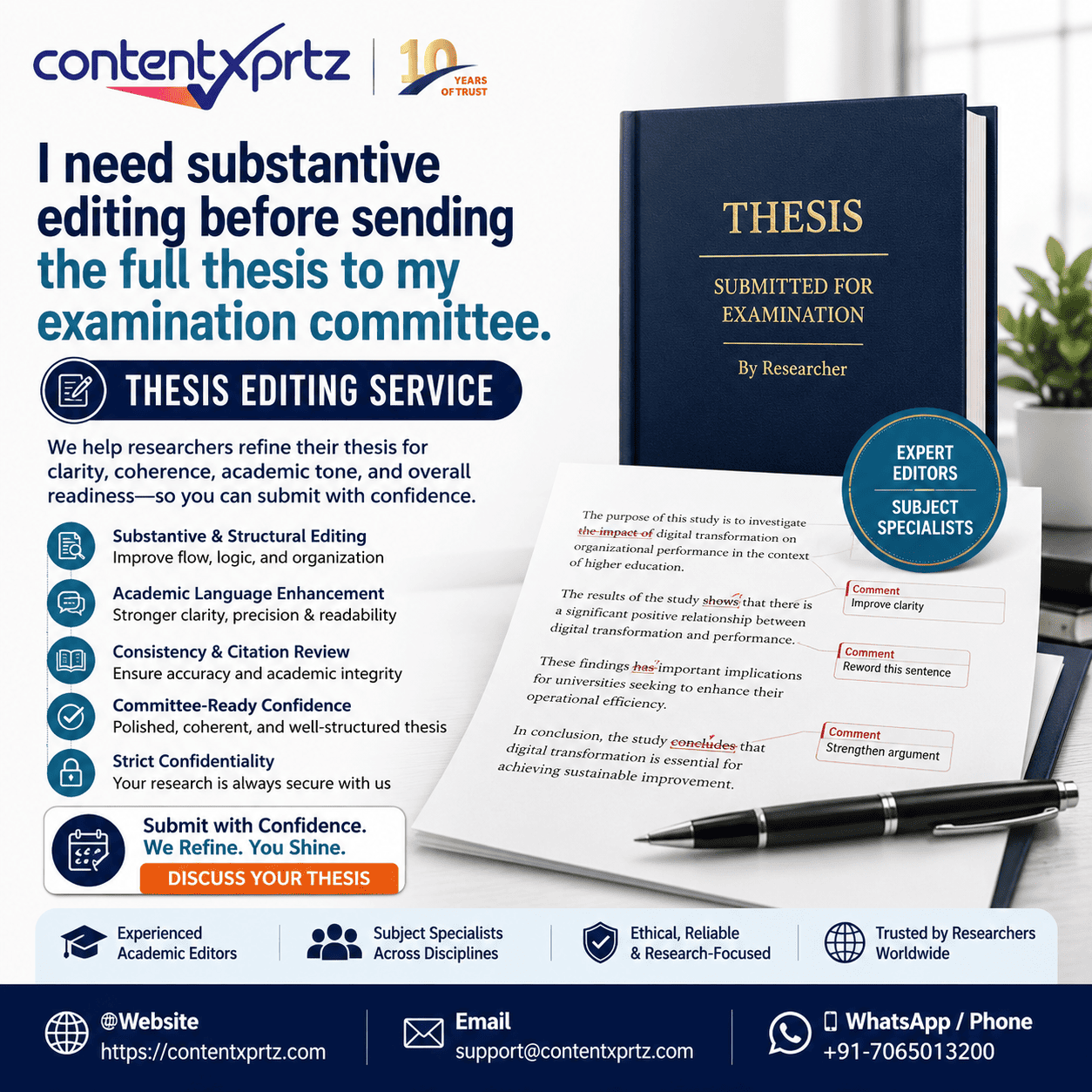
Contentxprtz can support researchers whose thesis content is substantially developed but needs clearer academic communication. Relevant support can include thesis editing, scholarly proofreading, consistency review, reference-format checks, language refinement for ESL authors, and document-level feedback on organization and readability.
The most useful engagement begins with a defined scope. An author may request language editing only, a structural review of selected chapters, consistency checking across a paper-based thesis, or a final proofread after supervisor approval. Editors should work from the researcher’s text and instructions, flag unclear reasoning rather than invent explanations, and preserve specialist terminology unless a change is justified.
For authors preparing a long dissertation or thesis, Contentxprtz thesis writing and editing support can be used as an ethical final-stage resource when permitted by the institution. The researcher remains responsible for the originality, evidence, analysis, conclusions, citations, and submission decisions.
Summary: Thesis Paper
A thesis paper is a sustained academic document that answers a focused research question through transparent engagement with evidence. Although exact chapter names vary, a successful thesis usually moves logically from the problem and literature to the chosen method or analytical approach, then to findings, interpretation, and a proportionate conclusion.
The safest workflow is to confirm institutional requirements first, narrow the question, map chapter purposes, organize evidence, draft for logic, and revise in layers. Literature should be synthesized rather than catalogued, methods should be justified rather than merely described, and the discussion should explain the contribution instead of repeating results. Final editing should address structure, evidence, language, citations, and formatting in separate passes.
Free resources such as supervisors, writing centres, librarians, style guides, templates, and reference managers are often enough for many problems. Professional thesis editing becomes more useful when the research is stable but the document needs specialist language, consistency, structural, or final-proofreading support. Whatever support is used, the author must remain able to explain and defend every claim in the submitted thesis.
Frequently Asked Questions
What is a thesis paper, and what is its main purpose?
A thesis paper is a substantial academic document that presents and supports a focused research inquiry. Its main purpose is to show that the author can identify a meaningful problem, engage critically with relevant scholarship, use an appropriate method or analytical approach, interpret evidence, and reach conclusions that follow from the work. In many degree programs, the thesis is also an assessment of research independence and scholarly communication. The exact expectations depend on the discipline and institution. An empirical science thesis may separate methods, results, and discussion, while a humanities thesis may develop the argument through thematic chapters. Some programs also permit article-based or papers-option theses. The practical starting point is therefore your current university handbook and supervisor guidance, not a generic online model. Before drafting, write one sentence that states the research question and one sentence that states the intended contribution. If those sentences are unclear, the document will usually become broad or repetitive. A strong thesis is not defined by length alone; it is defined by the coherence between question, evidence, reasoning, and conclusion.
How is a thesis paper different from a dissertation or research paper?
The terms vary by education system, so there is no universal naming rule. In some countries and universities, a master’s project is called a thesis and a doctoral project a dissertation; in others, the usage is reversed or varies by faculty. A research paper is usually shorter and narrower, often written for a course, conference, or journal, while a degree thesis is normally a larger supervised document with formal examination and institution-specific submission requirements. A thesis may contain original empirical research, theoretical analysis, creative practice, design work, archival interpretation, or a set of publishable papers, depending on the program. The important distinction is not the label but the governing requirements. Check the degree handbook for expected length, required sections, format, ethics, examination route, and whether a paper-based structure is allowed. If you plan to publish chapters later, also ask how copyright, co-authorship, and previously published material should be handled. Treat the university’s definition as authoritative for your submission.
What sections should a thesis paper include?
Most thesis papers include front matter, an introduction, a review of relevant literature, a methodology or analytical approach, findings or analysis, a discussion, a conclusion, references, and appendices when needed. Front matter may include a title page, declaration, abstract, acknowledgements, table of contents, and lists of figures or abbreviations. However, the order and names of sections are not universal. Humanities theses may integrate literature throughout argument-led chapters, qualitative studies may combine findings and discussion, and article-based theses may contain published or publishable papers connected by an integrating introduction and synthesis chapter. Start by obtaining your department’s official template or examples of recently accepted theses. Then map every section to a function: what question does it answer, what evidence belongs there, and what does the reader need before moving to the next section? This prevents duplicate background and helps keep the discussion distinct from the results. Do not copy another university’s structure without checking whether it matches your own program.
How do I choose a good thesis paper topic and research question?
Choose a topic by moving from broad interest to a problem that is important, researchable, and feasible. Start with the area you care about, then identify what is uncertain, contested, underexplored, poorly measured, or practically important. Narrow the scope using population, context, time period, theory, variables, material, or method where relevant. Next, test feasibility: can you access the required data, participants, archives, software, laboratory resources, or permissions within the available time? A useful research question is specific enough to guide evidence collection but open enough to require analysis rather than a yes-or-no lookup. Review recent literature to learn the vocabulary of the field and to avoid claiming a gap simply because you have not yet found prior work. Discuss the question with your supervisor before building the entire thesis around it. If the question changes later, update the aims, methods, chapter map, and conclusion so the document remains internally consistent.
How long should a thesis paper be?
There is no reliable universal word count for a thesis paper. Length depends on degree level, discipline, research design, university policy, and whether tables, references, appendices, creative components, or published papers count toward the limit. A qualitative humanities thesis may need extensive contextual argument, while an experimental thesis may communicate much of its evidence through figures, tables, and concise technical sections. Some universities set formal maximums, while others leave length largely to the committee or field. Use the official handbook as the source of truth and ask whether the limit applies to the main text only or to the entire document. A better writing target than raw length is functional completeness: the reader should have enough context to understand the problem, enough methodological detail to evaluate the work, enough evidence to support the claims, and enough discussion to explain the contribution and limitations. If a chapter is long because it repeats background or summarizes sources individually, cutting may improve the thesis rather than weaken it.
How do I write a literature review for a thesis without just summarizing sources?
Write the literature review around questions, themes, debates, methods, or evidence patterns rather than around individual authors. Begin by deciding what the review must establish for your research: key concepts, what is already known, where studies agree or conflict, which methods dominate, what limitations recur, and what unresolved issue leads to your research question. Build an evidence matrix that records each source’s method, context, finding, limitation, and relevance. Then group sources that speak to the same issue and compare them within paragraphs. A useful paragraph may state a pattern, cite several studies that support it, identify an exception or methodological difference, and finish by explaining why that pattern matters to your thesis. Avoid claiming a research gap solely because few papers use your exact wording. The gap may concern theory, population, method, context, measurement, replication, or unresolved disagreement. Verify every citation against the original source and distinguish what a paper actually found from your own interpretation.
What is the difference between thesis editing and thesis proofreading?
Thesis editing is broader than proofreading. Editing can address clarity, organization, paragraph flow, sentence structure, academic tone, terminology, repetition, transitions, consistency, and sometimes references or formatting, depending on the agreed scope. Proofreading is the final quality-control stage after substantive revisions are complete. It focuses on remaining errors such as spelling, punctuation, grammar, capitalization, numbering, captions, cross-references, and layout inconsistencies. The stages should not be reversed. If chapters are still being moved, methods are changing, or the argument is unresolved, detailed proofreading will have to be repeated. First complete conceptual and structural revision, then language editing, then citation and formatting checks, and finally proofread the stable document or exported PDF. If using a professional editor, provide the university’s editing policy and specify what changes are permitted. Ethical editing should improve how the author’s ideas are communicated, not invent data, sources, interpretations, or conclusions.
Can I use AI to help write or edit my thesis paper?
You can use AI only to the extent permitted by your university, supervisor, funder, publisher, and research context. Policies differ and are changing, so check the current rules before relying on any tool. Where permitted, AI may help with brainstorming search terms, outlining possibilities, language alternatives, or identifying surface inconsistencies. It should not be treated as an authoritative source or as a substitute for understanding the research. Generated references, quotations, statistics, explanations, and claims must be verified against authentic sources because AI systems can produce plausible but incorrect material. Do not upload confidential participant data, unpublished sensitive material, or proprietary information to a service unless the data-handling terms and approvals allow it. Keep records or disclosures if required. The strongest practical rule is that you should be able to defend every sentence, source, method, and conclusion without relying on the tool. If you cannot verify a generated statement, remove it rather than presenting it as scholarship.
When should I hire a professional thesis editor?
Consider a professional thesis editor after the research logic and major content are reasonably stable, particularly if the manuscript has persistent language, structure, consistency, formatting, or readability problems that self-editing has not resolved. Editing can be valuable for long documents, multilingual authors, paper-based theses assembled from different manuscripts, complex terminology, or final-stage consistency checks. Before hiring anyone, confirm what your university permits and whether outside editing must be acknowledged. Define the scope precisely: language editing, structural feedback, reference-format checks, formatting, or final proofreading. Ask the editor to preserve technical meaning and flag unclear reasoning rather than silently inventing explanations. Professional support is not a substitute for supervisor feedback on research design, analysis, or disciplinary contribution, and no responsible editor can guarantee thesis approval. Contentxprtz can assist with ethical thesis editing and proofreading when the author’s own research, evidence, citations, interpretations, and responsibility remain intact.
What should I check before submitting my thesis paper?
Before submission, perform separate checks for academic content, references, formatting, and the final file. Confirm that the title, abstract, aims, research questions, methods, findings, discussion, and conclusion tell the same research story. Make sure limitations are stated accurately and that conclusions do not exceed the evidence. Reconcile in-text citations with the reference list, verify key bibliographic details against original sources, and check that tables, figures, appendices, and cross-references are complete. Compare the document with the latest graduate-school or department requirements for margins, pagination, front matter, file type, declarations, naming conventions, and submission metadata. Confirm that any editing, translation, statistical assistance, or AI use has been handled according to policy. Export the required final format and inspect it page by page because conversion can create layout errors. Finally, keep backed-up copies of the submitted PDF, editable source files, data and analysis materials where appropriate, and the version approved by your supervisor or committee.
Conclusion: Build the Thesis Around a Defensible Research Story
The difficult part of a thesis paper is rarely the page count. It is keeping the research question, evidence, method, chapters, and conclusion aligned over a long project. A reliable process begins with institutional requirements and a focused question, then uses a chapter map and evidence system to keep the document coherent as the research grows.
Free support is often enough for planning, search design, reference management, and routine writing questions. Supervisors, writing centres, librarians, templates, and style guides should be used early. When the intellectual work is stable but the manuscript still needs language refinement, structural consistency, formatting, or final proofreading, expert-assisted editing can reduce avoidable presentation problems—provided it stays within university rules and preserves the author’s ownership.
Contentxprtz helps researchers improve clarity, structure, consistency, academic tone, and submission readiness through focused thesis editing and proofreading support. The goal is not to replace the researcher’s judgment but to make the researcher’s own work easier to understand and evaluate. “At Contentxprtz, we don’t just edit; we help ideas reach their fullest potential.”
Explore thesis writing and editing support when your research is ready for a careful communication-focused review.