Thesis Masters: How to Plan, Write, Edit, and Submit a Strong Master’s Thesis
Thesis masters is a common search phrase used by students who are trying to understand, plan, write, improve, or complete a master’s thesis. In practical academic terms, the task is not simply to produce a long document. A strong master’s thesis has to show that you can define a researchable problem, engage critically with relevant scholarship, choose and explain an appropriate method, present evidence accurately, build a defensible argument, acknowledge limitations, cite sources correctly, and follow the specific submission rules of your university.
That combination can feel demanding because the work happens at several levels at once. You may be reading dozens or hundreds of sources while refining your question. You may be collecting data, running experiments, coding interviews, building models, analyzing texts, or developing a practice-based project. At the same time, you must turn that work into chapters that make sense to a supervisor and examiner who did not experience the research process exactly as you did. Clear writing therefore becomes part of the research task itself, not a cosmetic step added at the end.
Master’s students also face practical pressures. Deadlines can compress the time available for revision. English may not be the writer’s first language. A department may have detailed rules for title pages, abstracts, headings, margins, tables, references, appendices, electronic submission, and defense procedures. A thesis can be intellectually strong but still become difficult to assess if the logic is buried under repetition, vague transitions, inconsistent terminology, weak signposting, or citation errors. Conversely, polished language cannot rescue an unclear research design or unsupported conclusion.
The most reliable approach is to separate the project into manageable stages: confirm the rules, define the question, map the literature, design the method, draft while researching, review the argument, edit for clarity, proofread for accuracy, and perform a final compliance check. This guide explains that workflow for students across disciplines. Where outside help is useful, it also distinguishes ethical thesis writing and editing support from assistance that would improperly replace the student’s own research, analysis, or authorship. The aim is a thesis that is clearer, more coherent, academically responsible, and genuinely yours.
Quick Answer: What Does “Thesis Masters” Mean?
“Thesis masters” usually refers to information or support related to a master’s thesis: a substantial research document completed as part of a thesis-based master’s degree. Depending on the university, field, and country, the final requirement may be called a thesis, dissertation, research project, capstone, or major paper. The name matters less than the official requirements attached to your program.
A strong master’s thesis should answer a focused research question with an appropriate scholarly method and a transparent evidence trail. It should show how the study relates to existing literature, explain what was done, present the results or analysis accurately, and state what can and cannot be concluded. The document must also meet university rules for structure, formatting, citation style, ethics, approval, and submission.
Your first action should therefore be to collect the official thesis handbook, department instructions, supervisor expectations, ethics requirements, and submission deadlines. Use those documents as the controlling standard. General guides can help you plan, but your university decides what counts as a compliant thesis.
Key Takeaways
- A master’s thesis is a research argument, not a collection of loosely connected chapters.
- Your university’s handbook and supervisor guidance override generic advice about word count, chapter order, formatting, and defense procedures.
- Start writing early; drafting exposes gaps in the research question, literature review, method, and evidence before the deadline becomes urgent.
- Separate substantive revision, language editing, proofreading, reference checking, and formatting into different passes.
- Every source, quotation, dataset, table, figure, and claim should be traceable and used according to academic-integrity rules.
- Professional editing can improve clarity and consistency, but it should not replace your original ideas, analysis, data interpretation, or author responsibility.
- A final submission check should cover both academic quality and technical compliance.
What This Page Covers
- What a master’s thesis is and how it differs from other graduate research outputs
- How to move from a broad topic to a defensible research question
- How to structure literature review, methodology, findings, discussion, and conclusion chapters
- A step-by-step thesis workflow from planning to final submission
- Common thesis-writing mistakes and how to prevent them
- Practical examples for different research situations
- How ethical editing, proofreading, and academic support can fit into the process
Table of Contents
- Methodology and academic sources
- What a master’s thesis means
- Why master’s theses become difficult
- Self-service, low-cost, and professional support
- Typical thesis structure
- Step-by-step workflow
- Ethical editing and author responsibility
- Common mistakes
- Practical examples
- Submission-readiness checklist
- Frequently asked questions
Methodology and Academic Sources
This guide is based on common graduate research, thesis-writing, academic editing, and submission-readiness workflows. It also reflects the principle that thesis requirements are institution-specific. For example, the Cornell Graduate School thesis and dissertation guide describes the thesis as a scholarly research work and makes clear that format requirements are set by the graduate school while content and length are shaped by the academic field, committee, and advisor.
Students should therefore treat external guidance as a planning aid, not as a substitute for university rules. Check your graduate-school handbook, faculty or department manual, research-ethics requirements, library guidance, and supervisor instructions. When citation style is specified, consult the official or institution-approved style source, such as the APA Style site for APA-based work.
Ethical assistance should preserve the author’s intellectual ownership. The Committee on Publication Ethics provides broader guidance on responsible authorship and publication practices that is useful when thesis chapters may later become journal articles. Contentxprtz can assist with academic editing, proofreading, formatting, and communication quality, but the student remains responsible for the research, data, arguments, citations, conclusions, and final submission.
What a Master’s Thesis Means in Academic Context
A master’s thesis is best understood as a sustained answer to a research question. It demonstrates that the student can work with scholarly literature, make justified methodological choices, analyze evidence, and communicate a conclusion at the level expected by the degree program. The thesis may not need to transform an entire field, but it should do more than summarize what others have written.
The expected contribution can take different forms. In an empirical project, it may be a new dataset, experiment, survey, interview study, model, or case analysis. In humanities research, it may be a new interpretation of texts, archives, artworks, legal materials, or historical evidence. In engineering or computing, it may involve design, implementation, testing, simulation, or performance evaluation. In business and social science, it may analyze organizations, markets, policies, behaviors, or processes using quantitative, qualitative, or mixed methods.
This variety is why there is no universal “correct” thesis template. Some universities require a conventional monograph. Others allow manuscript-based or paper-based structures in selected fields. Some require an oral defense; others use committee approval or an examination process. The Cornell guidance on thesis sections, for example, distinguishes required elements from suggestions and encourages students to follow leading academic standards in their field.
Master’s thesis versus dissertation
The words thesis and dissertation are used differently across education systems. In some countries, a master’s student writes a dissertation and a doctoral student writes a thesis; elsewhere, the reverse convention is common. Do not infer the academic level from the word alone. What matters is the degree program, assessment criteria, and official institutional definition.
Why Students Search for Thesis Masters Guidance
Most thesis problems are not caused by a single difficult chapter. They arise because research, writing, time management, supervision, and compliance interact. A broad research question creates an unmanageable literature review. An unclear method makes the results harder to interpret. Weak note-taking creates citation gaps. Late drafting reduces the time available for revision. Inconsistent supervisor feedback can lead to repeated rewriting if the student has not clarified the underlying decision.
The topic is still too broad
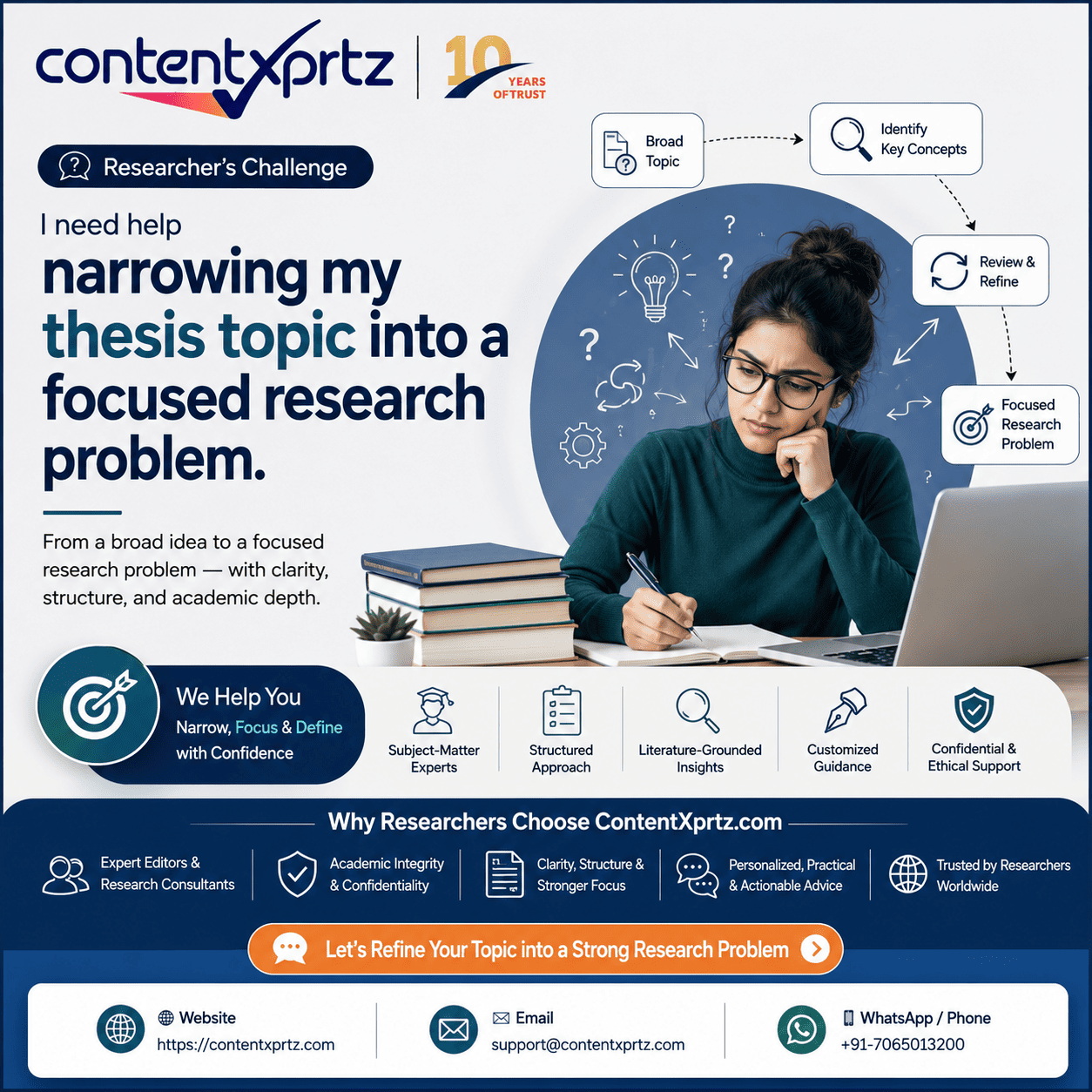
A topic such as “social media and consumer behavior” is an area, not yet a research question. A thesis needs boundaries: population, setting, variables or concepts, timeframe, method, and analytical purpose. Narrowing is not a sign that the work is unimportant. It is how a feasible project becomes rigorous.
The literature review becomes descriptive
Students often write one paragraph per source: Author A found this, Author B found that, Author C found something else. That format shows reading but not synthesis. A stronger literature review groups studies by concepts, theories, methods, findings, contradictions, or gaps. It tells the reader what the field knows, where uncertainty remains, and why the current study is needed.
The method is described but not justified
A methodology chapter should do more than list software, sample size, interview questions, laboratory equipment, or statistical tests. It should explain why the design fits the research question, how participants or materials were selected, how data were collected and analyzed, what ethical safeguards were used, and what limitations follow from those choices.
The student waits too long to write
Writing is a thinking tool. A rough paragraph can reveal that a concept is undefined, a source does not support the claim, a variable is inconsistent, or two chapters are answering different questions. Early drafts create opportunities for correction while the research is still flexible.
Free, Low-Cost, and Professional Thesis Support Options
Not every thesis problem requires paid support. Many students can solve substantial parts of the process using resources already available through their university. The best support option depends on the nature of the problem.
| Need | Good first option | When additional support may help |
|---|---|---|
| Understanding requirements | Graduate handbook, department office, supervisor | When rules conflict or the submission pathway is unclear |
| Research design | Supervisor, methods instructor, research office | When design choices need discipline-specific expert review |
| Literature searching | University librarian, subject databases | When search strategy, evidence mapping, or source organization is difficult |
| Academic English | Writing center, peer review, self-editing tools | When language issues repeatedly obscure meaning across chapters |
| Thesis editing | Structured self-editing checklist | When an independent editor can improve clarity, flow, consistency, and readability within university rules |
| Proofreading and formatting | Official template and final checklist | When a near-final document needs a systematic quality-control pass |
University writing centers, libraries, supervisor meetings, peer groups, reference managers, style manuals, and official templates are often enough for students who have a clear research design and adequate time. Professional assistance is more useful when the document is technically complete but hard to read, inconsistent, or difficult to review objectively after months of close work.
When Self-Service Editing Is Enough and When Expert Help Is Safer
Self-editing is usually enough when the argument is stable, the language problems are local, and you have time to work through the document in several passes. Read each chapter for one purpose at a time. First check argument and structure. Then paragraph logic. Then sentence clarity. Then terminology, citations, and formatting. Finally proofread the version that is actually going to be submitted.
Expert editing may be appropriate when readers repeatedly misunderstand the same sections, when English-language issues make strong research difficult to follow, when terminology changes across chapters, when a thesis has been assembled from separate papers or drafts, or when the student needs a fresh editorial perspective before final review. The safest model is transparent: the editor improves communication, the author controls the ideas and evidence, and the university’s policy on external editing is respected.
If you use professional thesis editing support, provide the editor with the university guidelines and explain what type of intervention is permitted. Ask for tracked or reviewable changes where possible so that you can understand and approve the revisions rather than submitting text you have not evaluated.
How to Structure a Master’s Thesis
A conventional chapter structure is useful because it mirrors the logic of research: define the problem, show what is already known, explain what you did, present what you found, interpret it, and state the implications. However, the precise sequence should follow your discipline and program.
Introduction
The introduction establishes the research problem, context, question or objectives, scope, and significance. It should tell the reader what the thesis is trying to accomplish and how the document is organized. Avoid turning the introduction into a miniature literature review unless your field expects that approach.
Literature review
The literature review synthesizes relevant scholarship and positions the thesis within it. Organize by themes, debates, theories, methods, or chronological developments rather than by source. End with a clear statement of the gap, unresolved question, or analytical need that leads to your study.
Methodology
The methodology chapter explains and justifies the research design. It may cover sampling, participants, materials, instruments, data sources, procedures, measures, coding, statistical analysis, validity, reliability, reflexivity, ethics, and limitations. Include enough information for an informed reader to understand how the evidence was produced.
Results or findings
Present the results in a sequence aligned with the research questions. Use tables and figures when they make evidence easier to understand, not simply to increase visual complexity. Distinguish what the data show from what you later infer or argue about those findings.
Discussion
The discussion explains what the findings mean. Connect them back to the research question and literature, examine agreements and contradictions, consider plausible alternative interpretations, and state limitations. Do not overclaim beyond the design or evidence.
Conclusion
The conclusion should answer the central research question directly, summarize the contribution, acknowledge important limitations, and identify realistic implications or future research. It should not introduce major new evidence that has not been discussed earlier.
Step-by-Step Guide to Writing a Master’s Thesis
1. Collect the rules before you build the document
Create one folder containing the thesis handbook, departmental instructions, assessment rubric, ethics approval documents, formatting template, citation requirements, defense information, and submission deadlines. Convert these into a checklist. This prevents late surprises such as an incorrect title page, missing declaration, wrong file type, or overlooked approval step.
2. Turn the topic into a researchable question
Write the question in one sentence. Then test it. Is it specific enough to answer within the available time and data? Are the key terms defined? Can the method genuinely address it? Does the question invite analysis rather than a descriptive report? If the answer is no, narrow the scope before gathering more material.
3. Build a literature map, not a pile of PDFs
For each source, record the citation, research question, context, method, main finding, limitation, and relevance to your thesis. Tag sources by theme. This makes synthesis far easier than relying on memory. It also reduces accidental misquotation and helps you trace claims back to the original paper.
4. Draft a working argument map
Write the central claim or purpose of each chapter and the evidence needed to support it. If two chapters have the same purpose, combine or differentiate them. If a chapter has no clear role in answering the thesis question, reconsider why it is there.
5. Write the method while decisions are fresh
Do not postpone methodology writing until the end. Record why you chose the design, how recruitment or sampling worked, how instruments changed, what exclusions occurred, and how analysis was conducted. Accurate process notes reduce the risk of reconstructing important details from memory months later.
6. Draft results close to the analysis
When data analysis is complete, create the core tables, figures, themes, or analytical outputs first. Then write around them. Every result should connect to a research question. Remove interesting but irrelevant findings unless they serve a justified secondary purpose.
7. Write the discussion as an argument
Start each discussion section with the finding or interpretation that matters, then compare it with prior literature, explain possible reasons, address limitations, and state what can reasonably be concluded. Avoid repeating the results chapter sentence by sentence.
8. Revise globally before polishing sentences
Read the thesis from beginning to end looking only at the research logic. Does the introduction promise what the thesis actually delivers? Does the literature review lead to the study? Does the method answer the stated question? Do the results support the discussion? Does the conclusion match the evidence? Fix these issues before spending hours on punctuation.
9. Edit for clarity and academic tone
Shorten overloaded sentences, define specialist terms, remove empty phrases, check tense consistency, make paragraph topic sentences informative, and replace vague references such as “this” or “it” when the antecedent is unclear. Academic writing should be precise, not artificially complicated.
10. Check citations and references systematically
Compare every in-text citation with the reference list and every reference-list entry with the thesis text. Verify names, years, titles, journal or book details, page ranges, DOI information where required, and citation style. Never cite a source you have not checked simply because another source cited it.
11. Proofread the final layout
Proofread after pagination, tables, figures, references, and appendices are stable. Check headings, page numbers, captions, cross-references, numbering, spacing, widows and orphans where relevant, table breaks, figure quality, and the table of contents. A clean layout helps examiners navigate the work.
12. Prepare for submission and defense as separate tasks
Submitting the file is not the same as defending the research. If your program has an oral defense, prepare a concise explanation of the problem, method, key findings, contribution, limitations, and decisions you would make differently. Practice answering questions without becoming defensive. A strong defense demonstrates understanding, not memorization.
Ethical Academic Editing and Author Responsibility
Ethical thesis support improves communication without taking over authorship. The student should remain able to explain every claim, method, table, result, citation, and conclusion in the thesis. If a change introduces an argument you do not understand or cannot defend, it should not be accepted simply because it sounds more sophisticated.
Editing can legitimately address grammar, punctuation, academic tone, clarity, repetition, paragraph structure, terminology, transitions, formatting, citation consistency, and reader navigation. Depending on university policy, an editor may also point out logical gaps, unclear methods, unsupported claims, or places where more evidence is needed. The author should decide how to resolve those issues.
Generative AI adds another layer of responsibility. University policies differ, and permitted use can change by course or research context. Treat AI-generated summaries, citations, paraphrases, code, and analytical suggestions as unverified until you check them. Never use fabricated references or invented data. Keep a record of tool use if your institution requires disclosure.
For thesis chapters that may later become journal manuscripts, apply responsible authorship and disclosure practices. Publication ethics, contributor roles, conflicts of interest, data availability, and AI policies may differ by publisher. Check the target journal’s author instructions rather than assuming that thesis acceptance automatically means a paper is submission-ready.
Common Master’s Thesis Mistakes to Avoid
- Starting with a title instead of a research question: a polished title cannot compensate for an unfocused problem.
- Reading without a literature system: unstructured notes make synthesis and citation checking harder later.
- Writing a source-by-source literature review: synthesis should organize knowledge, not merely summarize papers in sequence.
- Using a method because it is familiar: the design must fit the question and evidence, not just the software you know.
- Mixing results and interpretation accidentally: be clear about where evidence ends and your interpretation begins.
- Overstating conclusions: acknowledge sampling, measurement, context, design, and data limitations.
- Leaving references until the end: citation errors multiply when sources are not recorded during research.
- Editing only sentence grammar: thesis quality depends on argument structure, chapter logic, evidence, and consistency as well as language.
- Ignoring the official template: formatting and front-matter rules can be assessed separately from content quality.
- Submitting immediately after the last major rewrite: reserve time for a clean final proofread of the actual submission file.
Practical Examples: Three Master’s Thesis Situations
Example 1: The topic is too broad
A business student begins with “How digital marketing affects small businesses.” The literature spans platforms, countries, industries, firm sizes, advertising formats, and outcomes. Instead of reading indefinitely, the student narrows the study to one business category, one location, one defined outcome, and one timeframe. The literature review becomes more focused, the method becomes feasible, and the conclusion can make claims that match the actual evidence.
Example 2: Strong research, difficult English
An engineering student has a sound experiment and clear numerical results, but the thesis contains long sentences, inconsistent technical terms, and abrupt transitions. The supervisor understands the work but repeatedly comments that the argument is difficult to follow. The student first fixes chapter logic and figure order, then uses ethical academic editing to improve sentence clarity and consistency without changing data or technical meaning. The final version becomes easier to assess while remaining the student’s own research.
Example 3: The literature review is descriptive
A psychology student has summarized forty studies but cannot explain the research gap. The student reorganizes the review into three themes: established findings, methodological disagreements, and populations that remain under-studied. A final synthesis paragraph shows how those themes lead to the current research question. No new sources were required at first; the improvement came from changing the analytical structure.
Example 4: Formatting is left until the final week
A humanities student finishes the intellectual work but discovers that footnotes, chapter headings, figure captions, and front matter do not match the university template. Rather than manually changing each item repeatedly, the student creates consistent styles, updates the table of contents, checks page numbering, and runs a compliance checklist. The lesson is to set document styles early, even if final formatting happens later.
Master’s Thesis Editing and Submission-Readiness Checklist
Research and argument
- Is the research question explicit, focused, and answerable?
- Does every chapter contribute to answering that question?
- Are claims proportional to the evidence and research design?
- Are important limitations stated rather than hidden?
Literature and citations
- Does the literature review synthesize themes, debates, methods, or gaps?
- Have all quotations, paraphrases, data points, images, and adapted ideas been cited where required?
- Does every in-text citation have a matching reference entry?
- Have references been verified against authentic, traceable sources?
Method and results
- Can a knowledgeable reader understand how the study was conducted?
- Are sampling, instruments, procedures, analysis, and ethics explained accurately?
- Do results map clearly to the research questions?
- Are tables and figures numbered, titled, readable, and referred to in the text?
Writing and editing
- Does each paragraph make one clear contribution?
- Are key terms used consistently across chapters?
- Have repetition, vague wording, unnecessary jargon, and overly long sentences been reduced?
- Has the document been proofread after the last substantive revision?
Compliance and submission
- Does the thesis match the official template, margin, font, spacing, and front-matter rules?
- Are declaration, ethics, acknowledgements, appendices, and supplementary files included when required?
- Is the file format correct and are all fonts, figures, and links working?
- Have supervisor or committee revisions been addressed and recorded?
- Have you checked the final submission and defense deadlines?
How Contentxprtz Can Help With a Master’s Thesis
Contentxprtz supports students and researchers who have done the academic work but need help presenting it clearly and consistently. Relevant support can include thesis editing, proofreading, academic English improvement, structural feedback, formatting review, citation consistency, and final document quality checks. The appropriate level of intervention depends on your university policy and the stage of the thesis.
If your research question, data, or analysis is still unsettled, your supervisor or methods adviser should remain the first academic contact. If the research is complete and the main challenge is communication quality, a structured thesis writing and editing service can provide an independent editorial pass. Contentxprtz aims to preserve the author’s meaning while improving clarity, flow, consistency, and readability.
Summary: Thesis Masters and Master’s Thesis Writing
The phrase thesis masters points to a larger practical challenge: completing a master’s thesis that is academically sound, readable, ethical, and compliant with university rules. The strongest workflow begins with official requirements and a focused research question, then connects literature, method, evidence, analysis, and conclusion into one coherent argument.
Do not treat editing as a final cosmetic repair. Build clarity throughout the project by writing early, organizing sources carefully, documenting methodological decisions, and revising the research logic before polishing sentences. Use self-service resources when they are enough, and use professional assistance only where it supports rather than replaces your academic responsibility.
Frequently Asked Questions
What does “thesis masters” mean?
“Thesis masters” is commonly used as a search variation for a master’s thesis: the substantial research project or scholarly document completed in a thesis-based master’s degree. The exact requirement varies by university and program. Some master’s degrees require a formal thesis and oral defense, while others use a capstone, project, portfolio, internship report, or coursework route. Always confirm the terminology, required length, chapter order, research expectations, and submission rules in your program handbook before planning the document.
How is a master’s thesis different from a PhD dissertation?
A master’s thesis is normally narrower in scope and is completed within the timeframe and research expectations of a master’s program. A doctoral dissertation is usually expected to demonstrate a larger and more original contribution to knowledge. The precise distinction varies across countries, disciplines, and universities, so students should use their own graduate-school rules as the controlling standard rather than assuming that a master’s thesis is simply a shorter PhD dissertation.
How long should a master’s thesis be?
There is no universal word count for a master’s thesis. Length depends on discipline, degree type, research method, local regulations, and whether the program uses a monograph or manuscript-style format. A humanities thesis may need a different structure from an engineering, business, or life-sciences thesis. Use your university handbook, supervisor instructions, approved examples, and formatting guide to determine the expected range instead of targeting an arbitrary number.
What chapters are usually included in a master’s thesis?
A common structure includes an introduction, literature review, methodology, results or findings, discussion, and conclusion, supported by front matter and references. However, chapter structure is not universal. Some disciplines combine results and discussion, some integrate literature throughout the thesis, and some permit a paper-based format. Build the outline around your research question and institutional requirements, then confirm it with your supervisor before drafting heavily.
When should I start writing my master’s thesis?
Start writing before the research feels completely finished. Early writing can include the problem statement, research question, literature map, methods rationale, definitions, and a working outline. Writing while researching exposes gaps sooner and gives your supervisor something concrete to review. A practical approach is to set internal milestones for proposal approval, data collection, first full draft, supervisor revisions, language editing, formatting, and final submission.
Can I use AI tools while writing a master’s thesis?
Possibly, but only within your university’s rules and with careful human verification. Policies may restrict or require disclosure of generative AI use. AI output can contain fabricated citations, inaccurate summaries, weak paraphrases, or text that does not reflect your actual research. Never let a tool invent data, references, methods, or claims. Keep authorship responsibility with you, verify every source, and document permitted use where your institution requires it.
What is ethical thesis editing?
Ethical thesis editing improves clarity, grammar, consistency, structure, formatting, and readability without replacing the student’s intellectual contribution. The student must remain responsible for the research question, data, analysis, arguments, citations, interpretation, and final submission. Universities differ in what third-party editing is permitted, so students should check institutional policy and, where required, disclose professional assistance.
Should I edit or proofread my thesis first?
Edit first and proofread last. Editing addresses higher-level issues such as argument flow, chapter structure, repetition, academic tone, paragraph logic, terminology, and clarity. Proofreading is the final quality-control stage for spelling, punctuation, grammar slips, formatting inconsistencies, cross-references, tables, captions, and reference details. Proofreading too early wastes time because substantial revisions can introduce new errors.
How do I know whether my master’s thesis is ready to submit?
A thesis is closer to submission-ready when the research question is answered explicitly, every chapter has a clear role, the method is described accurately, findings are separated from unsupported claims, limitations are stated, citations are traceable, formatting matches university rules, and all supervisor-requested revisions have been addressed. Run a final checklist against the official handbook rather than relying only on visual polish.
When can professional thesis support help?
Professional support can help when the research is complete but the document needs clearer academic English, stronger flow, consistent terminology, reference checks, formatting cleanup, or an independent editorial review before submission. It should not fabricate sources, alter data, invent findings, or replace work that your university expects you to do independently. Contentxprtz can support ethical thesis editing and proofreading while leaving research ownership and final decisions with the student.
Conclusion: Finish the Thesis With Clarity and Academic Responsibility
A master’s thesis becomes manageable when you stop treating it as one enormous writing task and instead treat it as a sequence of decisions: what the research asks, what evidence is needed, how the method answers the question, what the results show, what the discussion can reasonably claim, and how the final document must be presented.
Free university resources, supervisor guidance, library support, templates, and disciplined self-editing may be enough for many students. Expert assistance becomes useful when the thesis is substantively yours but needs a clearer structure, stronger academic English, more consistent presentation, or a systematic final review. The boundary should remain clear: support can improve the communication of your research, but you remain responsible for the ideas, sources, data, analysis, citations, and final submission.
If your thesis is ready for an independent editorial review, explore Contentxprtz thesis writing and editing services for ethical, tailored support focused on clarity, consistency, and submission readiness.
At Contentxprtz, we don’t just edit; we help ideas reach their fullest potential.