Thesis Example: A Practical Guide with Sample Sections
A thesis example is most useful when it helps you see how the parts of a research project fit together: the problem leads to a focused question, the literature establishes what is already known, the methodology explains how evidence was gathered, the results present what was found, and the discussion shows what those findings mean. The strongest examples are not scripts to copy. They are models for structure, academic logic, evidence use, and presentation.
This guide gives you a realistic, simplified sample thesis built around one fictional research topic: the relationship between structured study-planning habits and perceived academic stress among postgraduate students. The sample is intentionally generic enough to demonstrate academic form without pretending that one chapter sequence fits every university, discipline, or degree.
Use the examples below to understand how a thesis can move from a research problem to a defensible conclusion. Then adapt the pattern to your own field, data, supervisor feedback, and institutional rules. University requirements can differ substantially: for example, some graduate schools specify required preliminary sections and detailed formatting rules, while others leave more of the structure to the department or supervisory committee.
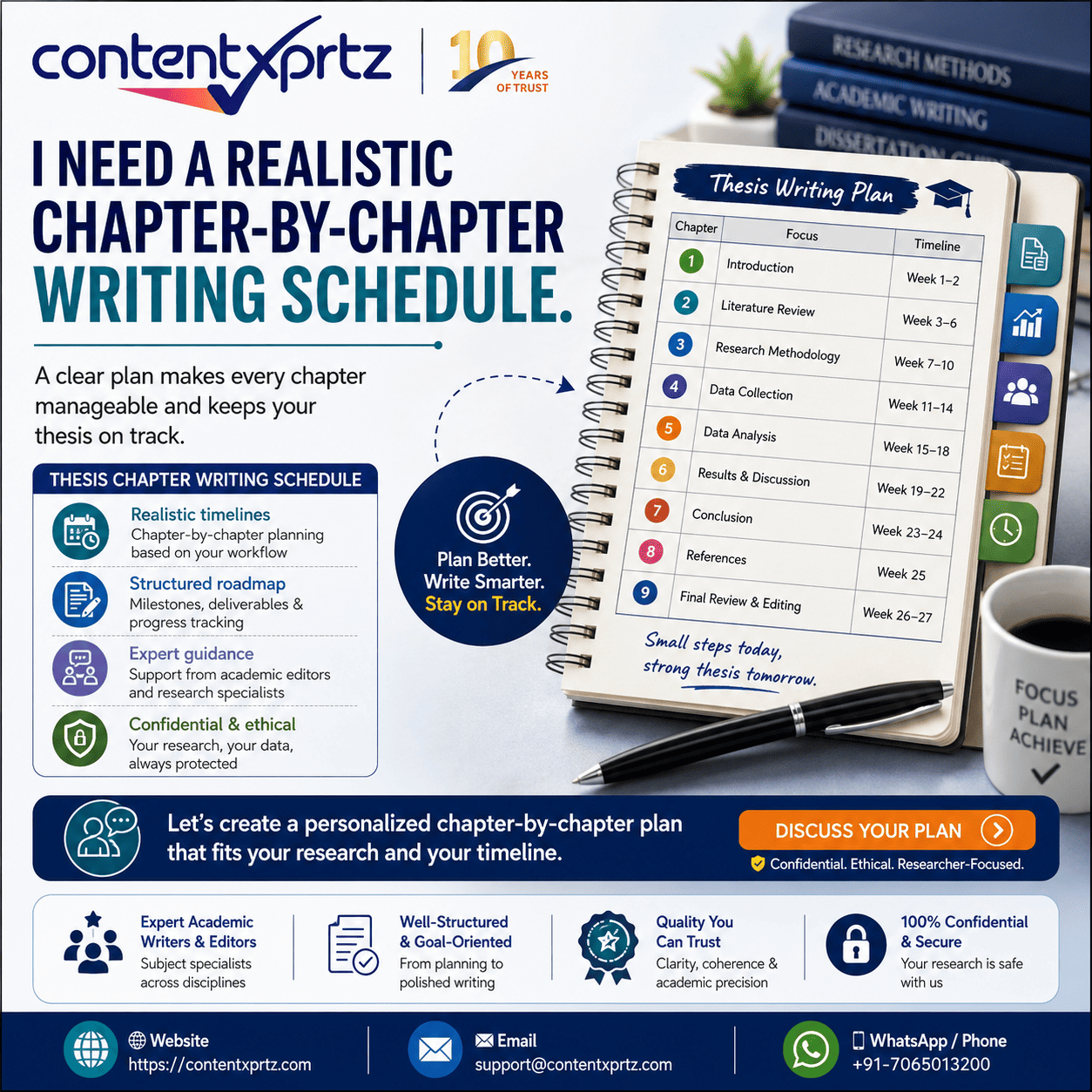
Quick Answer: What Does a Good Thesis Example Look Like?
A good thesis example has a visible line of reasoning. It begins with a clear research problem, converts that problem into a research question or objective, reviews the most relevant literature, explains a method that can answer the question, presents findings without overstating them, and then interprets those findings in relation to previous research.
For many research theses, a practical structure is: title page, abstract, contents, introduction, literature review, methodology, results or findings, discussion, conclusion, references, and appendices. However, this sequence is not universal. Some disciplines combine results and discussion, some use thematic chapters, and some permit paper-based theses containing journal-style manuscripts.
The right next step is to compare any example with your own university’s thesis handbook, department guidance, and supervisor expectations. Formatting, chapter names, abstract length, reference style, required declarations, and submission rules are institution-specific.
Key Takeaways
- A thesis example should teach structure and research logic, not provide wording to copy.
- Your introduction should define the problem, context, purpose, scope, and research question clearly.
- Your literature review should synthesise evidence and identify a justified gap rather than list one study after another.
- Your methodology must make the research process transparent enough for readers to understand how the evidence was produced.
- Results report what you found; discussion explains why the findings matter and how they relate to prior research.
- Your conclusion should answer the research question directly and distinguish findings, limitations, and recommendations.
- Always follow your institution’s formatting and academic-integrity requirements before using any sample as a model.
What This Page Covers
- A complete miniature thesis example using one fictional research topic.
- Examples of a thesis title, abstract, introduction, research questions, and objectives.
- A literature review example that demonstrates synthesis rather than summary.
- A methodology example with design, participants, data collection, and analysis.
- Examples of results, discussion, conclusion, limitations, and recommendations.
- A thesis structure table and a practical self-review checklist.
- Ethical guidance on using examples without copying or misrepresenting authorship.
What Is a Thesis?
A thesis is a substantial piece of scholarly work in which a student investigates a defined research problem and presents a reasoned account of the evidence, methods, analysis, and conclusions. The exact meaning of “thesis” varies across academic systems. In many institutions it refers to a master’s research project, while doctoral work may be called a dissertation; elsewhere the terms are used differently.
Regardless of terminology, the central academic expectation is usually the same: the document should show that you can formulate a researchable problem, engage critically with relevant scholarship, choose and justify an appropriate method, analyse evidence carefully, and communicate conclusions within the standards of your discipline.
Thesis Structure Example at a Glance
The table below shows a common monograph-style thesis structure. Treat it as a planning model rather than a universal rule.
| Section | Main purpose | What the reader should learn | Common mistake |
|---|---|---|---|
| Title page | Identify the project formally | Topic, author, degree, institution, submission details | Using a title that is too broad or inconsistent with the final study |
| Abstract | Summarise the whole study | Problem, objective, method, main results, conclusion | Writing only background and leaving out results |
| Introduction | Frame the research problem | Why the study matters and what it asks | Giving extensive literature without defining a precise problem |
| Literature review | Position the study in existing knowledge | What is known, debated, missing, or methodologically weak | Summarising sources one by one without synthesis |
| Methodology | Explain how the study was conducted | Design, participants/data, procedures, analysis, ethics | Describing steps without explaining why the method fits the question |
| Results / findings | Present analysed evidence | Patterns, estimates, themes, relationships, or outcomes | Mixing interpretation into every result before showing the evidence |
| Discussion | Interpret the findings | Meaning, comparison with prior work, implications, limitations | Repeating the results instead of explaining them |
| Conclusion | Close the argument | Answer to the research question and significance of the work | Introducing new evidence or making unsupported claims |
| References | Document cited sources | Traceable scholarly basis for the work | Inconsistent style or references that do not match in-text citations |
| Appendices | Provide supporting material | Instruments, extended tables, protocols, supplementary details | Hiding essential methodological information in an appendix |
Many graduate schools also specify preliminary pages, declarations, acknowledgements, lists of tables or figures, and submission-format requirements. Verify these before final formatting rather than relying on a generic online example.
Worked Thesis Example: From Topic to Final Conclusion
The fictional example below uses a small mixed-methods postgraduate study. It is deliberately concise so you can see the relationship between sections.
Sample thesis title
Structured Study Planning and Perceived Academic Stress Among Postgraduate Students: A Mixed-Methods Study
The title identifies the main variables, population, and broad methodological approach. It avoids promising causation because the fictional design below is primarily observational.
Sample research problem
Postgraduate students often manage competing academic, professional, and personal demands. Universities commonly recommend study-planning strategies, but students may use these strategies inconsistently, and the relationship between structured planning and perceived academic stress is not always clear in specific institutional contexts. Without local evidence, support programmes may promote generic time-management advice without knowing which planning behaviours students actually find useful.
Sample research question
What is the relationship between structured weekly study planning and perceived academic stress among postgraduate students at a metropolitan university?
Sample objectives
- Measure the frequency of structured weekly study-planning behaviours among postgraduate students.
- Measure perceived academic stress using a consistent survey scale.
- Examine whether planning frequency is associated with perceived stress.
- Explore how students describe the benefits and limitations of planning in their own study routines.
Thesis Abstract Example
A strong abstract compresses the study rather than introducing it. It should usually tell the reader what was investigated, how the research was conducted, what the main findings were, and what conclusion can reasonably be drawn.
Example abstract: Postgraduate students frequently report difficulty balancing coursework, research, employment, and personal responsibilities. This study examined the relationship between structured weekly study planning and perceived academic stress among postgraduate students at a metropolitan university. A mixed-methods design was used. Survey data were collected from 184 students using a short planning-behaviour index and a perceived academic stress scale, followed by semi-structured interviews with 16 volunteers. Higher planning scores were associated with lower reported stress, although the relationship was modest and did not establish causation. Interview participants described planning as most helpful when schedules included realistic task estimates, protected study periods, and flexibility for unexpected demands. Participants also reported that overly detailed plans could become another source of pressure. The findings suggest that study-planning support may be more useful when it emphasises realistic prioritisation and adaptability rather than rigid scheduling. Further longitudinal research is needed to test whether changes in planning behaviour lead to changes in stress over time.
Notice the restraint in the final sentence: the sample does not claim that planning “reduces” stress because the design does not establish a causal effect.
Thesis Introduction Example
The introduction should take the reader from a broad context to a specific research problem. It usually establishes significance, defines the scope, identifies the gap or practical need, states the research question or objectives, and previews the study.
Example introduction excerpt: Postgraduate study often requires students to coordinate independent research, coursework, teaching or employment, and personal responsibilities. These overlapping demands can create periods of substantial academic pressure. Universities commonly respond with workshops on time management and study planning, yet such advice can treat planning as a single behaviour rather than a set of practices that vary in frequency, realism, and flexibility. Existing research has linked self-regulation and planning behaviours with academic outcomes, but the relationship between structured weekly planning and perceived academic stress remains context-dependent. In particular, little is known about how postgraduate students interpret the usefulness of planning when schedules are disrupted by research uncertainty, supervisory deadlines, paid work, or family responsibilities. This study therefore examines the association between structured weekly study planning and perceived academic stress among postgraduate students and explores how students describe the advantages and limitations of planning in practice.
The excerpt moves in four steps: context, practical problem, knowledge gap, and study purpose. That progression is usually more effective than opening with dictionary definitions or a long history of the topic.
Literature Review Example: Synthesis Instead of a Source List
A literature review should organise knowledge around themes, debates, methods, or conceptual relationships. It should not read like a sequence of mini book reports.
Weak pattern: “Study A found that planning was helpful. Study B studied stress. Study C found that time management improved grades.”
Stronger synthesis example: Research on student self-regulation generally treats planning as one component of a broader cycle that includes goal setting, monitoring, strategy adjustment, and reflection. Across studies, structured planning is often associated with better task organisation and academic engagement, but the mechanisms are not uniform. Some findings suggest that planning helps by reducing uncertainty and clarifying priorities, while other work shows that unrealistic schedules can increase perceived failure when students cannot complete planned tasks. This tension is especially relevant for postgraduate education, where research activities are less predictable than routine coursework. As a result, the practical value of planning may depend not only on whether students plan, but on whether their plans are realistic, revisable, and aligned with competing commitments. A useful research gap is therefore to examine both measurable planning frequency and students’ qualitative accounts of how planning affects perceived stress.
This paragraph compares patterns across literature, identifies a tension, and turns that tension into a reason for the new study. That is the core work of synthesis.
Thesis Methodology Example
The methodology chapter explains how the research question was translated into a study. Readers should be able to understand the design, data source, sampling, procedures, analysis, and ethical safeguards.
Research design
This fictional study used a convergent mixed-methods design. Quantitative survey data were used to examine the relationship between planning behaviour and perceived stress, while qualitative interviews were used to explore how students interpreted planning in everyday academic life.
Participants and sampling
Postgraduate students enrolled in master’s and doctoral programmes were invited through university mailing lists. The survey included 184 complete responses. At the end of the survey, participants could volunteer for an interview; 16 were selected to reflect variation in programme level, study mode, and self-reported planning frequency.
Data collection
The survey included demographic items, a short planning-behaviour index, and a perceived academic stress scale. Interview questions explored how students planned weekly work, what disrupted their plans, and whether planning changed their experience of academic pressure.
Data analysis
Survey responses were summarised using descriptive statistics and analysed with an association test appropriate to the variables and assumptions. Interview transcripts were coded thematically, with codes refined into broader themes. Quantitative and qualitative findings were compared during interpretation rather than treated as completely separate studies.
Ethical considerations
Participants received study information, provided informed consent, and could withdraw before data analysis according to the approved protocol. Reporting avoided directly identifying participants, and interview excerpts were anonymised.
In a real thesis, this chapter would also explain instrument validity, missing-data handling, software, analytic assumptions, researcher reflexivity where relevant, and the exact ethics approval process.
Thesis Results Example
The results section should present findings in a clear order that follows the research questions. It should distinguish observed evidence from later interpretation.
Example quantitative result: Participants reported a mean planning score of 3.4 on a five-point index. Planning frequency showed a modest negative association with perceived academic stress, indicating that students who reported more consistent weekly planning also tended to report lower stress. Because the study was cross-sectional, this result cannot show whether planning reduced stress, lower-stress students found planning easier, or both were influenced by other factors.
Example qualitative result: Three themes were identified: planning as a way to reduce uncertainty, the importance of realistic workload estimates, and the need for flexible rather than rigid schedules. Several participants described relief when large tasks were broken into smaller actions. Others reported frustration when plans were so detailed that any disruption made the week feel unsuccessful.
If you include tables or figures, use them to make patterns easier to understand—not to repeat the same information in three formats.
Thesis Discussion Example
The discussion explains what the findings mean. It should reconnect the evidence to the research question, previous scholarship, theory, practical implications, and limitations.
Example discussion excerpt: The findings suggest that structured weekly planning is associated with lower perceived academic stress, but the size and design of the study require a cautious interpretation. The interview findings help explain why a simple “more planning is better” conclusion would be incomplete. Participants valued planning when it created realistic priorities and visible progress, yet rigid schedules sometimes increased pressure. This pattern is consistent with a self-regulation perspective in which planning is useful when it is paired with monitoring and adjustment. For postgraduate support programmes, the implication is that planning guidance may be more effective when it teaches students to estimate workload, identify essential tasks, and revise schedules after disruption rather than treating an unchanged weekly plan as a measure of discipline.
A strong discussion adds interpretation without inventing evidence that the study did not collect.
Thesis Conclusion Example
The conclusion should answer the central question and clarify what the study contributes. It can also summarise limitations and point to reasonable next research steps.
Example conclusion: This study examined the relationship between structured weekly study planning and perceived academic stress among postgraduate students. More consistent planning was associated with lower reported stress, while interviews suggested that the perceived usefulness of planning depended on realism and flexibility. The study therefore supports a nuanced view: planning may be helpful not simply because students create schedules, but because effective plans clarify priorities while allowing adjustment when academic work changes. The findings are limited by self-reported measures, a single institutional setting, and the cross-sectional design. Future research could test planning interventions longitudinally and compare outcomes across disciplines and study modes.
The example closes the argument without introducing a new theory, dataset, or literature stream.
How to Write Limitations Without Undermining Your Thesis
A limitation is not an apology. It is a statement about the boundaries of what your research can support. Clear limitations make claims more credible because they show that you understand the relationship between design and inference.
- Sampling limitation: “The single-institution sample may limit transferability to other postgraduate populations.”
- Measurement limitation: “Self-reported planning behaviours may be affected by recall or social-desirability bias.”
- Design limitation: “The cross-sectional design identifies association but cannot establish temporal or causal direction.”
- Qualitative limitation: “Interview volunteers may have had stronger views about planning than non-volunteers.”
After stating a limitation, explain its effect on interpretation rather than simply listing it.
Formatting a Thesis Example: What Can and Cannot Be Generalised
Formatting is one of the areas where online examples can mislead students. A beautifully formatted thesis from another university may violate your own institution’s rules.
Some graduate schools publish detailed requirements for page size, margins, fonts, spacing, tables, figures, required sections, and electronic submission. Others give only minimum standards and leave discipline-specific style decisions to departments or committees. For that reason, your official university guidance must take priority over any generic example.
| Element | Safe general principle | What must be checked locally |
|---|---|---|
| Title page | Use an accurate, specific title | Required wording, degree name, institution, date, signatures |
| Abstract | Include problem, method, principal findings, conclusion | Word limit and required layout |
| Margins and font | Use readable and consistent formatting | Exact dimensions, minimum font size, binding margin |
| Headings | Use a logical, consistent hierarchy | Numbering system and department conventions |
| Tables and figures | Number, title, and refer to them consistently | Caption style, placement, list requirements |
| References | Make every cited source traceable | APA, MLA, Chicago, Harvard, Vancouver, or journal-specific style |
| Submission | Use the final approved version | PDF standards, repository, embargo, copyright, forms, deadlines |
For an example of institution-specific requirements, Cornell Graduate School publishes separate guidance on thesis/dissertation structure and formatting. Those rules are useful as an illustration of how detailed local requirements can be, but they should not be treated as universal standards.
Official example sources: Cornell Graduate School thesis/dissertation guide and required sections, guidelines, and suggestions.
Common Mistakes When Using a Thesis Example
- Copying sentences or paragraph structures too closely. Use the model to understand function, then write from your own evidence and reasoning.
- Assuming the chapter order is universal. Confirm whether your discipline uses a monograph, paper-based, thematic, practice-based, or other structure.
- Borrowing a research question that does not match your data. Your question must be answerable with the evidence you can ethically and practically obtain.
- Writing the abstract before the findings are final and never updating it. The final abstract must match the final thesis.
- Turning the literature review into an annotated bibliography. Organise by ideas, debates, methods, or gaps rather than by author.
- Confusing results with discussion. Present evidence clearly, then interpret it at the level expected by your discipline.
- Using a sample reference style without checking local rules. The thesis example may use a different style or edition.
- Using invented citations or placeholder references. Every source in the final thesis should be real, read, relevant, and accurately cited.
Thesis Example Self-Review Checklist
Use this checklist after drafting each major section.
- Can I state the research problem in one or two precise sentences?
- Does the research question match the evidence I actually collected?
- Does the literature review show synthesis, comparison, and a justified research need?
- Does the methodology explain both what I did and why the approach was appropriate?
- Are results clearly connected to the research questions or objectives?
- Does the discussion interpret findings rather than simply repeat them?
- Are claims proportionate to the design and sample?
- Are limitations specific and linked to interpretation?
- Does the conclusion answer the research question directly?
- Do all in-text citations match the reference list and vice versa?
- Have I checked the latest official university formatting and submission guidance?
- Have I kept full ownership of the ideas, analysis, interpretation, and final submission?
Methodology and Academic Sources
This guide is based on common thesis-writing, academic-editing, and research-reporting workflows. It uses a fictional study to demonstrate structure rather than presenting a completed student thesis as a model to copy.
- Thesis and dissertation requirements differ by university, discipline, degree, and submission route.
- Researchers should check their graduate school handbook, departmental instructions, supervisor guidance, ethics conditions, and required citation style.
- The article uses current Cornell Graduate School guidance as one official example of how institutions define required sections and formatting; it does not imply that Cornell rules apply elsewhere.
- Contentxprtz can assist with ethical thesis editing, proofreading, formatting, and research communication support while the researcher remains responsible for original ideas, evidence, analysis, and conclusions.
When Professional Thesis Editing Can Help
Professional editing can be useful when the research is already yours but the document needs clearer academic communication. Typical needs include sentence clarity, grammar, academic tone, chapter coherence, consistency in terminology, table and figure presentation, reference formatting, and a final check against submission requirements.
Editing should not replace your intellectual work. A responsible editor should not fabricate sources, invent findings, manipulate data, hide authorship, or write conclusions that are not supported by your research. Students should also check what level of editing their institution permits and whether assistance must be disclosed.
If your draft is structurally complete and you want support preparing it for submission, Contentxprtz thesis writing and editing services can help with ethical language editing, thesis proofreading, formatting, and document-level clarity based on your own research and institutional requirements.
Summary: How to Use a Thesis Example Well
The best way to use a thesis example is to study the function of each section. Look at how the research problem becomes a question, how the literature supports the need for the study, how the method produces evidence, how results are reported, and how the discussion turns evidence into a defensible conclusion.
Then rebuild that logic around your own project. Do not copy wording, assume another university’s formatting rules apply to you, or use a polished sample to hide gaps in research design. A thesis is strongest when the structure makes your own reasoning easier to follow.
Frequently Asked Questions
What is a thesis example?
A thesis example is a model that shows how a completed thesis can be structured and written. It can help you understand the order and purpose of sections such as the title page, abstract, introduction, literature review, methodology, results, discussion, conclusion, references, and appendices. A good example should guide structure and presentation, not be copied as original work.
What should a good thesis example include?
A useful thesis example should include a clear research problem, focused research question or objective, appropriate review of prior literature, transparent methodology, evidence-based results, a discussion that interprets those results, a conclusion that answers the research question, and properly formatted references. Exact chapter names and formatting depend on the university and discipline.
Can I copy wording from a thesis example?
No. A thesis example should be used to understand structure, tone, evidence flow, and formatting. Copying language, ideas, data, or analysis without proper attribution can create plagiarism and academic-integrity problems. Write from your own research and cite any source you genuinely use.
How long should a thesis be?
There is no universal thesis length. Length varies by degree, discipline, research method, university rules, and whether the thesis is monograph-based or paper-based. Follow your graduate school or department guidance and ask your supervisor when requirements are unclear.
What is the difference between a thesis and a dissertation?
The terms vary by country and institution. In many universities, a thesis is associated with a master’s degree and a dissertation with a doctoral degree, while other systems use the terms differently. Always use the terminology and requirements defined by your university.
What should a thesis abstract contain?
A thesis abstract usually gives a compact account of the research problem, objective, method, principal results, and main conclusion. The exact word limit and formatting rules are institution-specific, so check your university guidance before finalising it.
How do I use a thesis example without making my writing generic?
Use the example as a structural reference only. Replace the sample problem, concepts, evidence, methods, and claims with content from your own project. Keep the logic of academic argument—problem, gap, method, evidence, interpretation—but let your discipline and research question determine the actual wording and chapter design.
When can thesis editing support be useful?
Thesis editing can be useful after you have drafted substantive content and need help with clarity, academic tone, coherence, grammar, consistency, formatting, or reference presentation. Ethical editing should preserve the researcher’s ownership of the ideas, methods, analysis, and conclusions and should comply with university rules.