Example of Thesis: Structure, Samples and Writing Guide
If you are searching for an example of thesis, you may be looking for one of two things: a sample thesis statement that shows the central argument of a paper, or an example of how a complete thesis or dissertation is organised. Both are useful, but they solve different problems. A thesis statement is usually one or two sentences that state the main claim or position. A full thesis is a sustained research document built from a question, literature, methods, evidence, analysis, and a defensible conclusion.
The safest way to use a thesis example is as a model of structure and reasoning, not as text to copy. A strong example helps you see how a broad topic becomes a focused research question, how chapters connect, how claims are supported, and how the author moves from evidence to contribution. Your university's rules, discipline, degree level, and supervisor's expectations should still control the final format.
This guide gives practical thesis statement examples, a chapter-by-chapter model, mini case studies across disciplines, a quality checklist, and guidance on when self-editing may be enough and when professional thesis editing can help. It is designed for first-time researchers, master's students, PhD scholars, ESL authors, and professionals who want a clear, ethical model for academic writing.
Quick Answer: What Is a Good Example of Thesis?
A good example of thesis work is one that makes its research purpose visible from the beginning. It states a focused problem or question, explains why the problem matters, engages critically with prior research, uses a method appropriate to the question, presents evidence clearly, and ends by showing what the research contributes and where its limits remain.
For a thesis statement, a useful model is: specific topic + clear position or relationship + reason or significance. For a complete thesis, the common pattern is introduction, literature review, methodology, results or findings, discussion, and conclusion, although humanities, practice-based, article-based, and professional doctorates may use different structures.
Do not copy a sample thesis simply because its wording sounds academic. Instead, study the function of each section, then rebuild the logic around your own question, data, argument, and institutional requirements.
Key Takeaways
- An example of thesis can mean a sample thesis statement or a model of a complete thesis document.
- A thesis statement expresses the central claim; a thesis or dissertation develops and defends that claim through research.
- The strongest thesis examples show a clear chain from research problem to evidence, interpretation, and contribution.
- Chapter order varies by discipline, so university handbooks and supervisor guidance take priority over generic templates.
- Examples should be used to learn structure, not copied for wording, arguments, references, or data.
- Editing can improve clarity, consistency, argument flow, and formatting without replacing the author's intellectual responsibility.
What This Page Covers
- The difference between a thesis statement and a full thesis
- Examples of strong and weak thesis statements
- A practical thesis structure with the purpose of each chapter
- Three mini examples from different academic disciplines
- A thesis quality-control checklist before submission
- Common mistakes that make a thesis feel unfocused or incomplete
- When thesis editing or proofreading support may be useful
Table of Contents
Methodology and Academic Sources
This guide reflects common academic writing and thesis-development workflows rather than a single universal template. Thesis requirements vary by institution, faculty, discipline, and degree. Students should check their official graduate handbook, ethics requirements, formatting rules, and supervisor guidance before applying any example.
For additional academic writing guidance, see the UNC Writing Center guidance on thesis statements, Purdue OWL thesis statement tips, and George Mason University Writing Center guidance. For research reporting, discipline-specific standards and your university's regulations remain the controlling source.
What Should an Example of Thesis Actually Show?
A useful thesis example should show research logic, not merely polished language. Readers should be able to identify the problem, the gap or motivation, the question, the method, the evidence, the interpretation, and the contribution. When these parts align, the thesis feels coherent even when the topic is technically complex.
Consider the difference between two approaches. A weak model may have an impressive introduction but a methodology that cannot answer the research question. A stronger model makes the alignment explicit: the question determines what evidence is needed, the method explains how that evidence will be obtained, and the discussion interprets the findings in relation to the original question and literature.
If your example does not help you see those connections, it may be a poor learning model even if it received a high grade in a different context.
Thesis Statement Examples: Weak, Better, and Strong
A thesis statement is the controlling claim or central position of a shorter academic paper and may also appear, in a more developed form, in a thesis introduction. It should be specific enough to guide the reader but flexible enough to be defended through evidence.
| Level | Example thesis statement | Why it works or fails |
|---|---|---|
| Weak | Social media affects university students. | Too broad; it does not specify the type, direction, population, mechanism, or significance of the effect. |
| Better | Frequent late-night social media use is associated with poorer sleep quality among first-year university students. | Defines the behaviour, outcome, and population, but still needs context and a defensible analytical angle. |
| Strong | Among first-year university students, late-night social media use appears to reduce sleep quality primarily by delaying bedtime and increasing cognitive arousal, suggesting that digital-wellbeing interventions should focus on pre-sleep routines rather than total daily screen time alone. | Specific, arguable, explanatory, and linked to a meaningful implication. |
The strong version is not universally correct; it is strong only if the study's evidence can support it. A thesis statement should emerge from the research rather than force the data to fit a predetermined conclusion.
Simple formula for building a thesis statement
Start with your topic, add the relationship or position you can defend, then state the significance. For example: This study argues that X influences Y through Z, which matters because… In qualitative work, you might frame the claim around a pattern, meaning, or process rather than a causal relationship.
Example of Thesis Structure for a Research Degree
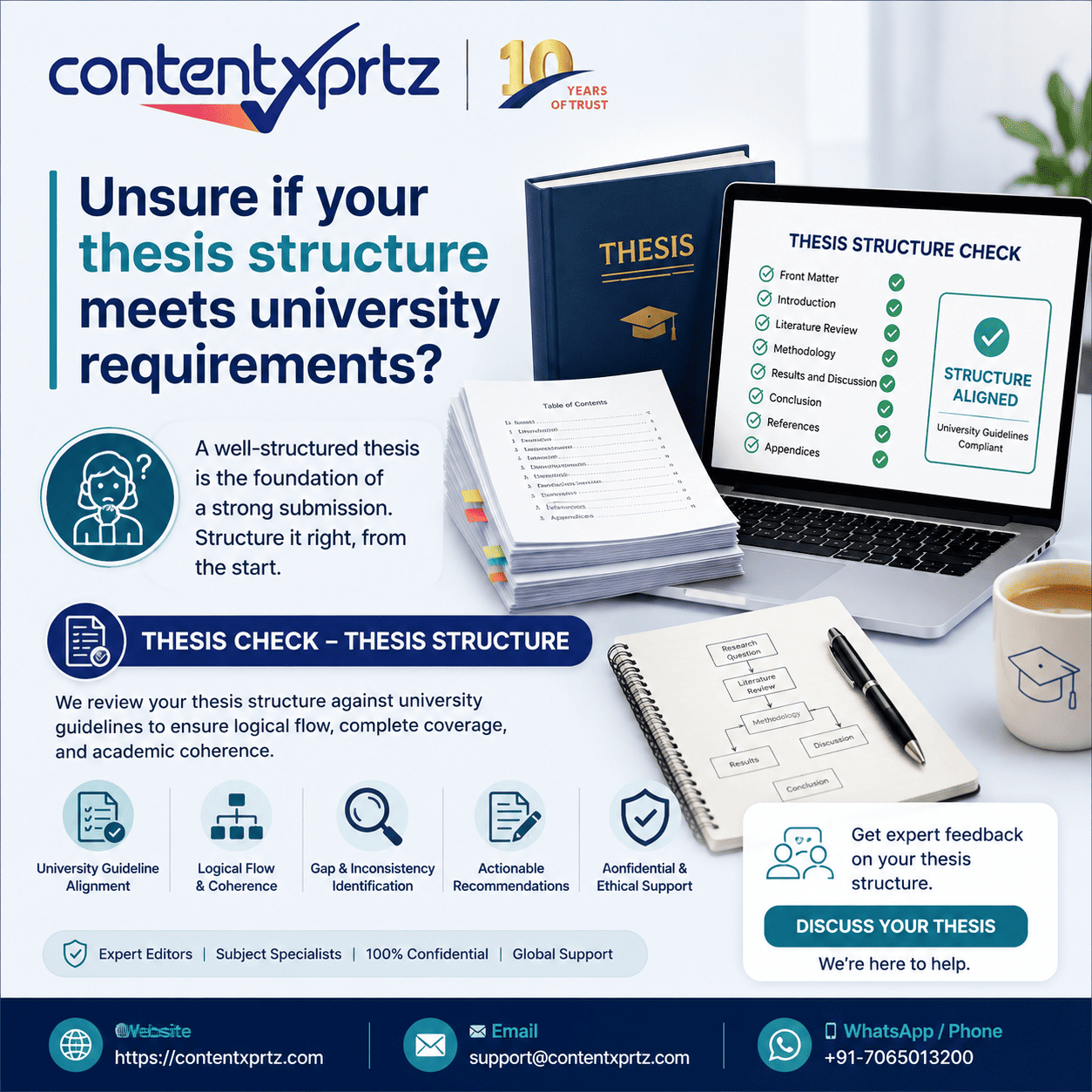
A conventional empirical thesis often follows six core chapters. The exact labels may change, and some universities combine results and discussion or require separate theoretical, methods, or publication chapters.
| Chapter | Main purpose | Questions it should answer |
|---|---|---|
| 1. Introduction | Define the problem, context, aims, questions, and contribution. | What is being studied? Why now? What will this thesis do? |
| 2. Literature Review | Synthesise what is known and identify the gap or tension. | What do scholars agree on? Where are the limitations or unresolved issues? |
| 3. Methodology | Explain and justify the research design, data, analysis, ethics, and limitations. | How was the study conducted, and why is this approach credible? |
| 4. Results / Findings | Present the evidence produced by the study. | What did the data show? |
| 5. Discussion | Interpret findings in relation to the questions and prior literature. | What do the findings mean, and how do they change understanding? |
| 6. Conclusion | Answer the research question, summarise contribution, limitations, and future work. | What has been established, what remains uncertain, and what follows? |
Front matter may include the title page, declaration, abstract, acknowledgements, table of contents, lists of figures or tables, and abbreviations. Back matter commonly includes references and appendices. Always use the ordering required by your university.
Chapter-by-Chapter Thesis Example: What Strong Writing Looks Like
Introduction example
A strong introduction moves from context to a precise research problem. It should not spend pages describing the broad field before stating the actual issue. One useful sequence is: context, problem, evidence that the problem exists, gap, research aim, questions or hypotheses, scope, contribution, and chapter overview.
Mini example: Instead of writing “Remote work has become common,” a focused introduction might explain that hybrid work adoption has grown but evidence about its effect on onboarding quality for early-career employees remains inconsistent. The thesis could then ask how manager contact, peer access, and digital socialisation shape early-role confidence in hybrid teams.
Literature review example
A literature review is not a catalogue of authors. It should organise studies by concepts, debates, methods, or findings and then explain how those strands connect. A paragraph should normally do more than report that “Author A found X and Author B found Y.” It should compare, evaluate, and synthesise.
Mini example: A review of hybrid onboarding might group research into socialisation theory, role clarity, manager support, peer networks, and digital communication. The gap may be that studies measure broad employee engagement but give limited attention to first-year employees in regulated service industries.
Methodology example
A credible methodology explains both what you did and why. For a qualitative study, that could include a constructivist stance, purposive sampling, semi-structured interviews, reflexive thematic analysis, ethics approval, and measures for credibility such as reflexive memoing and transparent coding decisions. For quantitative work, it may require variable definitions, sampling, instrument validity, statistical assumptions, power considerations, and robustness checks.
Results and discussion example
Results should present evidence without hiding inconvenient findings. Discussion should explain what those findings mean. If participants report that scheduled manager check-ins improved confidence but informal peer access had a stronger effect on belonging, the discussion might distinguish formal support from social learning and compare that interpretation with earlier onboarding research.
Conclusion example
The conclusion should answer the research question directly. It should not merely repeat the table of contents. A strong conclusion states the main finding, explains the contribution, acknowledges limitations, gives proportionate implications, and identifies realistic directions for future work.
Three Practical Examples of Thesis Topics and Research Logic
Example 1: Business and management
Topic: Hybrid onboarding and early-career employee confidence. Research question: How do manager contact and peer-network access influence role confidence during the first six months of hybrid employment? Possible method: Mixed methods using a survey followed by interviews. Contribution: Clarifies which onboarding mechanisms matter most rather than treating hybrid work as a single exposure.
Example 2: Public health
Topic: Appointment reminders and missed outpatient visits. Research question: Which reminder characteristics are associated with lower non-attendance among adults attending urban outpatient clinics? Possible method: Retrospective cohort analysis of appointment records, with careful attention to confounding and privacy. Contribution: Identifies operational patterns that may inform service design without claiming causation beyond the data.
Example 3: Education
Topic: Feedback literacy among postgraduate students. Research question: How do international postgraduate students interpret and act on written formative feedback in research-methods courses? Possible method: Interviews and document elicitation. Contribution: Shows where feedback wording, disciplinary conventions, and language confidence interact.
These examples demonstrate a principle worth copying: each topic becomes manageable only when the population, phenomenon, context, and analytical purpose are narrowed.
How to Use a Thesis Example Without Copying It
Use an example as an architectural reference. Study where the research question appears, how headings reflect the argument, how the author moves between claims and evidence, and how limitations are expressed. Then close the example and draft from your own notes and sources.
- Copy the function of a section, not its sentences.
- Do not reuse another student's research question merely by changing the location or population.
- Do not copy tables, conceptual models, references, or data unless you have the right to use them and cite them appropriately.
- Check whether the example belongs to the same discipline and degree level as your work.
- Use your university's formatting rules even if the example uses a different style.
Academic integrity requires transparent authorship. If your institution regulates the use of editing, generative AI, translation, or research assistance, follow those rules and disclose assistance where required.
Common Mistakes When Following an Example of Thesis
The biggest mistake is assuming that a successful thesis can be copied as a universal template. Structure follows research logic, and disciplines define evidence differently.
- Starting with a topic instead of a research problem: “Artificial intelligence in education” is a field, not a thesis question.
- Writing the literature review as summaries: A thesis needs synthesis, comparison, evaluation, and a reasoned gap.
- Choosing methods for convenience: The method must answer the question and fit the type of evidence required.
- Mixing results and interpretation without control: Some disciplines allow this, others prefer separation. Follow local conventions.
- Overclaiming: A small qualitative sample can produce valuable insight without proving population-wide causation.
- Leaving the argument until the conclusion: The reader should understand the thesis's central direction from the introduction onward.
- Formatting too early: Perfect margins cannot rescue an unclear research question; first fix logic, then presentation.
Thesis Quality Checklist Before Submission
Use this checklist after the substantive research is complete and again before final submission.
- Can a reader state the research problem after reading the first two pages?
- Do the research questions, methods, findings, and conclusion use consistent terminology?
- Does every major claim have appropriate evidence or citation?
- Are contradictory findings acknowledged rather than ignored?
- Are limitations specific and proportionate?
- Does the conclusion explain the contribution rather than introduce new evidence?
- Are references complete and consistent with the required citation style?
- Have tables, figures, appendices, abbreviations, and cross-references been checked?
- Has proofreading been separated from substantive editing so that both logic and language receive attention?
When Is Self-Editing Enough, and When Can Thesis Editing Help?
Self-editing may be enough when your argument is stable, your supervisor is satisfied with the research logic, the document is manageable in length, and you have time to review it in several passes. Use separate passes for structure, paragraph logic, evidence, citations, style, grammar, formatting, and final proofing.
Professional support can be useful when a thesis is long, written under deadline pressure, prepared in a second language, or contains inconsistent terminology, headings, citations, tables, and chapter transitions. Ethical editing should improve communication while preserving the author's research choices and intellectual ownership.
Contentxprtz provides thesis writing and editing support, including clarity-focused editing, thesis proofreading, structure review, reference consistency, and formatting assistance where permitted. A responsible editor should flag unclear claims and inconsistencies rather than invent evidence, fabricate references, or rewrite the research as if they were the author.
For researchers who need a narrower service, PhD thesis editing and thesis proofreading can be used at different stages: editing earlier for structure and clarity, proofreading later for surface-level accuracy and consistency.
Summary: Example of Thesis
An example of thesis is most valuable when it helps you understand academic structure rather than giving you text to imitate. For a thesis statement, look for a precise, arguable claim linked to evidence and significance. For a full thesis, look for alignment among the research problem, literature gap, question, method, findings, discussion, and contribution.
A strong model also shows restraint: it acknowledges limitations, uses sources accurately, and follows the conventions of its discipline. Before submission, check your university's rules, verify every citation, review the logic chapter by chapter, and complete a separate language and formatting check.
Frequently Asked Questions
What is an example of thesis?
An example of thesis can refer either to a sample thesis statement or to a model of a complete thesis or dissertation. A thesis statement is a concise central claim, while a full thesis is a research document that develops a question through literature, methods, evidence, analysis, and conclusion. Use examples to understand structure and academic reasoning, not to copy wording or arguments.
What is a simple example of a thesis statement?
A simple example is: “Regular formative feedback improves postgraduate research writing when students receive specific guidance on how to act on comments.” It is more useful than a broad statement such as “feedback is important” because it identifies a relationship and a context that can be examined with evidence.
How long should a thesis statement be?
A thesis statement is commonly one or two sentences, but there is no universal length. It should be long enough to express the central claim precisely and short enough to remain clear. A doctoral thesis may also state its central argument across a short paragraph in the introduction, depending on disciplinary convention.
What chapters are usually in a thesis?
A common empirical structure includes introduction, literature review, methodology, results or findings, discussion, and conclusion. Many theses also include front matter, references, and appendices. Humanities, article-based, practice-led, and professional doctorates may use different chapter structures, so your university's requirements take priority.
Can I use another student's thesis as a template?
You can use a legitimate thesis as a structural reference if your institution permits it, but you should not copy its wording, research question, argument, data, tables, or references without proper attribution and a valid scholarly reason. Check that the example matches your discipline, degree level, and current university requirements.
What makes a thesis example strong?
A strong thesis example has clear alignment from problem to conclusion. The research question is explicit, the literature review establishes a reason for the study, the methodology fits the question, findings are traceable to evidence, and the discussion explains the contribution without overstating what the data can prove.
What is the difference between a thesis and a dissertation?
The terms vary by country and university. In some systems, “thesis” is used for master's work and “dissertation” for doctoral work; in others, the terms are reversed or used differently. The safest approach is to follow the terminology in your institution's official handbook rather than assuming one global definition.
How do I start writing a thesis?
Start by clarifying the research problem and writing an answerable research question. Then map the literature needed to justify the problem, choose a method that can answer the question, and create a working chapter outline. Drafting can begin before every detail is perfect, but the question and methodological direction should be sufficiently stable to prevent large-scale rework.
Should I edit my thesis myself or use a professional editor?
Self-editing is often appropriate when you have sufficient time and strong control over academic English, structure, citations, and formatting. Professional editing can help with clarity, consistency, argument flow, and proofreading, especially in long or technically complex theses. Any assistance should follow your university's academic-integrity rules and preserve your authorship and research decisions.
Can Contentxprtz help with a thesis without writing it for me?
Yes. Contentxprtz can provide ethical thesis editing, proofreading, structure review, language improvement, reference consistency, and formatting support where permitted. The researcher remains responsible for the research question, sources, methods, data, analysis, conclusions, and final submission.
Conclusion: Use Thesis Examples as Models, Not Shortcuts
The best thesis example does not give you a piece of writing to reproduce. It helps you recognise the decisions behind strong academic work: a focused problem, a defensible question, an evidence-based argument, an appropriate method, careful interpretation, and a conclusion that accurately states the contribution.
For early exploration, free examples, university writing centres, supervisor feedback, and your institutional handbook may be enough. Expert assistance becomes more useful when the document needs a systematic language review, stronger chapter transitions, consistent terminology, detailed proofreading, or submission-ready formatting. Whatever support you use, author responsibility and academic integrity remain central.
Contentxprtz helps scholars improve clarity, structure, ethics, and thesis readiness without replacing the researcher's intellectual contribution. “At Contentxprtz, we don’t just edit; we help ideas reach their fullest potential.”