Where Can I Publish My Research Paper? A Practical Journal Selection Guide
If you are asking where can I publish my research paper, the most useful answer is not a random list of famous publishers. You need a journal or proceedings venue whose scope, readers, article type, peer-review standards, access model, and practical requirements fit the paper you actually wrote.
For a first-time author, that decision can feel harder than writing the final draft. Thousands of journals exist across disciplines, and their names alone do not tell you whether they are credible, indexed where your institution requires, affordable, open access, fast enough for your timeline, or genuinely interested in your topic. A good selection process turns this uncertainty into a sequence of checks.
This guide explains where research papers can be published, how to create a realistic journal shortlist, how to compare open-access and subscription routes, how to verify indexing and fees, how to avoid deceptive journals, and what to prepare before submission. It is designed for postgraduate students, PhD scholars, independent researchers, early-career academics, and professionals preparing scholarly work.
The central principle is simple: journal fit comes before journal prestige. A well-matched paper is easier for an editor to understand, easier to route to suitable reviewers, and more likely to reach the readers who can use the research.
Quick Answer: Where Can I Publish My Research Paper?
You can publish your research paper in a credible peer-reviewed journal, a scholarly society journal, a university-press journal, a reputable open-access journal, or—when appropriate for your field—a reviewed conference proceeding. The right venue is the one that regularly publishes work similar to yours and clearly explains its editorial process, author requirements, fees, and publication ethics.
Start by identifying three to five journals from papers you already cite. Compare their aims and scope, recent articles, article types, readership, indexing, open-access options, and fees. Publisher tools such as Elsevier Journal Finder can suggest candidates from your title or abstract, while the Directory of Open Access Journals is useful when you specifically want open-access venues.
Do not submit because a journal promises fast publication or sends you an invitation. Verify the journal independently, read its author instructions, and use a trust checklist before submitting. If manuscript quality or journal-readiness is the main barrier, consider ethical research paper editing support before submission.
Key Takeaways
- Publish in a journal that fits your manuscript’s subject, methods, article type, and target readers.
- Build a shortlist before submitting; do not choose a journal from one metric or one email invitation.
- Open-access journals can be fee-based or no-fee, while subscription journals may also offer paid open-access options.
- Verify indexing claims in the relevant official database and check current coverage close to the submission date.
- Use independent trust checks to reduce the risk of predatory or deceptive publishing.
- Read the Instructions for Authors before formatting the final manuscript and cover letter.
- Editing can improve clarity and journal readiness, but authors remain responsible for research, claims, data, citations, and final submission.
What This Page Covers
- The main places where researchers publish peer-reviewed papers
- A practical method for finding journals in your exact subject area
- How to compare journal scope, indexing, fees, access models, and timelines
- How to distinguish a journal article from a preprint or repository deposit
- How to check whether a journal appears trustworthy
- Common journal-selection and submission mistakes
- A final submission-readiness checklist and 10 detailed FAQs
Table of Contents
Methodology and Academic Sources
This article reflects common scholarly publishing workflows and current author guidance from established publishing and research-integrity resources. Journal policies vary by discipline, publisher, article type, country, funder, and institution, so the official author instructions of the specific journal should always be treated as the final operational source.
For publication venue selection, this guide draws on publisher guidance about journal matching and submission, the DOAJ directory for open-access discovery, Think. Check. Submit. journal checks, and the COPE Core Practices for publication ethics and transparency. These sources help authors evaluate fit and credibility; they do not guarantee that a particular manuscript will be accepted.
Where Research Papers Are Commonly Published
Most research papers intended as formal scholarly publications are submitted to academic journals, but the publishing landscape includes several legitimate routes. The best choice depends on what your field counts as a meaningful research output and what stage the manuscript has reached.
Peer-reviewed academic journals
Peer-reviewed journals are the standard route in many disciplines. An editor first assesses whether the manuscript fits the journal and meets basic quality and policy requirements. Suitable papers are then evaluated by independent reviewers with subject expertise. The journal may reject the paper, request revision, or eventually accept it. Peer review is not a guarantee that an article is perfect, but it is a formal quality-control process built into scholarly communication.
Scholarly society journals
Professional and learned societies often publish journals for a defined research community. These can be especially relevant when your research addresses a specialised audience. Society ownership alone does not remove the need for normal checks: read the scope, editorial policies, fees, and indexing information just as you would for any other journal.
Open-access journals
Open-access journals make articles available to readers without a subscription. Some charge an article processing charge (APC); others are supported by institutions or societies and charge authors nothing. A credible open-access journal should clearly state its peer-review model, fees, licensing terms, editorial board, contact details, and ethics policies.
Conference proceedings
In fields such as computer science and engineering, a peer-reviewed conference paper may be an important publication format. In other disciplines, conference abstracts or proceedings may carry less weight than full journal articles. Check whether your institution or field treats conference output as a formal publication and whether a later journal paper would be considered duplicate publication or an acceptable extension.
Preprint and institutional repositories
Repositories can make a manuscript discoverable before or after journal publication, depending on the journal’s policy. A preprint is generally not the same as a peer-reviewed journal article. Treat repository sharing as a dissemination route, not automatically as a substitute for formal publication.
How to Build a Shortlist of Journals That Actually Fit Your Paper
The strongest shortlist usually comes from your own literature review. Look at the journals that publish the studies you cite most often, especially recent papers using comparable methods or addressing a similar population, theory, intervention, dataset, or application.
Start with your reference list
Identify recurring journal titles in your references. If several papers central to your study come from the same journal, inspect that journal’s current aims and scope. The journal may have changed direction, so do not rely on an old article alone.
Search using your manuscript title and abstract
Use major concepts from your title, abstract, and keywords to search journal databases and publisher catalogues. Journal matching tools can accelerate discovery. Elsevier’s Journal Finder, for example, matches manuscript information against its own journal portfolio. Treat the result as a shortlist generator, not an endorsement.
Read recent issues
Open the journal’s current issue and several recent articles. Ask whether your manuscript would look intellectually at home there. A journal may mention your topic in a broad scope statement but publish almost no work using your methodology or addressing your specific research community.
Ask a disciplinary mentor or librarian
Supervisors, senior coauthors, research librarians, and experienced colleagues can often identify journals that are respected in your subfield and point out venue-specific expectations that are not obvious from metrics alone.
Compare Publication Routes Before You Decide
The table below separates common publication routes by what they are best for. It is not a ranking: each option can be appropriate in the right research context.
| Publication route | Best suited to | What to verify | Important caution |
|---|---|---|---|
| Peer-reviewed journal | Formal scholarly article publication | Scope, article type, peer review, indexing, author instructions | Prestige does not compensate for poor scope fit |
| Open-access journal | Immediate public access | APC, waivers, licence, peer review, DOAJ record where relevant | Open access can be legitimate with or without fees |
| Society journal | Defined disciplinary community | Society ownership, editorial board, audience, indexing | Still apply normal journal-quality checks |
| Conference proceedings | Fields where conferences are major publication venues | Review process, publisher, indexing, later-journal policy | An abstract may not equal a full peer-reviewed paper |
| Preprint repository | Early sharing before journal decision | Target-journal preprint policy, version labelling, DOI | Do not present a preprint as peer-reviewed |
| Institutional repository | Archiving an allowed manuscript version | Publisher self-archiving policy and embargo | The deposited version may differ from version of record |
If your goal is a credentialed peer-reviewed publication, prioritise a journal or recognised reviewed proceedings route. Repositories can complement that route by improving access and preservation where policies allow.
When Self-Service Journal Selection Is Enough and When Expert Help Is Useful
You can often select a journal yourself when the topic is focused, you understand the main journals in your field, and the manuscript is already structurally and linguistically strong. Start with your references, official journal websites, database source lists, and trusted journal-selection checklists.
Expert help becomes more useful when you have several plausible journals with different scopes, when your paper crosses disciplines, when you are unsure how reviewers will interpret the contribution, or when language and structure make the manuscript look weaker than the research actually is. In those situations, manuscript assessment or publication support can help you organise the decision.
Ethical support should never invent data, fabricate references, guarantee journal acceptance, or submit to multiple journals simultaneously. The author remains responsible for the study and every claim made in the manuscript.
How to Choose Where to Publish Your Research Paper: Step by Step
1. Identify the paper’s real contribution
Write one sentence stating what is new, useful, tested, compared, explained, or demonstrated. Journal selection becomes easier when the manuscript’s contribution is explicit.
2. Define the target reader
Decide who should read the work: specialists in one subfield, clinicians, educators, policy researchers, engineers, interdisciplinary scholars, or a broader scientific audience. A journal should give you access to the readers most likely to understand and use the paper.
3. Confirm the article type
Determine whether you have original research, a systematic review, narrative review, methods paper, case report, short communication, data article, protocol, or another format. A journal can fit the topic but still reject an unsupported article type.
4. Generate 5–10 candidate journals
Use cited literature, database searches, society websites, publisher catalogues, and journal finder tools. At this stage, generate options rather than choosing immediately.
5. Remove journals that are out of scope
Read aims and scope, recent issues, and editorial priorities. Remove journals where your topic or method would appear peripheral.
6. Check author instructions
Review word limits, abstract structure, reference style, figure requirements, supplementary files, reporting guidelines, ethics declarations, data availability statements, and cover-letter expectations. Springer Nature’s article publishing guidance is a useful example of how publishers describe the preparation, submission, review, and publication stages.
7. Verify journal legitimacy and indexing
Check editorial transparency and verify database claims independently. Do not rely on screenshots, copied logos, or a third-party list that may be outdated.
8. Compare access and cost
Record APCs, optional open-access charges, colour or page charges if any, waiver policies, institutional agreements, and repository options. Check the current journal page because fees can change.
9. Compare timeline information carefully
Some journals publish historical median decision or review times. Use these figures as estimates, not promises. Your manuscript may move faster or slower depending on editor availability, reviewer recruitment, revisions, and article complexity.
10. Rank your shortlist
Choose a first-choice journal and at least two backup journals. Rank primarily by fit and credibility, then by audience, access model, cost, required indexing, and practical timing.
11. Adapt the manuscript for the first-choice journal
Reformat the manuscript, references, title page, declarations, figures, supplementary files, and cover letter. Do not send the same generic package everywhere.
12. Submit to one journal at a time
Complete every disclosure accurately and keep a record of the submission. If the paper is rejected, use the feedback, revise where appropriate, and then move to your next journal.
How to Check Whether a Journal Is Credible, Indexed, and Suitable
A credible journal should be transparent enough that you can understand who publishes it, what it publishes, how manuscripts are reviewed, what authors may have to pay, and what happens after acceptance.
Verify the journal identity
Check the exact title, ISSN, publisher, domain, and editorial office. Deceptive websites sometimes mimic established journals or use confusingly similar names.
Verify indexing at the source
If your university requires Scopus, Web of Science, PubMed, MEDLINE, or another index, check the journal in the database’s current official source list. A journal’s own 'indexed in' panel is not sufficient evidence.
Review the editorial board and peer review
Editorial-board members should be identifiable and relevant to the journal’s field. The journal should explain its peer-review model. Be cautious if review is described only in vague promotional language or if acceptance appears guaranteed.
Check fees before submission
Credible journals disclose charges clearly. A journal may charge an APC, optional open-access fee, or no author fee. Hidden charges that appear late in the process are a warning sign.
Use independent transparency checks
The Think. Check. Submit. checklist encourages authors to verify whether they know the journal, can identify and contact the publisher, understand the peer-review process, and can confirm fees and other publishing conditions. COPE’s transparency principles similarly emphasize clear journal governance, peer review, ownership, policies, and business practices.
Open Access, Subscription Journals, APCs, and Repository Options
Access model and journal quality are separate questions. Both open-access and subscription journals can be credible; both require the same careful fit and transparency checks.
Fully open-access journals
All or most research content is freely readable. The journal may charge an APC, may offer waivers, or may be funded so that authors pay nothing. DOAJ is useful for discovering open-access journals and reviewing directory information, but the journal’s own current instructions remain important for fees and policies.
Subscription journals
Readers or institutions pay for access. Many subscription journals do not charge authors for the standard publishing route, though other charges may exist. Some offer a hybrid open-access option for an additional fee.
Green open access and repositories
A publisher may allow authors to deposit a preprint or accepted manuscript in an institutional or subject repository, sometimes after an embargo. The exact version and timing depend on policy. Check the journal or publisher’s self-archiving rules before uploading files.
Do not select a journal purely to avoid an APC. Instead, compare credible no-fee journals, society titles, institutional agreements, waivers, and repository rights while keeping scope and readership central.
What Journal Editors Look for Before They Send a Paper to Peer Review
Editors usually make an initial assessment before external peer review. They need to see quickly that the paper belongs in the journal and that its research question, contribution, methods, reporting, and presentation justify further evaluation.
Springer Nature’s guidance to authors notes that editors look at whether work is in scope, whether it adds value to the field, whether the paper is carefully prepared, and whether it follows ethical standards. In practical terms, your title, abstract, cover letter, conclusions, references, and overall manuscript presentation need to tell one coherent story.
A desk rejection does not always mean the research is poor. The paper may be out of scope, too specialised or too broad for the journal’s audience, inconsistent with article-type expectations, insufficiently novel for that particular title, or not ready in language and structure. This is why journal selection and manuscript preparation should be treated as one connected process.
Ethical Editing, Authorship, and Publication Responsibility
Editing is appropriate when it improves clarity, grammar, structure, formatting, consistency, and presentation while preserving the author’s research and intellectual contribution. The author should remain able to explain and defend every part of the manuscript.
Do not fabricate references, alter data to improve a result, invent peer-review claims, add honorary authors, hide conflicts of interest, or misrepresent prior publication. Where the research involved human participants, animals, clinical trials, protected data, or other regulated activities, follow the relevant ethics approval, consent, registration, and reporting requirements.
If you use AI tools during drafting or editing, verify all outputs and follow the policy of your target journal and institution. Never rely on generated references without checking that the source exists and supports the claim. For authors who want language and presentation support, Contentxprtz offers academic editing designed to strengthen the manuscript without replacing author responsibility.
Common Mistakes When Deciding Where to Publish
- Choosing by impact factor alone. A metric cannot tell you whether the journal’s readers or editors are interested in your specific study.
- Submitting to a journal outside the manuscript’s scope. This increases the chance of a rapid desk rejection.
- Trusting unsolicited invitations. Verify the journal independently even if the email mentions your previous work.
- Believing every indexing claim. Search the official database by title and ISSN.
- Ignoring publication fees until acceptance. Record current charges and waiver rules before submission.
- Confusing preprints with peer-reviewed publication. Label versions accurately and check journal policy.
- Formatting before checking the journal. Choose the venue first, then adapt the manuscript to its author instructions.
- Submitting to several journals simultaneously. Most journals prohibit duplicate submission.
- Using a generic cover letter. Explain why the paper matters to the chosen journal’s readership.
- Assuming editing guarantees acceptance. Editing can improve clarity and readiness, but editorial decisions depend on research quality, scope, reviewers, and journal priorities.
Practical Examples: Matching a Research Paper to a Publication Venue
Example 1: A PhD scholar with a narrow empirical study
Situation: A doctoral researcher has a strong dataset on a specialised educational intervention. The paper is methodologically sound but the sample and research question are highly focused.
Better approach: Shortlist journals that regularly publish intervention studies in the same educational subfield rather than aiming first at a broad multidisciplinary title. Read recent issues to confirm similar sample sizes and methods. The goal is to place the paper where reviewers understand the specific contribution.
Example 2: An independent researcher without affiliation
Situation: The author has completed a non-regulated data-analysis paper using public datasets but has no university affiliation.
Better approach: Search for journals based on topic and methods, not affiliation. Use accurate author information and follow the journal’s instructions for independent authors. If the journal asks about ethics, data sources, or conflicts, answer transparently.
Example 3: A researcher who needs open access but has no APC budget
Situation: A funder encourages public access, but the author cannot pay a large APC.
Better approach: Search credible no-fee open-access journals, check institutional publishing agreements and waivers, and compare self-archiving routes. Do not assume the only choices are paying a high APC or abandoning open access.
Example 4: An engineering paper already presented at a conference
Situation: A shorter version appeared in reviewed conference proceedings, and the authors now want a journal article.
Better approach: Check the journal’s prior-publication and conference-extension policy. The journal version may need substantial new material, transparent citation of the conference paper, and a clear explanation of what is new. Requirements vary by publisher and field.
Research Paper Journal Selection and Submission Checklist
Journal fit
- The journal’s aims and scope clearly include my topic.
- Recent articles show compatible subject matter, methods, and audience.
- The journal accepts my article type.
- I can explain in one or two sentences why this paper belongs in this journal.
Credibility and practical conditions
- I verified the journal title, publisher, ISSN, and contact details.
- I understand the peer-review model and editorial process.
- I independently verified any indexing requirement that matters to me.
- I checked the current APC or other publication charges and any waivers.
- I reviewed open-access, licence, copyright, and repository options.
Manuscript readiness
- The manuscript follows the current Instructions for Authors.
- The abstract accurately states purpose, methods, key results, and conclusion.
- Figures, tables, references, declarations, and supplementary files are complete.
- All authors have approved the manuscript and authorship order.
- Ethics, funding, conflicts of interest, data, and AI-use disclosures are complete where required.
- The manuscript is not simultaneously under consideration by another journal.
How Contentxprtz Can Help Before Journal Submission
Finding a suitable journal is only one part of publication readiness. A manuscript can be scientifically valuable and still struggle because the contribution is buried, the abstract is unfocused, language obscures the methods, references are inconsistent, or the paper does not follow the target journal’s structure.
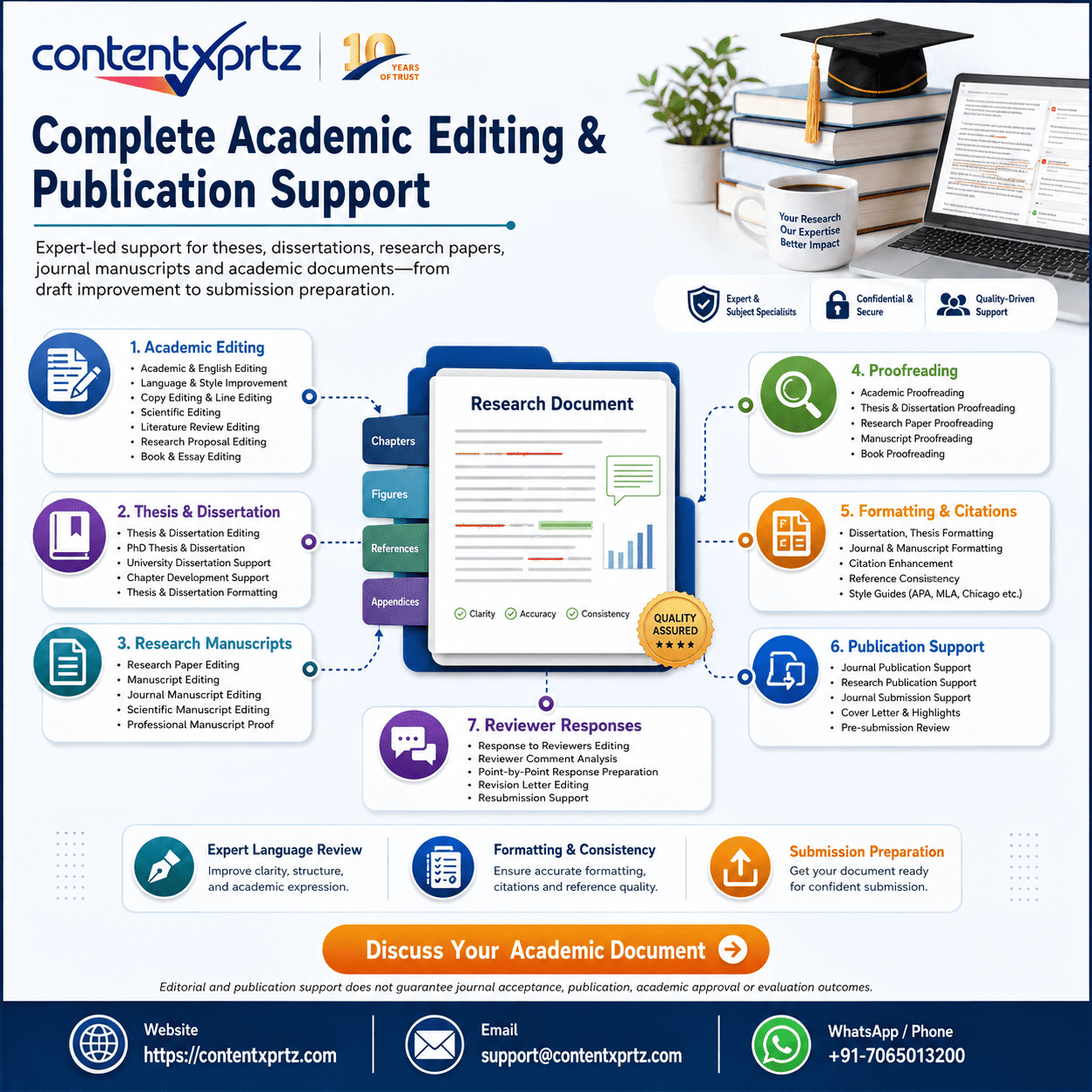
Contentxprtz can support researchers through research paper editing, manuscript-level quality checks, and relevant journal publication support. The purpose is to improve clarity, consistency, structure, formatting, and submission readiness while keeping authors responsible for the research and final decisions.
Professional support is especially useful when English is not your first language, when the paper has several coauthors and inconsistent sections, when a previous journal decision identified presentation problems, or when you want an experienced editorial review before submitting to your shortlist.
Summary: Where to Publish a Research Paper
If you are deciding where to publish, begin with fit: topic, methods, article type, and audience. Generate candidates from your own references and trusted journal-search tools, then verify scope, recent content, peer review, fees, access model, indexing, and author instructions on the journal’s official sources.
Choose open access or subscription publishing based on your goals and constraints, not assumptions about quality. Verify indexing independently. Treat preprints and repositories as complementary dissemination routes when permitted. Use Think. Check. Submit. and publication-ethics guidance to reduce the risk of deceptive journals.
Finally, prepare the manuscript for one target journal at a time. Clear writing, correct formatting, accurate citations, complete declarations, and ethical authorship practices will not guarantee acceptance, but they give editors and reviewers a fair opportunity to judge the research on its merits.
Frequently Asked Questions
Where can I publish my research paper?
You can publish a research paper in a peer-reviewed academic journal that matches your subject, article type, methods, and intended readership. Depending on your field, suitable options may include society journals, university-press journals, commercial publisher journals, fully open-access journals, hybrid journals, or reputable conference proceedings. Start with journals that have recently published papers similar to yours, then read each journal’s aims and scope and author instructions before making a shortlist. A journal-finder tool can generate candidates, but it should not replace your own scope check. If open access matters, you can also search the Directory of Open Access Journals and verify fees, licensing, and peer-review information on the journal’s official website. Avoid choosing solely by impact factor, rapid-publication claims, or an unsolicited email invitation. The best publication venue is the one whose readers need your work and whose editorial requirements your manuscript can genuinely meet. If your paper still needs language, structure, reference, or journal-readiness work, professional research paper editing can help you prepare it, but no editing service can guarantee acceptance.
How do I choose the right journal for my research paper?
Choose the journal by matching your manuscript to five things: scope, audience, article type, quality expectations, and practical submission conditions. First, compare your title, abstract, keywords, methods, and main contribution with the journal’s aims and scope. Next, inspect several recent articles to see whether the journal publishes work with a similar disciplinary focus and methodological depth. Confirm that your article type is accepted, because some journals publish original research but not case reports, short communications, protocols, or certain review formats. Then review peer-review model, indexing claims, publication fees, open-access options, data or ethics requirements, word limits, and expected files. Finally, consider legitimate journal-level metrics only after fit is established. A prestigious journal that is out of scope is usually a poorer choice than a well-matched journal read by the right research community. Build a shortlist of three to five journals and rank them before submission so you already know your next option if the first journal declines the paper.
Can I publish my research paper for free?
Yes, many legitimate journals allow authors to publish without paying an article processing charge, although the final article may then be available through subscription access rather than immediate open access. Some fully open-access journals also charge no author fee because they are funded by universities, societies, institutions, libraries, or grants. The Directory of Open Access Journals can help you identify open-access titles and inspect whether fees are listed, but you should still verify the current charge on the journal’s official website. Do not assume that a fee makes a journal predatory, and do not assume that a free journal is automatically trustworthy. Evaluate editorial transparency, peer review, ownership, author guidelines, licensing, indexing claims, and published articles. Also check whether your funder or institution has an open-access policy or publisher agreement that can cover or waive charges. If cost is a constraint, include 'no APC' or waiver eligibility in your journal-selection criteria from the beginning rather than discovering the fee only after acceptance.
How can I tell whether a journal is legitimate or predatory?
Evaluate the journal using multiple independent checks rather than one logo, metric, or indexing claim. Read the journal website carefully: it should clearly identify the publisher, editorial board, peer-review process, fees, copyright or licensing terms, contact information, and publication ethics policies. Confirm that editors appear to be real scholars with relevant expertise and that recent articles are within the stated scope. If the journal claims to be indexed in a database, verify the title directly in that database rather than trusting an image on the journal website. For open-access journals, check relevant directory records where appropriate. Think. Check. Submit. provides a practical checklist for assessing whether a journal or publisher is suitable and trustworthy, while COPE’s transparency and ethics guidance describes practices expected in responsible scholarly publishing. Warning signs include aggressive unsolicited invitations, implausibly broad scope, hidden fees, guaranteed acceptance, extremely fast peer review without explanation, unclear ownership, fake metrics, or journal titles designed to imitate established publications. No single warning sign is conclusive, so assess the whole pattern.
Do I need a university affiliation to publish a research paper?
Not always. Many scholarly journals accept submissions from independent researchers, industry professionals, clinicians, consultants, retired academics, or other authors who do not currently hold a university affiliation. The decisive issue is usually whether the research is appropriate for the journal and meets its scientific, ethical, methodological, reporting, and authorship requirements. If you are independent, describe your affiliation accurately rather than inventing an institutional connection. Some submission systems allow 'independent researcher' or a city and country; others provide journal-specific instructions. Certain studies may still require prior ethics approval, institutional oversight, permissions, trial registration, or data-governance compliance regardless of affiliation, especially when human participants, animals, protected data, or regulated research are involved. Funding and access to facilities may also affect what research can be conducted responsibly. Before submission, read the target journal’s author guidelines and ethics policies. If the journal requires information you do not have, contact its editorial office with a concise, transparent question rather than misrepresenting your status.
Should I publish in an open access or subscription journal?
Choose between open access and subscription publishing based on your audience, funder requirements, budget, licensing preferences, and the quality and fit of the journal—not on the access model alone. Open access can make the final article immediately available to readers without a subscription, but some journals charge an article processing charge and the amount varies. Subscription journals may charge no publication fee for the standard route, while some offer a hybrid option in which authors can pay for open access. Your institution or funder may require a particular licence or repository deposit, and publisher agreements may cover some fees. In every model, check scope, peer review, editorial transparency, ethics policies, and the journal’s standing in your discipline. Open access is not synonymous with predatory publishing, and subscription access is not a guarantee of quality. If you need wide public accessibility but cannot pay an APC, investigate no-fee open-access journals, institutional agreements, waivers, and legitimate repository options permitted by the publisher.
How do I check whether a journal is indexed in Scopus or Web of Science?
Verify indexing claims in the database’s own official source list or journal lookup rather than relying on the journal’s website. Search by the exact journal title and, when possible, the ISSN because similar titles can cause confusion. Check whether the coverage is current, whether only certain years are indexed, and whether the title has changed. Also distinguish the journal itself from individual articles that may appear in a search engine or citation platform. A journal can be discoverable online without being covered by Scopus or Web of Science. Indexing may matter for institutional, funding, promotion, or doctoral requirements, but it should not be your only journal-selection criterion. Scope, readership, peer-review quality, editorial practices, and fit with your manuscript remain essential. If your university requires publication in a particular indexing category, obtain the requirement in writing and verify the journal against the current official list immediately before submission, because coverage decisions can change over time.
Can I submit the same research paper to more than one journal at the same time?
Normally, no. Standard scholarly publishing practice requires authors to submit a manuscript to one journal at a time unless a journal explicitly states a different policy. Simultaneous submission can waste editor and reviewer effort and may violate the declarations you make during submission. If the journal rejects the paper, or if you formally withdraw it and the withdrawal is confirmed, you can then submit to another journal after adapting the manuscript and cover letter as needed. Before resubmitting, remove references to the previous journal, reformat according to the new author instructions, and consider whether reviewer or editor feedback revealed problems that should be fixed first. Conference abstracts, preprints, theses, and prior reports can create additional questions about what counts as prior publication, so check the target journal’s policy rather than assuming. Springer Nature’s author guidance, for example, states that an article should be submitted to one journal at a time. Transparency is safer than trying to accelerate the process through duplicate submission.
Is a preprint repository the same as publishing in a peer-reviewed journal?
No. Posting a manuscript as a preprint and publishing a peer-reviewed journal article are different forms of research communication. A preprint makes a manuscript publicly available before formal journal peer review, which can support early sharing, feedback, priority claims, and discoverability in fields where preprints are common. A journal publication usually adds editorial assessment, peer review, formal versioning, publication metadata, and the journal’s record of publication. Because policies vary, check whether your target journal accepts manuscripts that have already appeared as preprints and whether it asks you to disclose the preprint during submission. Also update the preprint record with the final journal citation when appropriate. Do not describe an unreviewed preprint as if it has passed journal peer review. If your main goal is to establish a formal peer-reviewed publication, use a preprint as a complementary dissemination route only when compatible with your field, funder, institution, and target journal.
When should I get professional help before journal submission?
Professional support is most useful when the research is complete but the manuscript is not yet communicating it clearly enough for the target journal. Common reasons include difficult English expression, weak paragraph flow, inconsistent terminology, unclear tables or figure captions, reference-format problems, an abstract that does not reflect the main findings, or uncertainty about whether the manuscript follows the journal’s instructions. Journal-readiness support can also help authors compare potential journals and identify formatting or submission requirements, but the author should remain responsible for the research question, data, analysis, interpretation, citations, authorship, and final submission. Ethical editing should improve clarity and presentation without fabricating evidence or replacing the researcher’s intellectual contribution. Contentxprtz research paper editing and publication support can be appropriate when you want a second set of expert eyes before submission, especially for a first journal article or an ESL manuscript. The service should be treated as quality support, not as a promise of acceptance or a substitute for scientific peer review.
Conclusion: Choose the Journal That Gives Your Research the Right Home
The question “where can I publish my research paper?” is best answered by a disciplined selection process, not by a universal list of journals. Your paper needs a venue whose scope, readership, article type, peer-review standards, costs, access model, and publishing policies match your research.
Self-service selection is often enough when you know your field and can confidently verify journal information. Expert-assisted editing or publication support can be useful when the manuscript needs clearer language, stronger organisation, closer alignment with author instructions, or an independent journal-readiness review. In either case, publication integrity depends on authentic research, traceable references, accurate disclosures, and author responsibility.
If your manuscript is ready for a final editorial review, explore Contentxprtz research paper editing services for ethical support with clarity, structure, language, formatting, and publication readiness.
“At Contentxprtz, we don’t just edit; we help ideas reach their fullest potential.”