What Is a Dissertation Guide? Role, Support & Expectations
What is a dissertation guide? In most academic contexts, a dissertation guide is the person more formally called a dissertation supervisor, thesis supervisor, research adviser, or faculty mentor. This person helps you make sound research decisions, understand programme expectations, stay within a feasible scope, and improve the academic quality of your work through discussion and feedback. The exact title and authority of the role depend on your university.
The most important distinction is between guidance and authorship. Your guide may help you sharpen a research question, discuss methods, suggest useful literature pathways, identify weaknesses in an argument, and comment on drafts within institutional limits. However, the dissertation remains your work. You are normally responsible for the research, data, analysis, citations, ethical conduct, deadlines, and final submission.
This distinction matters because students often approach supervision with one of two unrealistic expectations: either that the guide will solve every research problem, or that asking for guidance shows weakness. Neither is helpful. Effective supervision is a structured academic relationship in which the student prepares, makes decisions, and acts on feedback while the supervisor provides direction, challenge, context, and quality-focused questioning.
This article explains how dissertation guidance works in practice, what supervisors commonly do and do not do, how to prepare for meetings, how to use feedback without losing ownership, and when ethical professional academic editing support may complement — but never replace — your university supervisor.
For many students, the difficult part is not finding a definition but knowing how to use supervision well. A postgraduate researcher may be worried about thesis quality, chapter structure, citation accuracy, grammar, research ethics, or whether a draft is ready to show a supervisor. A PhD scholar may need to decide when supervisor feedback is enough and when specialist language editing or dissertation proofreading could help without crossing authorship boundaries. Cost also matters: university supervision and library support are normally part of the academic programme, while external editing should be used selectively and only when permitted. The safest approach is to treat your dissertation guide as the authority on programme-specific expectations and to use other support for clearly defined needs such as research skills, writing development, language clarity, or formatting. That combination keeps the project academically yours while giving you the right kind of help at each stage.
Quick Answer: What Is a Dissertation Guide?
A dissertation guide is an academic mentor who supports a student through the planning, research, writing, and revision of a dissertation. Universities more commonly use terms such as dissertation supervisor, thesis supervisor, or research adviser. The guide's job is to point you in productive directions, ask critical questions, help you interpret academic requirements, and provide feedback within the rules of your programme.
A guide does not normally write the dissertation, perform the research for you, guarantee approval, or become responsible for errors in your final submission. The University of Manchester's dissertation guidance describes supervision as helping students plan and guiding them through learning, while Oxford's postgraduate policy states that responsibility for the dissertation ultimately rests with the student.
Your best next step is to read your programme's dissertation handbook before the first meeting and clarify the practical rules: how often you can meet, how many drafts can be reviewed, expected turnaround time, required ethics procedures, and what types of editing or external assistance are permitted.
Key Takeaways
- A dissertation guide is usually the same role as a dissertation or thesis supervisor, although institutional terminology varies.
- The guide supports research decisions, planning, methods, structure, progress, and academic feedback; the student remains the author and decision-maker.
- Supervision rules — including meeting frequency and draft-review limits — differ by university and programme.
- Students get better guidance when they arrive with specific questions, written progress, and a clear agenda.
- Supervisor feedback should strengthen your reasoning, not replace your independent analysis or writing.
- Professional editing may complement supervision when permitted, especially for language, formatting, and clarity, but it must preserve academic integrity.
- If supervision becomes unavailable or ineffective, use the department's documented escalation or supervisor-change process.
What This Page Covers
- The meaning of “dissertation guide” in university practice
- What a guide should and should not do
- How dissertation supervision differs from editing, tutoring, and co-authorship
- How to prepare for supervision meetings and use feedback effectively
- Common student mistakes that reduce the value of supervision
- Practical examples from undergraduate, master's, and doctoral work
- When additional ethical editing or dissertation proofreading can be useful
Table of Contents
Methodology and Academic Sources
This guide draws on current university supervision policies and handbooks rather than treating “dissertation guide” as a universal job title. For example, Oxford University's postgraduate taught-course guidance describes dissertation supervision as a pattern of regular meetings within a planned framework and states that final responsibility rests with the student. The University of Cambridge Faculty of Biology sets out mutual expectations for supervisors and students, while the University of Manchester dissertation handbook explains that supervisors guide rather than do the dissertation work directly.
Practical meeting advice also reflects the University of Bath's guidance on working with a dissertation supervisor. These sources illustrate a common principle, but your own university's handbook has priority because supervision models, feedback limits, ethics procedures, assessment structures, and permitted third-party support vary.
What Does “Dissertation Guide” Mean in an Academic Context?
A dissertation guide is best understood as the academic person responsible for supervising the process of independent research, not as someone who supplies a finished dissertation plan or correct answer. In some countries and institutions, “guide” is common terminology. Elsewhere, “supervisor,” “adviser,” “mentor,” or “director of studies” may be used.
The role exists because a dissertation asks students to work more independently than they do in most taught assignments. You must transform a broad interest into a defensible question, decide what evidence is relevant, choose or justify methods, manage a long project, interpret findings, and present a coherent argument. A supervisor provides experienced academic judgment at key points so that you do not have to navigate every decision without feedback.
Guide, supervisor, adviser, and mentor: are they identical?
Not necessarily. A dissertation supervisor is usually directly connected to the research project. An academic adviser may oversee broader progress across a degree. A co-supervisor may contribute complementary subject or methods expertise. A mentor may provide career or professional advice without formal authority over the dissertation. Because titles vary, always confirm who is authorised to approve or advise on specific parts of your project.
| Role | Typical purpose | What to verify |
|---|---|---|
| Dissertation guide / supervisor | Research direction, progress, feedback, academic standards | Meeting and draft-review limits |
| Co-supervisor | Additional subject or methods expertise | Division of responsibilities |
| Academic adviser | Broader degree progress and pastoral/academic navigation | Whether they have authority over the dissertation |
| Methods or statistics adviser | Specialist methodological guidance | Scope, approvals, and authorship expectations |
| Professional editor | Language, clarity, consistency, formatting where permitted | University policy on third-party editing |
What Does a Dissertation Guide Actually Do?
A dissertation guide helps you make better academic decisions at points where inexperience can create avoidable problems. The exact duties depend on the programme, but effective supervision usually touches five areas: scope, method, evidence, argument, and project management.
1. Helps refine the research question
A broad topic such as “social media and mental health” is not yet a dissertation question. A guide may help you define a population, context, concept, period, theoretical lens, or outcome so the project can be completed with available time and data. They may challenge assumptions and ask whether the question is sufficiently specific, researchable, original for the degree level, and aligned with assessment criteria.
2. Discusses appropriate research methods
Your supervisor may help you compare qualitative, quantitative, mixed-methods, doctrinal, historical, experimental, computational, or review-based approaches. The goal is not to select a method because it is familiar, but because it can answer the question. In regulated or human-participant research, the guide may also help you understand when ethics approval, consent, data protection, or institutional permissions are required.
3. Points you toward relevant literature and scholarly conversations
A guide may recommend foundational authors, theories, databases, review papers, or terminology. However, literature searching remains a research skill you are expected to develop. Use your university library, subject databases, citation chaining, and reference-management tools to build a traceable evidence base rather than expecting the supervisor to provide a complete reading list.
4. Gives feedback on structure, argument, and progress
Supervisors often identify patterns that students cannot easily see in their own drafts: a chapter that answers a different question, a weak transition from literature to method, over-claiming from limited data, or a discussion section that repeats results instead of interpreting them. Feedback is most useful when it points to the underlying academic problem rather than merely correcting sentences.
5. Helps you plan a realistic path to submission
Dissertations fail operationally as often as intellectually. Data access takes longer than expected, recruitment stalls, analysis expands, or students postpone writing until the final weeks. A guide can help sequence the work into milestones and identify dependencies early.
What a Dissertation Guide Should Not Do
A guide supports learning; they should not become the hidden author of assessed work. Boundaries protect academic integrity and also make supervision more educational.
- Write chapters for you. The language and argument should remain yours unless your institution explicitly permits a defined form of editing.
- Invent or verify data on your behalf. You remain responsible for the authenticity, storage, analysis, and reporting of your evidence.
- Guarantee a grade, approval, or publication outcome. Assessment depends on the submitted work and the rules of the programme.
- Provide unlimited draft reviews. Many programmes place clear limits on feedback opportunities.
- Correct every grammar or formatting error. Supervisors may point out recurring issues, but line editing is often outside normal supervision.
- Make every decision. A dissertation is evidence that you can exercise independent scholarly judgment.
If you are unsure whether a request is appropriate, ask a process question: “What kind of feedback are you allowed to give on this draft?” That keeps expectations transparent.
Free, Low-Cost, and Professional Dissertation Support Options
Students often combine several types of support. The key is to use each for the task it is designed to handle and to check institutional rules before sharing assessed work externally.
| Support | Best for | Main caution |
|---|---|---|
| University dissertation guide | Academic decisions, research design, progress, permitted draft feedback | Time and review scope may be limited |
| University library | Database searching, evidence discovery, reference tools | Librarians support search skills, not dissertation authorship |
| Writing centre | Writing development, planning, recurring language or structure issues | May not provide full-document editing |
| Peer or study group | Accountability, discussion, presentation practice | Protect confidential data and avoid inappropriate text sharing |
| Professional academic editor | Language, clarity, proofreading, formatting, reference consistency where allowed | Must preserve authorship and follow university policy |
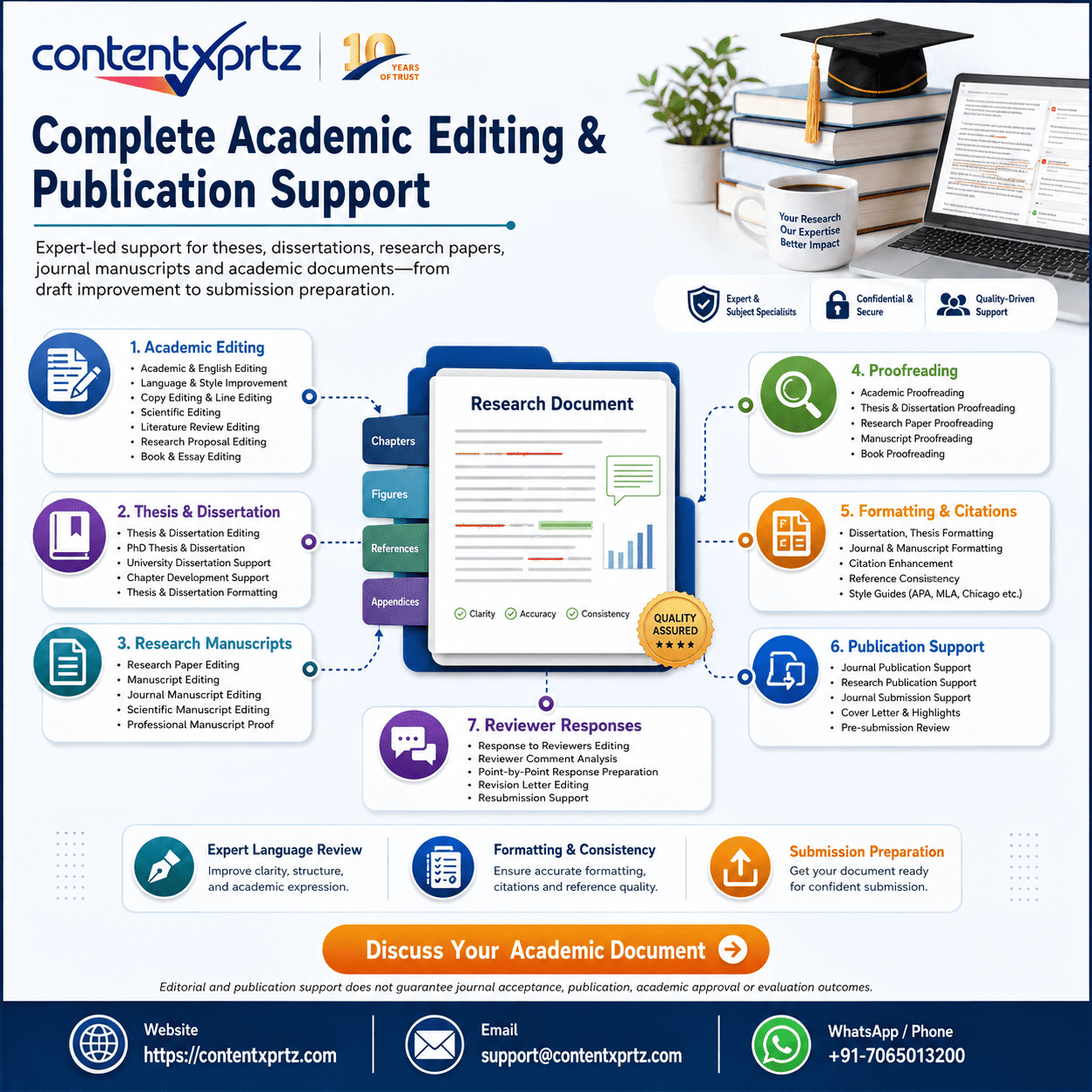
For students who have completed the research but need language and presentation support, Contentxprtz academic editing support can focus on clarity, consistency, and readability while leaving research decisions and authorship with the student.
How to Work Effectively With Your Dissertation Guide
The quality of supervision depends partly on how well you use limited contact time. Productive students do not arrive with the question “Is my dissertation okay?” They bring a concrete decision, a short piece of evidence, and enough context for the supervisor to respond meaningfully.
Before the meeting
- Review your last action list and note what you completed.
- Send a concise agenda and any permitted draft with enough lead time.
- Identify two or three decisions that are blocking progress.
- Bring the relevant handbook rule if your question concerns format, ethics, or assessment.
- Separate content questions from administrative questions that can be answered elsewhere.
During the meeting
Explain what you tried before asking for a solution. If your literature review feels unfocused, show your current inclusion logic and chapter outline. If your method is uncertain, explain the options you considered and why. Ask for criteria rather than an answer: “What would make this research question too broad?” is often more useful than “Which title should I choose?”
After the meeting
Write down the decisions, not just the comments. Convert feedback into actions with dates. Where a comment is ambiguous, confirm your understanding quickly rather than discovering weeks later that you interpreted it differently.
How to Use Supervisor Feedback Without Losing Ownership
Feedback is evidence about how a knowledgeable reader experiences your work; it is not an instruction to accept every suggestion mechanically. First identify the level of the comment. Is the supervisor questioning the research design, the logic of an argument, the evidence, the organisation, or merely the wording? Higher-level issues should be resolved before sentence-level polishing.
If a supervisor writes “so what?” beside a paragraph, the problem may not be the prose. You may need to explain why the finding matters to the research question. If they repeatedly mark “source?” the issue may be evidential support or citation traceability. If they say a chapter is “descriptive,” you may need more comparison, evaluation, synthesis, or interpretation.
Create a feedback log with columns for comment, interpretation, action, status, and any question to raise at the next meeting. This prevents contradictory revisions and helps you see recurring weaknesses.
When you disagree with feedback
Academic disagreement is not automatically a problem. Explain your reasoning with evidence. You might say that you considered a suggested framework but retained another because it better matches the dataset and research question. A good supervisor can then challenge the reasoning rather than the student's willingness to comply. For formal requirements, however, the programme handbook and approved research protocol take precedence over preference.
Ethical Academic Editing and Author Responsibility
Dissertation support should make the student's work clearer and more defensible without replacing the student's intellectual contribution. This principle applies to supervisors, writing centres, editors, AI tools, and peer feedback.
Before using any external editor or AI-based writing tool, check the university's rules. Some institutions permit proofreading or language correction within defined boundaries; others require disclosure or restrict assistance for assessed work. Never allow a third party to invent data, fabricate citations, rewrite findings to change their meaning, or add arguments that you cannot defend.
References should be authentic and traceable. Every source included in the dissertation should be checked against the original document. AI-generated references, summaries, or paraphrases should be verified because fluent wording can still contain factual or bibliographic errors. The author remains responsible for the final text.
Common Mistakes to Avoid With a Dissertation Guide
- Waiting for the supervisor to create the project. Bring ideas and options rather than outsourcing the first decision.
- Sending a full chapter hours before a meeting. Agree on review lead time and respect it.
- Asking vague questions. “Is this good?” produces less useful feedback than a specific question about scope, evidence, or structure.
- Ignoring earlier feedback. Repeatedly presenting the same unresolved problem weakens trust and wastes supervision time.
- Treating every suggestion as a command. Understand the academic reason behind feedback and make defensible decisions.
- Using the guide as a proofreader. Fix recurring grammar, citation, and formatting issues systematically rather than expecting line-by-line correction.
- Hiding problems until the deadline. Raise blocked data access, ethics delays, failed recruitment, or major scope changes early.
- Failing to document decisions. Keep concise records of approved changes, deadlines, and methodological choices.
Practical Examples: How Dissertation Guidance Works
Example 1: A master's student with an over-broad topic
A student proposes “The impact of artificial intelligence on education.” The guide does not simply supply a title. Instead, they ask which educational level, which AI use, which stakeholder group, what period, what evidence is accessible, and what outcome the student wants to investigate. The student revises the topic to a focused question about postgraduate students' use of generative AI for formative feedback in one institutional context. The intellectual work remains the student's, but supervision makes the project feasible.
Example 2: A PhD scholar whose method no longer fits the question
After pilot interviews, a doctoral researcher realises the original coding framework does not capture a new theme emerging from the data. The supervisor helps the student distinguish between a legitimate methodological adaptation and a change that would require formal protocol or ethics amendment. The student documents the reasoning, follows institutional procedures, and updates the methods chapter transparently.
Example 3: A student asking for “proofreading”
A student sends a 12,000-word draft and asks the supervisor to correct the English. The supervisor explains that the programme permits feedback on argument and structure but not comprehensive language editing. They mark several recurring issues and advise the student to use the university writing centre or an approved external editor if policy allows. The student retains responsibility for implementing corrections across the document.
Example 4: A disagreement about chapter structure
A supervisor suggests moving a theoretical framework into the literature review, but the student believes a standalone chapter better supports the analysis. Instead of silently rejecting the advice, the student prepares a one-page rationale showing how each chapter answers part of the research question. The next meeting becomes a discussion about argument architecture rather than preference.
Dissertation Guide and Supervision Checklist
Before supervision begins
- I have read the dissertation handbook and assessment criteria.
- I know who my formal supervisor or guide is and what authority they have.
- I understand the expected meeting frequency and draft-review limits.
- I know the ethics, data protection, and approval procedures that apply.
- I have clarified how we will communicate and how far in advance drafts must be sent.
During the project
- My research question is specific enough to guide evidence collection and analysis.
- I keep a record of supervision decisions and action items.
- I bring specific questions to meetings.
- I distinguish supervisor guidance from my own final academic decisions.
- I verify sources, citations, data, and AI-assisted material independently.
Before submission
- I have resolved substantive feedback before focusing on surface editing.
- I have checked formatting, references, tables, figures, appendices, and required declarations.
- Any external editing or proofreading complies with institutional policy.
- The final argument, claims, analysis, and wording are work I understand and can defend.
How Contentxprtz Can Help Alongside Dissertation Supervision
A university dissertation guide and a professional academic editor perform different functions. Your guide is the primary source for programme-specific research expectations, methodological direction, progress, and academic supervision. An editor can be useful later when the research and argument are substantially in place but the document needs clearer language, consistent terminology, stronger transitions, reference checks, or formatting support.
Contentxprtz supports scholars with ethical academic editing and research paper editing services. For dissertation-related work, the scope can be limited to the assistance your institution permits, such as language clarity, proofreading, consistency, and presentation. We do not replace the student's research responsibility or promise academic outcomes.
Need a Careful Academic Editing Review?
If your research and argument are complete but the draft needs clearer language, consistency, or publication-quality presentation, choose an ethical editing scope that matches your university rules.
Summary: What Is a Dissertation Guide?
A dissertation guide is the academic supervisor or adviser who helps a student navigate an independent research project. The role is to provide direction, challenge, feedback, and progress support — not to author the dissertation. The guide may help refine scope, discuss methods, point toward literature, review permitted drafts, and identify risks, while the student remains responsible for research decisions, evidence, analysis, citations, ethics, and submission.
The best supervision relationship is explicit and prepared. Read your handbook, understand the limits, bring focused questions, document decisions, and act on feedback. If you need language editing or proofreading beyond normal supervision, use only support that your institution permits and keep authorship transparent.
Frequently Asked Questions
What is a dissertation guide?
A dissertation guide is usually the academic supervisor, adviser, or faculty mentor assigned to support a student through a dissertation or thesis project. The exact title varies by university. The guide helps the student refine a feasible research question, plan the project, choose appropriate methods, identify useful literature, interpret institutional requirements, and review work within the limits set by the programme. A guide does not normally write the dissertation, produce the analysis, guarantee approval, or take responsibility for the student's claims. Universities commonly treat supervision as a guided learning relationship: the supervisor provides direction and constructive feedback, while the student remains responsible for the research, writing, citations, ethics, deadlines, and final submission. Before relying on any general advice, check your dissertation handbook because the number of meetings, draft-review limits, approval processes, and permitted forms of editing can differ substantially by department and degree.
Is a dissertation guide the same as a dissertation supervisor?
Often, yes. In many institutions, “dissertation guide,” “dissertation supervisor,” “thesis supervisor,” and “research adviser” describe closely related roles, but local terminology matters. A taught master’s programme may allocate a dissertation supervisor specifically for the final project, while a doctoral programme may use a principal supervisor plus one or more co-supervisors or academic advisers. Some universities distinguish an academic adviser, who supports broader programme progress, from the person who supervises the dissertation itself. The safest approach is to use the title in your university handbook and confirm which person can approve your topic, advise on methods, comment on drafts, sign ethics paperwork, or report progress. Do not assume that every academic mentor has the same authority. If your programme uses “guide” informally, ask what responsibilities and feedback limits are formally attached to that role.
What does a dissertation guide actually help with?
A dissertation guide typically helps with decisions rather than doing the student's work. Useful guidance may include narrowing an over-broad topic, testing whether a research question is answerable, suggesting starting points for the literature, discussing research design, identifying practical or ethical risks, reviewing a chapter outline, giving feedback on a permitted draft, and helping the student plan milestones. A supervisor may also point out when the argument is unclear, when evidence does not support a claim, or when the scope needs to be reduced. The guide's role is not unlimited. They may not proofread every sentence, supply references on demand, perform statistical analysis, rewrite chapters, or repeatedly review the same material. Expectations should be agreed early, including meeting frequency, turnaround time, preferred communication method, and what kinds of drafts the supervisor is allowed to read.
Can a dissertation guide choose my topic for me?
A guide may suggest areas, help test ideas, or offer a list of available projects, but students are usually expected to take intellectual ownership of the final research question. In some programmes, especially laboratory, clinical, or funded projects, the broad topic may already be defined. Even then, the student normally needs to understand the problem, refine the scope, and make defensible research decisions within the approved framework. A useful supervisor will help you distinguish between an interesting subject and a workable dissertation question by considering access to data, available time, ethics approval, methodological competence, word limits, and the existing literature. If you are stuck, bring two or three possible questions with a short note on why each matters and what evidence you could realistically collect. That gives the meeting a concrete basis for discussion.
How often should I meet my dissertation guide?
There is no universal meeting schedule. The correct frequency is set by your university, department, programme, and sometimes by the stage of the project. Some taught programmes specify a limited number of supervision meetings, while doctoral supervision can continue regularly over a much longer period. A productive rhythm is more important than simply meeting often. Early meetings may focus on scope and design, middle meetings on evidence and analysis, and later meetings on argument, structure, and submission readiness. Before each meeting, send a short agenda or agreed draft in time for the supervisor to review it. Afterward, record decisions, actions, and deadlines. If your handbook states a maximum number of meetings or draft reviews, plan those opportunities strategically rather than using them for questions you could answer from the handbook or library guidance.
Will my dissertation guide edit or proofread my dissertation?
Usually, a guide gives academic feedback rather than full professional editing. They may comment on logic, structure, evidence, methodology, interpretation, and recurring writing problems, but many programmes limit how much line-by-line correction or repeated draft review a supervisor can provide. The purpose is to support the student's learning and preserve authorship. Proofreading, copyediting, formatting, and language editing may be permitted separately, but institutional rules differ. If you use professional dissertation editing, confirm what your university allows and make sure the service improves clarity without adding arguments, fabricating references, changing data, or concealing authorship. Contentxprtz provides ethical academic editing and dissertation proofreading support where permitted, while the author remains responsible for the research, meaning, citations, and final submission.
What should I prepare before meeting my dissertation guide?
Prepare material that makes the meeting decision-focused. Bring your current research question, a short progress summary, the relevant section of your dissertation plan or draft, and a small set of specific questions. For example: Is the scope realistic? Does the method answer the research question? Is the chapter sequence logical? Which issue should I resolve before collecting more data? If you are sharing a draft, mark the areas where you most need feedback rather than asking the supervisor to “check everything.” Also review previous meeting notes so you can show what you changed. Good preparation respects limited supervision time and helps you receive more useful feedback. After the meeting, create a short action list with owners and dates, and confirm any decision that affects methodology, ethics, data access, or the submission timetable.
What should I do if my dissertation guide is not responding?
First, check the communication expectations in your programme handbook and allow the normal response period. Then send a concise follow-up that includes the date of your earlier message, the specific decision you need, and any genuine deadline. Avoid sending repeated daily messages. If the delay begins to affect ethics approval, data collection, progression, or submission, use the programme's formal escalation route. This might involve a dissertation coordinator, programme director, graduate tutor, departmental administrator, or postgraduate office. Keep a professional record of messages and meeting requests. If the problem is persistent or the supervisory relationship has broken down, ask what process exists for mediation, co-supervision, or a change of supervisor. Do not silently redesign a high-stakes project simply because guidance is delayed; document what needs approval and seek the appropriate academic contact.
Can I change my dissertation guide or supervisor?
Many universities have a process for changing supervision when there is a substantial academic, practical, or relationship problem, but the rules differ. A change may be considered if the project moves outside the supervisor's expertise, the supervisor is unavailable for an extended period, conflicts cannot be resolved, or the working relationship is no longer effective. Start with the least disruptive route: clarify expectations, discuss the concern professionally, and involve the programme lead or postgraduate administrator if appropriate. If a change is needed, ask how existing approvals, ethics applications, data ownership, project scope, and deadlines will be handled. A supervisor change is an academic administration decision, not simply a personal preference, so follow the documented procedure and keep the discussion focused on the support required to complete the research responsibly.
When should I seek professional dissertation support in addition to my guide?
Professional support can be useful when you need help that falls outside normal supervision, such as language editing, proofreading, reference consistency, formatting, document organisation, or a structured clarity review. It can also help multilingual researchers identify recurring language problems before submission. However, external support should not replace the supervisor, invent research, analyse data without appropriate author involvement, create citations that were not verified, or write assessed work in a way that violates university rules. First check your institution's policy on editing and third-party assistance. Then define a narrow, transparent scope: for example, grammar and style, APA formatting, table consistency, or clarity of transitions. Contentxprtz can support ethical dissertation editing and proofreading, but the student remains responsible for the research question, methods, analysis, interpretation, citations, and final submitted text.
Conclusion: Use Your Dissertation Guide as an Academic Partner
Students searching for what is a dissertation guide are often really asking a more practical question: “What can I reasonably expect from the person supervising my dissertation?” The answer is guidance, not substitution. A strong guide helps you frame a workable project, recognise weak reasoning, use appropriate methods, manage progress, and interpret academic expectations. The student still owns the research and the final submission.
Self-service support from handbooks, libraries, writing centres, and reference tools is often enough for routine questions. Expert editing may become useful when a mature draft needs language, consistency, formatting, or clarity work that falls outside the supervisor's role and is permitted by your institution.
Contentxprtz can support that final communication stage with ethical academic editing designed to preserve the author's meaning and responsibility. Academic integrity remains central: you should understand, verify, and be able to defend every part of your submitted dissertation.
“At Contentxprtz, we don’t just edit; we help ideas reach their fullest potential.”