Can I Publish a Research Paper Without Affiliation?
Can I publish research paper without affiliation? Yes. In many journals, you can submit and publish as an independent researcher even if you are not currently employed by a university, research institute, hospital, company, or other formal organization. What matters most is that you meet the journal’s authorship, ethics, reporting, originality, data, disclosure, and manuscript-quality requirements. Your lack of institutional affiliation should be stated honestly rather than hidden or replaced with an organization that did not support the work.
Researchers become unaffiliated for many legitimate reasons. You may have graduated before finishing a paper, left a university or employer, be between appointments, work as an independent consultant, conduct scholarship after retirement, or pursue a self-funded project outside a formal institution. None of those situations automatically prevents scholarly publication. The practical challenge is knowing what to enter in the affiliation field, how to handle ethics approval or access to research infrastructure, and how to demonstrate a credible, traceable author identity.
Publisher rules vary. Taylor & Francis, for example, states that authors without a current relevant institutional affiliation should state their independent status. ICMJE guidance emphasizes accurately identifying the institution or organization to which work should be attributed and warns against listing funding sources or affiliations that did not contribute to the work. The safest approach is therefore simple: check the target journal’s author instructions, describe your affiliation status truthfully, and provide reliable contact and author-identification details.
This guide explains how independent researchers can prepare a journal-ready submission, what affiliation wording may be appropriate, when institutional ethics oversight can still be necessary, how ORCID can strengthen author identification, and which mistakes can delay or undermine a submission. If your manuscript is academically sound but needs language, structure, formatting, or journal-readiness improvement, ethical academic editing services can help without inventing an affiliation or changing authorship responsibility.
Quick Answer: Can You Publish a Research Paper Without Affiliation?
Yes. An author can often publish a research paper without a current university or institutional affiliation. You may identify yourself as an independent researcher, independent scholar, independent consultant, or another accurate professional status if the journal’s submission system allows it. Do not create a fictional affiliation, keep using a former institution as though it currently supports you, or list an organization merely to make the paper appear more credible.
Your manuscript will still be judged on the same core issues as other submissions: fit with the journal, research quality, methodology, originality, ethics, transparent authorship, conflicts of interest, reporting quality, and clarity. Some projects also require ethics committee approval, data-use permissions, clinical-trial registration, institutional access, or funder documentation. Being independent does not remove those obligations.
Before submission, read the journal’s author instructions and editorial policies. If the online form forces an institutional entry, contact the journal office rather than entering misleading information. Use a stable email address and, where possible, link an ORCID iD so editors and readers can identify your scholarly record even when your employment changes.
Key Takeaways
- You can often publish scholarly research without a university, company, hospital, or research-institute affiliation.
- Use an accurate status such as “Independent Researcher” when the journal permits it; never invent an institution.
- A previous institution should normally be listed only when the work was actually conducted there or the journal’s policy supports that attribution.
- Independent status does not remove requirements for ethics approval, participant consent, permissions, data governance, conflicts-of-interest disclosure, or research integrity.
- ORCID, a professional email address, a complete author profile, and transparent contact information can improve identity consistency.
- Journal selection should focus on scope, editorial standards, peer-review practices, indexing claims, fees, and author guidelines—not on promises of easy acceptance.
- Editing and publication support may improve presentation and compliance, but the author remains responsible for the research and final submission.
What This Page Covers
- What “affiliation” means in a research paper and why journals ask for it
- How to list yourself when you are an independent or unaffiliated researcher
- Whether lack of affiliation affects peer review, credibility, fees, or acceptance
- How ethics approval and data access work when research is conducted independently
- A step-by-step submission workflow for independent researchers
- Common affiliation and journal-selection mistakes to avoid
- Practical examples and a pre-submission checklist
Table of Contents
Methodology and Academic Sources
This guide is based on common journal-submission workflows and current publisher and authorship guidance. Taylor & Francis explicitly notes in its editorial policies on affiliations that an author without a current relevant institutional affiliation should state independent status. The ICMJE manuscript-preparation recommendations ask authors to specify the institutions or organizations to which the work should be attributed and encourage ORCID identification.
Submission requirements differ by journal, discipline, study type, country, and publisher. Springer Nature’s article publishing guidance emphasizes following each target journal’s specific instructions, ethics requirements, permissions, declarations, and technical checks. For authorship and corresponding-author responsibilities, the ICMJE authorship recommendations provide a useful benchmark. Always verify the current rules of the journal you plan to submit to.
What Does “Affiliation” Mean in a Research Paper?
An author affiliation identifies the institution, organization, or professional setting connected to the research. It commonly appears beneath the author name and may include a department, university, research institute, hospital, laboratory, company, nonprofit organization, or other body where the research was conducted or supported.
Affiliation is not the same as authorship. Authorship reflects intellectual contribution and responsibility for the work; affiliation describes an organizational relationship relevant to the research or author. A person can meet authorship criteria without being employed by a university. Conversely, being employed by a prestigious institution does not make someone an author if they did not make the required contribution.
Why journals collect affiliation information
- To show where the research was performed or supported
- To help readers identify and contact authors
- To support institutional reporting and research attribution
- To clarify potential conflicts of interest or organizational relationships
- To support eligibility checks for institutional publishing agreements or fee discounts
- To help distinguish authors with similar names
Because affiliation has a factual function, accuracy is more important than prestige. If no institution was connected to the work, “Independent Researcher” or an equivalent truthful designation may be more appropriate than borrowing the name of a former university.
How Should an Independent Researcher List an Affiliation?
Use the description that most accurately represents your status and that the target journal accepts. Common options include “Independent Researcher,” “Independent Scholar,” or a genuine professional organization if the research was conducted there and the organization permits that attribution.
| Situation | Possible affiliation approach | What to verify |
|---|---|---|
| No current institutional relationship | Independent Researcher / Independent Scholar | Journal submission-field rules and whether city/country are requested |
| Research completed while at a former university | Institution where the work was conducted, with current-status note if required | Publisher policy and former institution’s naming conventions |
| Self-employed consultant conducting genuine research | Independent Researcher or your legitimate registered professional entity | Conflict-of-interest disclosure and relevance of the business to the study |
| Retired academic continuing scholarship | Emeritus affiliation if formally held; otherwise independent status | Whether emeritus title is current and authorized |
| Between academic appointments | Affiliation where work was substantially completed, or independent status | Target journal’s policy on current versus research-time affiliation |
Do not use an institution merely because you studied there in the past. If the institution did not host, approve, fund, supervise, or otherwise have a legitimate connection to the work, listing it can mislead editors and readers. If your status is unusual, a short note to the editorial office before submission is safer than guessing.
What if the submission system requires an institution?
Some electronic systems are designed around conventional university affiliations and may not provide an obvious “independent” option. Do not enter a false university to get past the form. Look for “Other,” “Not affiliated,” or free-text fields. If none exists, contact the journal’s editorial support team and ask how independent authors should complete the field. Keep the answer for your records.
Does Publishing Without Affiliation Reduce Your Chance of Acceptance?
Lack of affiliation should not, by itself, determine whether a paper deserves publication, but the practical experience can vary across journals and disciplines. Editors still need confidence that the research meets methodological, ethical, reporting, and documentation standards. Independent researchers may therefore face more questions about ethics oversight, access to data, laboratory resources, funding, or the provenance of materials when those issues are central to the study.
Many peer-review models attempt to focus reviewer attention on the manuscript rather than institutional prestige. However, editorial screening can include author details, and journals may need affiliation information for compliance, publishing agreements, conflict checks, or correspondence. The best way to reduce avoidable concern is not to overcompensate with prestige signals; it is to submit a complete, transparent, professionally prepared manuscript with traceable data and declarations.
Strong manuscript assessment can be useful before submission if you want an independent review of structure, argument coherence, journal fit, reporting completeness, and obvious presentation weaknesses.
Can You Conduct and Publish Research Independently Without University Ethics Approval?
Sometimes, but not automatically. Whether ethics review is required depends on the research design, participants, data, local law, professional standards, funder rules, and journal policy. An independent researcher cannot simply declare that ethics approval is unnecessary because there is no university involved.
Research involving human participants, identifiable personal information, clinical interventions, vulnerable populations, biological samples, animals, or sensitive datasets may require formal ethics review or regulatory approval before the work begins. In many settings, approval cannot be obtained retrospectively. If you are planning such research independently, identify an appropriate ethics review route before collecting data. Depending on your country and field, this may involve an independent ethics committee, hospital board, professional body, commercial IRB/REC service, collaborating institution, or other recognized review mechanism.
For research based entirely on public datasets, literature analysis, simulation, theoretical work, or other low-risk methods, formal ethics approval may not be required, but journals can still ask for an ethics statement explaining why. The decisive sources are the applicable law, recognized research standards, and the target journal’s current policy—not assumptions based on employment status.
What You Need Before Submitting as an Independent Researcher
A journal does not need a university logo to evaluate your work, but it does need enough information to process the manuscript responsibly. Prepare the following items before you open the submission portal.
- Stable author identity: Use the same spelling of your name across the manuscript, ORCID, prior publications, and submission account.
- ORCID iD: Link it when the journal supports ORCID. It helps distinguish you from researchers with similar names and remains stable when affiliations change.
- Reliable email: Use an address you will retain for years. Avoid temporary or shared accounts.
- Accurate affiliation statement: Decide whether “Independent Researcher” or a legitimate research-time affiliation applies.
- Funding declaration: State the actual funding source or that no specific funding was received, according to journal wording.
- Conflict-of-interest declaration: Disclose relevant financial and non-financial relationships.
- Ethics and consent records: Include approval numbers, exemption statements, consent language, or data-use permissions where required.
- Data and materials statement: Explain availability, restrictions, repositories, or access conditions if the journal requests it.
- Contributor statement: For multi-author work, accurately describe contributions using the journal’s preferred taxonomy or format.
How to Publish a Research Paper Without Affiliation: Step-by-Step
1. Finish the research before choosing a prestige label
Build the submission around the research itself. Confirm that the question is clear, methods are appropriate, results are reproducible or defensible, limitations are acknowledged, and claims do not extend beyond the evidence.
2. Identify journals that publish your type of work
Read recent articles, aims and scope, accepted article types, author guidelines, editorial policies, peer-review model, fees, and data requirements. Avoid choosing a journal solely because it promises rapid publication.
3. Check the journal’s affiliation policy
Search the author instructions for “affiliation,” “independent researcher,” “author information,” or “title page.” If the answer is unclear, contact the editorial office before submission.
4. Prepare your author identity
Create or update your ORCID profile, use a stable email, and keep your name consistent. Do not manufacture a lab, institute, or research center to look more established.
5. Resolve ethics, permissions, and data governance
Confirm that ethics review, consent, copyright permissions, dataset licenses, clinical registration, or other approvals were obtained when required. Independent status does not waive these obligations.
6. Format the manuscript to the journal
Follow title-page, abstract, word-count, reference, figure, table, supplementary-file, reporting-checklist, and anonymization requirements. A submission can be returned before peer review if technical requirements are incomplete.
7. Write a transparent cover letter
Briefly state what the paper contributes, why it fits the journal, and any unusual affiliation circumstances that require explanation. Do not use the cover letter to pressure editors or claim guaranteed novelty.
8. Complete every declaration accurately
Funding, conflicts, authorship, prior submission, preprints, data, AI use, and ethics fields should be completed truthfully. A missing institution is usually less problematic than an inaccurate declaration.
9. Submit and respond professionally
Keep all editorial correspondence, reply to technical queries promptly, and address peer-review comments point by point. If the paper is rejected, use the feedback to strengthen the manuscript before choosing another suitable journal.
How to Choose a Legitimate Journal When You Are Unaffiliated
Independent researchers can be attractive targets for low-quality or predatory publishers because they may have less access to institutional librarians and journal-selection support. Evaluate the journal itself rather than trusting email invitations or indexing claims.
| Check | Healthy sign | Warning sign |
|---|---|---|
| Scope | Recent articles closely match your topic and method | Journal claims to publish almost every discipline |
| Peer review | Process and editorial standards are clearly described | Acceptance is promised before meaningful review |
| Editorial board | Members are identifiable and relevant to the field | Names are unverifiable, duplicated, or unrelated |
| Fees | APCs and waiver rules are transparent before submission | Fees appear unexpectedly after acceptance |
| Indexing | Claims can be verified directly in the named database | Logos or vague “global indexing” claims replace evidence |
| Contact and policies | Publisher identity, ethics, corrections, copyright, and contact details are clear | Policies are copied, contradictory, or difficult to locate |
Prestige is not the only marker of quality. A specialized society journal or reputable open-access journal may be a better fit than a famous title outside your scope. What matters is legitimate editorial practice, appropriate readership, transparent fees, and alignment between your manuscript and the journal.
Will You Have to Pay More Without an Institutional Affiliation?
Not necessarily. Submission and publication fees depend on the journal’s business model, not simply on whether you have an affiliation. Some journals charge no author fee. Others charge article processing charges for open access, page charges, color charges, or optional services. Institutional agreements sometimes cover or discount open-access fees, so an independent author may not qualify for those specific arrangements.
Before submission, read the journal’s fee page and waiver policy. Some publishers offer discounts or waivers based on country, funding status, society membership, or financial circumstances. Never assume that paying a fee guarantees acceptance. Legitimate journals separate editorial judgment from payment and explain when charges become due.
Common Mistakes Independent Researchers Should Avoid
- Inventing an affiliation: A fabricated institute can create serious credibility and integrity concerns.
- Using a former university without context: If the work was not conducted there, the attribution may be misleading.
- Starting human-participant research before ethics review: Approval may be impossible to obtain retrospectively.
- Choosing journals from unsolicited email promises: Verify scope, editorial board, fees, indexing, and publisher identity independently.
- Assuming a polished manuscript can fix weak research: Editing improves communication; it cannot repair invalid methods or unsupported conclusions.
- Submitting to multiple journals simultaneously: Many journals prohibit duplicate submission of the same manuscript.
- Ignoring author instructions: Missing declarations, poor formatting, and incomplete files can lead to technical return before review.
- Listing honorary co-authors: Add authors based on genuine contribution and responsibility, not institutional prestige.
If your paper needs help with language, reference consistency, structure, or journal formatting, professional editing for researchers can improve presentation while preserving your ownership of the work.
Practical Examples: Publishing Without a Current Affiliation
Example 1: A graduate completes the paper after leaving university
Riya collected data and completed most of her study while enrolled at a university, then graduated before the manuscript was ready. She checks the journal’s policy and lists the university as the affiliation where the research was conducted, with a current-address or independent-status note if requested. She does not imply that the university currently employs her.
Example 2: A self-funded independent scholar writes a theoretical paper
Marcus conducts a literature-based conceptual study using publicly available sources. No institution funds or hosts the project. The target journal allows free-text affiliation, so he uses “Independent Researcher” with his city and country, provides ORCID, and submits from a stable personal email.
Example 3: A consultant analyzes client-derived data
Ana is self-employed and wants to publish findings based on work completed for a client. She first checks contractual confidentiality, data-use rights, consent, de-identification, and conflict-of-interest requirements. She does not assume that being independent gives her permission to publish proprietary data.
Example 4: A retired academic continues publishing
David has formally retired but holds an emeritus appointment. He confirms that the title is current and permitted by the institution, then lists the emeritus affiliation according to the journal’s format. If he had no formal continuing relationship, he would use independent status instead.
Independent Researcher Pre-Submission Checklist
Author and affiliation
- My affiliation statement is truthful and current.
- I have not listed an institution that did not support or host the work.
- My name is consistent across the manuscript, ORCID, and submission account.
- I have a stable corresponding-author email.
Research integrity
- All authors meet the journal’s authorship requirements.
- Ethics approval, exemption, consent, and permissions are documented where required.
- Funding and conflicts of interest are disclosed accurately.
- Data and materials statements are complete and truthful.
- References are authentic, traceable, and checked against original sources.
Journal readiness
- The journal scope fits my research question and article type.
- I verified fees and indexing claims from authoritative sources.
- The manuscript follows the journal’s formatting and reporting requirements.
- The cover letter explains the contribution without exaggerated claims.
- I am submitting to only one journal at a time unless the journal explicitly permits another model.
How Contentxprtz Can Help an Independent Researcher Prepare for Submission
Independent researchers often need the same scholarly support that university authors obtain from supervisors, writing centers, lab colleagues, or institutional research offices. Ethical professional support can help close communication and formatting gaps without fabricating credentials or taking over authorship.
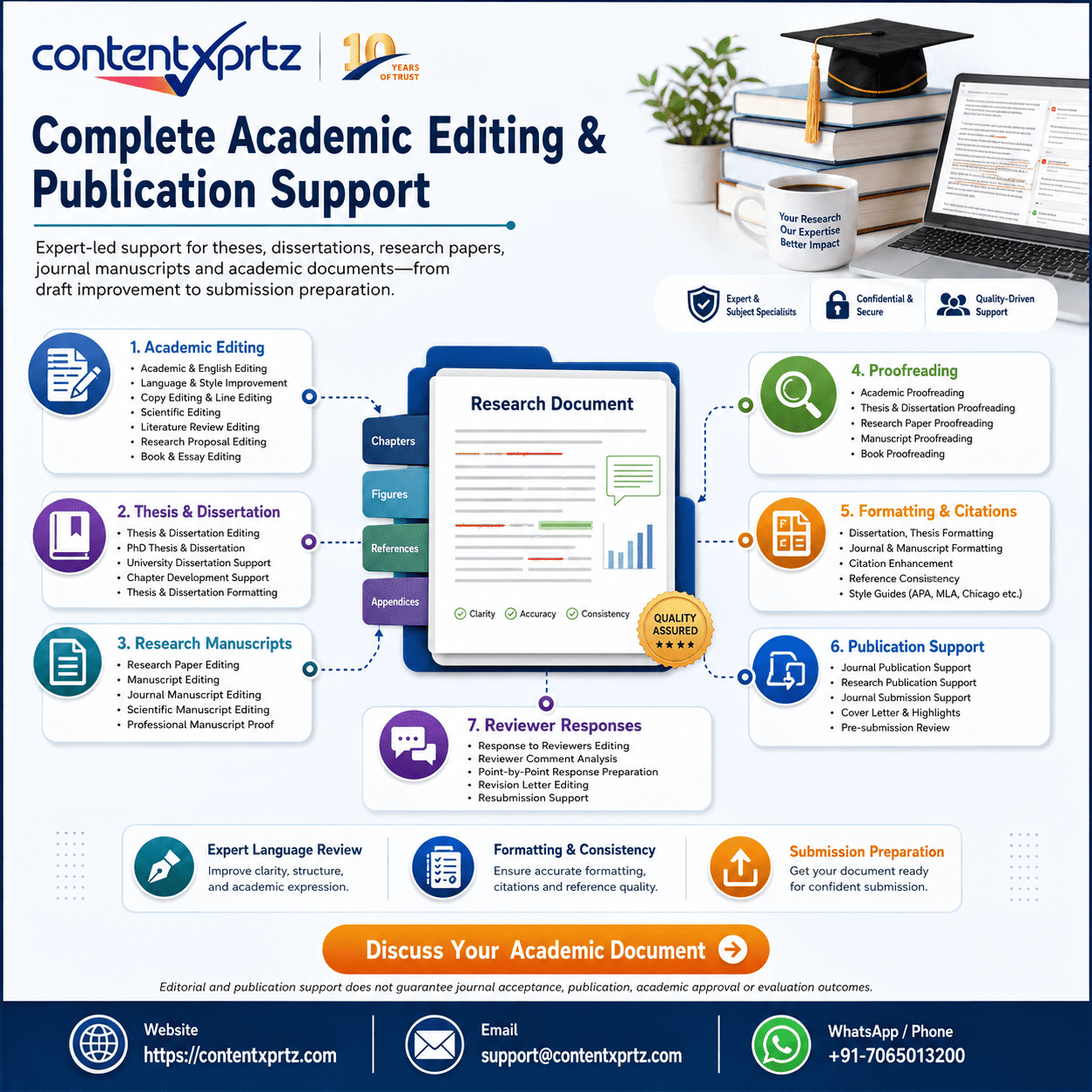
Contentxprtz can assist with ethical academic editing, language clarity, manuscript organization, reference consistency, and journal-specific formatting. For papers that need broader submission planning, journal publication support can help authors understand journal requirements and prepare submission materials. These services do not guarantee acceptance and should never be used to invent affiliations, data, authorship contributions, citations, or ethics approvals.
Summary: Publishing a Research Paper Without Institutional Affiliation
You can often publish a research paper without institutional affiliation. The strongest approach is to be transparent: identify yourself as an independent researcher when appropriate, use a legitimate prior affiliation only when the work was actually conducted there and the journal’s rules support it, and contact the editorial office if the submission system does not accommodate independent authors.
Your independent status does not lower the standards that apply to the research. Ethics approval, consent, data rights, conflicts of interest, authorship, reporting, originality, and citation accuracy still matter. A credible submission combines sound research with a suitable journal, complete declarations, a stable author identity, and clear scholarly writing.
Frequently Asked Questions
Can I publish research paper without affiliation?
Yes. Many journals accept manuscripts from independent researchers who do not have a current university, hospital, company, or research-institute affiliation. The key is to describe your status accurately and follow the target journal’s author instructions. If the journal provides a free-text affiliation field, wording such as “Independent Researcher” or “Independent Scholar” may be appropriate. If the system requires an institution and gives no independent option, contact the editorial office instead of entering a false organization. Lack of affiliation does not remove normal requirements for authorship, ethics approval, funding disclosure, conflicts of interest, data permissions, reporting standards, or research quality. You should also use a stable email address and, where possible, link an ORCID iD so your scholarly identity remains traceable even if your employment changes. Acceptance will depend on the manuscript’s fit, quality, methodology, ethics, and editorial assessment rather than a promise attached to any affiliation status.
What should I write in the affiliation field if I am an independent researcher?
Use a truthful designation that matches the journal’s policy. “Independent Researcher” or “Independent Scholar” is commonly understandable, sometimes followed by city and country when the journal requests a location. If you conducted the research while genuinely affiliated with a university or organization, the journal may prefer the institution where the work was completed, with a note indicating your current status. Do not use a former university merely because you once studied there, and do not invent a laboratory, institute, consultancy, or company to make the submission look more credible. Publisher requirements differ, so check the title-page and author-information instructions before submission. When an online system does not provide a suitable option, ask editorial support how they want independent authors to complete the field. Keeping the response from the journal can help you document why the affiliation was entered in a particular way.
Can I use my former university as my affiliation after graduation?
Sometimes, but only when that attribution is accurate and consistent with the journal’s policy. If the research was conducted, approved, supervised, or substantially completed while you were at the university, many publishers allow the research-time affiliation to be listed and may permit a current-address note. If the project began after you left and the institution had no genuine connection to the work, continuing to list it can be misleading. Check whether your former department or university has rules about use of its name, especially for research involving institutional facilities, participants, proprietary data, or ethics approval. If you are uncertain, ask both the journal and, where appropriate, the institution. The safe principle is to distinguish where the work was done from where you are employed today. Your manuscript should not imply continuing institutional endorsement when none exists.
Do independent researchers need ORCID to publish?
ORCID is not universally mandatory, but it is strongly useful for independent researchers and is required or encouraged by many submission systems. An ORCID iD gives you a persistent researcher identifier that is not tied to a specific employer. That is valuable when you publish between jobs, after graduation, during consulting work, or while working outside academia. Link your ORCID to the journal submission account when supported and keep your name, publications, and current status accurate. ORCID does not replace an affiliation, prove research quality, or guarantee that a journal will accept the manuscript. It simply improves identity consistency and helps distinguish you from authors with similar names. Use it together with a stable email address, accurate author details, complete disclosures, and a well-prepared manuscript.
Can I publish human-participant research without a university ethics committee?
Possibly, but you may still need recognized ethics review before starting the study. Human-participant research can require approval or exemption depending on the research design, local law, participant risk, privacy, data sensitivity, funder rules, professional standards, and journal policy. Being independent does not automatically make the research exempt. If you have no university ethics committee, identify another legitimate review route before collecting data, such as an independent ethics committee, hospital review board, professional body, collaborating institution, or other recognized mechanism available in your jurisdiction. Do not assume approval can be obtained after data collection; retrospective approval may be unacceptable. For low-risk research using public or fully anonymized data, formal review may not be required, but the journal can still ask for an ethics statement explaining the basis. Verify the requirements that apply to your specific study before recruitment or data collection begins.
Will journals reject me because I use a personal email address?
A personal email address does not automatically make a manuscript ineligible, especially when the author is independent, retired, or between institutions. The more important questions are whether the address is stable, professional, secure, and monitored throughout peer review and after publication. Some journals or submission systems may prefer institutional email verification, but independent authors should not create a false institutional account or misrepresent employment. Use an address you expect to keep for years, add ORCID when possible, and make sure your name and contact information are consistent across the manuscript and submission profile. If a journal specifically requires institutional verification for a particular policy, contact the editorial office and explain your independent status. Clear, prompt correspondence and complete author information usually matter more than the email domain alone.
Can an independent researcher publish in Scopus- or Web of Science-indexed journals?
Yes, independent status does not by itself prevent submission to journals indexed in major bibliographic databases. Indexing applies to the journal or source, not to whether every author has a university affiliation. You should still verify any indexing claim directly in the relevant database rather than trusting a journal logo, email invitation, or website badge. More importantly, choose the journal for scope, editorial quality, peer-review standards, audience, transparency, and fit with your article type. A journal being indexed does not guarantee acceptance, and a researcher being unaffiliated does not guarantee rejection. Prepare the manuscript to the journal’s standards, use truthful author information, provide required ethics and data statements, and respond professionally during peer review. Avoid services or publishers that promise guaranteed indexed publication in exchange for payment.
Do I need a professor or institutional co-author to publish?
No. You should not add a professor, supervisor, or institutional researcher merely to make the paper look more credible. Co-authorship should be based on genuine intellectual contribution and responsibility under the journal’s authorship policy. Honorary or guest authorship can create ethical problems and may misrepresent who performed the work. A legitimate co-author can strengthen a project when they truly contribute—for example, by helping design the study, analyze data, interpret results, or revise the manuscript and accept accountability—but their institution should not be used as a shortcut around independent status. If you need expertise without authorship, consider an acknowledged consultant, statistician, librarian, or editor when the journal’s policy allows it. Keep authorship, acknowledgments, and paid professional support clearly distinguished.
How do I avoid predatory journals as an unaffiliated researcher?
Evaluate the journal before submitting or paying. Check whether its aims and scope match your topic, whether recent articles are credible, whether editors are identifiable, how peer review is described, when fees are disclosed, and whether ethics, corrections, copyright, and contact policies are clear. Verify indexing claims directly in the database named by the journal. Be cautious of unsolicited emails that flatter your work, guarantee acceptance, promise unrealistically fast peer review, or use journal names that resemble established titles. A legitimate open-access fee is not automatically a sign of a predatory journal, but the fee should be transparent and editorial decisions should remain independent of payment. Independent researchers who lack library support can also ask experienced colleagues, librarians, scholarly societies, or publication consultants to review a journal choice before submission.
When should an independent researcher use professional editing or publication support?
Professional support can be useful when the research is complete but the manuscript needs clearer academic English, stronger organization, reference consistency, journal formatting, or help interpreting submission requirements. Ethical editing should improve communication without inventing data, changing the author’s conclusions, creating fake citations, or supplying a false affiliation. Publication support can also help you build a journal shortlist, understand author guidelines, prepare a cover letter, organize submission files, and respond more clearly to reviewer comments. It cannot guarantee acceptance because editorial outcomes depend on research quality, journal scope, methodology, novelty, reviewer assessment, and editorial judgment. If you use external support, remain responsible for every claim, citation, dataset, declaration, and final revision. Contentxprtz can assist with research-paper editing and publication readiness while keeping authorship and research responsibility with you.
Conclusion: You Can Publish Independently—Accuracy Matters More Than Prestige
If you are asking whether you can publish without affiliation, the practical answer is yes in many journals. Your next step is to choose a journal that fits the work, verify its author-information policy, and represent your status honestly. Free self-service preparation may be enough when your manuscript is already clear, properly formatted, ethically documented, and aligned with the target journal. Expert-assisted editing or publication support becomes more useful when language, structure, journal requirements, reviewer responses, or submission documentation are creating avoidable barriers.
Contentxprtz can help improve clarity, organization, ethical presentation, reference consistency, and publication readiness through its research paper editing service. The goal is not to manufacture institutional credibility; it is to present genuine research as clearly and professionally as possible while the author remains responsible for the ideas, methods, data, citations, declarations, and final submission.
At Contentxprtz, we don’t just edit; we help ideas reach their fullest potential.