How to Edit a Thesis: A Practical Step-by-Step Academic Editing Guide
Learning how to edit a thesis is less about correcting every sentence at once and more about reviewing the document in the right order. A strong thesis edit moves from large questions—research purpose, argument, chapter logic, evidence, and interpretation—to smaller questions such as paragraph flow, academic tone, citations, grammar, punctuation, formatting, and final proofreading. That sequence matters because polishing sentences before the structure is stable can waste hours on text that later needs to be moved or removed.
For PhD scholars and postgraduate students, thesis editing can feel unusually difficult because the document is long, technically dense, and already familiar after months or years of work. You may know what a paragraph is supposed to mean so well that your eyes skip over missing explanations. You may also be balancing supervisor comments, university formatting rules, a submission deadline, and concerns about whether external editing or AI tools are permitted. A methodical process reduces that pressure by turning one very large task into a series of controlled editorial passes.
This guide explains a practical thesis editing workflow for doctoral and master's research. It covers structural editing, argument and evidence checks, paragraph-level revision, academic style, citation consistency, tables and figures, formatting, proofreading, version control, ethical use of tools, and the point at which professional academic editing support may be useful. The aim is not to make a thesis sound artificially perfect; it is to help the author's research become clearer, more consistent, and easier to evaluate.
Quick Answer: How to Edit a Thesis
Edit your thesis in separate passes. First check whether the research question, central claim, chapter sequence, methods, results, discussion, and conclusion form one coherent argument. Next, revise paragraph logic and evidence. Then edit sentences for clarity, academic tone, terminology, concision, and grammar. After the text is stable, check citations, reference-list consistency, tables, figures, cross-references, and university formatting requirements. Finish with a slow proofread of the final formatted document.
Do not begin by correcting commas on page one and moving linearly to the last page. Thesis-level problems are hierarchical: a weak chapter purpose matters more than a weak transition, and an unsupported interpretation matters more than a typographical error. Fixing higher-level issues first prevents repeated work.
Keep backups and use version control throughout. If you use an external editor, grammar checker, or generative AI tool, follow your university's rules, protect confidential data, review every change yourself, and retain responsibility for the final thesis.
Key Takeaways
- Edit from big-picture structure to sentence-level detail, not the other way around.
- Give each editing pass one purpose: structure, argument, paragraphs, style, references, formatting, or proofreading.
- Check the thesis as a complete document, not only as separate chapters, because terminology and claims must remain consistent across the whole work.
- Use supervisor comments as decision points, but preserve a revision log so you can see what changed and why.
- Proofreading is the final stage after substantive editing and formatting; it is not a substitute for structural revision.
- Automated tools can suggest edits, but the researcher must verify meaning, citations, confidentiality, and institutional compliance.
- Professional thesis editing should clarify the author's work without replacing the author's intellectual contribution.
What This Page Covers
- A step-by-step thesis editing workflow from first revision to final proof
- How to review research questions, arguments, chapters, paragraphs, and evidence
- How thesis editing differs from proofreading and formatting
- How to edit citations, references, tables, figures, abbreviations, and cross-references
- Practical examples for PhD scholars, master's students, and ESL researchers
- Common thesis editing mistakes and how to avoid them
- When self-editing is enough and when ethical professional support may help
Table of Contents
Methodology and Academic Sources
This article is based on common academic editing, proofreading, and thesis-revision workflows rather than a single universal rulebook. Thesis requirements vary by university, faculty, discipline, degree type, and submission system, so your institution's current thesis manual and supervisor instructions should remain the controlling sources for formatting and permitted assistance.
For broader academic-writing and publication ethics, useful references include the Purdue Online Writing Lab proofreading guidance, the UNC Writing Center guidance on editing and proofreading, the APA Style grammar and writing guidance, and the ICMJE guidance on author responsibility when using AI-assisted technologies. Students should also check university policies on external editing, acknowledgment, confidentiality, and generative AI.
Before You Edit: Freeze the Right Draft and Build a Revision Plan
The fastest way to lose control of a thesis edit is to revise several competing files without a clear master copy. Before changing the text, create a dated master version, back it up in at least two locations, and store supervisor comments separately. If your institution provides a thesis template, confirm that you are working in the correct document before heavy formatting begins.
Next, turn feedback into an editing plan. Separate comments into categories such as argument, missing evidence, methodology, discussion, structure, style, citations, formatting, and administrative requirements. This matters because a supervisor's note saying “clarify this section” may require a conceptual rewrite, while “check consistency” may be a whole-document search task.
Create a thesis editing dashboard
A simple table can stop revision work from becoming circular. Record the issue, the location, the required action, the source of the comment, and whether it has been completed.
| Editing pass | Main question | Typical actions | Do this before |
|---|---|---|---|
| Structure | Does the thesis tell one coherent research story? | Move, merge, cut, or expand sections; clarify chapter purposes | Sentence polishing |
| Argument and evidence | Does every major claim have adequate support? | Check logic, interpretation, limitations, source use, and overclaiming | Proofreading |
| Paragraph and style | Can readers follow the reasoning easily? | Improve topic sentences, transitions, concision, terminology, and voice | Final formatting |
| References | Are citations accurate and consistent? | Match in-text citations to references; verify metadata and quotations | Final PDF |
| Formatting | Does the document follow university rules? | Check headings, margins, numbering, captions, TOC, lists, and appendices | Final proofread |
| Proofreading | What residual errors remain? | Correct spelling, punctuation, missing words, duplicates, layout glitches | Submission |
This order is intentionally top-down. If a chapter needs to be restructured, there is little value in perfecting every sentence inside it first.
Step 1: Edit the Thesis Structure Before Editing Sentences
Structural editing asks whether the thesis is organized in the best way to answer the research question. Start by reading only the title, abstract, chapter titles, section headings, first paragraphs, and conclusions. This “skeleton read” often reveals duplication, missing steps, and chapters that drift away from the core inquiry.
Check the research thread from beginning to end
Your introduction should establish the problem, context, gap or rationale, objectives or questions, scope, and contribution. The literature review should build the conceptual foundation for those questions. The methods should explain how the questions were investigated. Results or findings should present the evidence generated. The discussion should interpret that evidence rather than merely repeat it. The conclusion should answer the research questions at the level justified by the data and acknowledge limitations.
Place the research questions beside the major chapters and ask: where is each question introduced, investigated, answered, and revisited? If one question disappears for 100 pages and returns in the conclusion, readers may struggle to see the logic. Add signposting or reorganize material if necessary.
Test every chapter's job
Write a one-sentence purpose statement for each chapter. If two chapters have nearly identical purpose statements, their boundaries may be unclear. If you cannot explain a chapter's purpose in one sentence, it may contain several competing functions.
Also review chapter openings and closings. Each opening should orient the reader to what the chapter will do and how it connects to the thesis. Each closing should synthesize the chapter's contribution and create a logical bridge to what follows. Avoid repetitive mini-summaries that simply restate headings.
Step 2: Edit the Argument, Evidence, and Interpretation
Once the structure is stable, test the intellectual logic. A thesis can be grammatically polished and still be difficult to defend if claims exceed the evidence, key assumptions remain implicit, or the discussion does not distinguish findings from interpretation.
Mark claims by strength
Review sentences containing words such as “proves,” “demonstrates,” “causes,” “confirms,” “always,” “significantly,” or “novel.” Ask what evidence allows that strength of language. In many research contexts, more precise wording—“suggests,” “is associated with,” “supports the interpretation,” or “within this sample”—better matches the study design and limitations. The correct wording depends on the discipline and analysis, not on a preference for weaker language.
Check whether evidence appears where the claim is made
A common thesis problem is delayed support: a paragraph makes a strong claim, but the citation or data explanation appears several sentences later. Bring evidence close to the claim it supports. For literature-based claims, verify that the cited source actually supports the sentence as written. For empirical claims, make sure tables, figures, statistical outputs, quotations, or qualitative themes are referenced accurately.
Separate results from discussion where your discipline requires it
In theses with distinct results and discussion chapters, avoid smuggling extensive interpretation into the results section and then repeating it later. In integrated formats, make the transition between observed result and interpretation explicit. Readers should be able to tell what the data show, what you infer from them, how that connects to previous literature, and where uncertainty remains.
Step 3: Edit Paragraphs for Academic Flow and Reader Logic
Paragraph editing turns the thesis argument into readable units. Each paragraph should normally have a clear function: introduce a point, present evidence, compare studies, explain a method choice, interpret a result, qualify a claim, or transition to the next idea.
Use the first-sentence test
Read only the first sentence of every paragraph in a section. Together, they should create a recognizable logical sequence. If they sound like unrelated statements, the section may need reordering or stronger topic sentences. If several consecutive paragraphs begin with author names—“Smith found… Jones argued… Lee reported…”—the literature review may be organized as a list of studies rather than a synthesis of ideas.
Look for paragraph overload
A paragraph that runs for most of a page often contains more than one argumentative move. Split it where the focus changes. Conversely, a series of one- or two-sentence paragraphs can make academic writing feel fragmented unless the discipline or rhetorical purpose justifies them.
Improve transitions without overusing signposts
Transitions should express relationships, not merely decorate the prose. Use them to show contrast, continuation, cause, qualification, sequence, or consequence. Replace vague phrases such as “as mentioned earlier” with specific connections when possible. Readers should not need to search backward to understand what “this” refers to.
Step 4: Edit Academic Style Without Erasing Your Scholarly Voice
Good academic editing makes meaning easier to follow while preserving disciplinary precision. It does not require making every sentence longer, more formal, or more complex. In fact, many thesis sentences improve when unnecessary nominalizations, stacked clauses, filler phrases, and repeated definitions are reduced.
Watch for vague nouns such as “thing,” “aspect,” “issue,” and “factor” when a more precise term is available. Define technical terms when they first appear and then use them consistently. Do not alternate among near-synonyms if they refer to the same construct unless the distinction is intentional.
Edit for concision
Search for phrases such as “it is important to note that,” “due to the fact that,” “in order to,” and “it can be seen that.” Some may be necessary, but many can be shortened. Cutting unnecessary framing makes space for analysis.
Edit cautious language deliberately
Academic hedging is not weakness; it calibrates certainty. Words such as “may,” “suggests,” “appears,” “likely,” and “within this context” can be essential when evidence is limited. But excessive hedging can make a strong result sound uncertain. Match the level of certainty to the design, evidence, and disciplinary conventions.
Support ESL clarity without changing technical meaning
For researchers writing in an additional language, focus on meaning first. Check article use, prepositions, subject-verb agreement, tense consistency, sentence boundaries, and collocations, but do not accept a grammar tool's suggestion if it changes a technical term or causal relationship. Read revised sentences against the surrounding paragraph to make sure the research meaning is unchanged.
Step 5: Edit Citations, References, Quotations, and Source Use
Reference editing is both a consistency task and an integrity task. A perfectly formatted reference is still a problem if the source does not support the claim, the quotation is inaccurate, or the author cited a secondary description without checking the original source where required.
Run a two-way audit: every in-text citation should have a corresponding reference-list entry, and every reference-list entry should be cited in the thesis unless the chosen style permits otherwise. Then verify names, years, titles, journal or book information, volume and issue numbers, page ranges, DOIs, URLs, and access dates where required.
Check direct quotations manually
Compare quotations with the original source, including spelling, punctuation, omitted words, and page numbers. Confirm that block quotations and quotation marks follow the required style. Do not rely on copied citations from search engines or reference-manager imports without verification.
Use reference managers as assistants, not authorities
Zotero, EndNote, Mendeley, and similar tools can make large reference lists manageable, but imported metadata may contain capitalization errors, incomplete page ranges, duplicate records, or incorrect document types. Fix the underlying record rather than repeatedly editing the formatted citation by hand if the software is generating the bibliography.
Step 6: Edit Tables, Figures, Cross-References, and Thesis Formatting
Formatting should become a major focus only after the content is reasonably stable. Start with the university's current thesis specification: page size, margins, fonts, line spacing, heading hierarchy, page numbering, title page wording, declaration pages, abstract length, table-of-contents format, appendix rules, and electronic submission requirements.
Audit tables and figures as standalone evidence
Every table and figure should have a clear number and caption, be mentioned in the text, and communicate something necessary. Check units, decimal places, legends, abbreviations, axis labels, sample sizes, significance markers, and source notes. Avoid repeating all values from a table in prose; use the text to interpret the pattern that matters.
Update automated fields at the end
If your word processor generates the table of contents, lists of figures, lists of tables, figure numbers, equation numbers, or cross-references, update all fields after the final structural changes. Then inspect the output manually. Automated fields can still produce broken page numbers or stale references when headings have moved.
Check front matter and appendices
Front matter is easy to neglect because writers focus on chapters. Verify the title, degree name, department, institution, date, declarations, acknowledgments, abstract, keywords, contents, lists, and abbreviations. In appendices, make sure every appendix is labeled consistently and cited from the main text where appropriate.
Step 7: Proofread the Final Formatted Thesis Slowly
Proofreading is the last pass, not the first. Its purpose is to catch residual errors after structural and language changes have stopped. Ideally, proofread the version that is closest to submission, because converting to PDF or applying a template can create new layout problems.
Change your reading method to interrupt familiarity. Read selected sections aloud, use text-to-speech, increase the zoom, print high-risk pages, or read sentence by sentence from the end of a section backward when checking spelling and punctuation. Search electronically for repeated problems you know you make.
Final proofreading checklist
- Title page details match official records.
- Abstract reflects the final research questions, methods, main findings, and conclusion.
- Heading levels, numbering, capitalization, and spacing are consistent.
- Table of contents and lists of tables or figures show the correct titles and pages.
- Every figure, table, equation, and appendix cross-reference points to the correct item.
- In-text citations and references match.
- Abbreviations are defined and used consistently.
- Numbers, units, symbols, and statistical notation follow disciplinary conventions.
- Headers, footers, page numbers, margins, fonts, and line spacing meet university rules.
- No tracked changes, comments, hidden text, placeholders, or unresolved notes remain.
- The final PDF has been visually inspected page by page for broken tables, missing symbols, widows, or unexpected blank pages.
Thesis Editing Checklist Before Submission
Structure and argument
- The research questions are answered explicitly.
- Each chapter has a distinct purpose and logical position.
- Major claims match the strength of the evidence.
- The abstract, introduction, discussion, and conclusion are consistent.
Language and consistency
- Technical terms, abbreviations, tense, and participant labels are consistent.
- Paragraphs have clear functions and logical transitions.
- Unnecessary repetition and vague wording have been reduced.
- Automated suggestions have been reviewed for changes in meaning.
References and evidence
- Every in-text citation has a matching reference entry.
- Quotations and page numbers have been verified against original sources.
- Tables and figures are cited, numbered, labelled, and explained correctly.
- Reference-manager metadata has been checked rather than assumed correct.
Final submission
- The current university thesis manual has been followed.
- Contents pages, lists, cross-references, and numbering have been updated.
- Comments, tracked changes, placeholders, and hidden notes have been removed.
- The final PDF has been reviewed page by page before upload.
Common Mistakes When Editing a Thesis
The most damaging editing mistakes are usually process mistakes rather than grammar mistakes. They make the revision inefficient or create new inconsistencies.
Editing linearly from page one
This encourages sentence polishing before structural decisions are complete. Instead, do global passes by issue.
Accepting every supervisor or software suggestion automatically
Supervisor feedback deserves careful attention, but comments may sometimes point to a symptom rather than the exact solution. Automated tools are even more limited. Understand the underlying problem before revising.
Changing terminology during late-stage polishing
Replacing a technical term with a “better sounding” synonym can accidentally create conceptual inconsistency. Maintain a terminology sheet for constructs, variables, participant labels, acronyms, and key theoretical terms.
Rewriting citations without checking sources
When a sentence changes, its citation may no longer support the revised claim. Recheck source alignment after substantive rewriting.
Formatting too early
Hours spent perfecting page breaks can disappear when one new paragraph pushes the rest of the document forward. Apply stable styles early, but reserve detailed pagination and layout cleanup for the final stage.
Skipping the PDF review
A word-processing file can look correct while the submitted PDF contains missing fonts, shifted equations, cropped figures, or altered page breaks. Always inspect the actual submission format.
Practical Thesis Editing Examples
Example 1: The chapter that repeats the literature review
A doctoral candidate's discussion chapter summarizes the same ten studies already described in the literature review. During structural editing, the candidate identifies the purpose of the discussion as explaining how the new findings relate to previous evidence. The rewrite reduces background summary and reorganizes the chapter around three findings, each followed by comparison with earlier studies, explanation of mechanisms, limitations, and implications.
Example 2: The claim is stronger than the design
A master's thesis based on a cross-sectional survey says that one workplace factor “caused” higher stress. During argument editing, the student checks the study design and changes the wording to describe an association rather than causation, then adds a limitation about temporal inference. The edit improves accuracy without weakening the value of the result.
Example 3: An ESL researcher has strong results but dense prose
A researcher has technically sound analyses, but paragraphs contain long sentences with several embedded clauses. The editing pass preserves all domain-specific terms while splitting overloaded sentences, clarifying pronoun references, standardizing tense, and moving key results to the beginning of paragraphs. The research stays the same; the reading effort decreases.
Example 4: Citation style looks correct but the reference list is incomplete
A PhD student uses a reference manager and assumes the bibliography is accurate. A two-way audit finds several in-text citations with no matching entries and duplicate records for the same conference paper. Correcting the source records and regenerating the bibliography prevents inconsistent references from reaching the final thesis.
Example 5: The thesis is edited but not submission-ready
A candidate finishes language editing and immediately uploads the file. The university system converts it to PDF and breaks a wide table across two pages. A final-format inspection would have caught the problem. The lesson is that submission readiness includes layout verification, not only textual correctness.
Self-Editing, Peer Feedback, Supervisor Review, or Professional Editing?
Most theses use a combination of support. Self-editing is essential because only the researcher fully understands the intended contribution. Supervisors are critical for scholarly direction, methodological reasoning, and disciplinary expectations. Peers can reveal where explanations are unclear to an informed reader. University writing centres may help with writing process and selected language issues.
Professional editing can be useful when the thesis is intellectually complete but needs a systematic language, clarity, consistency, reference, or formatting review—especially for a long document or an author working under time pressure. The appropriate scope depends on institutional policy. A professional editor should not invent data, manufacture citations, change findings to make them stronger, or take over the candidate's intellectual decisions.
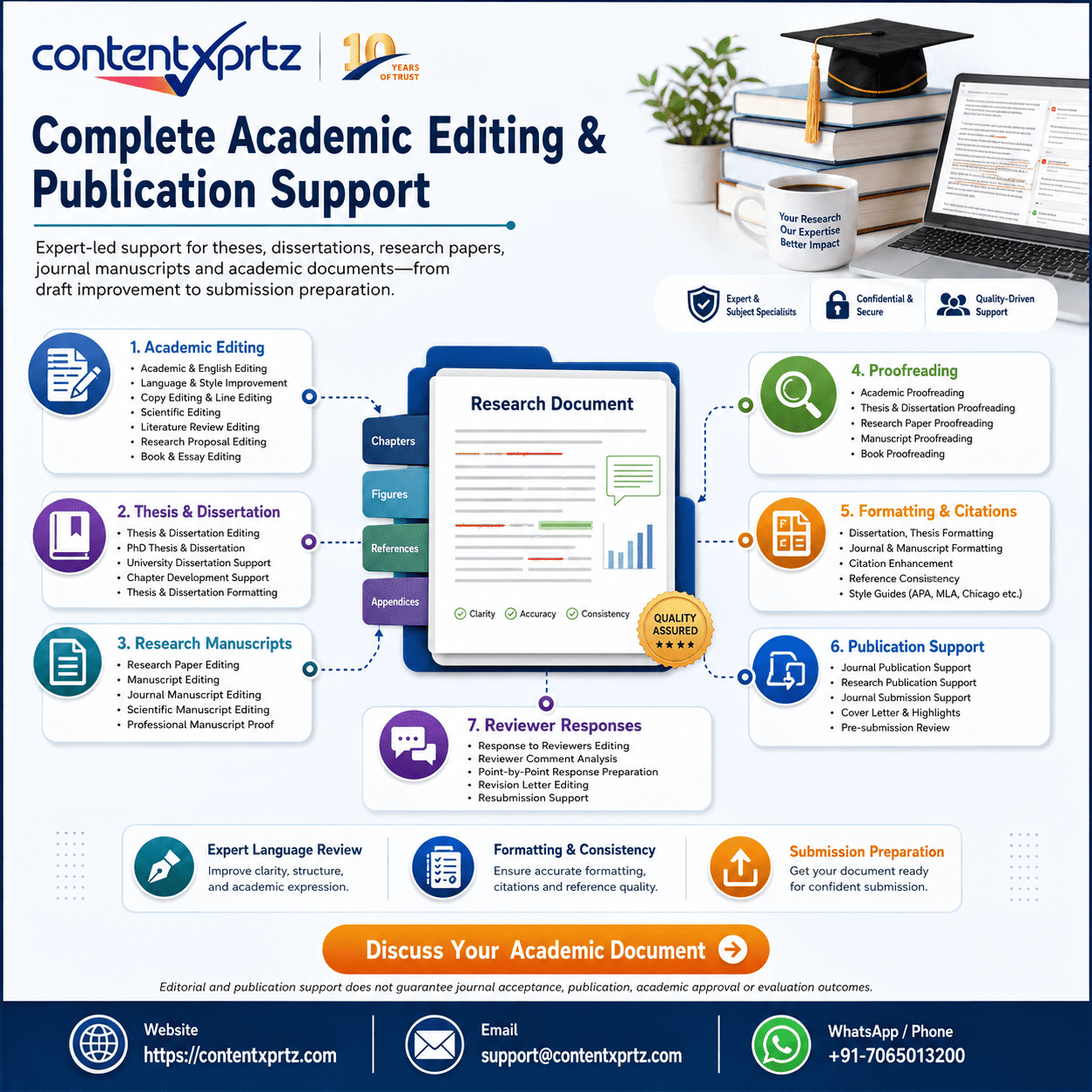
If your institution permits external editing, Contentxprtz can support thesis and dissertation clarity through ethical academic editing and proofreading. The candidate should review all changes, preserve original research ownership, and disclose assistance where required.
How to Use AI and Grammar Tools Responsibly During Thesis Editing
Automated tools are most useful when treated as detectors, not decision-makers. A grammar checker may notice subject-verb agreement, duplicated words, or punctuation patterns. A generative AI tool may suggest alternative phrasing or help identify passages that sound repetitive. But both can introduce errors, remove necessary qualifiers, change disciplinary terminology, or produce unsupported information.
Before uploading thesis text to any external system, check confidentiality, data-protection requirements, participant consent, intellectual-property restrictions, embargo conditions, and institutional rules. Research involving unpublished data, commercially sensitive material, patient information, or confidential peer review may require especially strict handling. ICMJE's current guidance for medical publishing emphasizes that human authors remain responsible for accuracy, attribution, originality, and transparent disclosure of AI-assisted use where required.
A safe workflow is to make one controlled change at a time, compare it with the original, verify technical meaning, recheck citations, and keep a record of tool use if your institution expects disclosure.
Summary: How to Edit a Thesis Without Losing Control of the Research
To edit a thesis effectively, work from the largest decisions to the smallest. Stabilize the research story and chapter structure, test arguments against evidence, improve paragraph logic, refine academic language, audit citations and references, standardize tables and figures, apply university formatting, and only then proofread the final document.
The strongest editing process is deliberate rather than endless. Each pass should have a defined purpose and a stopping condition. Keep backups, document major revisions, use tools cautiously, and check institutional rules whenever outside assistance or AI is involved. The final thesis should remain recognizably yours: your research question, your evidence, your interpretation, and your scholarly responsibility—communicated as clearly and consistently as possible.
Frequently Asked Questions
How do I edit a thesis effectively?
Edit a thesis in passes rather than trying to fix everything at once. Start with the research question, thesis claim, chapter purpose, and overall structure; then review paragraph logic, evidence, terminology, citations, tables and figures, sentence-level style, formatting, and finally proofreading. Work from the largest issues to the smallest so you do not spend time polishing passages that may later be deleted or rewritten. Keep a clean backup, use tracked changes or versioned files, and check your university's thesis manual before the final formatting pass.
What should I edit first in a thesis?
Edit the argument and structure first. Confirm that the title, abstract, introduction, research questions, methods, results, discussion, and conclusion tell one coherent research story and that each chapter has a clear job. Only after the structure is stable should you spend significant time on wording, grammar, punctuation, references, and typography. This order reduces duplicated work and makes sentence-level editing more meaningful.
What is the difference between thesis editing and proofreading?
Thesis editing improves substance and presentation at several levels, including argument, organization, paragraph flow, academic tone, clarity, consistency, and sometimes references or formatting. Proofreading is the final quality-control stage after substantive revisions are complete. It focuses on residual errors such as spelling, punctuation, missing words, inconsistent capitalization, numbering, cross-references, and layout problems. Proofreading cannot compensate for a weak argument or poorly organized chapter.
How many times should I edit my thesis?
There is no universal number, but most theses benefit from several focused passes. A practical sequence is one structural pass, one argument-and-evidence pass, one paragraph-and-style pass, one citation-and-formatting pass, and one final proofread. Complex dissertations may need additional supervisor-driven revisions. The key is to give each pass a defined purpose rather than rereading the whole thesis repeatedly without a checklist.
How can I edit a thesis when I am too familiar with the text?
Create distance before the final edit whenever your schedule allows. Change the viewing format, read difficult passages aloud, review chapters in a different order, print selected pages, or use text-to-speech to expose missing words and awkward rhythm. Use a checklist and search systematically for known habits such as long sentences, vague pronouns, inconsistent abbreviations, or repeated transition phrases. Feedback from a supervisor, peer, writing centre, or ethical professional editor can also reveal problems that familiarity hides.
Can I use AI or grammar tools to edit my thesis?
Tools can help identify possible grammar, spelling, repetition, and readability issues, but they should not replace author judgment or institutional rules. Automated suggestions can alter technical meaning, invent references, flatten disciplinary style, or mishandle confidential research. Review every proposed change, verify citations against original sources, and check your university's policy on generative AI and external editing. Where disclosure is required, describe tool use accurately.
How do I edit citations and references in a thesis?
First confirm that every in-text citation has a matching reference-list entry and that every listed source is actually cited where required. Then check author names, dates, titles, capitalization, journal or book details, DOI or URL formatting, page ranges, and punctuation against the required style. Use a reference manager if helpful, but do not assume imported metadata is correct. Finally, verify direct quotations and page numbers against the original sources.
Should I edit each thesis chapter separately or the whole thesis together?
Use both approaches. Edit individual chapters deeply because each chapter has its own argument, evidence, and internal structure, but also conduct whole-thesis passes for continuity. Whole-document checks are essential for terminology, abbreviations, numbering, cross-references, duplicated explanations, chapter transitions, recurring claims, and consistency between the abstract, introduction, results, discussion, and conclusion.
Can a professional editor edit a PhD thesis?
Professional thesis editing may be appropriate when it is permitted by the university and the scope of assistance is transparent. An editor can improve clarity, grammar, consistency, organization, formatting, and language while preserving the candidate's intellectual contribution. The editor should not fabricate evidence, rewrite the research contribution as their own, alter results to strengthen a claim, or conceal authorship. Always check institutional rules and retain responsibility for every final change.
How long does it take to edit a thesis?
Editing time depends on length, technical complexity, language quality, formatting requirements, the number of tables and references, and how much structural revision is still needed. A nearly complete thesis may require several focused days or weeks of staged editing, while a thesis with unresolved argument or chapter issues may need much longer. Build revision time into the submission plan and reserve a separate final proofread after the document is formatted.
What is a good final thesis proofreading checklist?
Check the title page and front matter, headings and numbering, table of contents, lists of figures and tables, captions, cross-references, citations and references, abbreviations, equations, units, page numbers, margins, fonts, spacing, widows and orphans, hyperlinks where applicable, and every requirement in the university template. Then proofread slowly for spelling, punctuation, missing words, duplicate words, inconsistent terminology, and last-minute errors introduced during formatting.
When should I stop editing my thesis?
Stop substantive editing when the argument is stable, required supervisor revisions are addressed, chapters are coherent, evidence supports the claims, and further changes are mostly stylistic rather than necessary. Then freeze the content and perform a controlled formatting and proofreading stage. Endless polishing can introduce new inconsistencies, so use submission criteria and a final checklist to define completion.
Conclusion: Edit for Clarity, Consistency, and Defensibility
Thesis editing is not a cosmetic final step. It is the process of making the research easier to inspect: readers should be able to follow the question, understand the method, distinguish evidence from interpretation, trace sources, and see how the conclusion follows from the work presented.
Start early enough to separate substantive revision from proofreading, and resist the temptation to fix everything in a single pass. A structured workflow gives you better control over a long document and makes supervisor feedback easier to manage. When external support is appropriate, use it transparently and within university rules.
For researchers who need a careful final language and consistency review, Contentxprtz offers ethical academic editing support focused on clarity rather than replacing authorship. “At Contentxprtz, we don’t just edit; we help ideas reach their fullest potential.”