How to Become an Academic Editor: Skills, Training, and Career Path
How to become an academic editor is less about collecting one perfect qualification and more about building a reliable combination of editorial judgment, academic literacy, subject awareness, ethical discipline, and practical experience. Academic editors work with research papers, theses, dissertations, journal manuscripts, book chapters, reports, and other scholarly documents. Their job is to make the writing clearer, more consistent, and better aligned with the author's purpose and the relevant academic or publisher requirements—without taking ownership of the research itself.
The route into the profession can look different for a language specialist, a former researcher, a postgraduate scholar, a publishing professional, or a subject-matter expert. Some editors begin with proofreading and copyediting. Others move from research or teaching into manuscript editing because they already understand how scholarly arguments, methods, evidence, citations, and journal conventions work. What unites successful editors is not a single degree title but demonstrable competence.
This guide explains the career path step by step: what academic editors actually do, the skills and qualifications that matter, how to choose a niche, how to train and practise, how to build a portfolio, where to look for work, how to use professional standards, and where ethical boundaries sit. It also distinguishes manuscript editing from journal editorial decision-making so you can choose the right career direction.
Quick Answer: How to Become an Academic Editor
To become an academic editor, first develop strong copyediting and proofreading fundamentals, then add academic-specific skills such as research literacy, citation awareness, journal-style compliance, clear author queries, and subject familiarity. Choose the editing level and disciplines you can handle responsibly, complete practical training, practise on permission-based or simulated manuscripts, and build a portfolio that shows your judgment.
You do not necessarily need a PhD. A relevant advanced degree can help in technical or discipline-specific editing, but professional editing skill is a separate competence that must be learned and demonstrated. Start with work that matches your current ability, seek feedback, document your development, and expand into more complex manuscripts only when you can do so accurately.
Most importantly, learn the boundaries of the role. Academic editing should improve communication and presentation while preserving the author's ideas, evidence, interpretation, and responsibility for the final submission.
Key Takeaways
- There is no universal licence for academic editors; employers and clients judge a mix of editing skill, subject knowledge, training, experience, and evidence of competence.
- A PhD can be useful for technical or substantive work, but it does not replace professional copyediting, proofreading, or author-communication skills.
- Build your career in stages: fundamentals, academic conventions, supervised practice, portfolio, entry-level work, specialisation, and ongoing professional development.
- Learn to distinguish proofreading, copyediting, stylistic editing, substantive editing, and journal editorial decision-making.
- Choose a subject niche narrow enough to build credibility but broad enough to find sustainable work.
- Ethics and confidentiality are core professional skills, especially when handling unpublished research or using AI-assisted tools.
- Good academic editors make defensible changes, ask precise questions, and preserve the author's intellectual ownership.
What This Page Covers
- What academic editing means and how it differs from journal editing.
- Qualifications, skills, and subject expertise that help editors get hired.
- A step-by-step route from beginner practice to paid academic editing work.
- Training, professional standards, certifications, and continuing development.
- Portfolio building, editing tests, job routes, and freelance positioning.
- Ethical boundaries, confidentiality, AI use, and author responsibility.
- Practical examples and a readiness checklist for aspiring editors.
Table of Contents
- What academic editing involves
- Qualifications and skills
- Step-by-step career path
- Choosing a subject and editing niche
- Building experience and a portfolio
- Finding jobs and freelance work
- Ethics, confidentiality, and AI
- Practical career examples
- Academic editor readiness checklist
- Frequently asked questions
Methodology and Academic Sources
This guide is based on professional editorial standards, training pathways, and scholarly publishing guidance rather than on a claim that every employer uses the same hiring rule. Editors Canada's Professional Editorial Standards describe the knowledge, skills, and practices used across structural, stylistic, copyediting, and proofreading work. The Chartered Institute of Editing and Proofreading provides staged training for aspiring and experienced editors. In the life sciences, the Board of Editors in the Life Sciences offers a specialist certification route with experience requirements.
For research integrity and reporting, editors should also understand resources from the Committee on Publication Ethics and discipline-specific reporting guidance such as the EQUATOR Network. These resources do not turn an editor into a researcher or peer reviewer; they help editors recognise when a manuscript may need an author query or a guideline check.
Publisher expectations vary by journal, discipline, manuscript type, and house style. University rules on thesis editing can also vary. Aspiring editors should therefore learn general professional standards and then verify the instructions that apply to each actual project.
What Does an Academic Editor Actually Do?
An academic editor improves scholarly communication at an agreed level of intervention. Depending on the assignment, that can range from final-stage proofreading to detailed language and copyediting, or to higher-level comments on structure and argument. The editor's scope should be clear before work begins.
| Editing level | Typical focus | What the editor should avoid |
|---|---|---|
| Proofreading | Typos, punctuation, spacing, minor consistency, final formatting checks | Rewriting arguments or making major structural changes at proof stage |
| Copyediting | Grammar, usage, consistency, terminology, style, cross-references, references and completeness checks | Changing technical meaning or silently correcting uncertain facts |
| Stylistic or language editing | Clarity, sentence flow, paragraph coherence, academic tone, readability | Flattening the author's voice or adding unsupported claims |
| Substantive editing | Organisation, logic, section balance, argument clarity, presentation of evidence | Designing the research, inventing analysis, or becoming an uncredited author |
| Journal editorial role | Scope assessment, peer-review management, editorial decisions, policy oversight | Confusing decision-making authority with manuscript editing services |
A useful distinction is between manuscript editing and journal editing. A manuscript editor serves the author or publisher by improving a document. A journal editor may decide whether a paper proceeds to review, select reviewers, evaluate revisions, manage conflicts of interest, and recommend or make publication decisions. Those are different career tracks even though both require editorial judgment.
Editors Canada defines professional editing broadly as reviewing, correcting, improving, and suggesting changes to optimise material for its audience, medium, and purpose. Its standards also emphasise the need to avoid introducing errors and to continue professional development. For an academic editor, that means language skill alone is not enough: you must understand what should be changed, what should be queried, and what should be left to the author.
What Qualifications Do You Need to Become an Academic Editor?
You need evidence of competence more than one universal credential. A degree can establish subject or academic familiarity, but employers and clients still need proof that you can edit professionally.
Academic background
A bachelor's degree is a common baseline for professional editorial roles, but the ideal background depends on the material. A master's degree or doctorate may be valuable when you edit highly specialised manuscripts, work with complex methods, or provide substantive comments in a narrow discipline. A former researcher may already understand literature reviews, methods sections, peer review, and journal culture; a language or publishing professional may bring stronger editorial mechanics. Both can become excellent academic editors if they fill the gaps in the other side of the skill set.
Editorial training
Formal training helps turn intuitive language ability into repeatable professional practice. A good course should cover scope, grammar and usage, copyediting marks or digital equivalents, style sheets, queries, consistency, proofreading, and client communication. The CIEP, for example, offers staged copyediting and proofreading training from introductory through more advanced levels. Training is especially useful when you are moving from being a strong academic writer to editing someone else's work, because editing requires restraint as well as correction.
Specialist certification
Certification is optional in many markets, but it can strengthen credibility in a specialist niche. BELS, for example, evaluates manuscript editors in the life sciences and normally expects both higher-education study and editing experience before certification. That makes certification better viewed as evidence of established proficiency than as the very first step into the profession.
Core competencies
- Language control: grammar, punctuation, spelling, usage, syntax, and academic register.
- Editorial judgment: knowing the difference between an error, a consistency issue, a stylistic preference, and a question for the author.
- Research literacy: recognising article structure, methods terminology, evidence claims, tables, figures, limitations, and citation logic.
- Style competence: applying a journal guide, house style, or style manual consistently while documenting project decisions.
- Digital editing: Word Track Changes, comments, compare functions, PDF markup, reference tools, and clean file handling.
- Communication: concise queries, tactful explanations, accurate scoping, deadline management, and expectation setting.
- Ethics: confidentiality, conflict awareness, attribution, responsible tool use, and respect for author responsibility.
How to Become an Academic Editor Step by Step
The most reliable path is progressive: learn the fundamentals, practise with feedback, prove your competence, then expand your scope. Trying to begin with complex dissertation or medical-manuscript editing before you can consistently copyedit a short paper creates avoidable risk for both you and the author.
Step 1: Decide what kind of academic editing you want to do
Choose an initial service level. Proofreading, copyediting, language editing, and substantive editing require overlapping but different skills. Also decide whether you are more interested in author-facing manuscript work or in journal editorial operations. This single decision influences your training, portfolio, and job search.
Step 2: Audit your current skills
Take a diagnostic approach. Can you explain why a sentence is ambiguous? Can you edit without changing technical meaning? Can you build a style sheet? Can you identify a missing citation without inventing a source? Can you compare journal author instructions with a manuscript and find mismatches? List your gaps instead of assuming that a strong degree or fluent English covers everything.
Step 3: Complete practical editing training
Choose training that includes exercises and feedback, not only theory. Learn copyediting and proofreading mechanics first. If you plan to specialise, then add subject-specific modules, academic style, reference editing, or scientific writing conventions. Keep samples of your exercises so you can see how your judgment improves over time.
Step 4: Learn the scholarly manuscript ecosystem
Academic editors should understand the typical path from draft to submission, peer review, revision, acceptance, and production. Learn common article sections, abstract conventions, tables and figures, supplementary materials, citation systems, reporting guidelines, and journal instructions. You do not need to become an expert in every publisher, but you should know how to find and apply the relevant rules.
Step 5: Practise on academic material safely
Use public-domain, self-created, permission-based, or supervised text. Practise editing abstracts, introductions, literature reviews, methods, discussions, references, and figure captions. Create a style sheet each time. Add author queries where meaning is unclear. Compare your edited version with feedback from an instructor or experienced editor.
Step 6: Build a focused portfolio
Your portfolio should show the kind of work you want to be hired for. Include short samples of tracked edits, a style sheet, selected queries, and perhaps an anonymised project summary. Do not publish confidential manuscripts or identifiable client material without explicit permission.
Step 7: Take entry-level tests and assignments
Editing companies, publishers, and agencies often use sample tests. Treat these seriously: follow the brief, edit to the requested level, resist unnecessary changes, and meet the deadline. For freelance work, begin with manageable project sizes and transparent scopes. Reliability is part of editorial competence.
Step 8: Review your errors and specialise
Keep an error log. If you repeatedly miss reference inconsistencies, table problems, hyphenation decisions, or author-query issues, design your next training around that weakness. Ongoing professional development is a core expectation in professional editorial standards, not an optional extra after you become 'experienced'.
Choose an Academic Editing Niche You Can Defend
Specialisation makes it easier to learn deeply, market clearly, and avoid editing beyond your competence. You do not need to limit yourself forever, but your first niche should make sense given your background.
| Niche | Useful knowledge | Typical documents |
|---|---|---|
| Life sciences and medicine | Scientific terminology, study designs, reporting guidelines, statistics awareness | Research articles, reviews, clinical papers, case reports |
| Engineering and technology | Technical terminology, equations, units, figures, standards awareness | Journal papers, conference papers, technical reports |
| Social sciences | Qualitative and quantitative methods, theory, survey language, citation practice | Articles, theses, dissertations, reports |
| Humanities | Argument development, textual analysis, citation-heavy prose, discipline conventions | Articles, monographs, chapters, dissertations |
| ESL academic editing | Academic English, cross-linguistic interference, clarity without voice erasure | Manuscripts, theses, abstracts, cover letters |
In a technical niche, subject expertise helps you notice when a sentence is grammatically correct but conceptually suspicious. However, an editor should not silently 'fix' uncertain science. Query the author. Your role is to support accurate communication, not to substitute your interpretation for the researcher's.
How to Build Experience and an Academic Editing Portfolio
A strong portfolio shows how you think. Recruiters and clients need evidence that you can make appropriate changes and communicate uncertainty professionally.
Use controlled samples
Create three to five short samples rather than one enormous document. One might demonstrate copyediting, another language editing, another references and formatting. Use tracked changes and comments. Add a one-page style sheet showing decisions such as spelling variant, abbreviations, capitalisation, number treatment, heading style, and reference conventions.
Show queries, not just corrections
Academic editing often depends on asking the right question. Include examples such as: 'The Methods section reports 126 participants, but Table 1 totals 124. Please confirm the correct sample size.' That demonstrates more value than a portfolio filled only with punctuation corrections.
Protect confidentiality
Never assume that editing a manuscript gives you permission to display it. Use anonymised summaries or simulated samples unless the author has explicitly agreed to public display. This is particularly important for unpublished research, student work, commercially sensitive data, or health information.
Collect evidence of professional development
List relevant courses, association memberships, certifications, webinars, mentoring, and supervised editorial work. Do not exaggerate. A transparent early-career profile is more credible than a long list of vague claims.
Where Can You Find Academic Editing Work?
Academic editing work exists across publishers, editing companies, universities, research organisations, scholarly societies, and freelance markets. The best starting route depends on whether you want structure and mentoring or independence and direct client responsibility.
In-house or contracted editing companies
These roles can provide a defined workflow, tests, style expectations, quality checks, and repeated exposure to academic manuscripts. They may be especially useful for new editors who want volume and feedback. Read contracts carefully, understand confidentiality rules, and make sure the expected editing level is realistic for the time allowed.
Publishers and journals
Publishers employ or contract copyeditors, production editors, managing editors, editorial assistants, and other specialists. These roles may involve manuscript preparation, house style, proof coordination, metadata, author communication, and production systems. If your goal is journal decision-making rather than copyediting, seek editorial assistant or research-community routes that expose you to peer-review management and editorial policy.
Universities and research organisations
Research offices, communications teams, writing centres, graduate schools, labs, and institutes sometimes need language editing, report editing, grant support, or publication-preparation help. Policies vary, so understand what assistance students and researchers are allowed to receive.
Freelance editing
Freelancing gives you control over niche, workload, and client relationships but also makes you responsible for marketing, scoping, contracts, invoices, data security, revisions, and disputes. Define your service precisely. 'Academic editing' is too broad by itself. A clearer positioning might be 'copyediting and language editing for public-health manuscripts' or 'thesis proofreading and reference consistency for social-science researchers'.
Do not market by promising publication, acceptance, or guaranteed outcomes. Your value is the quality and reliability of the editing process.
Ethical Academic Editing and Author Responsibility
Ethics is part of the craft, not a disclaimer added at the end. Academic editors work close to unpublished ideas, original data, authorship decisions, citations, and assessment documents. That access creates responsibilities.
- Preserve authorship: improve clarity without replacing the researcher's ideas, analysis, or conclusions.
- Do not fabricate: never invent references, data, quotations, participant details, results, or reviewer responses.
- Query uncertainty: when a fact, number, citation, or technical statement seems wrong, ask rather than guessing.
- Respect institutional rules: thesis and student-editing policies differ; some institutions limit the level of permitted intervention.
- Protect confidentiality: handle files securely and disclose any tool or subcontractor use as required.
- Avoid conflicts of interest: disclose relationships or circumstances that could impair independent professional judgment.
- Verify AI-assisted work: never trust an automated suggestion merely because it sounds fluent.
Using AI tools responsibly
AI-assisted tools may be acceptable in some workflows, but confidentiality and accuracy come first. Do not upload unpublished or sensitive text to a system unless the client permits it and you understand the data handling. Verify every suggestion yourself. Academic text can contain specialised distinctions that a generic language model may erase or distort.
Ethical editing is also transparent about limits. If the manuscript has serious methodological problems, you can flag clarity or reporting issues, but you should not present yourself as having validated the research unless that is explicitly within your qualified role.
Common Mistakes Aspiring Academic Editors Should Avoid
- Assuming a degree equals editing competence. Academic expertise and editorial expertise overlap, but they are not the same.
- Over-editing. Rewriting every sentence in your own voice can damage meaning and undermine authorship.
- Skipping the brief. A perfect substantive edit is still wrong if the client ordered proofreading only.
- Claiming every discipline. Broad marketing can hide real knowledge limits.
- Editing confidential material casually. Use secure file practices and understand tool permissions.
- Relying on automated grammar tools as authority. Academic language often needs contextual judgment.
- Ignoring references and internal consistency. Strong academic copyediting extends beyond sentence-level grammar.
- Guaranteeing publication. Acceptance depends on research quality, journal scope, peer review, editorial judgment, and many factors outside an editor's control.
Practical Examples: Three Routes Into Academic Editing
Example 1: The PhD graduate moving into manuscript editing
A researcher finishes a doctorate in molecular biology and has extensive experience writing papers but little formal editing training. Their fastest route is not to advertise 'expert editing' immediately. They take a structured copyediting course, practise on scientific samples, learn style sheets and author queries, and begin with life-science copyediting tests. Their subject knowledge becomes a differentiator after editorial fundamentals are in place.
Example 2: The language editor specialising in ESL research papers
An English-language professional already edits business and web copy. They want to move into academic work. They study scholarly article structure, common citation systems, research-reporting conventions, and the difference between language problems and methodological problems. Their portfolio focuses on clarity, cohesion, and preserving non-native authors' meaning rather than pretending to validate the science.
Example 3: The postgraduate student building experience ethically
A master's student is interested in editing but has no paid experience. They take introductory training, volunteer on a student journal within its policies, create simulated academic editing samples, and ask an experienced editor to review their work. After several months of deliberate practice, they apply for junior proofreading and editorial-assistant roles rather than taking on entire doctoral theses independently.
Example 4: The experienced editor entering a technical niche
A general copyeditor wants to work in engineering. Instead of simply adding 'technical editing' to a service list, they study common engineering paper structures, units, equations, figure conventions, and publisher requirements. They take limited-scope assignments in a familiar subfield and expand only when they can edit accurately without guessing at technical meaning.
Academic Editor Readiness Checklist
Before you accept independent academic editing work, check whether you can answer yes to most of the following.
- I can explain the difference between proofreading, copyediting, language editing, and substantive editing.
- I can edit grammar and clarity without changing an author's intended meaning.
- I can create and maintain a project style sheet.
- I can write concise, respectful author queries when information is unclear.
- I can follow journal or university instructions and identify conflicting requirements.
- I understand the basic structure of the scholarly documents in my chosen niche.
- I can check references and internal consistency without fabricating missing information.
- I have a secure process for confidential files and a clear policy for tool use.
- I have at least a small portfolio or assessed sample showing my editing judgment.
- I know when a manuscript problem is outside my competence and should be referred back to the author or another specialist.
- I can scope a project, estimate workload, meet deadlines, and document client expectations.
- I have a plan for continuing professional development.
If several items are still uncertain, that does not mean the career is closed to you. It simply gives you a practical training plan before you take responsibility for higher-stakes manuscripts.
How Contentxprtz Can Help You Understand Professional Academic Editing
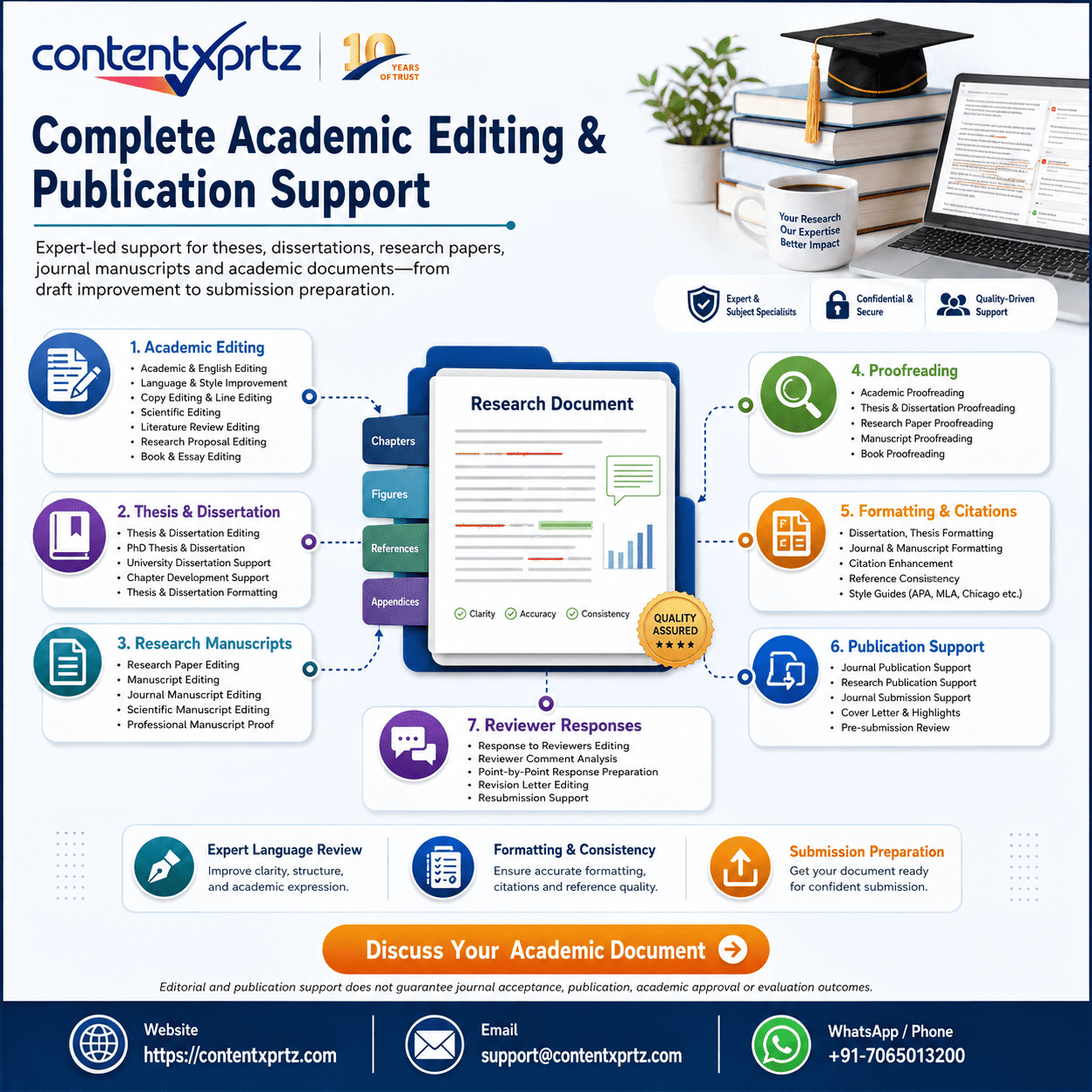
If you are an author or researcher who needs manuscript support rather than a career change, Contentxprtz provides research paper editing support focused on clarity, language, consistency, formatting, and publication readiness within an ethical scope. For aspiring editors, reviewing how professional academic editing is scoped can also help you understand the difference between correcting language, querying uncertainty, and taking over an author's intellectual work.
Contentxprtz supports researchers and academic authors across disciplines, but editing cannot guarantee journal acceptance or replace the author's responsibility for evidence, methods, citations, conclusions, or submission decisions. The most useful professional relationship is one in which the editor strengthens communication while the researcher remains clearly in control of the scholarship.
Summary: How to Become an Academic Editor
To become an academic editor, build professional editing skill first, then add the academic, subject, and ethical knowledge required by your chosen niche. A relevant degree can help, and a doctorate can be valuable for specialised work, but neither is a substitute for copyediting competence, careful author queries, style control, or consistent project management.
The strongest path is incremental. Learn the editing levels. Train. Practise with feedback. Understand scholarly workflows. Build a permission-safe portfolio. Take work that matches your actual ability. Keep an error log and continue learning. As your competence becomes repeatable, you can specialise, pursue credentials where useful, and take on more complex manuscripts.
Academic editing is ultimately a profession of judgment. Your job is not to make every sentence sound like you. It is to help authors communicate their own work more clearly, accurately, consistently, and responsibly.
Frequently Asked Questions
What qualifications do you need to become an academic editor?
There is no single universal degree or licence required to become an academic editor, but you need strong editorial skill, subject awareness, and evidence that you can improve scholarly text without changing an author's meaning. A bachelor's degree can be enough for some general academic copyediting roles, while a master's degree or PhD may be preferred for discipline-specific, technical, or substantive editing. What matters most is whether you can edit accurately, follow style and journal instructions, query authors diplomatically, and recognise when a problem is linguistic rather than methodological. Professional training in copyediting or proofreading can strengthen your foundation, and specialist credentials may be useful in fields such as the life sciences. Build competence before chasing titles: study grammar and usage, learn track changes and style sheets, practise on real or simulated manuscripts, and get feedback from experienced editors. Then present your training, subject expertise, editing samples, and client or employer experience clearly. Requirements vary by employer, journal, publisher, and editing level, so always read the role description rather than assuming that one academic qualification automatically makes you job-ready.
How do I become an academic editor with no experience?
Start by creating structured practice experience rather than waiting for someone to hand you a full manuscript contract. Take a reputable introductory copyediting or proofreading course, learn the core expectations of scholarly manuscripts, and practise on public-domain, self-created, or permission-based samples. Edit short passages first, then build up to abstracts, introductions, literature reviews, tables, references, and complete papers. Keep a style sheet for every exercise and record why you made important changes. Ask a mentor, instructor, or experienced editor to review selected samples so you can identify habits you may not notice yourself. You can also volunteer for a student journal, research group, scholarly society, nonprofit publication, or supervised university project when appropriate. Do not claim professional experience you do not have, and do not edit confidential manuscripts without clear permission. Once you can demonstrate consistent work, create a small portfolio showing before-and-after edits, query style, and attention to references. Apply first for junior, assistant, freelance test, or limited-scope assignments where the expectations match your current competence.
Do you need a PhD to become an academic editor?
No, a PhD is not required for every academic editing role. Many excellent academic editors enter the field through language, publishing, communications, librarianship, journalism, translation, or subject-specific professional backgrounds. A doctorate can be valuable when the work requires deep familiarity with research methods, discipline-specific terminology, argument conventions, or advanced technical content, but it does not replace editing skill. Someone with a PhD may understand research deeply yet still need training in copyediting, proofreading, style sheets, author queries, and production workflows. Conversely, an experienced editor without a doctorate may be highly effective at language and manuscript editing within an appropriate scope. The right qualification depends on the assignment. Developmental or technical editing in a narrow field may demand stronger subject expertise, while language editing may depend more on editorial proficiency and academic English. When applying, show the combination that matters for the role: editing training, subject knowledge, publications or research exposure, software skills, style-guide familiarity, and a portfolio that proves careful judgment.
What skills should an academic editor learn first?
Learn accuracy, clarity, consistency, and editorial judgment before trying to master every specialised tool. Your first skills should include grammar, punctuation, spelling, usage, sentence structure, paragraph flow, consistency checking, and the ability to preserve an author's intended meaning. Next, learn the difference between proofreading, copyediting, stylistic editing, substantive editing, and developmental editing so you do not over-edit or promise the wrong service. Academic editors also need to work confidently with tracked changes, comments, style sheets, reference lists, tables, figures, abbreviations, headings, and journal or university instructions. Research literacy matters because you must recognise unsupported statements, inconsistent terminology, missing citations, reporting problems, or unclear methods without pretending to be the researcher. Communication is equally important: good editors write concise, respectful queries and explain high-impact changes without becoming adversarial. Finally, learn ethical boundaries, confidentiality, conflicts of interest, and responsible use of AI-assisted tools. A reliable editor is not the person who changes the most text; it is the person who makes the right changes, flags the right risks, and leaves authors in control of their work.
How can I build a portfolio for academic editing?
Build a portfolio that demonstrates judgment, not just corrected commas. Use only material you have permission to show, or create simulated academic samples that do not contain confidential or unpublished research. A useful portfolio can include a short copyediting sample, a language-editing sample, a reference and formatting check, a style sheet, and a page of representative author queries. Where possible, show a clean 'before' passage, your tracked edit, and a brief note explaining the scope of the work. Remove names, data, affiliations, or other identifying information unless the author has explicitly approved public use. You can also describe completed projects in anonymised terms, such as 'edited a 7,000-word public-health manuscript for clarity and journal style,' without revealing confidential content. Keep the portfolio focused on the niche you want to enter. A life-science editor should demonstrate comfort with scientific structure and terminology; a humanities editor may show argument flow, citation consistency, and style-guide control. Update the portfolio as your skill improves, and never use a client's manuscript as marketing material simply because you edited it.
Where can academic editors find their first clients or jobs?
Academic editors commonly find work through editing companies, scholarly publishers, university departments, research organisations, professional associations, referrals, job boards, and carefully built freelance networks. Start with roles whose scope matches your experience: junior editor, editorial assistant, language editor, proofreader, manuscript editor, or freelance contractor. Professional associations can help you understand standards, training pathways, directories, and networking opportunities, while universities and learned societies sometimes need editorial support for journals, reports, repositories, or research communications. If you freelance, create a clear service page that states your subject areas, editing level, turnaround policy, confidentiality approach, and what you do not do. Avoid mass messages promising acceptance or claiming expertise in every discipline. Your first clients are more likely to trust you when your niche is clear and your sample work is strong. Referrals often become important later, so reliability, deadline discipline, respectful communication, and accurate scoping matter as much as marketing. Treat every editing test or small assignment as evidence of professional judgment.
Is academic editing the same as being a journal editor?
No. An academic manuscript editor and a journal editor can work on the same paper but have very different responsibilities. A manuscript editor typically improves language, clarity, consistency, style, structure, references, or presentation before or during publication production. A journal editor, such as an associate editor or editor-in-chief, usually has editorial decision-making responsibilities within a journal: assessing fit, selecting reviewers, managing peer review, evaluating revisions, handling conflicts of interest, and making or recommending publication decisions. Some journals also employ managing editors or copyeditors who work on production and language rather than acceptance decisions. The distinction matters because a freelance academic editor should never imply that editing gives them influence over peer review or journal acceptance. If your career goal is journal editorial leadership, research experience, disciplinary reputation, peer-review experience, and governance knowledge may be especially important. If your goal is manuscript editing, professional editing skill, subject familiarity, style competence, and client communication are usually more central. Clarify which path you want before choosing training and building experience.
Can academic editors use AI tools in their work?
Academic editors can use AI-assisted tools only when the workflow, client agreement, confidentiality requirements, and relevant institutional or publisher policies permit it. The editor remains responsible for every change or suggestion delivered to the author. Do not upload confidential, unpublished, identifiable, proprietary, or sensitive manuscript content to a tool unless you have explicit permission and understand how the service handles data. AI may help with limited tasks such as brainstorming consistency checks or spotting possible language issues, but it can also invent facts, alter technical meaning, flatten author voice, mishandle citations, or introduce subtle errors. Human verification is therefore essential. An editor should be able to justify changes independently rather than treating an AI output as authority. Keep client expectations transparent, follow data-protection obligations, and prefer tools and settings appropriate for confidential professional work. The safest principle is simple: use technology to support editorial judgment, never to replace accountability, subject awareness, or the author's ownership of the research.
How long does it take to become a professional academic editor?
There is no fixed timeline because readiness depends on your starting skills, subject background, training intensity, feedback, and the complexity of the work you want to handle. Someone who already has strong academic writing experience and language skills may become competent in entry-level copyediting relatively quickly after focused training and supervised practice. Moving into substantive, technical, medical, or high-stakes editing can take much longer because the editor must learn discipline conventions, research reporting expectations, ethical boundaries, and specialised terminology. Instead of measuring progress only by months, use competence milestones: Can you edit a sample accurately without changing meaning? Can you build and follow a style sheet? Can you distinguish an error from a preference? Can you query unclear claims tactfully? Can you follow a journal's instructions and preserve citations? Can you scope a project and meet a deadline? Professional associations emphasise ongoing development because editors continue learning throughout their careers. Start with work you can do well, seek feedback, document your development, and expand your scope only when your evidence of competence supports it.
What is the best step-by-step route for how to become an academic editor?
The strongest route is to combine editorial training, a defined academic niche, deliberate practice, ethical awareness, and progressively harder real work. First, decide whether you want to focus on language editing, copyediting, proofreading, substantive editing, or a subject-specialist area. Second, assess your current gaps in grammar, style, research literacy, software, and subject knowledge. Third, complete practical training and study recognised editorial standards. Fourth, practise on permission-based or simulated academic material and obtain feedback. Fifth, learn journal instructions, citation styles, reporting guidelines, and confidentiality expectations relevant to your niche. Sixth, create a small portfolio and professional profile that accurately describe your competence. Seventh, seek junior roles, contractor tests, supervised assignments, or small freelance projects. Eighth, review your errors, continue professional development, and specialise further as your experience grows. Certifications can strengthen credibility in some markets, but they work best after you have real competence. Throughout the process, avoid rewriting authors' ideas, fabricating citations, guaranteeing publication, or presenting yourself as a journal decision-maker when you are providing manuscript editing.
Conclusion: Build Competence Before You Build a Client List
The practical answer to how to become an academic editor is to treat editing as a professional discipline in its own right. Strong English or a research degree can give you a useful starting point, but reliable academic editing depends on trained judgment, academic literacy, careful scope control, respectful communication, and ethical restraint.
Self-directed learning and low-cost practice may be enough to test whether the field suits you. For professional work, structured training, assessed practice, mentoring, and credible feedback are safer foundations. As you move into specialised or higher-stakes manuscripts, subject expertise and knowledge of reporting or publisher requirements become increasingly important.
If you are a researcher preparing a manuscript and need professional assistance with clarity, language, consistency, or journal-readiness, Contentxprtz can provide ethical editing support while you remain responsible for the research and final submission.
At Contentxprtz, we don’t just edit; we help ideas reach their fullest potential.