Write My Research Paper: A Practical and Ethical Guide to Getting Help
“Write my research paper” is a search people often make when the problem is bigger than simply producing sentences. You may have a deadline but no workable research question. You may have found dozens of papers but cannot turn them into a coherent literature review. You may understand the subject but struggle to express it in academic English. Or you may have a full draft that still feels repetitive, under-evidenced, badly structured, or inconsistent in its citations. In each case, the useful question is not “Who can produce a paper for me?” but “What kind of research or writing support will help me complete this paper responsibly?”
A research paper is an argument built from traceable evidence, method, analysis, and accountable authorship. That makes it different from ordinary web content. The writer needs to understand what is being claimed, where the evidence came from, why the method is appropriate, what limitations remain, and how each source supports the discussion. For assessed work, the student must also follow the institution’s academic-integrity policy. For journal manuscripts, authorship, disclosure, reporting, AI use, and editorial-assistance rules may apply. A polished paper that the named author cannot explain is not a successful academic outcome.
That does not mean you must work without support. Good research is collaborative in many legitimate ways. Supervisors guide scope and argument. Librarians help design searches. Statisticians explain analyses. Writing centres teach academic communication. Colleagues provide peer feedback. Professional editors improve clarity, consistency, grammar, structure, and formatting. Research support specialists can help you organise a literature review or interpret reviewer feedback. The important boundary is that support should strengthen the author’s work rather than conceal who produced the intellectual contribution.
This guide shows how to move from a vague topic or unfinished draft to a defensible research paper. It explains how to define the task, develop a question, search and evaluate sources, build an evidence-led outline, draft each section, revise critically, verify citations, use AI cautiously, and decide when professional academic writing support or academic editing services may be appropriate. The goal is not to remove the researcher from the process. It is to make the process clearer, more manageable, and more ethical.
Quick Answer: How Should I Get Help to Write My Research Paper?
If you are searching for help to write your research paper, first identify the exact bottleneck. If you do not know what to study, you need research-question and scope guidance. If you cannot find reliable evidence, you need literature-search support. If you have sources but no argument, you need synthesis and outlining help. If you have a complete draft, you may need academic editing, proofreading, reference checking, or formatting rather than new writing.
The most ethical form of support keeps the researcher in control of the intellectual work. You should choose and understand the evidence, approve the method, make the interpretation, verify citations, and take responsibility for the final paper. Assistance should be transparent where university or publisher rules require disclosure.
Avoid services or tools that offer fabricated data, invented citations, undisclosed ghostwriting, guaranteed grades, or guaranteed publication. Those claims bypass the real academic task and can create serious integrity problems. Use expert help to improve process and communication—not to substitute for authorship.
Key Takeaways
- “Write my research paper” usually signals a process problem: scope, evidence, structure, language, citations, or time management.
- Break the project into research design, evidence gathering, analysis, drafting, revision, and final quality control.
- Professional support is strongest when it improves your work while preserving your ideas, evidence, and responsibility.
- Never rely on unverified AI-generated sources, quotations, statistics, or references.
- Academic editing, proofreading, and research guidance are different services; choose the one that matches your actual bottleneck.
- Institutional and journal policies can differ, so check rules on editing, outside assistance, authorship, and AI disclosure.
- A defensible paper is one you can explain, source, revise, and stand behind.
What This Page Covers
- What people usually mean when they search for research paper writing help
- A step-by-step workflow from assignment brief to final submission
- How to develop a research question and evidence-led outline
- How to search, evaluate, synthesise, and cite academic sources
- The difference between self-service help, coaching, editing, proofreading, and deeper research assistance
- How to use AI tools cautiously without surrendering author responsibility
- Practical examples, a readiness checklist, FAQs, and ethical next steps
Table of Contents
Methodology and Academic Sources
This guide is based on common academic writing, research support, editing, and publication-readiness workflows, together with recognised guidance on authorship, research integrity, and responsible use of AI. Requirements vary by institution, discipline, assignment type, research design, and target journal, so the governing course handbook, university policy, ethics approval, reporting guideline, and journal author instructions should always take priority.
For publication ethics and author responsibility, the ICMJE authorship recommendations emphasise accountability for published work. Its guidance on AI use by authors states that AI tools should not be listed as authors and that humans remain responsible for accuracy, integrity, originality, and appropriate attribution. Springer Nature’s AI guidance for researchers similarly centres human accountability and policy-compliant disclosure. The Committee on Publication Ethics guidance is another useful reference point for publication-integrity questions.
Contentxprtz can support ethical research writing, editing, proofreading, formatting, and publication preparation. Such support should not fabricate sources or evidence, replace the researcher’s analysis, or create claims the author cannot verify.
What “Write My Research Paper” Usually Means in Practice
The phrase often hides a more specific problem that can be solved more safely and efficiently once it is named. A student who says “I need someone to write my research paper” may actually be struggling to narrow a broad topic. A PhD scholar may have the analysis but need help turning chapters or study results into a journal-style argument. An ESL researcher may need language polishing that preserves technical meaning. A professional may understand the subject but be unfamiliar with academic citation and evidence standards.
| What you are struggling with | What you probably need | What you should still own |
|---|---|---|
| Topic is too broad | Scope and research-question coaching | Final question and rationale |
| Too many sources | Search strategy and evidence organisation | Source selection and interpretation |
| No clear argument | Outline and synthesis feedback | Claims and reasoning |
| Method section is confusing | Method explanation or specialist review | Actual design, data, and decisions |
| English is unclear | Academic editing or ESL language polishing | Meaning and technical accuracy |
| References are inconsistent | Citation and formatting support | Source authenticity and relevance |
| Draft is complete but rough | Substantive editing, copyediting, or proofreading | Final approval and submission |
This distinction matters because buying more help than you need can create unnecessary cost and ethical risk. If the problem is formatting, you do not need someone to rewrite your argument. If the problem is a weak research question, proofreading cannot fix it. Diagnose first; choose support second.
How to Write My Research Paper Step by Step
The fastest responsible route is to separate research decisions from writing decisions. Trying to research, analyse, cite, and polish every sentence at once usually creates delay and inconsistency.
Step 1: Decode the task before researching
Identify the required output, audience, word limit, deadline, evidence expectations, citation style, and assessment criteria. A university assignment may ask for critical comparison, while a journal article may require a specific reporting structure and detailed methods. Write the task in one sentence: “This paper must answer X for Y audience using Z type of evidence.” That sentence becomes your scope control.
Step 2: Turn the topic into an answerable research question
A topic such as “social media and mental health” is not yet a research question. Narrow it by population, variable, context, timeframe, or method. A question such as “How is nightly social-media use associated with self-reported sleep quality among first-year university students?” gives you searchable concepts and a clearer path to evidence.
Step 3: Build a search map
List the main concepts and synonyms before searching. Combine subject databases, your university library, Google Scholar, publisher platforms, and relevant repositories. Keep a search log for serious projects. Record database, date, search string, filters, and useful results. This reduces repeated searching and helps you explain how evidence was identified.
Step 4: Read for decisions, not for volume
Do not collect fifty PDFs and assume progress has been made. Screen titles and abstracts against your question. For promising sources, read the methods, results, discussion, limitations, and reference trail. Record what each source contributes: definition, theory, method, finding, disagreement, limitation, or gap. That note becomes material for synthesis.
Step 5: Develop a claim-evidence outline
Instead of headings alone, write each section as a claim followed by the evidence needed to support it. For example: “Existing studies show a consistent association, but measurement methods differ.” Under that claim, place the studies that establish the association and the studies that illustrate measurement variation. This produces an argument-led outline rather than a source-by-source summary.
Step 6: Draft the body before perfecting the introduction
Write the sections where the evidence is strongest. Each paragraph should have a purpose: claim, evidence, interpretation, and connection to the paper’s question. Drafting the introduction too early often creates promises the final paper does not fulfil. Once the argument is stable, write an introduction that accurately previews it.
Step 7: Revise in layers
First revise for logic and evidence. Then revise for structure and transitions. Next edit sentence clarity, terminology, grammar, and academic tone. Finally, proofread formatting and typographical details. Mixing all levels of revision at once wastes attention.
Step 8: Verify every citation and factual claim
Open the original source and confirm that it supports your statement. Check quotation wording and page numbers where applicable. Match in-text citations to the reference list. Confirm DOIs, dates, author order, journal titles, and editions. Citation software helps with consistency but does not remove the need for verification.
How to Find and Use Evidence Without Turning the Paper Into a Summary
A research paper should synthesise evidence around your question rather than describe one source after another. Synthesis means comparing studies, identifying patterns, explaining differences, and showing what those differences mean for your argument.
Use an evidence matrix with columns such as citation, research question, sample, method, main findings, limitations, and relevance to your paper. Then sort studies by themes or claims. You may discover that several papers agree on the direction of an effect but use different measures, or that results differ by population. That is analytically useful; it gives you something to explain rather than merely report.
Be cautious with source hierarchy. A peer-reviewed article is not automatically correct, and a report is not automatically weak. Judge evidence by relevance, design, transparency, recency where appropriate, and the strength of the underlying data. Check whether important work has been corrected or retracted. For high-stakes reviews, follow discipline-specific review standards and seek librarian or methodological support.
Write from your evidence notes, not from the source text
After reading a source, close it and explain the relevant point in your own words from your notes. Reopen the source to verify accuracy and citation. This reduces patchwriting and encourages genuine understanding. If exact wording is essential, quote sparingly and follow the required citation style.
Free, Low-Cost, and Professional Research Paper Support Options
Different stages of a paper benefit from different kinds of support. Start with the least intensive option that solves the problem.
| Support option | Best for | Strength | Boundary to watch |
|---|---|---|---|
| Supervisor or instructor | Scope, expectations, conceptual feedback | Knows the academic context | Availability may be limited |
| University writing centre | Planning, academic writing skills, revision | Educational and usually free | May not offer subject-specific expertise |
| Academic librarian | Databases, search strategy, source discovery | Strong information-literacy support | Does not normally make research decisions for you |
| Peer feedback | Clarity, argument, reader perspective | Fast and contextual | Quality depends on reviewer expertise |
| Grammar or reference tools | Surface errors and consistency checks | Low cost and fast | Can introduce errors or miss disciplinary nuance |
| Professional academic editor | Structure, language, consistency, final polish | Focused expert review | Must preserve authorship and follow policy |
| Research support specialist | Complex planning, synthesis, feedback interpretation | Can resolve specific process bottlenecks | Role must be clearly bounded and ethical |
If you already have a strong draft, professional proofreading may be sufficient. If the argument or organisation needs deeper work, a manuscript assessment or substantive edit may be more appropriate. For research-paper-specific assistance, use the Contentxprtz research paper writing support service to request help that is matched to your stage and institutional requirements.
When Self-Service Help Is Enough—and When Expert Support Adds Value
Self-service is usually enough when you understand the task, can find credible sources, have a workable method, and mainly need discipline and time. Use your library, reference manager, style guide, course resources, and a revision checklist. A writing group or peer review can provide valuable accountability without changing ownership of the work.
Expert help becomes more useful when you repeatedly lose the thread of the argument, are working in a second language, must respond to complex supervisor or reviewer comments, need discipline-specific formatting, or cannot distinguish substantive editing from proofreading. It is also useful when a paper has passed through many revisions and inconsistencies have accumulated.
The decision should be based on risk and need, not anxiety. A professional editor cannot rescue missing data or justify an unsuitable method. A statistician cannot make an unsupported causal claim defensible. A writing consultant cannot replace reading the literature. Strong support identifies the problem accurately and works within that boundary.
Can AI Help Me Write My Research Paper Responsibly?
AI can assist with narrow tasks, but the human author must remain responsible for the paper. Policies differ, so check your institution, funder, ethics framework, and target journal before using generative tools.
Potentially lower-risk uses include generating search-term variants, explaining unfamiliar terminology, creating a revision checklist, testing whether an abstract is understandable, or suggesting alternative sentence structures. Higher-risk uses include generating literature claims, citations, data interpretations, methods, or results without independent verification. Never upload confidential manuscripts, identifiable participant data, proprietary data, or unpublished material to a tool unless its privacy and data-use terms are compatible with your obligations.
ICMJE guidance says AI-assisted tools should not be listed as authors because they cannot take responsibility for accuracy, integrity, and originality. It also stresses human review and appropriate attribution. Springer Nature’s current guidance likewise emphasises author accountability and transparent declaration in line with policy. Treat these principles as a baseline: verify outputs, protect confidential information, disclose use when required, and never let a tool invent the scholarly record.
Common Mistakes When Seeking Research Paper Writing Help
Asking for a complete paper before defining the question
This creates generic writing and weak evidence because there is no stable research problem. Define the question and scope first.
Treating every source as equally credible
Search ranking is not evidence quality. Evaluate relevance, method, publication context, limitations, and traceability.
Writing one paragraph per source
This produces an annotated bibliography instead of an argument. Organise paragraphs around claims and compare multiple sources within each theme.
Using citations you have not opened
A citation may be misquoted, retracted, irrelevant, or simply fabricated by an AI system. Verify the original record and read enough of the source to represent it accurately.
Using proofreading to solve a structural problem
Proofreading fixes surface errors. If sections are missing, claims are unsupported, or the argument is incoherent, you need substantive revision first.
Leaving reference checks until the final hour
Reference problems often reveal deeper issues: unsupported claims, missing sources, duplicate citations, or inconsistent versions. Check as you draft and perform a final audit.
Assuming paid assistance is automatically permitted
Institutional and journal rules vary. Some allow language editing but restrict content development. Others require acknowledgment. Check the policy that governs your work.
Practical Examples: Matching the Help to the Real Problem
Example 1: The postgraduate student with a broad topic
A postgraduate student begins with “AI in education” and asks for someone to write the paper because every search produces thousands of results. The real problem is scope. The correct approach is to narrow the population, educational setting, AI application, and outcome, then build a search strategy around those concepts. A writing adviser or research support professional can help test whether the question is answerable, but the student should choose the final question and interpret the literature. Once the scope is clear, much of the writing difficulty disappears.
Example 2: The PhD scholar with a complete but difficult draft
A PhD scholar has already collected data, completed analysis, and written a 7,000-word manuscript. Reviewers say the discussion is hard to follow and the English is inconsistent. This person does not need a new research paper. They need substantive editing followed by language editing. An editor can identify repeated arguments, unclear transitions, inconsistent terminology, and paragraphs where conclusions extend beyond the results. The scholar should approve every substantive change and remain responsible for the interpretation.
Example 3: The ESL researcher facing citation and language problems
An ESL researcher has strong technical content but mixes tense, uses inconsistent terminology, and has references imported from several databases with different metadata. The correct support is academic language editing plus a reference audit. The editor should improve clarity without changing technical meaning. The author should verify source details and ensure every citation supports the associated claim. This is a much safer use of professional help than handing over the entire paper.
Example 4: The first-time journal author using AI for literature notes
A first-time author asks an AI tool to summarise a topic and receives several convincing-looking citations. Instead of inserting them into the manuscript, the author searches each title in scholarly databases and discovers that two references do not exist. The correct workflow is to treat AI output as a prompt for verification, not evidence. The author rebuilds the literature section from authentic sources and documents AI use according to the journal’s policy.
Research Paper Readiness Checklist
Before you submit, confirm that the paper is defensible at the level of argument, evidence, ethics, and presentation.
- Task: The paper answers the actual assignment or journal requirement.
- Question: The research question is specific enough to answer within the available evidence and word count.
- Evidence: Key claims are supported by credible, relevant, traceable sources.
- Method: The method is described accurately and matches what was actually done.
- Analysis: Results are interpreted without overstating causality, certainty, or generalisability.
- Structure: Every section has a clear purpose and the argument progresses logically.
- Paragraphs: Paragraphs synthesise evidence around claims rather than simply summarising one source at a time.
- Citations: In-text citations and reference-list entries match, and bibliographic details have been checked.
- Originality: Paraphrases genuinely reflect your understanding and sources are attributed correctly.
- AI use: Any AI-assisted work has been verified, kept within policy, and disclosed if required.
- Editing: Language, terminology, tables, figures, headings, and formatting are consistent.
- Responsibility: You can explain the research choices, evidence, argument, and conclusions in your own words.
How Contentxprtz Can Help Without Replacing the Researcher
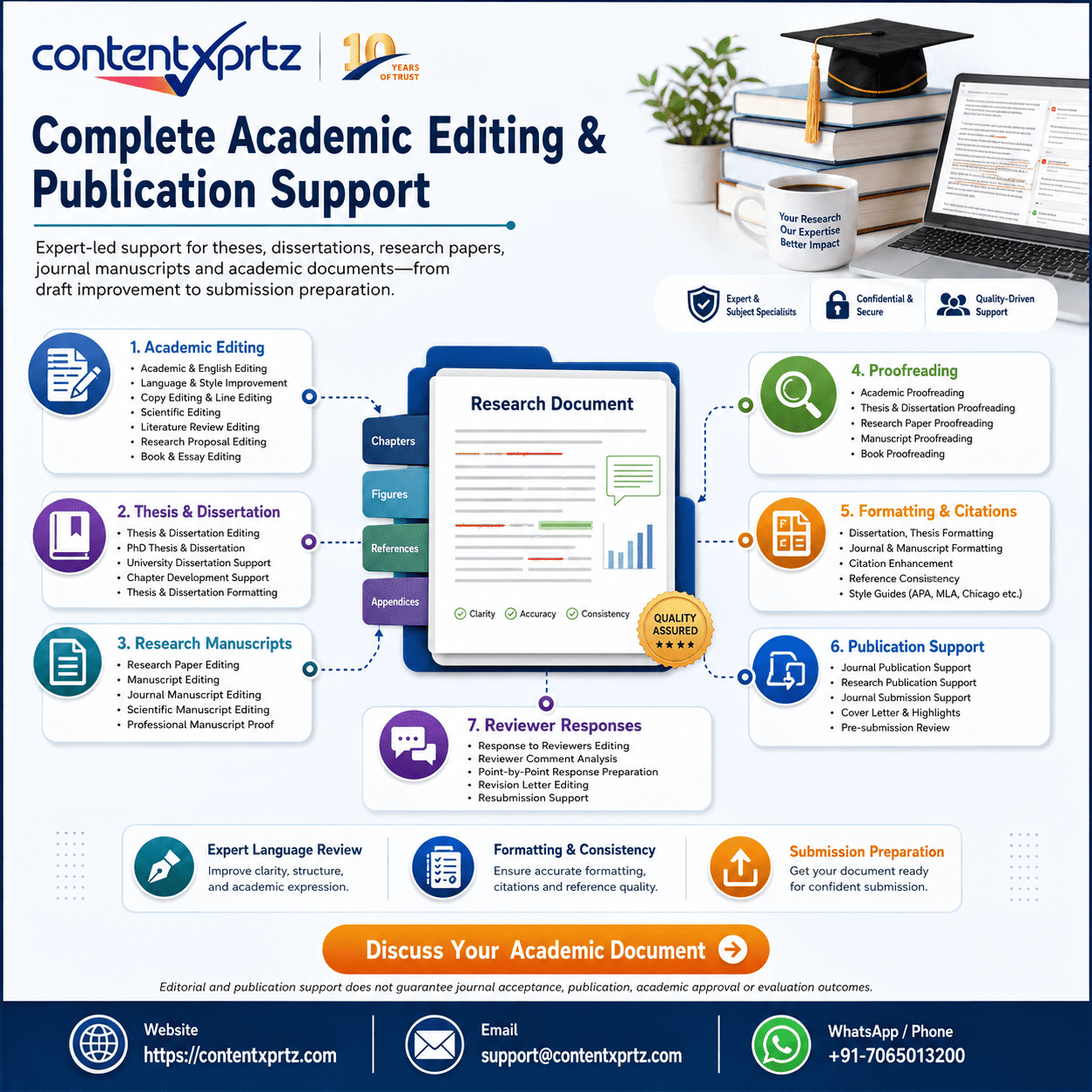
Contentxprtz supports researchers who need targeted help with the writing and publication process. The best starting point depends on what is already complete. If you have a question but no structure, research writing guidance may help you organise the work. If you have a draft with logic or flow problems, academic editing support can focus on clarity and coherence. If the paper is structurally sound but needs final quality control, proofreading may be enough. If you are preparing for journal submission, publication support can help with readiness, formatting, and response requirements.
The central principle is bounded assistance. Contentxprtz can help organise, review, edit, proofread, and prepare academic work, while the researcher remains responsible for evidence, data, interpretations, citations, and final submission. This protects the value of expert assistance without confusing it with authorship.
Summary: Write My Research Paper the Responsible Way
If you are searching “write my research paper,” identify the exact obstacle before choosing a service or tool. A good research paper is not produced by polished language alone. It depends on a clear question, credible evidence, appropriate method, careful analysis, accurate citation, coherent structure, and accountable authorship.
Use free resources when they are sufficient: supervisors, libraries, writing centres, peer feedback, databases, and reference managers. Use professional support when the draft needs specialist editing, language improvement, structured research guidance, citation cleanup, or publication-readiness review. Keep the assistance aligned with university or journal rules, verify AI-generated material, and never outsource responsibility for claims you must defend yourself.
Frequently Asked Questions
What does “write my research paper” help ethically mean?
Ethical research paper help supports your process without pretending that someone else’s undisclosed work is your own. Appropriate support can include clarifying an assignment or journal brief, refining a research question, planning a structure, improving a literature-search strategy, explaining methods, reviewing a draft for logic, editing language, checking citation consistency, and helping you understand feedback. The researcher or student should remain responsible for the intellectual work: choosing and reading sources, making claims, analysing data, interpreting results, and approving the final text. If your university, funder, employer, or target journal has rules about outside assistance, follow those rules and disclose support when required. A useful test is whether you could explain and defend the paper yourself. Contentxprtz can provide research paper assistance, editing, and structured guidance, but ethical support should strengthen your authorship rather than replace it.
Can someone write my research paper for me?
A third party can help you develop, edit, or improve a research paper, but submitting undisclosed ghostwritten academic work as your own may violate institutional or publication rules. The safest approach is to keep authorship and intellectual responsibility with the named author. You should understand the research question, verify every source, approve the method, own the analysis, and be able to defend the argument. Professional assistance is most defensible when it is transparent and bounded: coaching, outlining from your ideas, language editing, reference checks, formatting, statistical explanation, or feedback on a draft. For journal manuscripts, publisher policies may also require disclosure of writing or AI assistance. Before using any service, check the applicable academic-integrity and authorship policy rather than assuming that paid support is automatically permitted.
How do I start a research paper when I feel stuck?
Start by reducing the task to one answerable question and one concrete next action. Read the assignment or journal instructions, write down the required outcome, define the topic boundaries, and turn the topic into a research question. Then list the concepts you need to investigate and search for credible sources using your library databases, Google Scholar, or discipline-specific indexes. Do not begin by trying to write a polished introduction. Build a working outline from the evidence you actually find. A simple sequence is question, evidence, position, structure, draft, revision, and reference check. If the problem is uncertainty rather than lack of effort, a supervisor, librarian, writing centre, or research support professional can help you define the next step without taking over the intellectual work.
What information should I provide when asking for research paper assistance?
Provide the material that defines the task and the work you have already completed. Useful inputs include the assignment brief or target journal guidelines, research question, discipline, required word count, deadline, citation style, any marking rubric, approved proposal, method, datasets you are permitted to share, source list, supervisor comments, and your current draft or outline. Also state what kind of help you want—for example, structure feedback, literature-search guidance, language editing, reference formatting, or response-to-feedback support. Do not send confidential, identifiable, copyrighted, or sensitive material unless you are authorised to share it and the service has appropriate privacy controls. The clearer the boundaries, the easier it is to keep the assistance ethical and aligned with your institution’s expectations.
How long does it take to write a good research paper?
There is no reliable universal number because research papers differ in purpose, evidence requirements, methods, length, discipline, and the writer’s starting point. A short course paper based on an existing source set may take days, while an empirical journal manuscript can develop over months after the underlying study is complete. A better planning method is to estimate separate stages: interpreting the brief, searching and screening sources, reading and note-taking, analysis, outlining, drafting, revising, citation checking, and final formatting. Reserve time for feedback and unexpected problems. If a deadline is close, prioritise a defensible minimum: a clear question, credible evidence, honest limitations, accurate citations, and a coherent argument. Rushing should never justify fabricated sources, invented data, or unverified AI-generated claims.
Can AI help me write my research paper?
AI can assist with limited tasks, but it should not be treated as an accountable author or an unquestioned source. Depending on your university or journal policy, AI may help brainstorm search terms, explain a concept, improve grammar, create a checklist, or suggest alternative phrasing. Human authors must verify accuracy, references, originality, confidentiality, and whether disclosure is required. ICMJE guidance states that AI tools should not be listed as authors and that humans remain responsible for submitted material; Springer Nature likewise emphasises human accountability and transparent declaration under its policies. Never assume an AI-generated citation is real. Check every reference in an authoritative database or publisher record, protect confidential data, and follow the specific policy that governs your paper.
What is the difference between research paper writing help and editing?
Research paper writing help is a broad category that can include planning, research coaching, argument development, source organisation, method explanation, or feedback during drafting. Editing begins with text that already exists and focuses on improving it. Developmental or substantive editing addresses organisation, logic, coherence, and whether sections serve the paper’s purpose. Copyediting improves sentence-level clarity, consistency, terminology, and style. Proofreading is the final quality-control stage for residual grammar, spelling, punctuation, formatting, and typographical issues. For academic integrity, the deeper the intervention, the more important it is to preserve the author’s meaning and follow institutional or publisher rules on permitted assistance and acknowledgment.
How can I make sure my research paper citations are accurate?
Treat citation accuracy as a verification task, not a formatting task. For every in-text citation, confirm that you have read the source, that the source actually supports the statement, and that the bibliographic details match the authoritative record. Check author names, year, title, journal or book, volume, issue, pages, DOI, and edition where relevant. Match every in-text citation to one reference-list entry and remove unused references. Use a reference manager if it helps, but review imported metadata because automated records can be incomplete. When paraphrasing, cite the original source rather than a secondary summary when possible. Never include a reference simply because an AI system, search snippet, or another paper mentions it without verification.
When should I use professional research paper editing support?
Professional editing is useful when the research and core ideas are yours but the paper needs clearer structure, stronger academic English, consistent terminology, tighter argument flow, accurate formatting, or a final quality review. It can be especially helpful for ESL authors, interdisciplinary papers, revised manuscripts, or drafts prepared under time pressure. Editing is not a substitute for missing research, weak methods, unsupported claims, or fabricated evidence. Before hiring support, decide whether you need developmental feedback, copyediting, proofreading, reference formatting, or a combination. Ask how changes will be tracked, how meaning will be preserved, and how confidentiality is handled. For assessed work or journal submissions, check whether editing must be disclosed or is restricted by policy.
How can Contentxprtz help with a research paper?
Contentxprtz can support the parts of the research-writing process that benefit from structured guidance and editorial review while keeping authorship with the researcher. Relevant assistance may include research-paper planning support, literature-review organisation, academic language editing, manuscript assessment, proofreading, citation and formatting checks, and publication-readiness review. The appropriate service depends on what you already have. If you have only a topic, start with research planning and source strategy. If you have a complete draft, editing or proofreading may be enough. If you are preparing a journal manuscript, publication-focused checks may be useful. The researcher remains responsible for the research question, evidence, data, analysis, claims, citations, and final submission. Contentxprtz does not need to be involved at every stage; use expert help only where it solves a real problem.
Conclusion: Get the Right Help, Not Just More Help
The hardest part of a research paper is usually not typing. It is making a sequence of defensible academic decisions: what question to ask, which sources to trust, how to interpret evidence, what claim the evidence supports, how to acknowledge limitations, and how to communicate the result clearly.
Self-service support is often enough when the research problem is clear and the main challenge is time or discipline. Expert-assisted academic writing or editing becomes valuable when the problem is specialised: literature organisation, argument structure, ESL academic English, citation consistency, manuscript assessment, or final publication preparation. The purpose of professional support should be to improve clarity, structure, ethics, and readiness while keeping the author responsible for the intellectual content.
If you need structured, ethical research paper writing support, choose the level of help that matches your actual bottleneck and check the rules that apply to your institution or target journal. “At Contentxprtz, we don’t just edit; we help ideas reach their fullest potential.”