Scientific Research Paper: How to Write, Structure, and Prepare It Ethically
A scientific research paper is not simply a record of what happened during a study. It is a carefully structured argument that allows other researchers to understand the question, examine the method, assess the evidence, and judge whether the conclusions are justified. For a PhD scholar, first-time journal author, postgraduate student, laboratory researcher, clinician, engineer, or interdisciplinary professional, the difficult part is often not producing data; it is turning a complex research process into a paper that is accurate, readable, transparent, and appropriate for a specific academic audience.
That challenge becomes sharper near submission. A manuscript may contain strong findings but still be weakened by an unfocused Introduction, incomplete Methods, inconsistent numbers, unclear figures, excessive interpretation, citation errors, or language that makes the logic hard to follow. Authors working in English as an additional language may face an extra layer of pressure: they must communicate specialist ideas precisely without allowing grammar or sentence structure to distort the science. At the same time, authors need to respect publication ethics, authorship rules, institutional policies, journal instructions, and responsible use of AI.
The most reliable way to write a scientific paper is to separate the work into stages: define the message, map the evidence, choose the correct article structure, draft each section for its specific purpose, check every claim against the study records, then edit for scientific logic before polishing language. A clear paper does not need inflated vocabulary. It needs disciplined reasoning, explicit connections between evidence and interpretation, consistent terminology, and enough methodological detail for readers to understand how the results were produced.
This guide explains that workflow in practical terms. It covers research paper structure, IMRaD, scientific writing, manuscript preparation, common mistakes, ethical authorship, self-editing, professional editing, and publication-readiness checks. Where expert help is useful, research paper writing support or academic editing services should strengthen the author’s communication without replacing the author’s responsibility for the research, data, interpretation, sources, and final submission.
Quick Answer: What Is a Scientific Research Paper?
A scientific research paper is a scholarly document that communicates research through a transparent chain of reasoning: problem → method → evidence → interpretation → conclusion. Original research papers commonly use the IMRaD structure—Introduction, Methods, Results, and Discussion—although the exact organization depends on discipline, study design, article type, and journal requirements.
To write one well, begin with the research question and the main evidence rather than with elegant sentences. Decide what the paper needs to prove or explain, identify the findings that directly answer the objective, and build each section around a distinct function. The Introduction establishes the problem and gap; Methods explain how the study was conducted; Results report the findings; Discussion interprets those findings in context.
The most important caution is that good writing cannot repair weak or unsupported science. Authors must verify data, analyses, citations, ethics approvals, authorship, and reporting requirements independently. Editing and professional assistance can improve clarity and presentation, but the researcher remains accountable for the scientific content.
Key Takeaways
- A scientific paper should make the research question, method, evidence, and interpretation easy to follow.
- IMRaD is common for original research, but journal and disciplinary instructions take priority over generic templates.
- Drafting Methods and Results first can help authors build the paper around evidence rather than background.
- Results should report findings; Discussion should explain what those findings mean and what they do not prove.
- Every citation, number, table, figure, and claim should be traceable to an authentic source or research record.
- Ethical editing improves communication without inventing data, references, conclusions, or authorship contributions.
- Publication readiness requires scientific, ethical, language, formatting, and journal-compliance checks—not proofreading alone.
What This Page Covers
- The meaning and purpose of a scientific research paper
- The standard IMRaD structure and when it changes
- A step-by-step scientific writing workflow from research question to final draft
- How to write the title, abstract, Introduction, Methods, Results, and Discussion
- Scientific writing choices that improve clarity without oversimplifying the research
- Common manuscript mistakes, practical examples, and a publication-readiness checklist
- When self-editing is enough and when ethical professional support may be useful
Table of Contents
- Methodology and academic sources
- What a scientific research paper means
- Scientific paper structure
- Step-by-step writing workflow
- How to write each section
- Self-editing and professional editing
- Ethics and author responsibility
- Common mistakes
- Practical examples
- Publication-readiness checklist
- Frequently asked questions
Methodology and Academic Sources
This article is based on common scientific manuscript-development workflows and established guidance on manuscript preparation, authorship, publication ethics, and journal submission. It is designed as practical academic communication guidance rather than a replacement for a discipline-specific reporting guideline or a target journal’s author instructions.
For original biomedical research, the ICMJE manuscript-preparation recommendations explain the familiar IMRaD organization and the functions of major manuscript sections. The ICMJE authorship guidance emphasizes both contribution and accountability. More broadly, the COPE principles for transparency and best practice reinforce the importance of explicit publication-ethics policies. Publisher-specific requirements still vary, so authors should also consult the target journal’s guide; for example, Elsevier’s manuscript-preparation guidance directs authors to journal-specific instructions on format and submission.
Researchers should always verify current university, funder, ethics-board, reporting-guideline, and journal requirements for their own study. Contentxprtz can assist with ethical editing, proofreading, manuscript structure, and publication preparation, but source verification and scientific responsibility remain with the authors.
What a Scientific Research Paper Means in Academic Context
A scientific paper is a verifiable communication of research. Its job is not to impress the reader with complexity. Its job is to make the research understandable enough that another informed reader can evaluate the logic, evidence, and limitations.
That distinction matters because “research paper” is used loosely. A class assignment may summarize literature without reporting a new study. A review article may synthesize existing evidence. A theoretical paper may develop a model. An original scientific article normally presents a specific investigation and makes the relationship between question, method, results, and interpretation explicit.
For an empirical paper, four questions should remain visible throughout the manuscript:
- Why was the study needed? This is the purpose of the Introduction.
- How was the study conducted? This is the purpose of the Methods.
- What was found? This is the purpose of the Results.
- What do the findings mean? This is the purpose of the Discussion.
A paper becomes difficult to review when these functions blur. For example, a Results section that argues extensively about significance before the findings are fully reported can obscure what the data actually show. A Methods section that defends every design choice at length can become a second Discussion. Clear scientific writing separates these functions first, then connects them through consistent terminology and logical transitions.
Why Students, PhD Scholars, and Researchers Struggle with Scientific Papers
The pressure usually comes from having to solve several different problems at once. The researcher knows the project deeply, but the reader does not. The author therefore has to decide what background is essential, what details belong in Methods, which results deserve emphasis, how much uncertainty to acknowledge, and how to explain limitations without undermining the work.
First-time authors often write in the order the research happened. Scientific papers are rarely most effective in that order. Failed experiments, exploratory analyses, changes in direction, and months of reading may be important to the project history but not to the final communication. The manuscript needs a cleaner evidence pathway based on the final research question and defensible analyses.
Language adds another challenge. Researchers may overuse passive constructions because they sound “academic,” or choose complex words where simple technical language would be more precise. Others use vague transitions such as “therefore” or “thus” without showing the reasoning that justifies the connection. Good scientific prose is not automatically formal-sounding prose; it is prose in which the logical relationship between sentences is clear.
Publication pressure can also encourage unhelpful shortcuts: adding citations without reading the source, stretching conclusions beyond the data, copying wording from papers in the field, or trusting AI-generated references. These shortcuts weaken traceability and may create ethics problems. A safer approach is slower but more defensible: maintain verified sources, keep the paper aligned with actual analyses, and edit the scientific argument before polishing style.
Scientific Research Paper Structure: The IMRaD Framework and Beyond
For many original research articles, IMRaD provides the central structure: Introduction, Methods, Results, and Discussion. It is widely used because it mirrors the logic of scientific inquiry, not because every paper must look identical.
| Section | Primary question | What belongs here | Common mistake |
|---|---|---|---|
| Title | What is this study about? | Topic, population/system, key variable or design where useful | Being vague, promotional, or overloaded |
| Abstract | What did the study ask, do, find, and conclude? | Objective, methods, central results, cautious conclusion | Adding claims or numbers not supported in the paper |
| Introduction | Why was the study needed? | Context, known evidence, gap, objective/hypothesis | Writing a broad literature review with no clear gap |
| Methods | How was the study conducted? | Design, setting, participants/materials, procedures, measures, analysis, ethics | Omitting details needed to evaluate or reproduce the work |
| Results | What was found? | Primary and secondary findings, tables, figures, uncertainty/statistics | Mixing interpretation and opinion into the findings |
| Discussion | What do the findings mean? | Interpretation, comparison, implications, limitations, future work | Restating all results or claiming more than the design supports |
| References | Which sources support the paper? | Authentic, relevant, accurately formatted citations | Citing unverified or fabricated sources |
Some journals combine sections or require additional components. Qualitative studies may organize findings thematically. Engineering papers may emphasize system design and validation. Computational papers may include datasets, code, benchmarks, and ablation analyses. Clinical studies may require reporting checklists, trial registration, participant-flow information, or detailed ethics statements. The target journal and reporting standard should override a generic template.
Step-by-Step: How to Write a Scientific Research Paper
1. Define the paper’s single central message
Write one sentence that states the problem, the study action, and the main contribution without promotional language. If the sentence requires five unrelated findings, the paper may be trying to do too much. This statement is not necessarily the final title or abstract; it is a drafting control that helps decide what belongs in the manuscript.
2. Read the target journal instructions before drafting deeply
Check article type, word limits, abstract structure, figure and table limits, reference style, reporting guidelines, data policies, author declarations, and supplementary-material rules. A strong manuscript can still become inefficient to revise if it was developed for the wrong format.
3. Build an evidence map
List the objective, each analysis that addresses it, the result produced by that analysis, and where the result will appear—text, table, or figure. This makes inconsistencies visible early. If a conclusion has no corresponding result, or a result does not answer any stated objective, revise the manuscript plan before polishing prose.
4. Draft Methods with the actual study records beside you
Describe the design, setting, participants or materials, procedures, measures, equipment or software where relevant, statistical or analytical methods, and ethics procedures. Avoid reconstructing Methods from memory. For reproducible work, precision in sampling, conditions, parameters, exclusions, preprocessing, and analysis decisions may be more important than elegant style.
5. Draft Results around questions, not around software output
Do not paste every statistical output or measurement into the manuscript. Report the findings that answer the research objectives, including relevant uncertainty, effect sizes, confidence intervals, or other discipline-appropriate information. Make sure numbers match across narrative text, tables, figures, abstract, and supplementary files.
6. Write the Introduction after the paper’s evidence story is clear
Move from the specific research context to the unresolved gap and then to the objective. Each paragraph should narrow the reader toward the reason this study was needed. Avoid turning the Introduction into a complete history of the field. Cite the sources that establish the problem, current understanding, and gap.
7. Write the Discussion as interpretation with boundaries
Begin with the main finding in relation to the research question. Explain how the results align or conflict with relevant literature, why those patterns may have occurred, and what the study contributes. Then state limitations in concrete terms. End with implications that are proportional to the design and evidence.
8. Write the title and abstract last
The title and abstract are easier to write accurately when the manuscript is stable. The abstract should not introduce new data or claims. It should use the same terminology and key numbers as the main paper.
9. Run separate quality-control passes
Do not try to check science, language, references, formatting, and ethics in one read. Use one pass for logic, one for numerical consistency, one for citations, one for language and terminology, and one for journal compliance.
How to Write Each Major Section Clearly
Title: precise, searchable, and proportionate
A strong title identifies the topic and often the study context or design. Avoid absolute claims such as “proves,” “solves,” or “eliminates” unless the evidence truly supports that language. Do not load the title with every variable measured. Readers should be able to predict the paper’s central subject accurately.
Abstract: a compressed version of the scientific argument
Abstracts are often the first—and sometimes only—part read by potential readers. State the objective, essential method, principal findings, and conclusion. Report central quantitative results when the journal and study type call for them. Do not use the abstract to hide limitations or exaggerate novelty.
Introduction: context, gap, objective
A useful pattern is three moves: establish the problem, show what is known and what remains unresolved, then state the objective or hypothesis. Each cited source should perform a job. If a paragraph could be removed without changing the reader’s understanding of the gap, it may be unnecessary.
Methods: enough transparency for evaluation
Methods should be written so an informed reader can understand exactly how the evidence was produced. Include design choices that materially affect interpretation. For human or animal research, describe applicable ethical approval and consent information. For computational studies, specify datasets, preprocessing, code or model versions, evaluation metrics, and validation procedures where relevant.
Results: evidence before explanation
Organize results in the same order as the objectives or analysis plan. Use tables when exact values need comparison and figures when visual patterns matter. Do not repeat every number in both the text and the table. The narrative should guide the reader to the important finding and its magnitude.
Discussion: meaning, comparison, limitations, implications
Interpretation should be anchored to the actual findings and study design. Observational evidence usually does not justify strong causal language. Small exploratory studies should not be generalized to populations far beyond the sample. Limitations are not a ritual list; they explain how design constraints affect confidence in the conclusions.
References: traceability, not decoration
Every reference should be authentic, relevant, and checked against the original source. A citation manager helps with organization, but imported metadata can still contain errors. Authors should verify author names, titles, year, journal, volume, pages or article number, and DOI where applicable. Never cite a reference solely because an AI system or secondary source suggested it.
Free, Low-Cost, and Professional Options for Scientific Writing Support
Many researchers can improve a paper substantially with self-service tools. University writing centers, library consultations, journal author resources, reporting guidelines, reference managers, spellcheckers, grammar tools, and peer feedback can all be useful. These options are often sufficient when the scientific argument is already clear and the author mainly needs a final consistency check.
Low-cost workflows work best when the author separates the tasks. A grammar checker can flag sentence-level issues but cannot reliably decide whether the Discussion overstates causality. A reference manager can format citations but cannot confirm that the cited source actually supports a claim. A journal template can control headings but cannot resolve a weak research objective.
Professional manuscript editing becomes more useful when the paper has high stakes, multiple authors, complex terminology, substantial language friction, or structural problems that make the science difficult to follow. For final-stage language and mechanics, scholarly proofreading may be enough. The choice should be based on the manuscript’s actual problem, not on the assumption that every paper needs the same service.
When Self-Editing Is Enough—and When Expert Editing Is Safer
Self-editing is usually enough when the manuscript has a clear scientific story, the authors are comfortable with academic English, the target journal format is understood, and there is time for multiple review passes. A co-author who was not responsible for the first draft can also provide valuable distance because they are more likely to notice assumptions that the primary writer considers obvious.
Expert editing is safer when sentence structure repeatedly obscures meaning, the Introduction lacks a clear gap, the Discussion has logical jumps, sections written by several authors conflict in terminology, or the paper is being prepared for a journal with demanding style and submission requirements. Editing can also help multilingual researchers express complex ideas more naturally without changing scientific meaning.
The boundary matters. An editor may recommend that a claim appears too strong, flag an unexplained inconsistency, or ask the author to verify a statistic. The editor should not decide what the data “must” mean, invent missing analyses, create fake references, or make undisclosed substantive contributions that cross institutional or journal rules. For deeper evaluation of study design or statistical analysis, authors may need subject-matter or statistical review rather than language editing alone.
Ethical Scientific Writing and Author Responsibility
Scientific writing is inseparable from research integrity. A polished manuscript can still be ethically weak if it misrepresents contributions, hides relevant conflicts, reports findings selectively, uses fabricated citations, or presents conclusions that exceed the evidence.
Authorship should reflect meaningful intellectual contribution and accountability according to applicable journal or disciplinary rules. Before submission, co-authors should agree on the author list, order where relevant, corresponding-author responsibilities, and contribution statements. Individuals who provided editing, administrative, technical, or other support may need acknowledgement rather than authorship, depending on the contribution and policy.
Authors also remain responsible for third-party and AI-assisted work. AI-generated text should be verified carefully because fluent language can conceal factual or citation errors. Confidential manuscripts, unpublished data, participant information, or proprietary material should not be entered into external systems without appropriate permission and safeguards. If a journal requires disclosure of AI assistance, follow the journal’s current policy.
References must be authentic and traceable. Paraphrasing does not remove the need to cite the underlying idea. Direct wording should follow quotation rules where quotations are appropriate. Image adjustments, statistical choices, exclusions, and data processing should be consistent with disciplinary norms and reported transparently when they could affect interpretation.
For authors needing help with originality, citation consistency, or human review of AI-assisted drafts, ethical academic integrity support should focus on verification and responsible rewriting rather than promises of “guaranteed plagiarism removal.”
Common Mistakes That Weaken a Scientific Research Paper
- Starting with background instead of the research question. The paper becomes broad before the reader knows what problem the study solves.
- Writing Methods from memory. Small details about samples, parameters, exclusions, software, or procedures can be lost.
- Reporting every result. A manuscript becomes difficult to follow when exploratory outputs compete with the findings that answer the objective.
- Using causal language for non-causal designs. Association, prediction, and causation are not interchangeable.
- Repeating numbers inconsistently. Abstract, text, tables, figures, and supplements can drift apart after several revisions.
- Using citations as decoration. A reference must actually support the claim it follows.
- Hiding limitations behind vague language. Readers need to understand how limitations affect interpretation.
- Submitting before journal-specific checks. Article type, word limits, declarations, reporting checklists, and file requirements vary.
- Assuming grammar correction equals scientific editing. A grammatically clean paper can still contain structural and logical weaknesses.
- Trusting AI-generated references or factual claims. All outputs require independent verification.
Practical Examples: From Draft Problem to Scientific Paper Solution
Example 1: A PhD scholar with a data-heavy thesis chapter
Situation: A PhD scholar converts a thesis chapter into a journal paper. The draft contains twelve tables and describes analyses in the order they were performed over two years.
Common confusion: The author assumes all thesis detail must remain in the article and that cutting material will make the work look weaker.
Better approach: Return to the journal-paper objective. Identify the analyses that directly answer it, move secondary detail to supplementary material where appropriate, and organize Results around questions rather than chronology. The Discussion should interpret the selected evidence instead of repeating the thesis chapter.
How ethical expert guidance helps: A structural editor can flag duplicated background, help align headings with the evidence sequence, and identify where the reader loses the central argument. The scholar still decides which analyses are scientifically essential and approves every change.
Example 2: A first-time researcher preparing an original article
Situation: A researcher writes a strong Methods section but begins the Introduction with two pages of textbook definitions and ends without a specific research gap.
Common mistake: The author believes a long background proves knowledge of the field.
Better approach: Reduce general background and use each paragraph to narrow toward the unresolved problem. The final Introduction paragraph should state the objective, research question, or hypothesis in language that matches the Methods and Results.
How ethical expert guidance helps: An academic editor can recommend a tighter argument flow and identify unsupported transitions. The editor should not invent a research gap that is not supported by the literature.
Example 3: An ESL author with scientifically correct but difficult prose
Situation: An engineering researcher has accurate data and figures, but sentences frequently exceed forty words and contain several dependent ideas. Reviewers may have difficulty distinguishing the main claim from qualifications.
Common mistake: The author replaces technical terms with more “advanced” vocabulary, which creates inconsistency.
Better approach: Preserve necessary technical terminology, shorten sentence architecture, place the principal claim early, and use explicit transitions for contrast, cause, limitation, and implication.
How ethical expert guidance helps: professional editing for researchers can improve readability while preserving the author’s scientific meaning, with queries raised wherever the intended meaning is uncertain.
Example 4: A collaborative paper with inconsistent numbers
Situation: Three co-authors revise different sections. The abstract reports one sample size, the Methods another, and a figure caption contains an older value.
Common mistake: Everyone focuses on wording, assuming numerical consistency has already been checked.
Better approach: Create a final source-of-truth sheet for sample size, key outcomes, model names, statistical values, figure numbers, and terminology. Run a dedicated consistency pass after substantive revisions stop.
How ethical expert guidance helps: A manuscript review can flag cross-section discrepancies, but only the research team can confirm which value is correct from the study records.
Scientific Writing Style: Clear Does Not Mean Simplistic
Scientific clarity comes from explicit logic. Prefer a sentence that states the actor, action, and result over one that buries the action in abstract nouns. Use passive voice when the action or procedure matters more than the actor, but do not use it automatically. Active voice is often clearer when explaining what the study examined, what the authors found, or what the results suggest.
Keep terminology stable. If a variable is called “treatment adherence” in Methods, do not call it “compliance behavior” in Results unless the terms genuinely differ and are defined. Use abbreviations only when they reduce repetition rather than creating memory work for the reader.
Qualifiers are part of scientific accuracy. “May,” “was associated with,” “suggests,” and “within this sample” are not signs of weakness when the design requires caution. Conversely, do not dilute a well-supported result with unnecessary hedging. Match certainty to evidence.
Paragraphs should have a visible function. The first sentence typically establishes the point; middle sentences provide evidence or reasoning; the final sentence may connect the point to the next idea. If a paragraph contains background, method, result, and implication simultaneously, consider separating it.
Scientific Research Paper Publication-Readiness Checklist
Use this checklist after the scientific content is stable. It separates different forms of quality control so a clean-looking document does not hide evidence or compliance problems.
| Check area | Questions to verify |
|---|---|
| Research logic | Does the objective match the design, analyses, results, and conclusion? |
| Methods | Are procedures, samples, measures, analyses, software, ethics, and exclusions described accurately? |
| Results | Do all key numbers match across abstract, text, tables, figures, and supplements? |
| Interpretation | Are causal, general, or mechanistic claims supported by the study design and evidence? |
| Literature | Has every important citation been checked against an authentic source? |
| Authorship | Are author roles, order, affiliations, acknowledgements, and contributions accurate and agreed? |
| Ethics | Are approvals, consent, conflicts, funding, data statements, and required disclosures complete? |
| Language | Is meaning clear, terminology consistent, and unnecessary complexity removed? |
| Journal fit | Does the paper match scope, article type, word limits, formatting, reporting, and file requirements? |
| Submission files | Are the cover letter, figures, supplements, checklists, declarations, and other required documents ready? |
If several rows remain uncertain, a staged review is more effective than one final proofread. Resolve scientific discrepancies first, then ethics and references, then language and formatting.
How Contentxprtz Can Help with a Scientific Research Paper
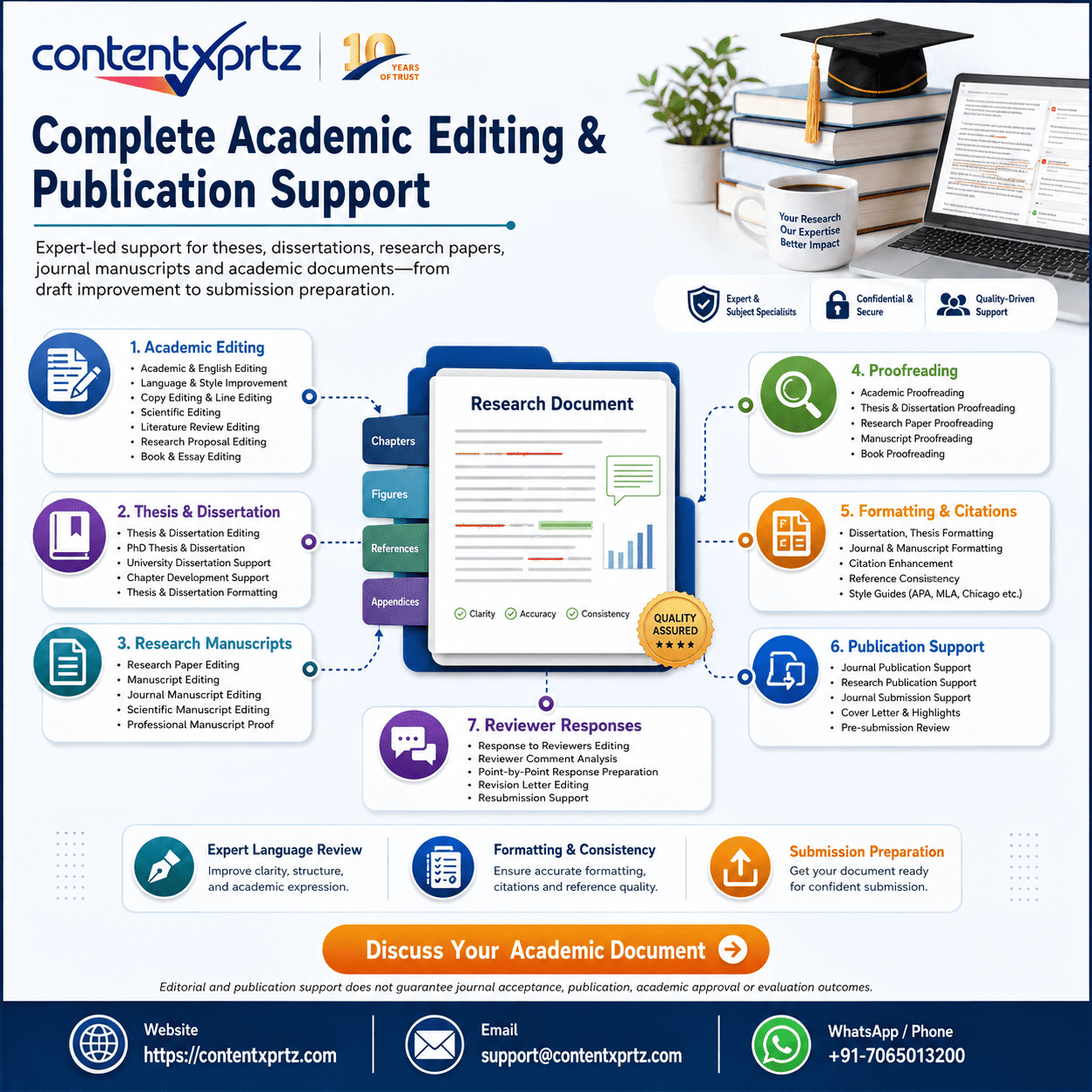
Contentxprtz can support researchers who already have legitimate research material but need help turning it into clear scholarly communication. Depending on the manuscript stage, relevant support may include research writing help, academic editing, proofreading, manuscript assessment, and journal publication support.
The useful starting point is the problem, not the service name. A paper with good structure but inconsistent English may need language editing. A paper with polished sentences but an unclear research gap may need structural review. A submission-ready draft may mainly need formatting and final checks against the journal instructions.
Ethical support should preserve the author’s ownership and accountability. Contentxprtz does not need to replace the researcher’s interpretation to add value; it can improve how that interpretation is expressed, identify places where readers may misunderstand the logic, flag inconsistencies for author review, and help prepare the manuscript for a more efficient submission process. Journal acceptance still depends on scientific quality, scope, novelty, methodology, reviewer assessment, and editorial judgment.
Summary: Scientific Research Paper
A scientific research paper communicates a research question through transparent methods, evidence, interpretation, and appropriately limited conclusions. For many original articles, IMRaD provides the core structure, but discipline-specific reporting standards and target-journal instructions determine the final format.
The strongest writing process begins with the scientific message rather than with sentence polishing. Map the objective to the analyses and results, draft Methods from study records, report Results consistently, use the Introduction to define the gap, and use the Discussion to interpret findings without exceeding the evidence. Verify every citation and number, document authorship and ethics correctly, and treat AI-generated material as unverified until checked by a responsible author.
Self-editing, peer feedback, library support, and journal resources are often enough for a well-organized manuscript. Expert-assisted editing becomes useful when structure, language, consistency, or submission requirements create avoidable barriers. In either case, the author remains responsible for the research, claims, data, citations, and final submission.
Frequently Asked Questions
What is a scientific research paper?
A scientific research paper is a structured scholarly document that reports or analyzes research using evidence, transparent methods, disciplined reasoning, and traceable sources. In an original empirical paper, the author usually explains the research problem, describes how the study was conducted, presents the findings, and interprets what those findings mean in relation to existing knowledge. Many disciplines use an Introduction, Methods, Results, and Discussion sequence, often called IMRaD, although the exact format varies by field and journal. A scientific paper is not simply a long essay with technical vocabulary. It should allow readers to understand the research question, evaluate the method, distinguish observations from interpretation, and follow the evidence supporting each claim. Review papers, methodological papers, case reports, brief communications, and theoretical papers may use different structures. Before writing, authors should therefore identify the article type and read the target journal’s instructions. Contentxprtz can help with ethical research paper assistance, language editing, structure, and formatting, but the author remains responsible for the research, data, analysis, citations, claims, and final submission.
How do I start writing a scientific research paper?
Start by defining the paper’s central research question and deciding what the manuscript must communicate to a reader who was not involved in the study. Gather the final protocol, data outputs, tables, figures, literature notes, approvals, and journal instructions before drafting. Many researchers find it easier to write the Methods and Results first because these sections are grounded in completed procedures and findings, then draft the Introduction and Discussion once the evidence story is clear. Create a one-sentence purpose statement, a list of the three to five most important findings, and a provisional figure or table order. This prevents the manuscript from becoming a chronological diary of the project. Check which reporting guideline, disciplinary convention, or journal template applies. Keep a reference manager or verified citation list open as you write so claims are supported with authentic sources. Draft for accuracy before polishing style. If the paper has several co-authors, agree early on responsibilities, version control, and authorship expectations. Professional editing can improve clarity and coherence after the scientific decisions are made, but it should not invent data, conclusions, or references.
What is the standard structure of a scientific research paper?
For many original research articles, the standard structure is title, abstract, introduction, methods, results, discussion, conclusion where required, references, and supporting elements such as tables, figures, acknowledgements, funding statements, data availability information, and conflict-of-interest disclosures. The core IMRaD structure—Introduction, Methods, Results, and Discussion—is widely used because it mirrors the logic of a research study: why the question matters, what was done, what was found, and what the findings mean. However, structure is not universal. A qualitative study may integrate findings and interpretation differently; a mathematics paper may organize around propositions and proofs; a review article may use thematic sections; and some journals combine Results and Discussion. The target journal’s guide for authors is therefore the controlling practical reference. Within each section, use a clear function: the Introduction should establish the gap and objective; Methods should support reproducibility; Results should report findings without excessive interpretation; Discussion should interpret findings, compare them with prior work, state limitations, and explain significance. Avoid forcing a paper into a template that conflicts with disciplinary practice or journal instructions.
How long should a scientific research paper be?
There is no universal word count for a scientific research paper. Length depends on the article type, discipline, complexity of the study, amount of data, journal policy, and whether supplementary material is allowed. A brief communication may be only a few thousand words, while a full research article, systematic review, methodological paper, or interdisciplinary study may be considerably longer. The safest approach is to check the target journal’s current author instructions for limits on the main text, abstract, references, tables, figures, and supplementary files. Do not expand a manuscript merely to sound more scholarly. Editors and reviewers generally benefit from concise writing that explains the research completely without repetition. At the same time, excessive compression can hide methodological details, limitations, or necessary context. If no journal has been selected yet, write a complete evidence-based draft and then adapt it once a suitable venue is chosen. During editing, remove repeated background, redundant result descriptions, unnecessary adjectives, and discussion points not supported by the study. Keep essential methodological and interpretive information even when reducing length. Scientific completeness and clarity should guide revision before an arbitrary word target.
What is the difference between a research paper and a scientific research paper?
The terms overlap, but “research paper” is broader. A research paper can refer to many forms of academic inquiry across the sciences, social sciences, humanities, law, business, and other fields. A scientific research paper usually implies a manuscript grounded in systematic scientific investigation, empirical or analytical methods, evidence, reproducibility or transparency, and discipline-specific reporting conventions. In laboratory, clinical, engineering, environmental, and many social-science contexts, a scientific paper often uses an IMRaD-like structure and gives particular attention to methods, data, results, uncertainty, and limitations. The distinction is practical rather than absolute. A historical research paper may be rigorous and scholarly without using experimental methods; a theoretical physics paper may be scientific without presenting an experiment; and a systematic review is scientific even though it synthesizes existing studies. Authors should focus less on the label and more on the standards expected for the specific article type. That means a clear question, defensible methods, authentic sources, transparent reporting, accurate citations, and conclusions that do not exceed the evidence.
Can I use AI to write a scientific research paper?
AI tools may assist with limited tasks such as brainstorming search terms, checking grammar, reorganizing notes, or suggesting clearer wording, but authors must follow the policies of their institution, funder, discipline, and target journal. AI output can contain fabricated references, inaccurate claims, distorted statistical interpretations, hidden bias, or language that sounds plausible without being scientifically correct. It should never be treated as an authoritative source. Authors must verify every factual statement, citation, calculation, and interpretation against primary research records and reliable sources. AI tools should not be listed as authors because authorship carries accountability that a tool cannot accept; journals may also require disclosure of certain AI-assisted uses. Sensitive, unpublished, confidential, patient, proprietary, or identifiable information should not be entered into tools without appropriate permission and safeguards. The safest workflow is human-led: the researcher determines the question, methods, analysis, interpretation, and claims; any AI-assisted wording is critically reviewed; and the final paper is checked for accuracy, originality, disclosure requirements, and journal compliance.
How can I make a scientific research paper publication-ready?
Publication readiness means more than correcting grammar. First, confirm that the manuscript fits the scope and article type of the target journal. Then check scientific completeness: the objective matches the study design, Methods describe what was actually done, Results correspond to the stated analyses, tables and figures are internally consistent, and the Discussion does not overstate the findings. Verify every reference and ensure the citation style matches the journal. Review author names, affiliations, contribution statements, funding details, acknowledgements, conflicts of interest, ethics approvals, trial registration or data statements where applicable. Next, edit for logic and language: each paragraph should have one clear purpose, terminology should be consistent, abbreviations should be defined, and claims should be appropriately cautious. Compare the manuscript line by line with the journal checklist or guide for authors. Finally, prepare required submission files such as cover letter, highlights, graphical abstract, supplementary material, reporting checklist, or response documents if requested. Professional manuscript editing can help identify language, structure, consistency, and formatting problems, but publication decisions remain with editors and reviewers.
What common mistakes weaken a scientific research paper?
Common weaknesses include an unclear research question, an Introduction that reviews too much background without defining a gap, incomplete Methods, Results mixed with unsupported interpretation, selective reporting, inconsistent numbers across text and tables, overclaiming causation, ignoring limitations, and citing sources that the author has not verified. Language problems also matter when they obscure meaning: long sentences with multiple logical steps, inconsistent terminology, unexplained abbreviations, vague pronouns, or paragraphs that mix several arguments can make a sound study difficult to evaluate. Formatting mistakes—wrong reference style, missing declarations, poorly labelled figures, or failure to follow the journal’s article type—can create avoidable submission problems. Ethical errors are more serious: fabricated citations, duplicate publication, inappropriate authorship, undisclosed conflicts, manipulated images, or presenting AI-generated material without required verification or disclosure can damage trust. A strong pre-submission review therefore checks scientific logic, reporting completeness, data consistency, references, ethics statements, language, and journal compliance separately rather than treating proofreading as the only quality-control step.
When should I use professional editing for a scientific research paper?
Professional editing is useful when the research and scientific decisions are substantially complete but the manuscript needs clearer organization, stronger academic English, consistent terminology, improved readability, reference-format checking, or alignment with journal instructions. It is especially valuable for multilingual authors who understand their science well but want to reduce language friction for editors and reviewers, and for complex collaborative papers where sections written by different authors need a consistent voice. Editing can also help identify sentences that overstate the evidence, transitions that hide logical gaps, undefined terms, duplicated content, and discrepancies that should be checked by the author. The editor should preserve the researcher’s meaning and should not invent data, analyses, citations, or conclusions. If a manuscript still has unresolved methodological or statistical issues, those require appropriate subject-matter or statistical review rather than language editing alone. University or journal policies may also govern the level of permitted assistance, particularly for theses and assessed work, so authors should check applicable rules and disclose support when required.
Can Contentxprtz write or edit my scientific research paper ethically?
Contentxprtz can support a scientific research paper through ethical writing guidance, academic editing, proofreading, structural review, formatting, and manuscript-readiness assistance when those services are used in line with institutional and journal rules. The appropriate boundary is that the researcher remains the intellectual owner and accountable author of the work. The researcher should provide authentic data, methods, interpretations, references, and required approvals, and must review and approve every substantive statement in the final manuscript. Editing can improve clarity, grammar, flow, organization, terminology, and presentation without replacing the author’s original ideas. Where writing assistance is permitted, support can help a researcher turn legitimate notes, analyses, and source material into clearer scholarly prose, but it should not fabricate evidence, invent references, hide inappropriate authorship, manipulate findings, or promise acceptance. Authors should check their university and target journal policies on third-party assistance and disclose support when required. Contentxprtz’s role is to strengthen communication and readiness, not to replace research responsibility or editorial judgment.
Conclusion: Turn Good Research into a Clear Scientific Paper
The central problem in scientific writing is not how to make a paper sound more academic. It is how to communicate the research so that a reader can see the question, understand the method, follow the evidence, and judge the interpretation. A strong scientific research paper does this with a deliberate structure, accurate reporting, consistent data presentation, verified citations, clear language, and conclusions that stay within the limits of the study.
Free and self-service support can be enough when the scientific story is already coherent and the author has time to check logic, references, language, and journal requirements carefully. Expert-assisted academic editing or publication support is more useful when the manuscript contains structural complexity, substantial language barriers, multiple-author inconsistencies, or detailed submission requirements that benefit from another trained review.
Contentxprtz helps researchers improve clarity, structure, consistency, ethical presentation, and publication readiness while preserving author responsibility. The research team remains accountable for the design, data, analysis, citations, interpretations, disclosures, and final submission. “At Contentxprtz, we don’t just edit; we help ideas reach their fullest potential.”