Research Paper Writer: How to Get Ethical Academic Writing Support
A research paper writer can help a student, PhD scholar, academic researcher, or professional turn complex material into a clearer and better organised manuscript. The useful form of that support is collaborative and transparent: the researcher supplies the question, evidence, data, sources, analysis, and conclusions, while the writer helps with planning, structure, scholarly language, coherence, referencing, and publication readiness. The researcher remains responsible for the intellectual content and final submission.
The phrase can also describe services that cross an important ethical line. A ready-to-submit paper written by someone who did not conduct or understand the research may create problems with academic integrity, authorship, source accuracy, and accountability. That is why the right question is not simply “Who can write my research paper?” but “What kind of writing support is appropriate for my situation, and how do I remain the genuine author of the work?”
This guide explains what professional research writing help can legitimately include, how to evaluate a provider, how to work with a writer without losing control of your manuscript, what to check before submission, and when editing or publication support may be a better fit than full drafting assistance.
Quick Answer: What Is a Research Paper Writer?
A research paper writer is a professional who helps shape academic or research content into a structured manuscript. Depending on the permitted scope, that help may include outlining, reorganising sections, improving academic language, connecting evidence to claims, editing a literature review, refining an abstract, checking citations, formatting references, or preparing a manuscript for journal submission.
The safest model is author-led, expert-assisted writing. You provide the intellectual substance and approve every significant decision. The writer improves communication but does not invent results, fabricate sources, create data, or take undisclosed ownership of your work. For assessed coursework, dissertations, theses, or journal manuscripts, always check the rules that apply to external assistance before commissioning work.
International publishing guidance emphasises author accountability. The ICMJE authorship recommendations distinguish authors from contributors and specifically note that writing assistance, technical editing, language editing, and proofreading do not by themselves qualify someone for authorship. That distinction is useful even outside medical publishing: support can be legitimate, but credit, disclosure, and responsibility must be handled correctly.
Key Takeaways
- A research paper writer should strengthen your manuscript without replacing your intellectual responsibility.
- Ethical support can include planning, guided drafting, structural editing, language editing, citation cleanup, and journal-readiness checks.
- You should be able to explain, defend, and verify every major claim, source, result, and conclusion in the final paper.
- Do not use a provider that fabricates references, invents data, guarantees publication, or offers anonymous ready-to-submit work with minimal author involvement.
- Check your university, employer, funder, or target journal rules before using external writing assistance.
- Keep drafts, source notes, tracked changes, and communication records so the development of the manuscript remains transparent.
- When the paper already exists, academic editing or proofreading may be more appropriate than writing support.
What This Page Covers
- What a professional research paper writer can and cannot ethically do.
- The difference between writing support, academic editing, proofreading, and publication assistance.
- A step-by-step process for working with a writer while retaining authorship and control.
- How to evaluate expertise, confidentiality, citations, revisions, and quality.
- Common warning signs and mistakes that put a manuscript at risk.
- Practical examples for students, PhD scholars, ESL researchers, and journal authors.
- A final checklist for reviewing a paper before submission.
Methodology and Academic Sources
This article is based on common academic writing, editing, and manuscript-preparation workflows, together with publisher and authorship guidance that emphasises accountability, originality, disclosure, and accurate scholarly communication. Requirements vary across universities, disciplines, journals, and types of assessment, so readers should always check the rules that apply to their own project.
Useful reference points include the ICMJE Recommendations, Elsevier author resources, Springer Nature authorship and publishing policies, and the APA Publication Manual. These sources reinforce a central principle: writing quality can be supported by others, but authorship carries responsibility for the work.
What Can a Research Paper Writer Help With?
A capable research paper writer can reduce the communication burden around a complex project. The value is greatest when the research itself is already yours but the manuscript is difficult to organise, explain, or prepare for a specific academic audience.
Research question and scope clarification
A writer can help convert a broad topic into a more focused communication plan. For example, a student may have collected literature on “AI in education” but still need to define the population, setting, outcome, and purpose of the paper. The writer can ask structured questions, identify gaps in the outline, and help align sections with the actual objective. The final research question should still reflect the researcher's own project and supervisor or institutional requirements.
Outline and argument structure
Many weak papers are not weak because the author lacks knowledge; they are weak because the knowledge is presented in the wrong order. A writer can help design a logical section sequence, distinguish background from analysis, place evidence next to the claim it supports, and remove repeated points. This type of academic writing support is especially useful when a researcher has detailed notes but no stable narrative.
Guided drafting and rewriting
Guided drafting means the author remains actively involved. You may provide an outline, data interpretation, source notes, tables, and key arguments, then ask a writer to turn those materials into readable paragraphs. You review the draft, correct meaning, add missing evidence, and approve the wording. The writer should never silently insert claims or citations that you have not verified.
Academic language and ESL support
Researchers working in a second language often know exactly what they want to say but lose precision when expressing it in formal academic English. A writer or editor can improve sentence structure, transitions, terminology, concision, tone, and consistency. The goal is not to erase the author's voice; it is to make the intended meaning easier for supervisors, editors, and reviewers to follow.
Citations, references, and formatting
Research writing help may include checking whether in-text citations and reference entries correspond, standardising author names and dates, applying APA or another required style, and flagging unsupported statements. A professional can organise the reference list, but the author must still verify each citation against the original source. Reference-management errors, copied citations, or AI-generated references can introduce nonexistent or inaccurate sources.
Research Paper Writer vs Editor vs Proofreader: Which Support Do You Need?
The right service depends on the condition of your manuscript. Choosing too much support can waste money and create unnecessary authorship questions; choosing too little can leave structural problems untouched.
| Support type | Best when | Typical work | Author responsibility |
|---|---|---|---|
| Research paper writer | You have research material but need help shaping or drafting sections | Outline, guided drafting, synthesis, transitions, section organisation | Supply intellectual content, verify sources and claims, approve final text |
| Academic editor | You already have a full draft but structure or clarity is weak | Substantive editing, logic, coherence, style, terminology, flow | Decide which edits to accept and confirm meaning remains accurate |
| Proofreader | The manuscript is final and needs a surface-level quality check | Grammar, spelling, punctuation, typographical consistency | Complete substantive revisions before proofreading begins |
| Manuscript assessor | You need expert feedback before investing in detailed editing | Readiness review, gap analysis, structure and presentation feedback | Revise research and argument based on justified recommendations |
| Publication support specialist | Your paper is close to submission or under revision | Journal formatting, cover letter, response to reviewers, submission checks | Choose journal, approve files, respond intellectually to reviewers |
If your draft is substantially complete, manuscript assessment can identify the highest-impact problems before editing starts. If only language and mechanics remain, a proofreading service is usually the more proportionate option.
How to Choose a Research Paper Writer Without Compromising Integrity
Choose a provider by examining process rather than promises. A trustworthy writer should want to understand your project before quoting a solution, because research writing quality depends on subject matter, manuscript stage, target audience, evidence base, and permitted level of assistance.
1. Check subject fit
A writer does not need to be the world's leading expert on your exact topic, but they should understand the conventions of your discipline well enough to preserve terminology, argument style, evidence standards, and common paper structures. Ask about relevant academic or editorial experience and whether the work will be handled by a generalist or subject specialist.
2. Define the permitted scope
State clearly whether you want an outline, section-level drafting from your notes, substantive editing, language editing, references, formatting, or reviewer-response support. The more specific the scope, the easier it is to judge whether the final work remains your own and whether disclosure is needed.
3. Ask how sources are handled
Reliable writers should distinguish sources you supplied from additional sources they suggest. They should not invent quotations, create plausible-looking references, or cite articles they have not checked. If new sources are proposed, you should receive enough information to read and verify them yourself.
4. Require tracked and explainable changes
For editing and rewriting, tracked changes or a clear revision history is valuable. It lets you see what changed and why. It also prevents the final manuscript from becoming unfamiliar to you. You should never submit text that you cannot explain during a viva, supervisor meeting, peer-review exchange, or editorial query.
5. Protect confidential research
Unpublished manuscripts, datasets, reviewer reports, grant ideas, and patent-sensitive results may be confidential. Ask how files are stored, who can access them, whether subcontractors are used, and how long the material is retained. Avoid uploading confidential work to tools or services whose privacy terms you have not reviewed.
6. Reject guarantee-based sales claims
No writer controls a journal editor, peer reviewer, thesis committee, or assessor. Guarantees of publication, acceptance, a particular grade, or “100% plagiarism removal” are not credible indicators of quality. Strong services explain what they can improve and what remains outside their control.
A Step-by-Step Workflow for Working With a Research Paper Writer
A structured workflow keeps the author involved and creates checkpoints where accuracy can be verified before the next stage begins.
- Prepare the project brief. Include your purpose, research question, audience, target journal or assignment instructions, word count, citation style, deadline, and the specific support you want.
- Provide your source materials. Share your draft, outline, approved data, analysis, tables, figures, supervisor comments, reviewer feedback, and core references. Mark any material that is confidential.
- Agree on boundaries. Decide what the writer may change and what requires your approval. For example, language can be edited freely, but results interpretation, methodological claims, or new citations may require author confirmation.
- Review an outline or sample section. Before a long draft is produced, confirm that the structure, terminology, and level of intervention match your expectations.
- Work section by section. Review each major section while the project is still in progress. Correct meaning early rather than waiting until the end.
- Verify every citation and factual claim. Open the original sources, confirm the cited evidence, check numerical values, and make sure the reference list matches the text.
- Run an author-level integrity review. Confirm that the paper accurately reflects your methods, results, interpretations, limitations, and contribution. Remove any language that overstates the evidence.
- Apply target-specific requirements. Check journal author instructions, university formatting rules, reporting guidelines, word limits, figure requirements, and disclosure statements.
- Complete final language editing or proofreading. Once substantive changes are finished, do a clean final pass for grammar, punctuation, consistency, headings, tables, references, and formatting.
- Submit only after full author approval. The final file should be a manuscript you have read closely and can defend.
What Ethical Research Writing Support Should Never Do
Good support has clear limits. These limits protect the researcher, the scholarly record, and anyone who may later rely on the work.
- Never fabricate data. Results must come from legitimate research or clearly identified secondary sources.
- Never invent references. Every citation should correspond to a real source that can be checked.
- Never hide material authorship substitution. If someone else has made substantial intellectual contributions, authorship or acknowledgment rules may apply.
- Never plagiarise or disguise copied text. Rewording another source without attribution does not make it original scholarship.
- Never falsify methods or ethics approval. A writer cannot create procedures, participant consent, approvals, or experiments that did not occur.
- Never guarantee outcomes controlled by others. Publication, grades, thesis approval, and peer-review decisions cannot be promised responsibly.
If originality, paraphrasing, AI-use disclosure, or citation integrity is a central concern, specialised plagiarism and AI integrity support may be more appropriate than simply rewriting the manuscript.
Three Practical Examples of Research Writing Help Done Well
Example 1: PhD scholar with strong data but weak chapter-to-paper structure
A doctoral researcher has completed the analysis and has a thesis chapter of 12,000 words. They want to create a 6,000-word journal article. The ethical role of the writer is to help identify the central research question, remove thesis-only background, restructure the methods and results for the journal format, and tighten the discussion around the author's existing findings. The scholar approves the outline, checks every interpretation, and writes or confirms the final contribution statement. The writer improves communication; the scholar remains the author.
Example 2: ESL researcher preparing a first international journal submission
An early-career researcher has a complete manuscript in English but reviewers in an internal lab meeting find the sentences difficult to follow. A professional writer or editor improves syntax, transitions, terminology consistency, abstract clarity, and paragraph flow. They do not alter the numerical results or add claims. The researcher reviews the edited version line by line and confirms that every sentence still represents the intended meaning. This is closer to academic editing than outsourced writing.
Example 3: Professional converting an applied project into a research paper
A public-sector professional has conducted a documented programme evaluation and wants to publish the lessons learned. They have data, reports, stakeholder notes, and an outline but little experience with journal conventions. A research paper writer helps map the material into introduction, methods, results, discussion, limitations, and implications. The professional verifies all evidence, checks confidentiality restrictions, removes unsupported causal language, and confirms the final paper. The writing support makes the project publishable in form without inventing research content.
Common Mistakes When Hiring a Research Paper Writer
Most problems arise when the relationship is treated as a transaction for finished pages instead of a structured scholarly collaboration.
- Sending only a topic. A topic is not enough to produce a defensible research paper. The writer needs your objective, evidence, scope, and constraints.
- Not checking institutional rules. What is acceptable language editing in one setting may be restricted writing assistance in another.
- Accepting unfamiliar references. A real-looking DOI or journal title can still be wrong. Verify every source.
- Waiting until the deadline. Good collaboration requires time for author review, factual correction, and revision.
- Choosing only by price or word count. Quality depends on the service level, subject fit, revision method, and integrity safeguards.
- Submitting without reading the final version. The author should know the manuscript well enough to explain its reasoning and defend its conclusions.
- Using one service for every problem. If the paper is already strong, proofreading may be enough. If the analysis is weak, no amount of editing can substitute for additional research work.
How to Review a Draft From a Research Paper Writer
Do not review only for grammar. Use a layered check that starts with research meaning and ends with presentation.
Research ownership and meaning
- Every major claim reflects your actual evidence or a verified source.
- The research question, methods, results, and conclusions remain factually correct.
- You can explain every important argument and technical term.
- No new data, participants, procedures, approvals, or findings have been invented.
Sources and citations
- Every citation exists and has been checked against the original source.
- Quoted or closely paraphrased material is properly attributed.
- In-text citations and the reference list match.
- The required citation style is applied consistently.
Structure and readability
- Each section has a clear purpose and follows a logical sequence.
- Paragraphs begin with focused ideas and connect evidence to interpretation.
- Repeated background, duplicated results, and vague statements have been removed.
- Tables and figures are referenced and explained in the text.
Submission readiness
- The paper follows the target journal or institution instructions.
- Authorship, acknowledgments, funding, conflicts, and AI-use disclosures are handled where required.
- Word count, abstract, keywords, headings, tables, figures, and supplementary files are complete.
- The final manuscript has been proofread after all substantive edits.
When Professional Help Is Worth It
Professional research writing help is most useful when it solves a communication or process problem that the researcher cannot efficiently solve alone. It is not a substitute for doing the research.
You may benefit from expert assistance when your analysis is complete but the manuscript lacks a clear argument; when English-language phrasing is obscuring good science; when supervisor or reviewer comments require substantial restructuring; when you are converting a thesis chapter into an article; when a multidisciplinary paper needs consistent terminology; or when journal formatting and submission requirements are consuming time better spent on research.
Self-service may be enough when the paper already has a strong structure, your writing is clear, the reference list is reliable, and you have enough time for multiple revision passes. In that case, using a style guide, reference manager, journal checklist, and careful peer feedback may be sufficient.
Summary: Research Paper Writer
A research paper writer should be understood as a support professional, not as a replacement author. The most defensible form of assistance helps researchers organise their own evidence, express ideas clearly, improve academic style, check references, and prepare manuscripts for review while keeping authorship, interpretation, and accountability with the researcher.
Before hiring anyone, define what you need, check the rules that apply to your project, ask how sources and confidentiality are handled, and require a workflow that keeps you involved. If you already have a complete draft, editing or proofreading may be more appropriate than writing. If you are preparing for journal submission, publication support can help with presentation and process, but no service can ethically guarantee an editorial decision.
Frequently Asked Questions
What does a research paper writer do?
A research paper writer can provide structured academic writing support such as helping clarify a research question, organise an outline, improve argument flow, strengthen transitions, edit language, check citation consistency, and prepare a manuscript for submission. Ethical support should work from the researcher's own evidence, analysis, sources, and conclusions. The researcher must retain intellectual control, verify every claim and citation, approve the final manuscript, and follow the rules of the university, funder, or journal. A legitimate service should not fabricate data, invent sources, impersonate the author, or sell undisclosed ghostwritten work for submission as if it were created independently by the student or researcher.
Is hiring a research paper writer ethical?
It can be ethical when the service functions as transparent academic support rather than undisclosed authorship substitution. Language editing, proofreading, structural feedback, formatting, research communication coaching, and collaborative drafting support may be permitted in many settings, but rules vary. The safest approach is to check institutional and journal policies, define the writer's role in advance, keep an audit trail of revisions and sources, and disclose substantial writing assistance when required. If the hired person is making the core intellectual contribution while the named author cannot explain or defend the paper, the arrangement creates serious authorship and integrity concerns.
Can a research paper writer write my whole paper for me?
A service may be technically capable of producing a full draft, but submitting a paper that someone else wrote without appropriate authorship, acknowledgment, permission, or disclosure can violate academic or publication rules. Ethical support should preserve the researcher's responsibility for the research question, evidence, methods, analysis, interpretation, and final claims. A safer model is guided drafting: the researcher supplies the intellectual content and source base, while the writer helps shape structure, clarity, coherence, and scholarly presentation. For assessed student work, always follow the specific rules of the course or university before using external writing assistance.
How do I choose a trustworthy research paper writer?
Look for a transparent scope, subject-relevant experience, a clear revision process, confidentiality commitments, citation verification practices, and explicit boundaries against fabricated references, fake data, plagiarism, or guaranteed publication. Ask what the writer needs from you, how sources are handled, whether changes are tracked, and who remains responsible for factual accuracy. Be cautious if a provider promises a journal acceptance, a guaranteed grade, an impossible turnaround without reviewing your materials, or anonymous ready-to-submit papers that require little input from you.
What should I give a research paper writer before work starts?
Provide the research question or objective, assignment or journal instructions, your outline or draft, approved data and results, key sources, citation style, tables and figures, ethics or reporting requirements, target word count, deadline, and any supervisor or reviewer feedback. Also identify what kind of help is allowed and what you want the writer to do: planning, language editing, structural editing, citation cleanup, formatting, or submission preparation. Clear inputs reduce factual errors and help keep the support aligned with your own research.
What is the difference between a research paper writer and an academic editor?
A research paper writer may support drafting and organisation, while an academic editor typically improves an existing manuscript's clarity, logic, consistency, grammar, style, and presentation. In practice, ethical services often overlap: a writer may help turn detailed author notes into coherent sections, and an editor may recommend substantial restructuring. The important distinction is not the job title but the level of intellectual contribution. The named author should remain responsible for the ideas, evidence, interpretation, and final manuscript, and substantial third-party contributions should be handled according to the applicable disclosure or authorship policy.
Can a research paper writer help with citations and references?
Yes. A writer or editor can help apply the required citation style, standardise reference entries, flag missing citations, check that in-text citations appear in the reference list, and identify details that need verification. However, citation software and human editors can both make mistakes. The researcher should confirm every source against the original publication, verify DOI and bibliographic details, and ensure each citation actually supports the claim being made. No ethical service should invent references to make a manuscript look more scholarly.
Can a research paper writer help with journal publication?
A research paper writer can support manuscript preparation for a target journal by improving structure, language, abstract clarity, cover-letter wording, response-to-reviewer organisation, formatting, and compliance checks. Publication decisions remain entirely with editors and peer reviewers, and no writer can responsibly guarantee acceptance. Authors should choose the journal themselves with appropriate guidance, verify the journal's instructions, approve every submission file, disclose assistance where required, and remain accountable for the scientific or scholarly content.
How much involvement should I keep when using research writing help?
You should remain actively involved throughout the process. Approve the outline, supply and read the sources, verify data and interpretations, review tracked changes, question any unfamiliar claim, and be able to explain every important argument in the final paper. Keep copies of your drafts, source notes, analysis, feedback, and revision history. High author involvement improves accuracy and makes it much easier to show that the paper reflects your own research and judgment rather than outsourced authorship.
When should I use professional research writing help instead of self-editing?
Self-editing may be enough when the argument is already clear, the paper follows the required structure, the language is strong, and you have time to revise carefully. Professional help can be useful when English is not your first language, the manuscript has complex structure problems, reviewer comments are difficult to address, the paper crosses disciplines, the citation style is inconsistent, or a deadline leaves little time for multiple editing passes. The best service should complement your expertise rather than replace your intellectual responsibility.
Get the Right Level of Research Writing Support
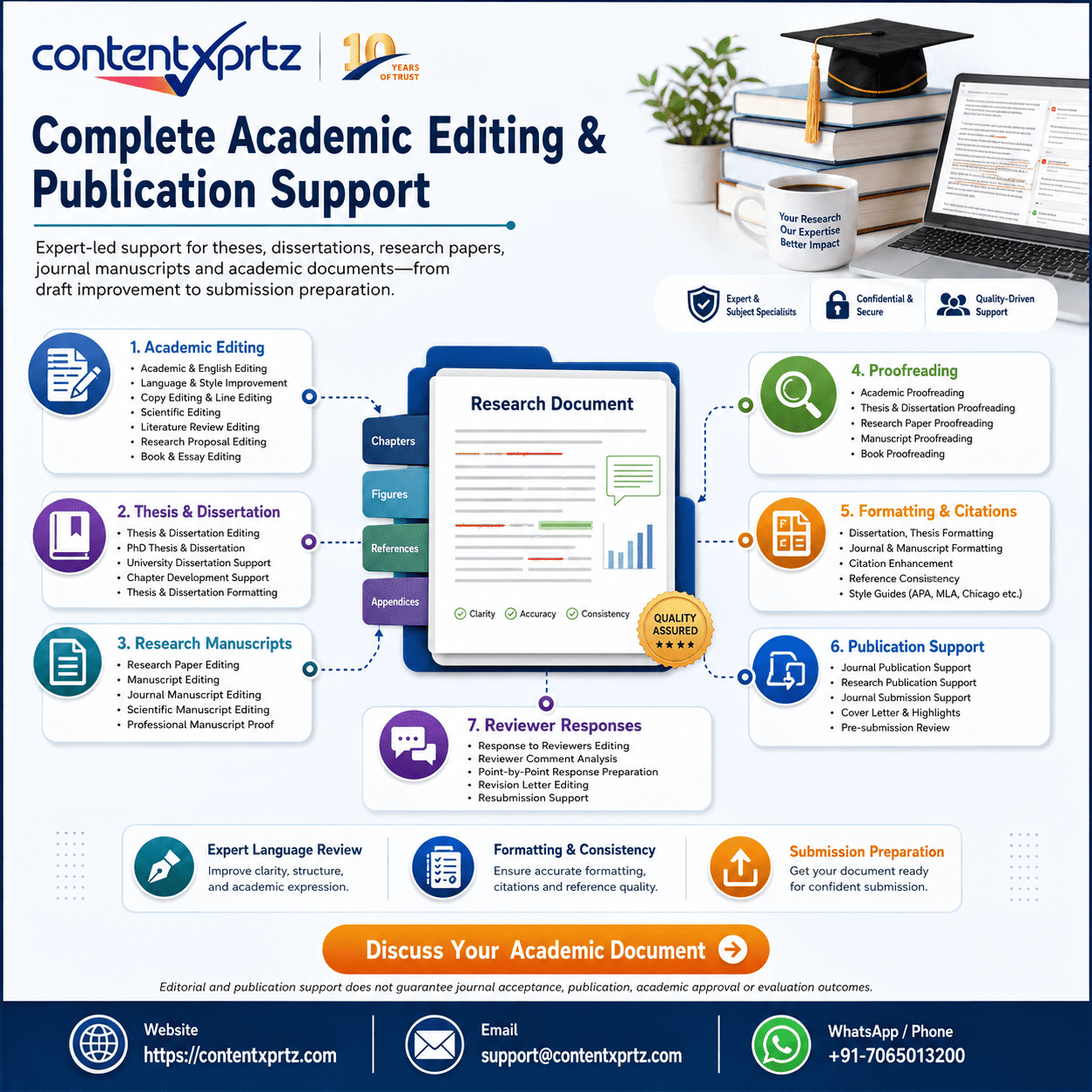
If your research is sound but the manuscript is difficult to structure, write, or prepare for submission, Contentxprtz can support the communication side of the process through ethical research writing assistance, academic editing, and publication-focused manuscript preparation. The service should begin with your material, your objective, and the level of help permitted in your academic or professional setting.
Explore Contentxprtz research paper writing support if you need help turning your own research, notes, analysis, and sources into a clearer scholarly manuscript. The final paper remains subject to your review, source verification, institutional rules, and author responsibility.
At Contentxprtz, we don’t just edit; we help ideas reach their fullest potential.