Research Paper Publication: A Step-by-Step Guide for Authors
Research paper publication is the stage where a completed study is transformed into a manuscript that can survive journal screening, peer review, revision, and production. For a first-time author, the process can look like one simple task—“submit the paper”—but successful scholarly publishing is actually a sequence of decisions: choosing a journal that fits the work, preparing the article to that journal’s requirements, confirming authorship and ethics, presenting the study clearly, submitting complete files, and responding constructively when editors or reviewers request changes.
The pressure is especially high for PhD scholars, postgraduate students, early-career researchers, and professionals who may be publishing alongside thesis deadlines, grant milestones, promotion requirements, or project commitments. A manuscript can contain sound research and still struggle if its central contribution is unclear, the target journal is poorly matched, the abstract does not communicate the result, references are inconsistent, figures are difficult to interpret, or the submission misses a journal-specific requirement. Equally, polished English cannot compensate for weak methods, unsupported conclusions, missing ethical approval, or a paper that falls outside the journal’s scope.
A practical publication strategy therefore begins with the research itself and moves outward. Authors should be able to state the research question, contribution, methods, principal results, limitations, and intended readership before deciding where to submit. The journal’s official author instructions then become the controlling checklist. Publisher resources from Elsevier on manuscript preparation and Springer Nature on publishing an article both emphasize journal-specific preparation rather than a one-size-fits-all manuscript.
This guide explains the publication journey from manuscript readiness to journal decision. It focuses on choices authors can control, mistakes that create avoidable rejection risk, ethical responsibilities that cannot be outsourced, and where publication support or academic editing services may help improve clarity and submission readiness without promising acceptance.
Quick Answer: How Does Research Paper Publication Work?
Research paper publication usually follows eight broad stages: finalize the research, prepare the manuscript, select a suitable journal, check the journal’s author instructions, submit the required files and declarations, complete editorial and peer review, revise the paper when requested, and—if accepted—approve the final production version. A journal can reject a manuscript at editorial screening or after peer review, and revision does not guarantee acceptance.
The strongest next step is to treat your target journal’s official instructions as a mandatory specification. Match the paper to the journal’s scope, prepare every required document, confirm that all authors agree with the submission, verify references and disclosures, and make the manuscript easy for editors and reviewers to understand. Professional help can improve language, organization, formatting, and response quality, but the author remains responsible for the science, claims, data, citations, and ethics.
Key Takeaways
- Journal fit matters before formatting. A technically perfect paper can still be rejected if the topic, article type, or contribution does not suit the journal.
- Publication readiness is broader than proofreading. Editors evaluate scope, novelty, methods, ethics, reporting quality, clarity, and completeness.
- The journal’s own instructions are authoritative. Templates, word limits, reference styles, declarations, and file requirements vary.
- Peer review is evaluative, not guaranteed. Reviewer and editor judgments can lead to rejection, revision, or acceptance.
- Author responsibility continues through every stage. Editing support should preserve the author’s meaning and never fabricate evidence or references.
- Reviewer responses should be point-by-point and traceable. State what changed, where it changed, and why a suggestion was not adopted when necessary.
- Guaranteed-publication claims are a warning sign. Legitimate support can improve readiness, but no ethical service can control the journal’s decision.
What This Page Covers
- What research paper publication means in practical academic terms
- How to decide whether a manuscript is ready for journal submission
- How to choose and verify an appropriate journal
- A step-by-step submission, peer-review, revision, and production workflow
- Common reasons papers fail before or during peer review
- Three realistic publication scenarios for researchers
- How ethical journal publication support can help without replacing author responsibility
Table of Contents
Methodology and Academic Sources
This guide is based on common scholarly publishing workflows and official author guidance from major publishers and editorial bodies. Because requirements differ by discipline and journal, readers should verify every submission rule on the target journal’s own website. The ICMJE recommendations on sending manuscripts to journals illustrate the importance of complete declarations, authorship confirmation, related-work disclosure, permissions, and required reporting checklists in medical publishing. Other disciplines may use different standards, but the principle is the same: journal-specific requirements control the submission.
The article also reflects general publication-ethics principles: do not submit the same manuscript to multiple journals simultaneously unless the relevant journal policies explicitly permit it; do not fabricate or manipulate data; disclose conflicts and funding where required; obtain permissions for reused material; and ensure that authorship accurately reflects contribution. The final responsibility for these matters belongs to the authors.
What Research Paper Publication Means in Academic Practice
Research paper publication is the process by which a scholarly manuscript is evaluated and, if accepted, incorporated into the formal academic record. It begins before the submission portal opens. The author must first decide whether the study has a coherent story, sufficient evidence, an identifiable contribution, and an audience that a specific journal actually serves.
A paper can be “finished” as a research document but not yet “publication-ready.” A publication-ready manuscript usually has a clear title and abstract, a logical argument, methods described with enough transparency for the field, results presented without contradiction, a discussion that distinguishes evidence from interpretation, limitations stated honestly, references checked, figures and tables readable, and all ethical or administrative declarations prepared.
| Stage | Main author task | Common failure point |
|---|---|---|
| Research completion | Confirm that analyses support the research question | Writing conclusions stronger than the data justify |
| Manuscript preparation | Present the study clearly and consistently | Unclear contribution, weak structure, inconsistent terminology |
| Journal selection | Match topic, readership, article type, and scope | Choosing by metric or speed alone |
| Submission preparation | Follow all author instructions and declarations | Missing files, permissions, statements, or formatting requirements |
| Editorial screening | Make relevance and contribution easy to evaluate | Scope mismatch or weak abstract/cover letter |
| Peer review | Engage with technical and conceptual criticism | Defensive or incomplete responses |
| Revision | Make and document changes consistently | Changing one section but leaving contradictions elsewhere |
| Production | Check proofs and publication details carefully | Missing errors introduced or retained in final proofs |
The important distinction is that publication support can strengthen the manuscript’s presentation and compliance, while the journal remains responsible for editorial decisions and peer review.
Is Your Manuscript Ready for Research Paper Publication?
A manuscript is ready to submit when its scientific content, reporting, language, formatting, and administrative requirements are sufficiently complete for the target journal. Readiness should be evaluated at several levels rather than reduced to grammar alone.
Scientific and logical readiness
- The research question is explicit and the study design addresses it.
- The methods and analysis are internally consistent.
- The results are reported without selective exaggeration.
- The discussion separates findings, interpretation, comparison with prior work, and limitations.
- The conclusion does not claim more than the study demonstrates.
Communication readiness
- The title reflects the study accurately.
- The abstract can stand alone and matches the full paper.
- Paragraphs have clear functions and transitions.
- Technical terms are used consistently.
- Tables and figures add information rather than duplicate long passages.
Submission readiness
- Author names, affiliations, contributions, and corresponding-author details are correct.
- Funding, conflict-of-interest, ethics, consent, data, and AI-use statements are included where required.
- References have been checked against original sources.
- Permissions are available for reused figures, tables, or substantial copyrighted material.
- The cover letter and supplementary files match the journal’s requirements.
When the research is sound but the paper is difficult to read, academic editing can help improve clarity and manuscript coherence. When the article already reads well but needs a final language and consistency pass, proofreading support may be sufficient.
How to Choose the Right Journal Before You Submit
The right journal is the one whose scope, readership, article types, standards, and publishing model align with the paper—not simply the journal with the highest metric. Journal selection is therefore a reasoning task, not a directory lookup.
Start with audience and scope
Write one sentence answering: “Who should read this paper, and why?” Then compare that audience with the journal’s aims and scope. Read recent articles, especially those using similar methods or addressing adjacent questions. A journal can cover your broad discipline while still rejecting a paper because the specific contribution falls outside its editorial focus.
Verify the article type and submission expectations
Confirm that the journal accepts your manuscript type: original research, review, brief report, methods paper, case report, data article, perspective, or another category. Then examine word limits, abstract format, reference style, figure specifications, supplementary data rules, reporting checklists, and required declarations.
Check legitimacy and transparency
Before paying any fee or transferring a manuscript, verify the journal on its official publisher website and independently check indexing claims where indexing matters to your objective. The ICMJE guidance on submission and peer-review responsibilities warns authors to evaluate the integrity, history, practices, and reputation of journals and to be alert to predatory or pseudo-journals.
Research Paper Publication Process: Step by Step
1. Freeze the scientific story before cosmetic formatting
Decide what the paper actually claims. Identify the research gap, study question, most important result, contribution, and limitations. If these points change from section to section, formatting the paper first wastes time. The manuscript should tell one coherent story supported by the evidence.
2. Shortlist journals using fit, not aspiration alone
Create a shortlist of realistic journals and compare scope, readership, recent publications, article type, access model, publication fees where applicable, and submission requirements. If you are unsure between journals, a structured journal publication support review can help organize the decision, but final journal choice remains the author’s.
3. Reformat only after choosing the target journal
Once the journal is chosen, use its official instructions as the checklist. This may affect the title page, abstract headings, word count, reference format, figure files, supplementary material, declarations, and reporting checklists. Springer Nature’s author guidance notes that every journal can have a different process and authors should check the journal’s submission guidelines.
4. Build a submission package
Depending on the journal, the package may include the main manuscript, title page, cover letter, figures, tables, supplementary files, graphical abstract, highlights, author-contribution statement, conflict-of-interest statement, funding declaration, data-availability statement, ethics or consent information, reporting checklist, and suggested reviewers. Never invent a document that the journal does not request, but do not omit one that it does.
5. Perform a pre-submission consistency check
Compare the title, abstract, methods, results, discussion, tables, figures, supplementary files, and references. Numbers should agree across locations. Abbreviations should be defined consistently. Citations should correspond to bibliography entries. Every table or figure mentioned in the text should exist, and every file uploaded should be the latest approved version.
6. Submit through the official journal system
Enter metadata carefully rather than treating the portal as clerical work. Author names, affiliations, title, abstract, keywords, funding, and declarations may later feed directly into editorial systems and published metadata. The corresponding author should keep confirmation emails and the manuscript ID.
7. Respond to technical checks promptly
Editorial-office staff may request missing files, higher-resolution figures, corrected declarations, revised references, or form completion before the editor evaluates the paper. A fast, precise response prevents avoidable delay and signals that the submission is well managed.
8. Understand editorial screening
The handling editor may decide that the paper is out of scope, insufficiently novel, methodologically unsuitable, unclear, or not competitive for the journal. This is often called a desk rejection. It does not necessarily mean the research has no value; it may mean the journal is not the right venue or the manuscript does not yet communicate its value clearly.
9. Engage with peer review as a revision process
If the paper is reviewed, the decision may include minor revision, major revision, reject and resubmit, or rejection. Read reviewer comments slowly, identify substantive versus presentational requests, and plan changes across the whole manuscript.
10. Prepare a point-by-point response
For each reviewer comment, state what you changed and where. If you disagree, explain why with evidence or methodological reasoning. Avoid emotional language. Editors need to see that you understood the concern and responded transparently.
11. Check the revised manuscript as a new document
Revisions can create secondary inconsistencies. A changed sample description may affect the abstract, methods, table captions, discussion, and supplementary file. Recheck cross-references, numbering, citations, and conclusions before resubmission.
12. Review proofs carefully after acceptance
Acceptance is not the final reading opportunity. Production proofs can contain formatting changes, misplaced symbols, equation errors, reference issues, or typesetting problems. Check author names, affiliations, tables, figures, mathematical notation, special characters, and reference links before approving proofs within the journal’s deadline.
What Peer Review Means for the Author
Peer review is an expert evaluation of a manuscript’s quality, validity, relevance, originality, and communication. It is not a certification that the paper is correct, and it is not a negotiation in which every reviewer request must automatically be accepted. The author’s task is to understand the concern behind each comment and respond with evidence, revision, or a clear justification.
Reviewers may question methods, sample size, analysis, novelty, literature coverage, interpretation, figures, terminology, or reporting. Some comments are easy to fix; others expose a conceptual weakness that requires substantial rewriting or additional analysis. A useful revision plan groups comments into scientific changes, presentation changes, and journal-compliance changes.
If the reviewer misunderstands a passage, that misunderstanding can itself be evidence that the manuscript is unclear. Rather than simply writing “the reviewer is wrong,” consider whether the paper should be revised so future readers reach the intended interpretation more easily.
| Reviewer comment | Best response approach | Avoid |
|---|---|---|
| “The rationale is unclear.” | Strengthen the gap, objective, and contribution in the introduction. | Only defending the original text. |
| “Please add analysis X.” | Assess whether it is methodologically justified; add it or explain why not. | Performing inappropriate analysis just to comply. |
| “The discussion overstates the result.” | Narrow claims and connect them directly to the evidence. | Replacing one exaggerated phrase with another. |
| “Language is difficult to follow.” | Revise sentence structure, terminology, transitions, and paragraph logic. | Running spellcheck only. |
| “References are incomplete.” | Add genuinely relevant sources and explain their relation to the work. | Citation padding or adding irrelevant papers. |
When a revision is complex, publication support can help organize the response document and ensure manuscript changes are traceable. Scientific decisions, however, remain with the author team.
Ethical Academic Editing and Author Responsibility
Ethical editing improves communication without taking ownership of the research. An editor can identify unclear logic, inconsistent terminology, grammar problems, formatting errors, reference inconsistencies, or places where evidence and claims do not align. An editor should not invent data, fabricate citations, write false declarations, conceal third-party involvement where disclosure is required, or promise a journal decision.
Authorship should reflect real contribution under the standards relevant to the discipline and journal. In medical publishing, for example, ICMJE authorship guidance sets contribution and accountability criteria that distinguish authors from other contributors. Researchers in other fields should follow their journal, institution, funder, or professional-society policies.
AI-assisted writing or editing also requires care. Authors should verify factual statements, citations, calculations, and generated language, and they should follow journal policies on disclosure or permitted use. An AI tool should never be treated as a source of authority simply because its language is fluent.
Common Research Paper Publication Mistakes to Avoid
- Choosing the journal after the manuscript is fully formatted. Journal requirements can alter structure, length, figures, and declarations.
- Submitting to a journal outside the paper’s scope. This creates avoidable editorial rejection.
- Using a generic cover letter. The letter should identify the manuscript, its contribution, and why it fits the specific journal.
- Assuming language editing fixes scientific weaknesses. Clear prose helps reviewers understand the paper but cannot repair unsupported methods or conclusions.
- Failing to reconcile numbers across text, tables, and figures. Small inconsistencies can undermine reviewer confidence.
- Ignoring journal-specific declarations. Funding, conflicts, ethics, consent, data, and author contributions may be mandatory.
- Submitting simultaneously to multiple journals. This is generally prohibited by scholarly-journal policies.
- Responding defensively to peer review. Even when you disagree, explain the scientific basis respectfully.
- Accepting every reviewer suggestion mechanically. Authors should not make changes that damage methodological validity simply to appear compliant.
- Trusting guaranteed-publication claims. No legitimate editing or publication-support provider controls independent editorial decisions.
Practical Research Paper Publication Examples
Example 1: A first-time PhD author targets the wrong journal
Situation: A doctoral researcher has a technically strong paper on a specialized materials method and chooses a broad high-profile journal because of its reputation. Confusion: The manuscript is repeatedly reformatted, but the abstract and cover letter never explain why the work matters to that journal’s general readership. Better approach: The author compares several journals, reads recent papers, and selects one where the method and audience align. The manuscript is then revised to emphasize the contribution that matters to that readership. Where expert help can help: A publication-readiness review can help structure the journal-fit comparison and clarify positioning, but it cannot determine acceptance.
Example 2: An ESL researcher has sound results but unclear argument flow
Situation: The data and analysis are complete, but reviewers previously commented that the paper is hard to follow. Confusion: The author assumes proofreading for grammar is enough. Better approach: The manuscript receives deeper language and structural editing: topic sentences are strengthened, terminology is standardized, transitions are improved, and the discussion is reorganized so each claim follows from a result. Where expert help can help: professional academic editing for researchers can improve readability while preserving the author’s scientific meaning.
Example 3: A revised manuscript receives conflicting reviewer requests
Situation: Reviewer 1 asks for more methodological detail, while Reviewer 2 requests a shorter manuscript. Confusion: The author tries to satisfy both by removing necessary explanation. Better approach: The response identifies the conflict, retains essential methodological transparency, moves suitable details to supplementary material if the journal allows it, and explains the compromise to the editor. Where expert help can help: Reviewer-response support can help organize the logic and ensure every response points to a specific manuscript change.
Research Paper Publication Readiness Checklist
Journal fit
- The journal’s scope clearly includes the topic and contribution.
- The journal publishes the relevant article type.
- Recent articles show an appropriate readership and methodological fit.
- Fees, access model, and indexing claims have been verified where relevant.
Manuscript quality
- The title and abstract match the paper’s actual findings.
- The research question and contribution are easy to identify.
- Methods are reported transparently enough for the field.
- Results, tables, figures, and narrative numbers agree.
- The discussion distinguishes evidence from interpretation.
- Limitations are stated honestly.
Ethics and references
- Authorship and contributor roles are correct.
- Required ethics, consent, funding, conflict, and data statements are ready.
- References are authentic, traceable, and formatted as required.
- Permissions are available for reused copyrighted material.
- Related or overlapping submissions are disclosed where required.
Submission package
- All required files use the journal’s requested formats.
- The cover letter is specific to the target journal.
- Supplementary files and reporting checklists are complete.
- Author names, affiliations, emails, and metadata have been checked.
- Every author has approved the submitted version.
How Contentxprtz Can Help with Journal Publication Readiness
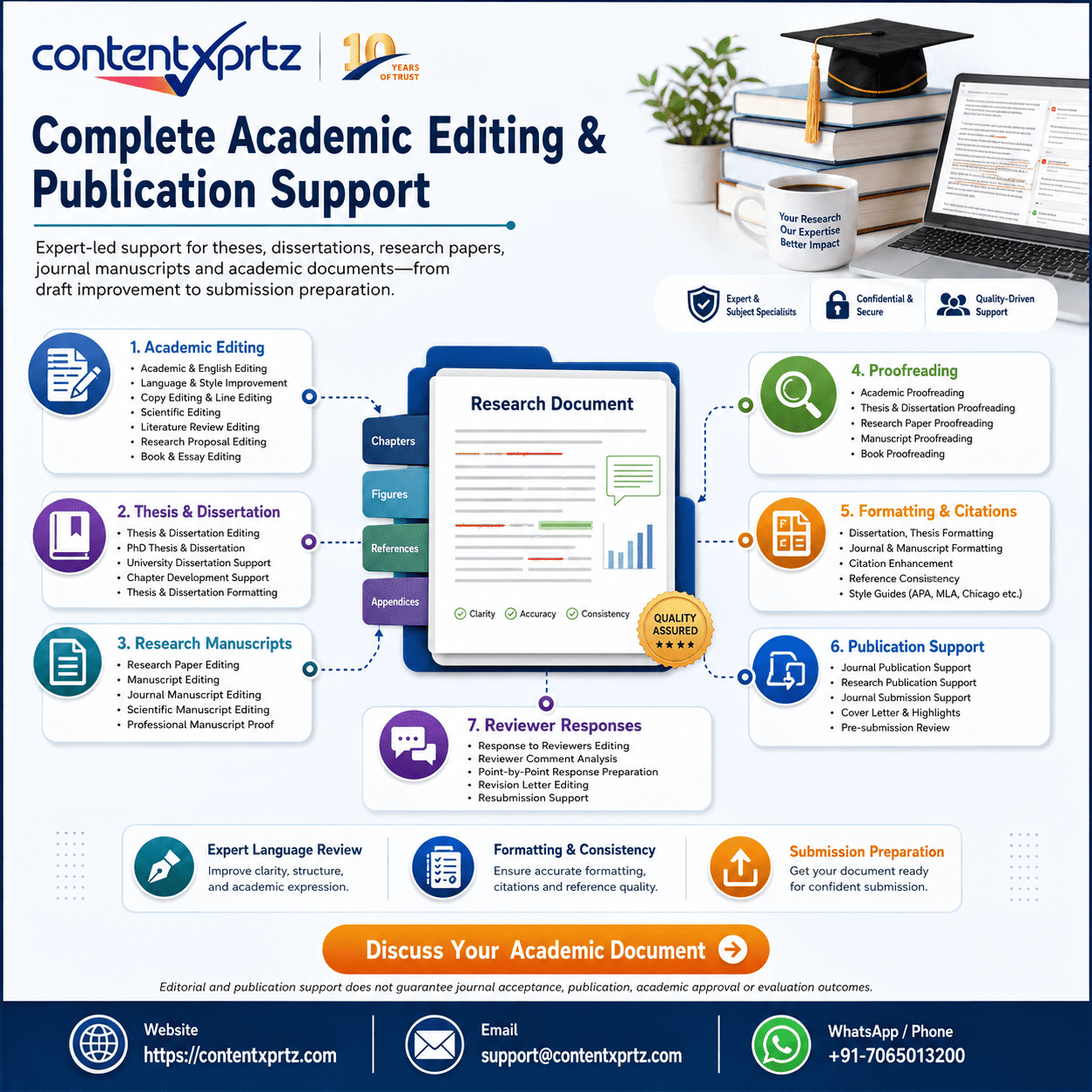
Contentxprtz can support authors who have completed their research but need help turning the manuscript into a clearer, more consistent, and journal-ready submission. Relevant support may include language editing, proofreading, manuscript assessment, journal-readiness review, formatting, citation consistency, and reviewer-response organization.
The appropriate level of help depends on the problem. If the manuscript’s ideas are sound but paragraphs are difficult to follow, deeper editing may be more useful than proofreading. If the paper is already clear but does not meet the target journal’s format and submission requirements, publication support may be the more direct need. Authors looking for research-writing assistance should use it ethically and remain responsible for all substantive academic content.
Contentxprtz does not control editors, reviewers, indexing services, or journal acceptance. The purpose of support is to improve the quality of communication, reduce avoidable submission errors, and help authors make informed decisions while preserving academic integrity.
Summary: Research Paper Publication
Research paper publication is a structured scholarly process, not a one-click submission. Authors improve readiness by first clarifying the study’s contribution, then choosing a journal that genuinely fits, following that journal’s instructions exactly, preparing all required declarations and files, and presenting the research with enough clarity that editors and reviewers can evaluate it efficiently.
Self-service preparation may be enough when the author understands the journal, writes clearly, and can audit the submission package independently. Expert support becomes more useful when language, structure, journal fit, formatting, or reviewer responses are creating uncertainty. In every case, the author remains responsible for the research, claims, evidence, citations, and ethical compliance.
Frequently Asked Questions
What is research paper publication?
Research paper publication is the process of preparing a scholarly manuscript, selecting an appropriate journal, submitting the paper, completing editorial and peer review, responding to revision requests, and, if the journal accepts the work, approving the final production version for publication. Publication is not a single upload step. Authors must align the manuscript with the journal’s scope and instructions, present methods and results transparently, verify citations and permissions, disclose relevant conflicts or funding, and preserve authorship responsibility. A strong submission can still be rejected because editors also consider novelty, fit, methodological strength, readership interest, and reviewer judgment. For that reason, researchers should treat publication as a quality-control and communication process rather than a guarantee of acceptance.
How do I choose the right journal for my research paper?
Choose a journal by matching your paper’s topic, methods, audience, article type, and contribution to the journal’s stated scope. Read several recent articles, review the aims and scope, confirm the journal accepts your article type, check author instructions, and understand access models, fees, indexing claims, and review policies. Do not choose a journal only because it advertises fast publication or a high metric. Verify the journal through its official publisher site and trusted directories or indexing services relevant to your field. If your paper is interdisciplinary, identify which readership is most likely to value the central contribution. Journal fit is often a major editorial screening factor, so a carefully matched journal can reduce avoidable desk rejection even though it cannot guarantee acceptance.
What should I do before submitting a research paper to a journal?
Before submission, confirm that every author has reviewed and approved the final manuscript, the paper fits the target journal, and all required files are ready. Check the journal’s instructions for structure, word limits, references, figures, tables, supplementary files, declarations, data statements, ethics approvals, and cover-letter requirements. Verify that citations are genuine and traceable, permissions are available for reused material, and any required reporting checklist is complete. Read the manuscript once for scientific coherence and again for language, formatting, and submission-system details. It is also wise to compare the title, abstract, keywords, methods, results, and conclusion for consistency. Professional manuscript editing or publication support may help with clarity and compliance, but authors remain responsible for the research, data, claims, citations, and final submission.
Does professional editing guarantee research paper publication?
No. Professional editing can improve language clarity, structure, consistency, formatting, and adherence to journal instructions, but it cannot guarantee research paper publication. Editorial decisions depend on factors that an editor or writing service cannot control, including journal scope, novelty, methodological quality, validity of the analysis, ethical compliance, reviewer feedback, competing submissions, and the editor’s judgment. Ethical publication support should therefore focus on making the author’s work clearer and more submission-ready without changing results, fabricating evidence, hiding authorship, or promising acceptance. Researchers should be cautious of any service or journal that claims guaranteed publication, guaranteed indexing, or guaranteed peer-review success.
How long does research paper publication take?
There is no universal publication timeline. The duration varies by journal, discipline, article type, editor workload, reviewer availability, number of revision rounds, author response time, production schedules, and whether the paper is transferred or resubmitted elsewhere. Some journals publish estimated review or decision times on their official websites, but these are not promises for an individual manuscript. Authors can reduce avoidable delays by submitting to a well-matched journal, following author instructions closely, preparing complete files and declarations, responding to editorial questions promptly, and answering reviewer comments systematically. If a deadline matters for a degree, grant, promotion, or project, plan around uncertainty rather than assuming a specific acceptance date.
What happens after I submit my paper to a journal?
After submission, the journal typically performs technical checks and an editorial screening. Staff may check files, formatting, declarations, authorship information, permissions, and policy compliance. An editor then considers whether the paper fits the journal and has sufficient quality or relevance to proceed. A manuscript may be rejected at this stage without external review. If it proceeds, the journal invites peer reviewers, receives reports, and issues a decision such as reject, revise, or accept. Revision may involve one or more rounds. After acceptance, the article enters production, where authors may review proofs and publishing agreements. Exact workflows differ by journal, so the journal’s own author guidance should be treated as the controlling source.
How should I respond to reviewer comments?
Respond to reviewer comments with a structured point-by-point document. Copy or summarize each comment, explain what you changed, identify where the change appears, and give a respectful evidence-based reason when you do not adopt a suggestion. Do not answer defensively or claim that a change was made when it was not. Recheck the entire manuscript after revision because one change can affect the abstract, methods, tables, conclusions, or references elsewhere. When reviewers disagree, explain the conflict to the editor and justify your chosen approach. Reviewer response support can help authors organize and clarify replies, but the researcher should make the scientific decisions and remain accountable for every revision.
Can I submit the same research paper to two journals at the same time?
In most scholarly publishing contexts, simultaneous submission of the same manuscript to multiple journals is not acceptable. Journals generally expect a manuscript to be under consideration at only one journal at a time, and submission forms often require the corresponding author to confirm this. If a paper is rejected or formally withdrawn from one journal, the author may then submit it elsewhere after adapting the manuscript and files as needed. Authors should also disclose closely related papers, preprints, conference versions, or prior reports when a journal’s policy requires it. Always check the target journal’s rules because policies can vary by discipline and publication model.
How can I avoid predatory or misleading journals?
Evaluate the journal before paying fees or submitting your manuscript. Confirm that the journal has a clear scope, identifiable editorial leadership, transparent peer-review and fee information, stable contact details, and a credible publishing history. Verify indexing claims directly with the database or directory rather than trusting logos on the journal website. Be cautious of unsolicited emails that promise rapid acceptance, guaranteed publication, unusually broad scope, or unclear charges. Compare the journal with established titles in your discipline and ask a supervisor, librarian, senior researcher, or publication specialist when uncertain. A reputable journal should explain its processes and should not need to guarantee acceptance to attract submissions.
When can Contentxprtz help with research paper publication?
Contentxprtz can help when an author needs ethical support with manuscript clarity, language editing, proofreading, journal-readiness checks, formatting, publication guidance, or reviewer-response organization. Support is most useful when the research itself is complete but the manuscript is difficult to communicate clearly, does not yet follow the target journal’s requirements, contains inconsistent references or presentation, or needs a disciplined pre-submission review. Contentxprtz should not be used to fabricate results, invent references, conceal authorship, or obtain a guaranteed acceptance. The author remains responsible for the study design, data, analysis, interpretation, citations, declarations, and submission decisions. The purpose of professional support is to improve communication and readiness while preserving academic integrity and the author’s intellectual ownership.
Conclusion: Publish with a Process, Not a Promise
The most reliable way to approach research paper publication is to control the parts of the process that are actually controllable: the quality of the study, clarity of the manuscript, fit with the journal, completeness of the submission package, integrity of authorship and declarations, and quality of the response to peer review. Editors and reviewers make independent decisions, so no ethical publication service can guarantee acceptance.
For some researchers, self-review and careful use of the journal’s instructions are enough. Others benefit from a second expert view when the manuscript has complex language, inconsistent structure, difficult reviewer comments, or journal-specific requirements. Contentxprtz supports these needs through relevant academic editing and publication assistance while keeping the author’s responsibility and intellectual ownership at the center.
Explore research paper writing and publication support from Contentxprtz when you need structured, ethical assistance with manuscript preparation and publication readiness.
At Contentxprtz, we don’t just edit; we help ideas reach their fullest potential.