Research Paper on Education: A Practical Guide to Topics, Methods, Structure, and Evidence
A research paper on education becomes much easier to write when the topic, research question, evidence, method, and structure are aligned from the beginning. The phrase can refer to many kinds of academic work: a student paper on classroom technology, a dissertation chapter on teacher identity, a quantitative study of student outcomes, a qualitative inquiry into learner experiences, a policy analysis, or a literature review that synthesizes what researchers already know. The challenge is not simply finding an “education topic.” It is turning an educational problem into a researchable question and then building a transparent argument from credible evidence.
Education is a particularly demanding research area because it combines human behavior, institutions, culture, policy, pedagogy, technology, assessment, and unequal social conditions. A conclusion that appears convincing in one school, age group, country, or instructional setting may not transfer automatically to another. Researchers therefore need to define context precisely, distinguish correlation from causation, explain how participants or sources were selected, and make claims that stay within the limits of the evidence.
Students and first-time researchers often feel pressure to begin writing before these decisions are clear. That can produce a broad literature review, a vague research question, a method that does not answer the question, or a conclusion that overreaches. PhD scholars and journal authors face additional expectations around ethics, methodological transparency, reporting standards, citation accuracy, and publication readiness. Language issues can add another layer for ESL researchers even when the underlying study is strong.
This guide provides a practical route from topic selection to final quality control. It explains how to narrow an education topic, formulate a research question, locate scholarly evidence, choose an appropriate methodology, structure the paper, handle ethics, avoid common mistakes, and decide when self-editing is sufficient. Where a researcher needs deeper help with argument, organization, language, or manuscript readiness, Contentxprtz can provide ethical academic writing support or academic editing services without replacing the author’s responsibility for ideas, data, analysis, citations, and final submission.
Quick Answer: How Do You Write a Research Paper on Education?
Start by narrowing a real educational problem into a specific research question. Define the population, setting, concept, intervention, comparison, or outcome that matters. Then search education-focused literature, identify what is already known, and decide what type of evidence can answer your question. Your method should follow the question: quantitative for measurable patterns or effects, qualitative for experiences and processes, mixed methods for integrated numerical and contextual evidence, or a structured literature review when the answer depends on synthesizing published studies.
Build the paper so each section performs one clear function. The introduction establishes the problem and research question; the literature review shows the evidence base and gap; the methods explain how evidence was obtained and analyzed; the results present findings; and the discussion interprets those findings without exceeding the design. Use accurate citations, report limitations, and follow institutional or journal ethics and formatting requirements.
The most important rule is alignment: your topic, question, literature, method, analysis, conclusions, and title should describe the same study. A polished paper cannot compensate for a research question that the evidence does not answer.
Key Takeaways
- A good education research topic is specific, researchable, relevant, and ethically feasible.
- The research question should determine the evidence and method—not the other way around.
- Education-specific databases such as ERIC can improve literature discovery, but source quality still requires human evaluation.
- Quantitative, qualitative, mixed-methods, and review designs answer different kinds of questions.
- Clear reporting matters because educational findings are strongly shaped by context, participants, measures, and implementation.
- Ethics applies to participant protection, data handling, authorship, citation, AI use, and honest reporting.
- Editing should improve clarity and structure while preserving the researcher’s original ideas and responsibility.
What This Page Covers
- How to choose and narrow education research topics
- How to write a focused research question and identify a meaningful gap
- How to search and evaluate academic sources for educational research
- How to choose quantitative, qualitative, mixed, or review methods
- How to structure the introduction, literature review, methods, findings, discussion, and conclusion
- How to handle ethics, AI-assisted writing, citations, and common research mistakes
- How to review an education paper before university or journal submission
Table of Contents
Methodology and Academic Sources
This article is based on common educational-research planning, academic writing, editing, and publication-readiness workflows. It also draws on guidance from the American Educational Research Association’s reporting standards, the ERIC education research database, UNESCO guidance on generative AI in education and research, and UNESCO’s recommendation on science and scientific researchers.
Requirements vary by discipline, university, paper type, research design, and target journal. Researchers should therefore use this guide as a planning framework and then verify the exact author instructions, ethics requirements, assessment rubric, and reporting standards that govern their own work. Contentxprtz can support ethical editing, proofreading, research organization, and manuscript readiness, but source selection, data, interpretation, and final academic responsibility remain with the author.
What Does a Research Paper on Education Mean in Academic Context?
An education research paper is an evidence-based academic argument about an educational question. It may investigate how people learn, how teachers teach, how institutions operate, how policy shapes outcomes, how technology changes learning environments, or how social conditions affect access and participation. What makes it research is the disciplined process used to connect the question with evidence and reasoning.
That definition matters because many weak papers are informative essays rather than research papers. An informative essay can explain “the benefits of inclusive education.” A research paper asks a sharper question such as, “How do co-teaching practices affect participation for students with identified learning needs in lower-secondary science classrooms?” The second formulation introduces a setting, an observable phenomenon, and a path toward evidence.
A research paper also needs boundaries. Education is affected by age, language, curriculum, teacher preparation, institutional resources, family context, assessment systems, and local policy. Authors should state where their evidence comes from and resist generalizing beyond what the design supports.
How to Choose a Strong Education Research Topic
A strong topic begins with a problem you can define, investigate, and explain. Broad themes are useful starting points, but they are rarely finished topics. “Online learning,” “teacher training,” “student motivation,” and “inclusive education” each contain dozens of possible research questions.
Use five filters before committing to a topic: relevance, specificity, evidence availability, methodological feasibility, and ethical feasibility. If the topic involves data from children, vulnerable populations, or settings where participation may be influenced by authority relationships, ethics and access should be considered at the topic-selection stage rather than after the paper is designed.
| Broad theme | Too broad | More focused research direction | Likely evidence |
|---|---|---|---|
| Digital learning | Technology in education | Formative quiz use and engagement in first-year online mathematics courses | Learning analytics, surveys, interviews |
| Teacher development | Teacher training effectiveness | How novice teachers apply mentoring feedback during their first school year | Interviews, observations, reflective logs |
| Assessment | Problems with exams | Student perceptions of low-stakes retrieval practice in secondary science | Survey plus focus groups |
| Equity | Educational inequality | Barriers to participation in blended learning among rural postgraduate students | Interviews, access data, institutional documents |
| AI in education | AI and students | How university students verify AI-generated study explanations in introductory economics | Task observations, interviews, artifact analysis |
Topic narrowing improves the rest of the paper. It makes database searching more precise, reveals which variables or experiences need definition, and reduces the temptation to make claims that exceed the evidence.
How Do You Turn an Education Topic into a Research Question?
The research question is the paper’s control center. A useful question is clear enough to guide evidence collection but open enough to require analysis. It should identify what you want to understand, compare, explain, describe, evaluate, or interpret.
For quantitative research
Questions often focus on relationships, differences, predictions, or effects. Define the population and measurable constructs. Instead of asking, “Does feedback help students?” ask, “What is the relationship between weekly formative feedback frequency and assignment revision quality among first-year university writing students?” If the design is observational, avoid causal verbs such as “causes” or “leads to” unless the methodology genuinely supports causal inference.
For qualitative research
Questions often explore experiences, practices, beliefs, decision processes, or meanings. A question such as “How do first-generation doctoral students describe the role of supervisory feedback in developing academic confidence?” signals that the evidence will probably involve participant accounts and interpretive analysis.
For mixed-methods research
The question should justify why both numerical and contextual evidence are required. For example, a study may measure whether engagement changed after a course redesign and then use interviews to understand why students responded differently. The paper must explain how the two evidence streams connect rather than reporting them as unrelated mini-studies.
How to Find and Synthesize Sources for Education Research
A literature review should establish what is known, how it is known, where evidence disagrees, and why your question still matters. Start by separating the research question into concepts. A study about mentoring and novice-teacher retention might include concept groups for mentoring, beginning teachers, retention or attrition, school context, and the relevant education level.
ERIC is a useful education-specific database because it supports education descriptors, peer-reviewed filters, publication types, and other fields. However, no single database is guaranteed to contain every relevant study. A serious thesis or journal article may require additional databases from psychology, sociology, economics, medicine, technology, or regional scholarship depending on the topic.
Create an evidence matrix before drafting
For each strong source, record the citation, research question, country or setting, sample, method, measures or data sources, key findings, limitations, and relevance to your study. This makes synthesis easier because you can compare studies across the same dimensions instead of relying on memory.
Then write by theme or debate. A strong paragraph might compare three studies that found improved engagement after formative feedback, note that two used self-report measures while one used behavioral data, and explain why the evidence remains uncertain for a different age group. That is synthesis. Three separate sentences saying “Study A found… Study B found… Study C found…” is usually only summary.
If source organization is becoming the bottleneck, ethical research support can help structure a literature matrix or review architecture, while the researcher remains responsible for reading, selecting, interpreting, and citing the underlying studies.
Which Method Should You Use for an Education Research Paper?
Choose the method after clarifying the question. Methodological sophistication is not the same as methodological fit. A simple design that answers the question transparently is stronger than an elaborate design that generates data unrelated to the problem.
Quantitative approaches
Use quantitative methods when constructs can be measured and the question concerns frequency, association, comparison, prediction, or intervention outcomes. Surveys, standardized assessments, administrative datasets, experiments, quasi-experiments, and learning analytics are common. Define variables before analysis, explain sampling, report missing data decisions, and distinguish statistical significance from practical educational importance.
Qualitative approaches
Qualitative methods help explain experiences, meanings, interactions, and processes. Interviews, focus groups, classroom observations, field notes, documents, and learner artifacts can be analyzed through systematic coding or other interpretive approaches. Authors should explain recruitment, context, data collection, coding, reflexivity, and how they judged the credibility of interpretations.
Mixed methods
Mixed methods are justified when the question needs both numerical patterns and contextual explanation. The paper should state the design logic, sequence, priority, and integration point. Simply adding a few interview quotes to a survey does not automatically make a study methodologically integrated.
Review-based papers
A review paper may be appropriate when the research question concerns the state of existing evidence rather than new participant data. The search, screening, inclusion criteria, synthesis method, and limitations should be transparent enough for readers to understand how the evidence base was formed.
The AERA standards for empirical social science reporting emphasize clear reporting of the problem, evidence, methods, and warrants behind conclusions. Target journals may impose additional design-specific reporting requirements.
Step-by-Step Structure for a Research Paper on Education
The exact heading names can vary, but the intellectual sequence should be easy to follow. Each section should answer a different reader question.
- Title: Name the educational issue precisely. Avoid titles that imply causality unless the design supports it.
- Abstract: If required, summarize the problem, method, main result, and conclusion using only information that appears in the paper.
- Introduction: Explain the problem, context, significance, gap, and research question. Move from broad relevance to the specific study.
- Literature review: Synthesize relevant scholarship and show how the study relates to existing evidence.
- Methods: Describe design, participants or sources, setting, measures, procedure, ethics, and analysis clearly enough for evaluation.
- Results or findings: Present the evidence in a logical order. Use tables or figures when they clarify rather than duplicate the text.
- Discussion: Interpret the findings against the research question and prior literature. Explain plausible meanings, limitations, and implications.
- Conclusion: State what the study contributes without introducing new evidence or overstating generalizability.
- References: Verify every reference against the original source and format it according to the required style.
Free and Low-Cost Support Versus Professional Academic Support
Many education papers can be improved substantially with free resources: university writing centers, supervisor feedback, library consultations, citation-management software, style guides, peer review from classmates or colleagues, and careful self-editing. These options are often enough when the assignment is short, the method is straightforward, and the author has time for multiple revision rounds.
Free grammar tools can catch spelling, punctuation, and simple sentence problems, but they may not identify whether the literature review establishes a defensible gap, whether a methods description supports the findings, or whether a discussion overstates what the data can prove. Automated suggestions can also change technical meaning if accepted without review.
Professional help is more appropriate when the manuscript has structural problems, reviewer or supervisor feedback spans multiple sections, English-language polishing must preserve precise academic meaning, or the document is close to thesis or journal submission. A good service should define the scope clearly and respect academic integrity. For sentence-level quality, scholarly proofreading may be sufficient. For deeper argument and organization issues, academic editing is more suitable.
Ethical Academic Writing and Author Responsibility in Education Research
Education research frequently involves relationships where participants may feel pressure to cooperate. A teacher-researcher studying their own students, for example, must consider whether learners can refuse without fear that participation will affect grades or relationships. Studies involving minors may require parental permission and learner assent in addition to institutional ethics review. Data containing educational records or sensitive personal information require careful access controls and de-identification.
Research ethics continues after data collection. Authors should not hide inconvenient findings, alter analyses to manufacture significance, exaggerate the implications of a small sample, or omit limitations that change how readers should interpret the result. UNESCO’s recommendation on scientific researchers highlights integrity, ethical principles, appropriate research oversight, responsible sharing, and recognition of research participants and knowledge sources.
AI use creates additional responsibilities. UNESCO’s guidance for generative AI in education and research emphasizes human-centered use, privacy, validation, and policy development. Researchers should never assume an AI-generated reference is genuine, and confidential participant data should not be uploaded into tools without explicit institutional authorization and appropriate safeguards.
Editing is ethical when it improves clarity, grammar, organization, formatting, and readability without fabricating data, inventing sources, concealing authorship, or replacing the researcher’s original intellectual contribution. Institutional policies vary, so students should check what level of assistance is permitted.
Common Mistakes to Avoid
- Starting with a topic instead of a question: broad topics generate broad literature reviews and unfocused conclusions.
- Choosing a method for convenience: a familiar survey is not useful if the question requires observation, interviews, or causal evidence.
- Using sources as decoration: citations should support specific claims and be discussed critically.
- Confusing correlation with causation: observational relationships do not prove that one educational factor caused another.
- Ignoring context: school level, country, culture, curriculum, language, and implementation can materially change findings.
- Overgeneralizing a small or narrow sample: describe the population your evidence actually represents.
- Writing methods too vaguely: readers need enough detail to understand what was done and judge the evidence.
- Letting the discussion become a second results section: interpretation should connect findings to theory, prior studies, limitations, and implications.
- Accepting automated edits blindly: grammar or AI tools can alter technical meaning, terminology, or citation accuracy.
- Editing only at sentence level: argument, alignment, evidence, structure, and references should be checked before final proofreading.
Practical Examples: Turning Education Ideas into Researchable Papers
Example 1: A postgraduate student studying online engagement
Situation: The student begins with “online education and student motivation.” Common mistake: They collect general sources about e-learning without defining motivation or a specific learner group. Better approach: They narrow the question to how weekly low-stakes quizzes relate to participation and self-reported motivation among first-year online mathematics students. They define each measure, use relevant recent literature, and avoid claiming that quizzes cause motivation unless the design supports causality. Expert support: An editor can help align the introduction, variables, and discussion while leaving data interpretation with the student.
Example 2: A PhD scholar researching teacher mentoring
Situation: The scholar has 25 interview transcripts from novice teachers. Common mistake: The draft contains many quotations but no clear analytic structure. Better approach: The researcher creates a coding framework, documents how themes were developed, connects those themes to the research question, and selects quotations that illustrate rather than substitute for analysis. They explain reflexivity and limits of transferability. Expert support: Ethical thesis editing can improve chapter flow and consistency without deciding what the data “should” mean.
Example 3: An ESL researcher preparing a journal manuscript
Situation: The study design and analysis are sound, but reviewers say the manuscript is difficult to follow. Common mistake: The author uses automated rewriting extensively, creating terminology changes and sentences that overstate results. Better approach: The author preserves technical terms, revises paragraphs around one main claim each, and checks that cautious language matches the evidence. Expert support: Professional research paper editing can improve academic English and cohesion while preserving the author’s intended meaning.
Example 4: A student comparing inclusive education policies
Situation: The student wants to compare two countries. Common mistake: They collect policy documents but treat differences in wording as differences in classroom practice. Better approach: The paper clearly distinguishes policy design, implementation evidence, and learner outcomes. It identifies comparable documents and explains contextual limits. Expert support: A research-writing consultant can help structure the comparison matrix and evidence hierarchy, while the student remains responsible for policy interpretation.
Education Research Paper Quality-Control Checklist
Before submission, review the paper in layers. Structural editing should come before sentence-level proofreading so you do not polish paragraphs that later need to be removed or rewritten.
- The title accurately reflects the research question, population, and design.
- The introduction explains the educational problem, significance, gap, and specific question.
- Key terms are defined consistently.
- The literature review synthesizes evidence rather than listing sources.
- The method clearly explains participants or sources, setting, data collection, ethics, and analysis.
- The evidence actually answers the research question.
- Results and discussion are separated appropriately for the chosen format.
- Causal language is used only when the design justifies it.
- Limitations are specific and connected to interpretation.
- Tables and figures are understandable, labeled, and referred to in the text.
- Every in-text citation has a matching reference and every reference is authentic.
- Citation style matches the university or journal requirements.
- AI-assisted or editorial support has been used in accordance with applicable policies.
- Grammar, punctuation, terminology, and tense are consistent.
- The final conclusion answers the research question without introducing new evidence.
When Is Expert Editing Safer Than Self-Editing?
Self-editing is often enough when the paper is short, the rubric is clear, the argument is stable, and the writer has enough time to revise in several passes. Read the paper once for argument, once for evidence and citations, once for paragraph flow, and only then for grammar and formatting.
Expert editing becomes more useful when the problem crosses several layers. Examples include a thesis chapter with supervisor comments about logic and language, a journal manuscript in which the methods and results are difficult to connect, or an ESL paper where sentence clarity is obscuring otherwise strong research. In these cases, a deeper manuscript assessment can identify whether the main issue is structure, evidence presentation, academic English, or submission readiness before detailed editing begins.
The ethical boundary is important: an editor can point out that a claim lacks support or that a method description is incomplete, but should not invent missing data or write a false methodological account. The researcher must decide what is true and provide the evidence.
How Contentxprtz Can Help With an Education Research Paper
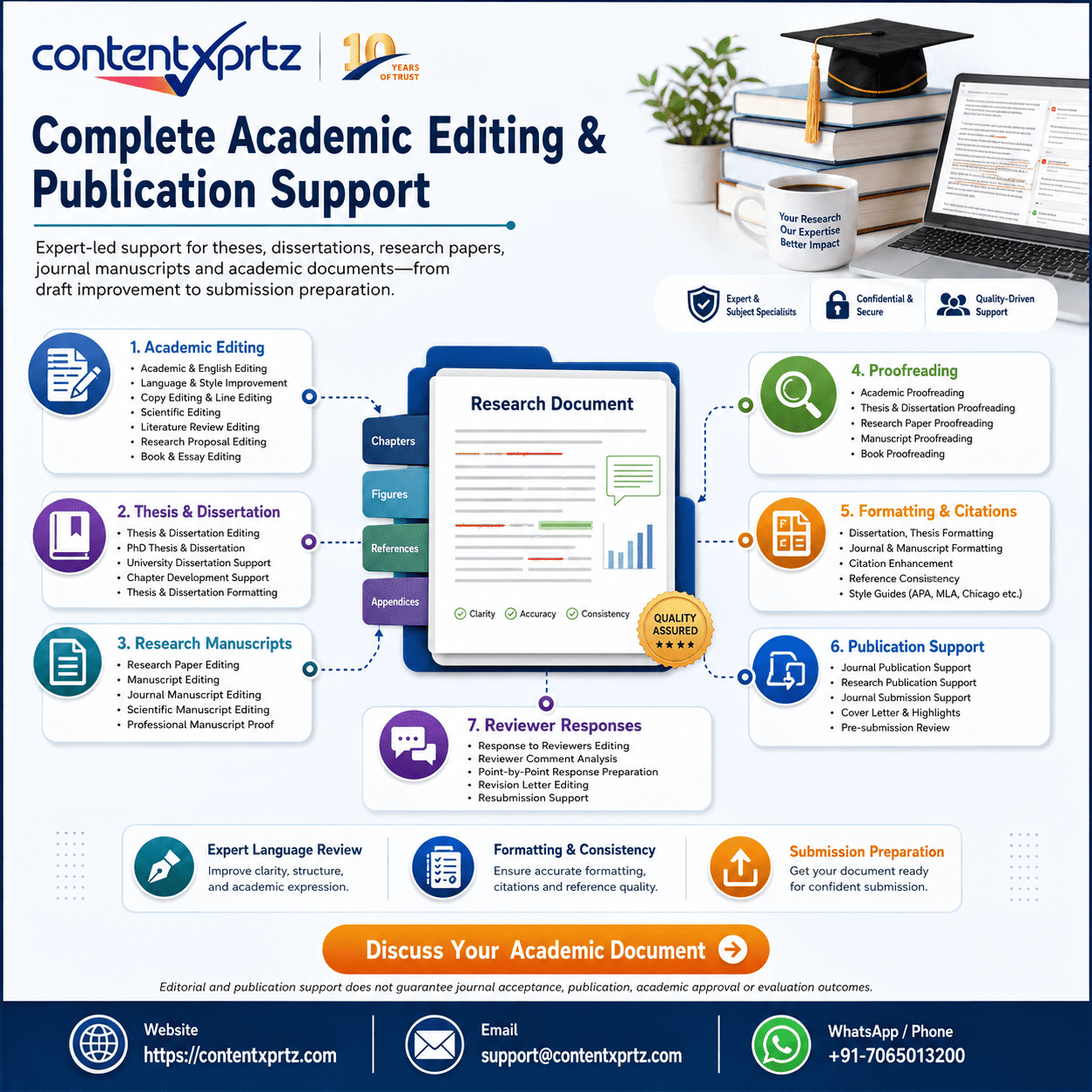
Contentxprtz can support education researchers at the stage where a legitimate research project needs clearer academic communication. Depending on the manuscript, that may involve improving the structure of a literature review, clarifying research questions, checking section alignment, polishing academic English, standardizing terminology, improving tables and captions, reviewing citations for consistency, or preparing a manuscript for a specific university or journal format.
For researchers who need assistance developing or organizing a draft, the most relevant option is research paper writing support. For authors who already have a complete draft, academic editing or proofreading may be a better fit. The scope should match the actual problem rather than adding unnecessary services.
Contentxprtz does not replace the researcher’s obligation to conduct the study, verify sources, analyze data, comply with ethics requirements, or approve the final text. Publication and academic outcomes depend on research quality, institutional rules, journal scope, reviewers, and editorial decisions.
Summary: Research Paper on Education
A successful research paper on education begins with a focused, answerable question and maintains alignment from literature review through conclusion. Educational research can use quantitative, qualitative, mixed-methods, review, or other designs, but the method must fit the question and the final claims must fit the evidence. Because education is highly contextual, authors should describe participants, setting, measures, procedures, and limitations clearly.
Use credible education databases and primary sources, synthesize rather than merely summarize scholarship, and treat ethics as part of research design and reporting. Free academic resources and careful self-editing may be enough for many papers. When deeper structure, language, citation consistency, or manuscript readiness becomes difficult, ethical expert support can improve communication without replacing the researcher’s own ideas, evidence, analysis, or responsibility.
Frequently Asked Questions
What is a research paper on education?
A research paper on education is a structured academic investigation of a question about teaching, learning, learners, educators, institutions, curricula, policy, technology, assessment, equity, or another educational issue. It should do more than describe a topic. A strong paper defines a focused problem, connects that problem to existing scholarship, explains how evidence was gathered or selected, analyzes the evidence systematically, and presents a defensible conclusion. The exact design depends on the assignment or publication goal. An empirical paper may report survey, interview, observational, experimental, administrative, or classroom data. A review paper may synthesize published studies to identify patterns, disagreements, and gaps. A conceptual paper may develop or critique an educational framework. Before writing, check the university, supervisor, course, or target journal requirements because expectations for length, methods, citation style, ethics approval, and reporting differ. The author remains responsible for the research question, evidence, interpretation, citations, and final claims, even when receiving ethical academic editing or research-writing support.
How do I choose a good topic for a research paper on education?
Choose a topic that is important enough to matter but narrow enough to investigate with the time, evidence, and access available to you. Start with a broad area such as teacher professional development, digital learning, inclusive education, student motivation, assessment, early childhood education, higher education, or educational policy. Then identify a specific population, setting, intervention, comparison, outcome, or problem. For example, “technology in education” is usually too broad, whereas “how formative quizzes influence engagement in first-year online mathematics courses” is much more researchable. Search recent education literature to learn the vocabulary used by researchers and to see whether the question has already been answered. ERIC is especially useful for education-specific discovery, while your university library may provide additional databases. A good topic also has a feasible evidence path: you should know what data or literature you could realistically obtain. Avoid choosing a topic only because it sounds fashionable. Relevance, scope, ethical feasibility, and a clear contribution are more important than novelty for its own sake.
What sections should an education research paper include?
Most education research papers include a title, abstract when required, introduction, literature review or integrated background, research question or hypothesis, methodology, results or findings, discussion, conclusion, and references. However, the exact structure depends on the paper type and the target institution or journal. A quantitative empirical paper commonly explains participants, measures, procedures, variables, and statistical analysis. A qualitative paper may describe the research setting, sampling, interviews or observations, coding, researcher reflexivity, and the process used to establish credibility. A mixed-methods study should explain why quantitative and qualitative components are combined and how the two strands are integrated. A literature review may instead organize evidence by themes, methods, chronology, or theoretical debates. Whatever the format, each section should have a clear job. The introduction establishes the problem and contribution; the methods make the study understandable and assessable; the results present evidence without overstating it; and the discussion explains what the findings mean in relation to prior research, limitations, and educational practice or theory.
Which research method is best for an education research paper?
There is no single best method for every education paper. The right method is the one that fits the research question, evidence needed, ethical constraints, and available resources. Quantitative methods are useful when the question concerns prevalence, relationships, group differences, prediction, or measurable intervention effects. Qualitative methods are appropriate when you need to understand experiences, meanings, classroom processes, institutional cultures, or how participants interpret an educational phenomenon. Mixed methods can be valuable when numbers and contextual explanations are both necessary and the study has a clear integration plan. Secondary-data analysis may be appropriate when credible datasets already exist, while systematic or structured reviews can answer questions by synthesizing prior studies rather than collecting new participant data. Method choice should follow the question, not personal preference. Education researchers should also consider whether the design respects learners and educators, whether the sample supports the intended claims, and whether the analysis can actually answer the stated question. Reporting standards from research associations and journals can help authors explain these decisions transparently.
How do I write a literature review for an education research paper?
A literature review should build the intellectual case for your study rather than become a sequence of one-paper summaries. Begin by defining the concepts in your question and creating a documented search strategy with synonyms, related terms, date limits where justified, and relevant databases. In education, ERIC can be a valuable starting point, but important projects may also require multidisciplinary or subject-specific databases available through your institution. Screen sources for relevance and quality, then create an evidence matrix recording the research question, sample, context, design, measures, key findings, and limitations of each study. As you write, group studies by themes, theoretical perspectives, methods, populations, or points of agreement and disagreement. Compare evidence instead of listing it. Explain where findings are consistent, where context changes the result, and what remains uncertain. The review should end with a clear gap or unresolved problem that leads naturally to your research question. Cite original sources accurately and avoid citing a paper you have not read simply because it was mentioned in another author’s work.
How can I find credible sources for a research paper on education?
Use a layered search strategy. Start with education-focused databases such as ERIC, then use your university library catalogue and relevant multidisciplinary databases to widen coverage. Search with concept groups rather than a full assignment sentence, and record the final search terms so you can repeat or explain the process. Once you find a strong paper, use its reference list for backward citation searching and identify newer work that cites it for forward searching. Credibility depends on more than where a source appears. Check the authors, publication venue, research design, sample, measures, analysis, limitations, conflicts of interest, and whether the claims match the evidence. Distinguish peer-reviewed journal articles from reports, dissertations, conference papers, preprints, and policy documents because each source type serves a different purpose. Official government or international-organization evidence may be important for policy and statistics. Avoid treating citation counts as a quality score. For a high-stakes thesis or publication manuscript, a subject librarian can help improve search coverage and reduce the risk of missing major evidence.
What ethical issues should I consider in educational research?
Educational research often involves people in settings where power differences matter, including students, children, teachers, families, and employees. Ethical planning therefore begins before data collection. Depending on the study and institution, you may need formal ethics or institutional review approval, informed consent, parental permission, learner assent, privacy protections, secure data handling, and a clear process for voluntary participation and withdrawal. Researchers should avoid coercion, especially when the investigator is also the participant’s teacher, supervisor, or evaluator. Sensitive topics require additional care around confidentiality and possible harm. Research integrity also applies to the paper itself: data should not be fabricated or selectively misrepresented, sources should be traceable, authorship should reflect real contributions, and limitations should be stated rather than hidden. If generative AI or automated tools are used, follow the university and journal’s current disclosure and data-protection rules and verify outputs carefully. Ethical academic support can improve language and organization, but it should not invent evidence, disguise authorship, or replace the researcher’s own intellectual responsibility.
Can I use AI to help write a research paper on education?
AI tools can support limited parts of the workflow, but they should be used under your university, funder, supervisor, and target journal rules. Appropriate uses may include brainstorming search terms, improving readability of text you wrote, creating a planning checklist, or helping you compare alternative ways to organize a section. Higher-risk uses include relying on AI-generated references, allowing a tool to invent evidence, submitting unverified factual claims, uploading confidential participant data, or using generated prose in ways that violate authorship or disclosure requirements. UNESCO’s guidance on generative AI in education and research emphasizes a human-centered, ethical approach, including attention to privacy and human oversight. For academic work, every reference should be checked against an authentic source, every statistic should be traceable, and every interpretation should remain the author’s responsibility. If you use AI-assisted language editing, retain a version history and verify that technical meaning has not changed. When policy is unclear, ask the institution or journal directly rather than assuming that a particular use is permitted.
What are the most common mistakes in a research paper on education?
The most common problems are usually problems of alignment. A paper may begin with a broad educational issue but use a research question that is too vague to answer. The literature review may summarize sources without establishing a gap. The method may not match the question, the sample may be too narrow for the claims made, or the measures may not represent the concept being discussed. Writers also sometimes mix results with interpretation, overstate causal conclusions from correlational evidence, ignore contradictory findings, or treat statistically significant results as automatically educationally important. Citation problems include inconsistent reference formatting, relying on secondary citations without reading the original source, and using weak or outdated evidence when stronger evidence exists. In qualitative work, authors may under-explain coding and reflexivity; in quantitative work, they may omit assumptions, uncertainty, effect sizes, or missing-data decisions. A final editing pass should therefore check argument, method, evidence, terminology, tables, references, and reporting requirements—not grammar alone. A structured manuscript assessment can be useful when the difficulty is deeper than sentence-level proofreading.
When should I seek professional help for a research paper on education?
Professional support is most useful when you already have a legitimate research task and need help communicating it clearly, organizing a complex manuscript, checking consistency, or understanding publication-readiness requirements. Self-service may be enough for a short class paper with a clear rubric, strong writing skills, and adequate time for revision. Expert help can add value when a thesis or journal manuscript has extensive reviewer or supervisor feedback, when the argument is difficult to follow, when an ESL author wants language polishing without changing meaning, or when methods, tables, citations, and sections need a coordinated quality check. The safest model is collaborative and transparent: the researcher supplies the ideas, evidence, analysis, and decisions, while an editor or academic writing specialist improves clarity, structure, consistency, and presentation within the institution’s rules. Contentxprtz offers research paper writing support and academic editing that can be scoped to the actual problem, but no ethical service can guarantee grades, journal acceptance, publication, or supervisor approval. The author remains responsible for the final submission and for verifying every claim and citation.
Conclusion: Build the Paper Around Evidence, Not Just a Topic
The hardest part of a research paper on education is rarely the final proofreading. It is deciding exactly what educational problem you are investigating, how the existing literature frames that problem, what evidence can answer the question, and how far your conclusions can reasonably go. Once those decisions are aligned, writing becomes more purposeful because every section supports the same research objective.
Free databases, library help, writing-center support, supervisor feedback, and careful self-revision may be sufficient for many assignments. Expert-assisted editing becomes more useful when a thesis or manuscript has complex structural issues, language barriers, inconsistent reporting, or publication-readiness concerns. Contentxprtz can help researchers improve clarity, organization, academic style, and presentation while respecting academic integrity and author responsibility.
Need structured support for your education research paper?
Use expert assistance to improve clarity, organization, academic language, and manuscript readiness while keeping your research decisions, evidence, analysis, and final responsibility in your hands.
At Contentxprtz, we don’t just edit; we help ideas reach their fullest potential.