How to Publish a Research Paper: Step-by-Step Guide
Learning how to publish a research paper can feel more difficult than writing the paper itself because publication requires several decisions that are rarely visible in the final article. You must identify a suitable journal, understand its scope, prepare the manuscript in the correct format, verify authorship and ethics information, submit through an editorial system, respond to peer review, and manage revisions without losing the core contribution of the research. For a first-time author, PhD scholar, postgraduate student, clinician, engineer, social scientist, or independent researcher, the process can appear fragmented because each journal presents its requirements differently.
The most important principle is that publication is not a single upload event. It is a sequence of quality and fit checks. A strong manuscript can be rejected when it does not match a journal's aims, article type, audience, or reporting expectations. A well-matched paper can still be delayed when figures are incomplete, references are inconsistent, author information differs across files, declarations are missing, or the cover letter does not explain why the work belongs in that journal. Language also matters: unclear sentences can hide a sound method or make the contribution difficult for an editor to assess. At the same time, editing must remain ethical. It should improve communication without inventing data, changing results, fabricating references, or taking scholarly responsibility away from the authors.
Researchers also face practical choices about cost, open access, indexing, peer-review models, turnaround expectations, AI-assisted writing, and predatory or low-transparency journals. These choices are easier when you separate what can be controlled from what cannot. You can control manuscript completeness, journal fit, citation accuracy, disclosure, formatting, and the quality of your response to reviewers. You cannot guarantee that an editor will send the paper for review or that reviewers will recommend acceptance.
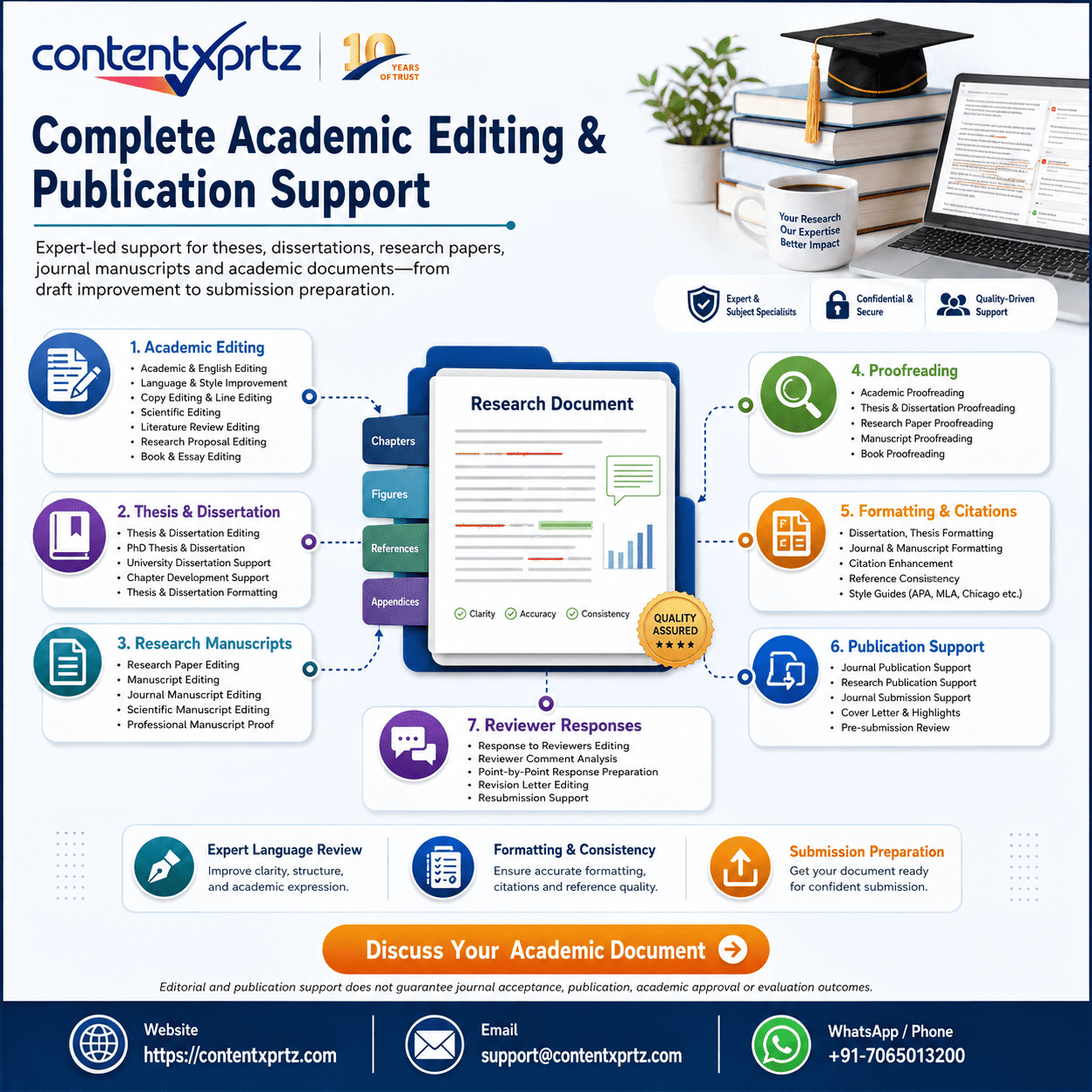
This guide explains the publication pathway from a publication-ready manuscript to journal selection, submission, revision, and final production. It uses publisher and editorial guidance as reference points and shows where self-service preparation is usually enough and where ethical publication support or academic editing services may help. Contentxprtz supports researchers with clarity, formatting, submission readiness, and reviewer-response preparation, while the author remains responsible for the research, claims, data, citations, and final submission.
Quick Answer: How Do You Publish a Research Paper?
To publish a research paper, first make the study and manuscript complete enough for independent evaluation. Then identify a journal whose aims, scope, audience, article type, and recent publications match your work. Read the journal's author instructions before formatting the final submission, because requirements for word count, references, figures, ethics statements, data availability, declarations, cover letters, and supplementary files vary.
Submit only to one journal at a time unless the journal explicitly permits another arrangement. After submission, the paper normally passes through a technical check and editorial screening. It may then be rejected, returned for corrections, or sent to peer review. If you receive reviewer comments, revise the manuscript carefully and answer every substantive point in a structured response letter. Acceptance, if it occurs, is followed by production steps such as licence forms, proofs, and publication.
The safest approach is to treat journal publication as a controlled workflow rather than a promise of acceptance. Follow official journal instructions, keep accurate records, disclose required information, and verify any AI-assisted or third-party editing against the journal's current policy.
Key Takeaways
- Journal fit matters as much as manuscript polish; scope mismatch can lead to rejection before peer review.
- Use the target journal's official author instructions as the primary submission checklist.
- Authors remain responsible for data, methods, claims, citations, authorship, disclosures, and final approval.
- Peer review is an evaluation process, not a guaranteed route to publication.
- Professional editing can improve clarity and readiness, but it should not alter the researcher's ideas or fabricate scholarly content.
- Fees, open-access options, licences, indexing, and review models should be checked before submission.
- AI-assisted writing or editing must be verified and disclosed when required by journal policy.
What This Page Covers
- What “publish research paper” means in a real journal workflow
- How to evaluate publication readiness before choosing a journal
- How to select a suitable journal and avoid low-transparency options
- What files and declarations are commonly required during submission
- How editorial screening, peer review, revision, and acceptance work
- Common publication mistakes and ethical issues to avoid
- When self-service preparation is enough and when expert support may help
Table of Contents
Methodology and Academic Sources
This article follows common academic publishing workflows and references current official guidance from major publishers and editorial organizations. The Springer Nature article publishing pathway emphasizes preparing the article, checking journal guidelines, submitting the manuscript, technical checks, editor and peer review, final decisions, and production. Elsevier's submission and editorial process guidance similarly notes that manuscript requirements vary by journal and that editors initially assess suitability, novelty, and scope.
For authorship, declarations, and submission responsibility, the article also refers to the ICMJE recommendations for sending a manuscript to a journal. On AI-assisted technologies, the ICMJE guidance on AI use by authors states that authors remain responsible for submitted material and should disclose use where required. Publisher and discipline-specific rules can differ, so always verify the current instructions of your target journal and institution.
What “Publish Research Paper” Means in Academic Context
Publishing a research paper means moving original or synthesized scholarly work through a journal's editorial process until it becomes part of the scholarly record. The process is not limited to writing. It includes selecting an appropriate publication venue, meeting ethical and technical requirements, presenting the methods and evidence transparently, responding to editorial and reviewer scrutiny, and approving the final version for publication.
A journal article is different from a classroom assignment or internal report because its audience includes external editors, reviewers, researchers, practitioners, and future authors who may rely on the work. That makes traceability essential. Claims should be supported by evidence, references should be authentic and complete, methods should be described at the level required by the discipline, limitations should be acknowledged, and authorship should reflect genuine contribution.
Publication also creates responsibility after acceptance. Corrections may be needed if an error is discovered. Data or materials may need to remain available under the journal's policy. Authors may receive questions from readers and should preserve the records needed to explain their work. For this reason, the best publication strategy starts with research integrity and clear reporting rather than with journal metrics alone.
Is Your Research Paper Ready for Journal Submission?
A paper is publication-ready when its research story, evidence, reporting, language, references, figures, declarations, and supporting files are coherent enough for an editor and reviewers to evaluate without avoidable confusion. This does not mean the article is perfect or certain to be accepted. It means the author has removed preventable obstacles that would distract from the scholarly contribution.
Check the research story before formatting
Confirm that the title, abstract, introduction, methods, results, discussion, and conclusion tell the same story. The research question should be clear. The methods should support the claims. Results should not introduce methods that were never explained, and the discussion should distinguish findings from interpretation. Avoid overclaiming beyond the design, sample, data, or evidence.
Check references and evidence
Open the sources behind important claims and confirm that they support the statement being made. Verify author names, years, titles, journal details, DOIs, and other required metadata. Remove references that were copied from another paper without being read. Reference-manager exports are helpful but not infallible.
Check language at the right level
Proofreading corrects surface errors such as spelling, punctuation, and grammar. Academic editing may also improve clarity, sentence logic, transitions, terminology consistency, and structural flow. If a paper needs deeper argument repair or methodological work, language editing alone is not enough. Researchers can use professional editing for researchers when the science is settled but the presentation still obscures meaning.
Free, Low-Cost, and Professional Options for Publication Preparation
| Option | Best use | Strength | Main limitation |
|---|---|---|---|
| Self-editing checklist | Experienced authors with a stable manuscript | Free and under the author's control | Authors can miss familiar errors |
| Supervisor or co-author review | Scientific logic, interpretation, discipline fit | Subject knowledge and project context | May not focus on language or journal formatting |
| University writing or library support | Writing, referencing, search, institutional guidance | Often included for students and staff | Availability and scope vary |
| Professional academic editing | Language, clarity, structure, consistency | Independent manuscript-focused review | Does not repair weak research design |
| Publication support | Journal formatting, submission files, reviewer responses | Workflow coordination and readiness checks | Cannot guarantee acceptance or peer-review outcomes |
The correct option depends on the problem. A paper with strong science and a few grammar errors may need only self-editing or proofreading. A technically complex paper written by an ESL author may benefit from deeper language editing. A first-time researcher facing a complicated submission system may need publication-support coordination even when the manuscript itself is strong.
When Self-Service Is Enough and When Expert Editing Is Safer
Self-service preparation is usually enough when the manuscript is clear, the author has published in similar journals before, the submission requirements are straightforward, and a co-author or supervisor can provide an independent check. The author should still allow time between drafting and final review, because distance makes inconsistencies easier to notice.
Expert editing is safer when meaning is difficult to follow, terminology varies, the paper has repeated grammar problems, the discussion overstates the findings, or journal instructions require complex restructuring. It may also help when the paper was translated from another language or assembled by several co-authors with different writing styles. scholarly proofreading can be enough for a well-structured manuscript; deeper manuscript editing is more appropriate when clarity and flow need substantial work.
Neither editing nor publication support should conceal authorship or create research that the author cannot defend. The final manuscript should still represent the authors' work, evidence, and decisions.
How to Choose a Journal Before You Submit
The right journal is one whose readers, scope, article types, standards, and practical requirements align with your manuscript. Start with intellectual fit, not prestige alone. Read several recent papers and ask whether your work would make sense beside them. Check whether the journal publishes the method and article type you used and whether its audience needs the contribution.
Evaluate fit and credibility
- Read the aims and scope and compare them with your title, abstract, and conclusion.
- Review recent issues for similar topics and methods without assuming similarity guarantees acceptance.
- Check the publisher, editorial board, peer-review description, contact information, policies, licences, and fees.
- Verify indexing claims through the relevant indexing service when indexing matters to your institution.
- Check open-access options, article processing charges, waiver policies, and copyright terms before submission.
- Look for transparent ethics, corrections, retractions, conflicts, authorship, and data policies.
Shortlist two or three realistic journals, but submit to only one at a time unless the journal explicitly allows otherwise. A backup list helps if the first journal rejects the paper, but each new submission should be reformatted and reconsidered rather than forwarded unchanged.
How to Publish a Research Paper: Step-by-Step
1. Finalize the research contribution
Write one or two sentences that explain what the paper adds. If you cannot identify the contribution clearly, editors may struggle to see why the paper belongs in their journal. The contribution may be a new finding, method, dataset, replication, synthesis, theoretical argument, clinical observation, or application, depending on the discipline and article type.
2. Build a realistic journal shortlist
Use papers you cite, database searches, publisher journal finders, supervisor knowledge, and recent literature to identify relevant journals. Compare fit, not just metrics. Read official journal pages rather than relying on unsolicited emails or third-party lists.
3. Read the author instructions line by line
Create a journal-specific checklist covering article type, word limits, abstract structure, headings, reference style, figures, tables, reporting guidelines, data statements, ethics statements, author contributions, conflicts, funding, cover letter, supplementary files, and submission-system fields.
4. Format the manuscript for that journal
Apply the requested structure and file conventions. Rename files clearly. Check anonymization if the journal uses double-anonymous review. Ensure figure legends and table titles are complete. Confirm that supplementary materials are cited in the manuscript and that all files open correctly.
5. Complete authorship and disclosure checks
Confirm author order, corresponding author, affiliations, contributions, funding, conflicts, acknowledgments, ethics approvals, consent, registration, and data availability where applicable. All authors should review and approve the final submission according to the applicable journal and disciplinary policy.
6. Write the cover letter
A concise cover letter usually identifies the manuscript, explains the central contribution and relevance to the journal, and includes declarations required by the journal. Do not oversell. Avoid claims such as “groundbreaking” unless the evidence genuinely supports them.
7. Submit through the official journal system
Enter metadata carefully because it can become part of the publication record. Match author names and affiliations to the manuscript. Upload the correct versions. Review the generated submission PDF before clicking the final confirmation.
8. Handle technical checks and editorial screening
Respond quickly if the editorial office requests missing files or corrections. If the editor rejects the paper for scope or priority, use the decision to refine your next journal choice rather than treating the outcome as proof that the research has no value.
9. Respond to peer review systematically
Create a response matrix. Address each comment, state what changed, identify the location, and explain respectfully when you disagree. Keep the revised manuscript and response letter synchronized. Contentxprtz provides manuscript editing and publication support for authors who need help presenting revisions clearly without changing their scientific decisions.
10. Review proofs and final publication details
After acceptance, check proofs for typesetting errors, author details, equations, figures, tables, references, and production queries. Proofs are usually not the stage for rewriting the paper extensively. Save the final citation, DOI, licence information, and published version for your records.
Ethical Academic Editing, Authorship, and Author Responsibility
Publication ethics protects both the author and the scholarly record. Editing should improve clarity, organization, grammar, terminology, and consistency without fabricating evidence or taking responsibility for claims the editor did not create. Authors should understand every substantive change and approve the final document.
Authorship is not a reward for seniority, funding, or administrative support. The applicable journal and disciplinary rules should determine who qualifies as an author and who should be acknowledged as a contributor. Never add a “guest” author to increase perceived credibility, and never remove a legitimate contributor to simplify submission.
AI tools require the same principle of human responsibility. If a journal permits AI-assisted tools, check its disclosure requirements and verify all output. AI-generated references can be false; summaries can omit limitations; paraphrases can distort meaning; and confidential manuscripts should not be placed into tools without understanding privacy and policy implications. The author remains accountable for originality, citations, data, interpretations, and submitted text.
Common Mistakes That Delay or Weaken Research Paper Publication
- Choosing by impact metric alone: a prestigious but poorly matched journal can reject a paper before review.
- Ignoring author instructions: missing declarations, wrong files, or incorrect article type can cause technical returns.
- Submitting to multiple journals at the same time: simultaneous submission is generally prohibited unless explicitly allowed.
- Using unverified references: citation-manager errors or AI-generated references can undermine credibility.
- Overclaiming results: conclusions should stay within the limits of design, sample, analysis, and evidence.
- Responding defensively to reviewers: a respectful evidence-based reply is more useful than arguing about tone.
- Changing author lists casually: authorship changes after submission can require explanations and agreement.
- Paying unknown journals without due diligence: verify publisher identity, peer review, policies, fees, and indexing claims.
- Assuming editing guarantees acceptance: language quality supports evaluation but cannot replace scientific fit and rigor.
- Waiting until acceptance to check fees: understand open-access and other charges before submission.
Practical Examples: Publication Decisions in Real Research Situations
Example 1: A first-time PhD scholar chooses a journal that is too broad
Situation: A doctoral researcher has a solid dataset and selects a famous multidisciplinary journal because colleagues recognize its name. Common mistake: The paper's contribution is highly specialized and does not match the journal's audience, so it is rejected before peer review. Better approach: Compare the manuscript with recent papers in several field-specific journals, then choose the venue where the method, topic, and expected contribution align. How ethical guidance helps: A publication-readiness review can help articulate fit and prepare the manuscript for the chosen journal, without claiming that selection will guarantee acceptance.
Example 2: An ESL researcher has strong science but unclear discussion
Situation: The methods and results are sound, but the discussion repeats findings and uses inconsistent terminology. Common mistake: The author relies on automated grammar correction, which fixes local errors but not argument flow. Better approach: Revise the discussion around interpretation, comparison with prior studies, limitations, and implications. How ethical guidance helps: ethical academic editing can improve clarity and consistency while preserving the author's technical meaning and claims.
Example 3: A research team receives major revision
Situation: Reviewers ask for clearer methods, additional sensitivity analysis, and a stronger explanation of limitations. Common mistake: The team edits the manuscript but sends a vague response saying “all comments addressed.” Better approach: Answer every comment individually, specify changes and locations, provide new analysis where feasible, and explain respectfully where a request cannot be followed. How ethical guidance helps: Reviewer-response editing can improve organization and tone while the authors retain responsibility for the scientific response.
Example 4: An independent researcher encounters a publication fee
Situation: The author completes peer review and then discovers an open-access charge that exceeds the budget. Common mistake: Cost was not considered during journal selection. Better approach: Check fees, waiver policies, licences, and institutional or funder agreements before submission. How ethical guidance helps: Publication planning can include cost and access requirements alongside scholarly fit, but final financial decisions remain with the author.
Research Paper Publication Readiness Checklist
- The research question and main contribution are clear.
- The manuscript matches the target journal's aims, scope, and article type.
- The title, abstract, methods, results, discussion, and conclusion are internally consistent.
- Claims are supported by authentic, checked references.
- All authors, affiliations, contributions, funding, and conflicts are correct.
- Ethics approval, consent, registration, and data statements are included where required.
- Figures, tables, legends, and supplementary files meet journal requirements.
- The cover letter is journal-specific and avoids exaggerated claims.
- Language editing has preserved the authors' meaning and responsibility.
- AI-assisted content, if used, has been verified and disclosed where required.
- Fees, licences, open-access options, and indexing claims have been checked on official sources.
- The final submission PDF has been reviewed before confirmation.
- A point-by-point reviewer-response plan is ready if revision is requested.
How Contentxprtz Can Help With Research Paper Publication Readiness
Contentxprtz supports researchers who have completed their scholarly work but need help making the manuscript clearer, more consistent, and better aligned with journal submission requirements. Depending on the paper, this may include academic editing, proofreading, journal-format review, reference consistency checks, submission-file preparation, cover-letter refinement, or reviewer-response editing.
The most relevant next step for this topic is research paper assistance and publication-readiness support. The service should be used to strengthen communication and workflow, not to replace the researcher's analysis, fabricate citations, create false authorship, or promise a publication outcome. Authors remain responsible for verifying every scientific claim, approving changes, and deciding where and when to submit.
Summary: How to Publish a Research Paper
To publish a research paper successfully, treat publication as a sequence of decisions: finish and critically review the manuscript, select a journal that genuinely fits, follow its instructions, complete authorship and ethics information accurately, submit through the official system, and respond to editorial and reviewer feedback with evidence and professionalism. Journal choice, manuscript clarity, transparent reporting, and careful submission preparation reduce avoidable problems, but they do not guarantee acceptance.
Self-service preparation is often enough for experienced authors with a clear manuscript and strong mentoring. Professional support becomes more useful when language obscures meaning, submission requirements are complex, reviewer responses need careful organization, or a first-time author wants an independent publication-readiness check. In every case, the researcher's integrity and responsibility remain central.
Frequently Asked Questions
How do I publish a research paper for the first time?
To publish a research paper for the first time, begin by deciding what your paper contributes and which readers need that contribution. Finish the manuscript before choosing a journal only if the target requirements are unlikely to shape the article; otherwise identify several suitable journals early and compare their aims, scope, article types, word limits, reporting requirements, ethics policies, data expectations, and reference style. Next, select one journal, adapt the manuscript to its author instructions, verify every citation, confirm author order and contributions, prepare figures and supplementary files, and write the required cover letter. Submit through the journal's official submission system and complete all declarations accurately. After editorial screening, the paper may be rejected, sent for peer review, or returned for technical corrections. If reviewers request changes, respond point by point and revise the manuscript carefully. Publication is not guaranteed at any stage, because decisions depend on research quality, journal fit, novelty, methods, reporting, and reviewer and editor judgment. First-time authors often benefit from a pre-submission checklist, a mentor's review, or ethical manuscript editing that improves clarity without replacing the author's scholarly responsibility.
How long does it take to publish a research paper?
There is no universal publication timeline. The process can range from weeks to many months, and sometimes longer, depending on the journal, discipline, manuscript quality, reviewer availability, number of revision rounds, production schedule, and whether the paper is transferred or resubmitted after rejection. A fast technical check does not mean a fast editorial decision, and a long review period does not necessarily indicate a problem with the paper. Authors can shorten avoidable delays by choosing a journal that genuinely fits the topic, following the author instructions exactly, submitting complete files, responding promptly to editorial queries, and preparing a clear revision package when reviewers comment. However, authors should be cautious about services or journals that promise guaranteed or unrealistically rapid acceptance. Before submission, check the journal's published information about review and production where available, but treat these figures as estimates rather than promises. If a deadline matters for graduation, funding, promotion, or a conference, plan backward and discuss the timing with your supervisor or institution. Ethical publication support can improve readiness and reduce preventable formatting or language problems, but it cannot control editor or reviewer timelines.
How do I choose the right journal for my research paper?
Choose the right journal by matching the paper's subject, contribution, article type, methods, audience, and level of novelty to the journal's actual aims and recent content. Start with journals you cite frequently and journals where closely related work is published, then read the aims and scope, instructions for authors, recent articles, editorial policies, peer-review model, indexing information, open-access options, fees, and data or reporting requirements. Do not choose a journal only because its title sounds relevant or because it advertises a high metric. Check whether the journal is transparent about its publisher, editorial board, peer-review process, fees, copyright terms, and contact information. For multidisciplinary work, compare several journals and ask which readership would most benefit from the results. A paper that is technically strong can still be rejected without review when it is outside scope. Conversely, a realistic journal fit improves the chance that editors can identify appropriate reviewers. Contentxprtz can support journal-readiness and selection research, but authors should verify the final choice on the journal's official website and remain responsible for the submission decision.
What documents are usually needed to submit a research paper?
Most journal submissions require more than the manuscript file. Common items include a title page, main manuscript, abstract, keywords, figures, tables, supplementary files, author affiliations, corresponding-author details, contribution statements, funding information, conflict-of-interest disclosures, ethics approval or consent information when relevant, data-availability statements, and a cover letter. Some journals also request highlights, graphical abstracts, reporting checklists, suggested reviewers, excluded reviewers, permissions for reused material, preprint information, clinical-trial registration, ORCID identifiers, or separate blinded files for anonymous peer review. Requirements vary substantially by discipline and journal, so the journal's official author instructions are the controlling source. Before uploading anything, create a submission folder and compare every required item against a checklist. Confirm that author names and affiliations are consistent across files and the online system, that figures use the correct resolution and file type, and that references and supplementary materials are complete. Missing declarations or mismatched files can trigger technical returns before an editor evaluates the research. Professional publication support can help organize and format these materials, but authors must provide accurate information and approve all declarations.
Can I publish a research paper without a university affiliation?
Yes, many journals allow independent researchers to submit and publish research papers without a university affiliation, provided the work meets the journal's scientific, ethical, reporting, and authorship requirements. An affiliation identifies the institution connected with the work; it is not automatically a requirement for authorship. If you are not affiliated with a university or organization, follow the target journal's instructions for independent authors and provide accurate contact information rather than inventing an institutional connection. The more important questions are whether the research is methodologically sound, whether any required ethics approval was obtained before the study, whether data and permissions are handled correctly, whether conflicts and funding are disclosed, and whether the manuscript fits the journal. Some research types require institutional resources, ethics oversight, clinical registration, laboratory facilities, or data-governance arrangements, so independence does not remove those obligations. If you previously conducted the research at an institution, clarify the correct affiliation and acknowledgments according to journal policy. Independent authors may also benefit from methodological peer feedback, statistical review, or language editing, but any outside assistance should comply with journal and disciplinary disclosure rules.
Do I have to pay to publish a research paper?
Not always. Some journals publish articles without charging authors, some charge article processing charges for open-access publication, some use hybrid models with optional open-access fees, and others may have separate charges for pages, colour figures, overlength articles, or special services. The amount and timing of fees vary widely, so check the official journal website before submission. A legitimate fee should be transparent and connected to a clearly described publishing model; authors should be cautious when charges appear only after acceptance or when a journal uses aggressive solicitation without credible editorial information. Also check whether your institution, funder, national agreement, or publisher has a waiver or discount program. Importantly, paying an article processing charge should not mean buying acceptance: reputable journals separate editorial decisions from payment. If cost is a major constraint, include publication model and fee transparency in your journal-selection criteria rather than discovering the issue after peer review. Contentxprtz can help authors compare submission requirements and prepare manuscripts, but it does not control publisher charges. The author should confirm all fees, waivers, licences, and payment terms directly with the target journal before committing to publication.
What happens after I submit a research paper to a journal?
After submission, the journal usually performs a technical check to confirm that required files, declarations, formatting elements, and basic policies are satisfied. The manuscript then reaches an editor, who assesses whether it fits the journal's scope and whether the research appears suitable for further consideration. The editor may reject it without external review, request preliminary changes, or invite peer reviewers. During peer review, experts evaluate aspects such as research question, methods, analysis, interpretation, reporting, novelty, limitations, and relevance. The editor then makes a decision, commonly reject, revise, or accept. A revise decision may be minor or major and can involve more than one round. Authors should respond systematically: copy each reviewer comment into a response document, explain exactly what changed and where, and respectfully justify any suggestion not adopted. If the article is accepted, the publisher may request final files, licence forms, payment where applicable, and proof corrections before online publication. Because workflows vary, use the target journal's official status definitions. Avoid sending repeated status requests too early unless the journal's stated timeline has been exceeded substantially.
How should I respond to peer reviewer comments?
Respond to peer reviewer comments with a structured, evidence-based revision package rather than a defensive letter. Begin by reading all comments together and identifying which points require new analysis, clearer explanation, additional literature, formatting changes, or a reasoned disagreement. Revise the manuscript first, then prepare a point-by-point response that reproduces or clearly identifies each comment, states what you changed, and gives the page, line, table, or section location. When you disagree, explain why with evidence and professional language; do not dismiss the reviewer. If a requested experiment or analysis cannot be completed, state the limitation and describe any alternative change that improves transparency. Check that revisions made for one reviewer do not create inconsistencies elsewhere. Also review the editor's letter carefully because editorial instructions take priority over individual reviewer preferences. A good response document helps the editor verify that concerns were addressed, but it cannot guarantee acceptance. Contentxprtz can assist with reviewer-response editing and manuscript consistency while preserving the author's scientific decisions, evidence, and responsibility for every reply.
Can I use AI tools when preparing a research paper for publication?
AI tools may be usable for limited research-writing tasks, but authors must follow the target journal's current policy and remain fully responsible for the submitted work. The ICMJE states that authors should disclose AI-assisted technology use where required, that AI tools should not be listed as authors, and that humans are responsible for accuracy, integrity, originality, attribution, and verification. In practice, an AI tool may help brainstorm wording, summarize notes, or suggest language revisions, but it can also invent references, misstate evidence, alter technical meaning, expose confidential material, or create unattributed text. Never treat AI output as a primary scholarly source. Verify claims against original literature, check every reference, protect unpublished or sensitive data, and disclose use according to journal requirements. Some publishers and disciplines have additional restrictions, especially for images, peer-review material, or confidential manuscripts. Human editing remains important when meaning, argument logic, terminology, and citation accuracy matter. Contentxprtz's ethical academic support can help researchers review clarity and consistency, but the author must make the final scholarly decisions and ensure compliance with institutional and publisher rules.
When should I get professional help to publish a research paper?
Professional help is most useful when the manuscript is scientifically complete but needs independent support with language clarity, structure, journal formatting, submission preparation, reference consistency, reviewer-response presentation, or publication workflow. It can also help first-time authors who understand their research but are unfamiliar with journal systems, ESL researchers whose ideas are stronger than the current English expression, or teams preparing a complex multi-file submission. Expert support should not fabricate data, invent citations, create fake authorship, guarantee acceptance, or replace the researcher's responsibility for analysis and interpretation. Before hiring anyone, define the problem precisely: do you need proofreading, substantive academic editing, journal-format checking, a cover-letter review, or publication-support coordination? Then verify what the service will and will not change. Authors should retain control of the argument, claims, data, methods, references, responses to reviewers, and final submission. Contentxprtz offers research paper and publication-readiness support designed to improve clarity and compliance while respecting academic integrity. If the manuscript still has unresolved methodological or analytical weaknesses, consult a qualified supervisor, subject expert, statistician, or ethics adviser before relying on language editing alone.
Conclusion: Publish With a Clear Process and Realistic Expectations
The core challenge is not simply finding a place to upload a manuscript. It is aligning a credible piece of research with the right journal, presenting it clearly, meeting technical and ethical requirements, and responding constructively when editors and reviewers identify weaknesses. Authors who control these steps are better prepared for publication even when the first submission does not succeed.
Free tools, supervisor feedback, and self-editing can be enough when the manuscript is already strong and the workflow is familiar. Expert-assisted editing or publication support may be safer when language, structure, journal formatting, submission files, or reviewer responses create avoidable risk. Contentxprtz helps improve clarity, structure, consistency, ethics, and publication readiness while respecting author responsibility and the uncertainty of peer review.
“At Contentxprtz, we don’t just edit; we help ideas reach their fullest potential.”