Buying Research Paper: What You Should Know Before Paying Anyone
Buying research paper content can sound like a fast solution when a deadline is close, the literature is overwhelming, academic English feels difficult, or a researcher is unsure how to turn data into a coherent manuscript. The important question, however, is not simply whether someone will sell you a paper. It is whether the support preserves your authorship, academic integrity, research accountability, and ability to explain every claim in the final document.
A finished paper written by someone else and submitted under your name can create serious integrity problems because it misrepresents who performed the intellectual work. Depending on the institution, assessment setting, publisher policy, and facts, this may be described as contract cheating, undisclosed ghostwriting, plagiarism, false authorship, or another form of academic misconduct. The label can vary, but the underlying issue is consistent: the submitted work should truthfully represent your contribution.
That does not mean researchers must work without support. Ethical research paper assistance can include coaching, literature-search organisation, language editing, proofreading, reference checks, formatting, statistical consultation, and publication-readiness feedback when these activities are permitted and transparent. The difference is that support improves your work rather than secretly replacing you as the author.
This guide explains the difference between purchasing authorship and purchasing legitimate academic services, the risks that researchers should evaluate, the questions to ask a provider, and a safer step-by-step route for finishing a paper under pressure. It is written for postgraduate students, PhD scholars, researchers, professionals, and academic authors who want practical help without losing ownership of their ideas.
Quick Answer: Is Buying a Research Paper a Safe Academic Choice?
Buying a completed research paper for submission under your own name is not a safe academic choice. It can misrepresent authorship and may breach university, employer, funder, or journal rules even if the paper is newly written and produces a low similarity score. The problem is not limited to copied text; it is also about who actually performed and can defend the intellectual work.
Paying for clearly defined assistance is different. You can often use editing, proofreading, formatting, reference checking, research coaching, statistical consultation, or publication support when the service operates within the rules that apply to your work. The safest model is transparent, reviewable, and author-led: you supply the research and draft, the specialist improves specific aspects, and you approve and understand every change.
Before commissioning help, check your institution or target journal policy, define the allowed scope in writing, protect confidential data, and avoid providers that promise an “undetectable” paper, guaranteed grade, or guaranteed publication.
Key Takeaways
- Submitting a purchased paper as your own can misrepresent authorship even when the text is original.
- A low plagiarism or similarity score does not establish that you wrote the paper or that the assistance was permitted.
- Ethical research support improves your own work through editing, coaching, formatting, reference review, or specialist consultation.
- University and journal rules differ, so the allowed level of third-party assistance should be checked before work begins.
- Authors must be able to explain their sources, methods, data, analysis, conclusions, and revisions.
- Transparent providers use defined deliverables, trackable revisions, authentic references, and realistic claims.
- If you are already behind schedule, seek permitted support or an extension rather than converting deadline pressure into an integrity problem.
What This Page Covers
- What “buying a research paper” can mean in different academic situations
- Why purchased authorship differs from legitimate editing and research support
- Academic integrity, plagiarism, ghostwriting, and authorship considerations
- Practical warning signs when evaluating online research-writing providers
- A safer workflow for completing a paper when you need urgent help
- Examples for students, PhD scholars, journal authors, and professionals
- Exactly what to ask an editor or research-support provider before paying
Table of Contents
Methodology and Academic Sources
This guide uses recognised academic-integrity and authorship principles rather than treating “buying research paper” as a simple commercial transaction. The Quality Assurance Agency's academic integrity resources address contract cheating and institutional approaches to academic misconduct. The U.S. Office of Research Integrity defines research misconduct in its jurisdiction around fabrication, falsification, and plagiarism, while noting that authorship disputes can be treated separately.
For scholarly publishing, the ICMJE authorship guidance links authorship with substantial contribution, critical drafting or review, final approval, and accountability. Publisher guidance also warns against ghost and gift authorship; see the Elsevier Researcher Academy authorship resource. Because policies vary by discipline and institution, researchers should always verify the exact rules that govern their course, thesis, funder, workplace, or journal submission.
What Does “Buying a Research Paper” Actually Mean?
The phrase can describe very different services, and the ethical outcome depends heavily on what is being purchased. At one extreme, a customer sends a topic and receives a finished paper that is intended to be submitted under the customer's name. At the other, a researcher pays an editor to improve grammar in a paper that the researcher designed, investigated, drafted, and can fully defend. Treating these as the same activity creates confusion.
A useful distinction is between replacement and support. Replacement occurs when an external writer performs intellectual work that the named author is expected to have performed and the contribution is concealed. Support occurs when an external specialist helps the real author improve a defined aspect of the work without taking over the author's responsibility.
| Service | What the provider does | Typical integrity position | What the author should verify |
|---|---|---|---|
| Finished paper for submission | Creates most or all of the manuscript from a topic or brief | High risk of misrepresented authorship or contract cheating | Institutional policy; do not submit as your own |
| Research coaching | Explains process, structure, search strategy, or planning | Often legitimate when advisory | Whether coaching is allowed and must be disclosed |
| Language editing | Improves grammar, syntax, clarity, and readability | Commonly accepted in research publishing | Journal or university editing rules |
| Substantive editing | Comments on organisation, logic, flow, and presentation | Can be legitimate but needs clear boundaries | Whether intellectual contributions require acknowledgement |
| Statistical consultation | Advises on analysis, assumptions, or reporting | Legitimate specialist input when transparent | Contribution statement or acknowledgement requirements |
| Reference and formatting support | Checks style, consistency, metadata, and layout | Generally low integrity risk | References must still be authentic and read by the author |
The practical test is simple: after the service is complete, can you explain how the research question was framed, why each source was used, how the methods were chosen, what the data show, how the conclusions were reached, and what revisions were made? If not, the service has probably moved beyond support into replacement.
Why Buying a Research Paper Can Become an Academic Integrity Problem
The core risk is misrepresentation of contribution. A research paper is not merely a block of polished text; it is a record of intellectual decisions. The named author is expected to stand behind the question, evidence, methods, interpretation, citations, and conclusions.
Authorship is both credit and accountability
In many publishing systems, authorship requires more than allowing your name to appear on a manuscript. The ICMJE criteria illustrate a broader principle used across scholarly communication: authors should make substantial contributions, participate in drafting or critical review, approve the final version, and accept accountability for the work. Discipline-specific rules differ, but purchasing a finished manuscript cannot automatically transfer those responsibilities to the buyer.
Plagiarism is not the only concern
A custom-written purchased paper may contain no obvious copied passages. It can still be problematic because the hidden writer created work that the named author presents as their own. ORI's policy defines plagiarism around appropriation without appropriate credit, while also distinguishing authorship or credit disputes from plagiarism in its own federal framework. Universities and publishers may classify the same situation differently. This is why “it passed the plagiarism checker” is not an ethical defence.
Ghostwriting can distort contribution
Ghostwriting generally involves substantial writing or intellectual work that is not transparently credited. In journal publishing, undisclosed ghost authorship is a recognised ethical concern. The safest approach is to define contributions before submission and acknowledge or credit contributors according to the policy that governs the work.
Academic assessments create an additional expectation
In assessed coursework, dissertations, and theses, the institution is often evaluating the student's own ability. That makes undisclosed replacement writing especially risky. Even excellent writing can become unusable if the student cannot explain its argument or if the level of external assistance exceeds what the institution permits.
Ethical Alternatives to Buying a Research Paper
You can purchase expertise without purchasing authorship. The safest support services solve a specific problem while keeping the researcher's intellectual decisions visible and reviewable.
Academic editing
Academic editing can improve sentence clarity, paragraph flow, terminology, consistency, and manuscript structure. A responsible editor flags unclear reasoning instead of inventing unsupported arguments. Tracked revisions give the author a record of what changed.
Proofreading
Proofreading focuses on grammar, punctuation, spelling, formatting consistency, and surface errors. It is often the lowest-risk form of paid support because it works on a substantially completed draft, though students should still check their institution's rules.
Literature review organisation
Researchers can receive help building search concepts, organising an evidence matrix, grouping themes, or checking whether citations are complete. The researcher should still read the sources and make the synthesis decisions. No provider should invent citations to make the literature review appear stronger.
Methodology or statistical consultation
Specialists may advise on study design, statistical assumptions, reporting, or data presentation. When the contribution is substantial, acknowledgement or contributor disclosure may be appropriate. The author should retain the data, code, analysis record, and rationale.
Journal-readiness support
Publication support can help align a manuscript with journal instructions, improve cover letters, check formatting, prepare response-to-reviewer documents, and improve language. It cannot ethically guarantee acceptance because publication depends on research quality, scope, editorial judgement, peer review, and many other factors outside an editing service's control.
Seven Risks to Evaluate Before Paying for a Research Paper Service
1. Authorship misrepresentation
If a provider creates the research logic, evidence synthesis, analysis, or conclusions and the contribution is hidden, the final paper may misrepresent who actually did the work.
2. Fabricated or unverifiable references
Some low-quality services use citations that look scholarly but do not exist, point to unrelated papers, or contain incorrect authors, years, volumes, pages, and DOIs. Every reference should be traceable to a source you have actually read.
3. Invented or manipulated data
A writer who does not possess your genuine research data cannot ethically manufacture results merely to complete a paper. Fabrication and falsification are serious research-integrity concerns. If your data are incomplete, the correct solution is to report limitations or adjust the study—not to create findings.
4. Confidentiality and intellectual-property exposure
Unpublished datasets, patient information, participant records, proprietary business data, patentable ideas, or confidential peer-review material may require strict handling. Do not upload sensitive files to a provider until you understand privacy terms, data retention, access controls, and any institutional restrictions.
5. Recycled or resold content
A provider may claim work is “custom” while reusing paragraphs, templates, or even entire papers. This can create similarity, copyright, confidentiality, and credibility problems that you may discover only after submission.
6. Inability to defend the paper
A supervisor, viva panel, reviewer, editor, or manager can ask why a method was selected or why a source was excluded. If you cannot answer because another person built the paper, the weakness becomes visible quickly.
7. Unrealistic commercial promises
Promises of guaranteed grades, guaranteed journal acceptance, guaranteed publication, or an “undetectable” paper are warning signs. Research outcomes depend on many independent factors. Credible services describe what they can improve, not what they cannot control.
How to Recognise a Responsible Research Support Provider
A responsible provider is transparent about boundaries. It should be able to tell you what is included, what is excluded, who will work on the document, how revisions will be shown, and what remains your responsibility.
| Safer signal | Warning sign |
|---|---|
| Works from your research, data, sources, and draft | Offers to invent evidence, results, or references |
| Defines proofreading, editing, coaching, or consulting scope | Sells “full paper, no questions asked” as a submission shortcut |
| Uses tracked or explainable revisions | Provides opaque text with no revision trail |
| Encourages policy and journal checks | Claims institutional rules do not matter |
| Makes realistic quality claims | Guarantees grades, acceptance, or publication |
| Explains confidentiality and file handling | Provides vague or missing privacy information |
| Expects the author to verify references and conclusions | Encourages submission without reading the final paper |
Price is not a reliable ethics signal. An expensive service can still cross authorship boundaries, while a modest editing service may operate transparently. Evaluate the work model, not only the marketing language.
Need Urgent Help? A Safer Step-by-Step Workflow Than Buying a Research Paper
1. Identify the real bottleneck
Write down what is actually stopping you: unclear topic, weak literature search, missing data, statistical uncertainty, writer's block, language difficulty, formatting, or lack of time. Different problems need different assistance.
2. Check the rules before outsourcing anything
Read the assignment instructions, thesis handbook, supervisor guidance, institutional integrity policy, or journal author instructions. If the rules are unclear, ask what level of third-party editing or consultation is permitted.
3. Build a minimum viable outline
Create headings for the research question, background, methods, results or argument, discussion, limitations, and conclusion. Under each heading, add only your own evidence and notes. This quickly reveals which sections need support.
4. Verify the source base
Open every source you plan to cite. Record the complete citation, the claim it supports, and the relevant page, table, or result. Remove references you cannot verify.
5. Separate intellectual help from language help
If the problem is language, use editing. If the problem is method selection, use a methodology or statistical consultant. If the problem is search design, use a librarian or literature-review specialist. Do not use a generic ghostwriter to cover all gaps invisibly.
6. Draft imperfectly but authentically
Write the first version in your own words even if the English is rough. An authentic draft gives an editor something real to improve and preserves the relationship between your reasoning and the final text.
7. Use comments and tracked revisions
Ask the specialist to explain major structural or substantive changes. Reject any edit that changes your meaning, adds a claim you cannot verify, or introduces a citation you have not read.
8. Run an authorship and citation audit
Before submission, ask: Can I explain every section? Is each reference real and relevant? Are contributions disclosed if required? Does the paper accurately reflect the data? Have I followed the correct citation and formatting style?
9. Keep a research trail
Save search logs, notes, drafts, data files, code, comments, and revision versions. This supports good research practice and makes later reviewer or supervisor questions easier to answer.
10. Submit only what you can stand behind
The final paper should be something you are willing and able to defend. If a paragraph sounds impressive but you cannot explain it, revise it until it reflects your own understanding.
Practical Examples: Where the Boundary Changes
Example 1: A master's student with weak academic English
The student has completed the literature review and analysis but the draft is difficult to read. Paying for proofreading and language editing is very different from paying someone to rewrite the paper from scratch. The student should keep tracked changes, review every revision, and check whether their institution requires disclosure.
Example 2: A PhD scholar stuck on the literature review
The scholar has hundreds of papers but no synthesis. A research-support specialist can help create an evidence matrix, cluster themes, and ask questions about gaps. The scholar must still read the studies, decide what evidence matters, and write the final interpretation. The support should organise thinking, not substitute for it.
Example 3: A journal author receives major revisions
The reviewers ask for clearer methodology reporting and stronger discussion. An editor can improve the response letter, language, structure, and consistency. A statistician may help verify an analysis. The authors remain responsible for deciding which revisions to make and for explaining any disagreement with reviewers.
Example 4: A professional needs a research-based white paper
A corporate white paper is not the same as an assessed university paper. Commissioned writing may be entirely legitimate if the organisation intentionally hires a writer and represents authorship or corporate ownership appropriately. The key is context and transparency. Academic assessment rules should not be imported mechanically into professional publishing, and professional commissioning should not be used to justify misrepresentation in a thesis or course submission.
Example 5: A student already purchased a finished paper
The safest next step is not to edit the purchased paper until it becomes “different enough.” The student should review the institution's rules, seek legitimate academic support, rebuild the work from authentic sources, and use the purchased material only if policy clearly permits a limited learning use. Deadline pressure is easier to address than a later integrity investigation.
Checklist Before You Pay for Academic Writing Support
- Purpose: Can you describe the exact problem you need solved?
- Policy: Have you checked the rules for third-party editing or consulting?
- Scope: Does the provider clearly distinguish editing, proofreading, coaching, and writing?
- Authorship: Will you still make and defend the core intellectual decisions?
- Sources: Will all references be authentic, traceable, and reviewed by you?
- Data: Is the provider prohibited from inventing or altering results?
- Revision trail: Will you receive tracked changes or explainable comments?
- Privacy: Do you understand how files and confidential data are handled?
- Claims: Does the provider avoid guarantees of grades, acceptance, or publication?
- Disclosure: Can the service work within acknowledgement or contributor requirements?
If several answers are unclear, do not proceed until the scope is documented. A reputable specialist should be comfortable with boundaries that protect both the researcher and the scholarly record.
When Contentxprtz Support Is Appropriate
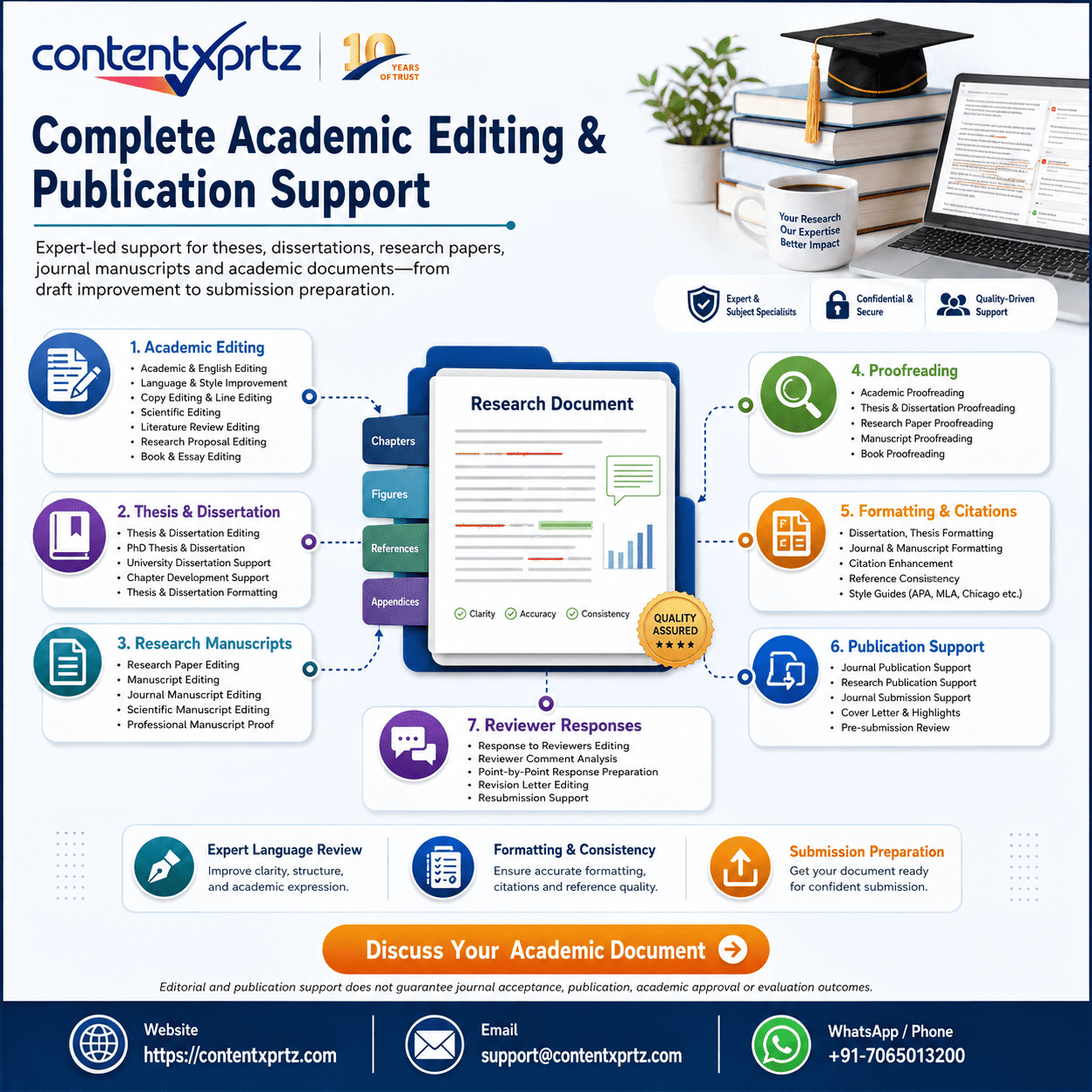
Contentxprtz is most useful when you already own the research problem and need structured academic help to communicate it well. Depending on the project and applicable rules, support can focus on language clarity, manuscript organisation, reference consistency, formatting, literature-review presentation, reviewer-response clarity, and journal-readiness.
The working principle is author responsibility. Editing should not fabricate findings, hide a contributor, manufacture citations, or promise an academic outcome. Researchers remain responsible for their data, sources, analysis, claims, and final submission. This is especially important for theses, dissertations, assessed coursework, and research articles where authorship carries formal accountability.
Need help improving your own research paper?
Use expert research paper assistance for clarity, structure, editing, referencing, and publication readiness while keeping your authorship and research decisions central.
Summary: Buying Research Paper Support Without Buying Authorship
The phrase “buying research paper” hides an important distinction. Purchasing a finished paper to submit under your own name can misrepresent authorship and create academic-integrity risks even when the paper is custom written. Purchasing permitted editing, proofreading, coaching, formatting, reference review, or specialist consultation can be legitimate when the researcher remains responsible for the intellectual work.
The safest decision is to define the real problem, check the applicable policy, choose a narrow and transparent support service, verify every source and claim, protect confidential information, and keep a revision trail. If you cannot explain or defend the final manuscript, it is not ready to carry your name.
Frequently Asked Questions
Is buying research paper content academically acceptable?
Buying a completed research paper and submitting it as your own is generally not academically acceptable because the submitted work does not transparently represent your authorship, research process, or intellectual contribution. Universities and publishers set their own rules, but the central integrity issue is misrepresentation: a reader, examiner, supervisor, or editor is led to believe that you performed work that another person produced. This can overlap with contract cheating, undisclosed ghostwriting, plagiarism, or false authorship depending on the circumstances and policy involved. A safer alternative is to pay for permitted support that leaves the intellectual work with you, such as language editing, proofreading, formatting, reference checks, statistical consultation, or structured coaching. Before using any external service, read your university, funder, employer, or target journal policy and ask what assistance must be disclosed. Keep your notes, data, drafts, and revision history so you can explain how the paper developed. Ethical research support should make your own work clearer and more rigorous; it should not manufacture authorship or conceal who actually created the research argument.
What is the difference between buying a research paper and paying for research paper assistance?
The difference is who owns and performs the core intellectual work. Buying a paper usually means receiving a finished or substantially finished manuscript intended to stand in for your own research or writing. Ethical research paper assistance supports a paper that remains yours. A legitimate editor may improve grammar, clarity, structure, formatting, references, or consistency, while a research consultant may explain methods, help organise a literature search, or point out gaps that you must resolve. The author should still understand the sources, defend the reasoning, verify the data, approve every claim, and remain accountable for the final submission. In journal publishing, authorship also carries responsibility, not merely credit. ICMJE guidance, for example, links authorship to substantial contribution, critical drafting or review, final approval, and accountability. If a service cannot explain exactly what it will change, who will do the work, what you must review, and whether disclosure may be required, treat that as a warning sign. Choose transparent assistance rather than replacement authorship.
Can I buy a research paper only as a sample or learning example?
A purchased sample can be less problematic than submitting purchased work, but you still need to handle it carefully. First, check your institution's rules because some universities restrict the use of contract-cheating services even when the buyer says the material is only for reference. Second, do not copy sentences, arguments, data, references, tables, or analysis into your own paper without appropriate permission and attribution. Third, do not assume that the sample is accurate. Commercially produced papers can contain weak reasoning, invented references, outdated sources, fabricated data, or citation errors. A safer learning route is to use instructor-provided exemplars, published open-access papers, university writing-centre models, reporting guidelines, or an editor who comments on your own draft. If you do obtain any external model, use it to study high-level features such as section order or paragraph function, then close it and write from your own evidence and notes. Your final work should be traceable to sources you actually read and analysis you can explain.
Will plagiarism software detect a bought research paper?
Plagiarism software cannot reliably determine whether a paper was bought. Similarity tools compare text against collections of published, submitted, or web-accessible material and highlight matching or similar passages; they do not prove authorship or the commercial origin of a manuscript. A custom-written purchased paper may show a low similarity score and still violate academic integrity rules because the problem can be undisclosed authorship or contract cheating rather than copied text. Conversely, a legitimate paper may show matches for references, technical phrases, quotations, or methods language. Institutions increasingly look beyond a single similarity percentage and may consider writing history, source use, oral defence, document metadata, abrupt changes in style, unverifiable citations, or inconsistencies between the submitted work and the author's demonstrated knowledge. The correct goal is not to make a bought paper 'pass' a detector. The goal is to produce and document your own research, cite sources accurately, and use permitted editing transparently. Similarity checking should support review, not become a substitute for authorship and integrity.
What are the main risks of buying a research paper online?
The main risks are academic misrepresentation, poor research quality, privacy exposure, financial loss, and loss of control over the manuscript. A seller may recycle the same paper, reuse your topic for another customer, include fabricated citations, invent data, or produce writing that does not match your course or discipline. You may also be unable to explain the methodology or defend the argument in a viva, supervisor meeting, peer-review response, or workplace discussion. If personal data, unpublished findings, participant information, or confidential institutional material is uploaded to an unknown provider, confidentiality can become another concern. There is also a practical authorship risk: a person who has not participated in the research cannot reliably know why particular exclusions, coding decisions, analytical choices, or interpretations were made. Before paying anyone, define the allowed scope of support, remove unnecessary sensitive information, check confidentiality terms, and insist that references be authentic and traceable. Prefer services that work on your draft and return tracked, explainable revisions rather than opaque replacement content.
Can a professional editor rewrite my research paper without violating academic integrity?
A professional editor can often revise language and presentation ethically, but the permitted level of intervention depends on your institution, discipline, assessment rules, and target journal. Commonly acceptable services include proofreading, grammar correction, consistency checks, formatting, reference-style correction, readability improvements, and comments that identify unclear logic. More substantive editing may also be acceptable when it helps the author reorganise or clarify their own ideas without introducing undisclosed original arguments, data, interpretations, or conclusions. The safest workflow uses tracked changes or an equivalent audit trail so you can review every edit and restore your intended meaning where necessary. For assessed student work, ask whether third-party editing must be declared. For journal submissions, check the journal's author and contributor policies. Ethical editing should increase clarity while preserving author responsibility. If the editor becomes the person who creates the research question, invents evidence, writes analysis you cannot defend, or materially determines the conclusions without appropriate credit, the relationship has moved beyond ordinary editing and may require attribution, disclosure, or authorship consideration.
Is ghostwriting the same as plagiarism in research publishing?
Ghostwriting and plagiarism overlap in some situations, but they are not identical concepts. Ghostwriting usually refers to substantial writing or intellectual contribution that is not transparently credited, while plagiarism concerns appropriating another person's ideas, processes, results, or words without appropriate credit. The U.S. Office of Research Integrity distinguishes plagiarism from many authorship disputes, and publisher policies may use additional categories such as ghost, guest, or gift authorship. This is why researchers should not rely on one label alone when evaluating a paid writing arrangement. Ask two practical questions: who made the intellectual contribution, and is that contribution represented honestly to the reader? If someone substantially shaped the paper but is hidden, there may be an authorship or disclosure problem even when no sentence was copied from a published source. If text or ideas are taken without credit, plagiarism concerns may also arise. The safest practice is transparent contribution records, authentic citations, clear acknowledgements where appropriate, and compliance with the specific authorship rules of the institution or journal.
What should I do if I already bought a research paper?
Do not submit it as your own simply because you have already paid for it. Pause and separate the commercial transaction from your academic obligations. Review your university, supervisor, employer, or journal policy; then determine whether the material can be used at all, for example only as a private learning aid, or whether it should be discarded. Do not copy its wording, references, data, or argument into your submission unless you have a legitimate, policy-compliant reason and can attribute the material appropriately. If you have a deadline, contact your supervisor, instructor, writing centre, or academic support office and ask for an extension or permitted assistance rather than compounding the problem. Build a fresh outline from the assignment or research question, locate and read authentic sources yourself, and write from your own notes. If language is the main barrier, use transparent proofreading or editing on your own draft. Keeping your search log, source notes, data files, analysis, and revision history will make the new work easier to defend and demonstrate.
How can I get research writing help without buying authorship?
Use support that strengthens your process rather than replacing it. You can ask a librarian to refine database searches, a supervisor to challenge your research question, a statistician to explain an analysis plan, a writing centre to review argument structure, or a professional editor to improve language and consistency. You can also use a reference manager, reporting checklist, style guide, or structured feedback rubric. The key is to preserve a clear line between assistance and authorship: you should select and read the evidence, make the research decisions, interpret the results, and approve the final claims. When receiving specialist input, record what was advised and what you changed. For journal manuscripts, use contributor statements or acknowledgements where required. Contentxprtz can provide research paper assistance focused on editing, structure, readability, referencing, and publication readiness while keeping author responsibility central. Before commissioning support, provide the service with your institution or journal rules so the scope can be adjusted to what is permitted.
What should I check before choosing an academic editing or research support service?
Check transparency, scope, expertise, confidentiality, revision practices, and ethics before you pay. A credible service should explain whether it provides proofreading, copyediting, substantive editing, formatting, literature-search support, statistical consultation, or another clearly defined service. It should not promise guaranteed grades, guaranteed journal acceptance, guaranteed publication, or undetectable ghostwriting. Ask whether editors use tracked changes, whether references are verified or merely formatted, how sensitive files are handled, and whether your material will be reused. Confirm that the service is willing to work within university or journal policies and that you remain responsible for the research, data, citations, and final submission. For discipline-specific work, check whether the editor understands the subject area and the required citation or reporting style. Finally, inspect the deliverables: useful support should leave you with a stronger manuscript and a clear record of revisions you understand. If the process is intentionally opaque or designed to conceal third-party authorship, choose another provider.
Conclusion: Choose Support You Can Defend
The practical problem behind buying a research paper is usually not laziness; it is pressure. Researchers may be facing a close deadline, unfamiliar methods, language barriers, a difficult literature review, or uncertainty about publication standards. Those are real problems, but replacement authorship creates a second problem instead of solving the first.
Free or self-service support may be enough when you can use university writing centres, library guidance, style manuals, reference managers, reporting checklists, supervisor feedback, or careful self-editing. Expert-assisted support becomes useful when the manuscript needs specialist language editing, structural review, reference consistency, methodological consultation, or publication preparation. The key is that the service should improve work you understand and own.
Contentxprtz supports researchers with ethical editing, proofreading, academic writing guidance, and publication-readiness services designed to strengthen clarity and structure while preserving author responsibility. Academic integrity matters because a research paper is not only text; it is a claim of contribution and accountability.
“At Contentxprtz, we don’t just edit; we help ideas reach their fullest potential.”