Applied Physics A: A Practical Manuscript and Submission Guide
Applied Physics A is commonly searched by researchers who need more than a journal name. They want to know whether their study fits the journal, how to prepare the manuscript, what editors may expect, and how to avoid a preventable desk rejection. For a PhD scholar or early-career physicist, this decision can be difficult because a paper may sit between materials science, applied physics, surface science, nanotechnology, energy research, device engineering, and physical chemistry. The challenge is not merely selecting a journal that publishes similar keywords. It is showing that the manuscript makes a clear, original, and well-supported contribution for the journal’s actual readership.
A strong submission begins with scope fit. Researchers should compare the central question, material system, physical mechanism, methods, and application relevance with the journal’s current aims and scope. They should then inspect recent articles, not to imitate their language, but to understand the level of physical interpretation, novelty, and evidence typically expected. This step matters because technically correct work can still be unsuitable when it is mainly routine synthesis, narrow optimisation, or engineering performance reporting without a substantial physics contribution.
Preparation also requires more than grammar correction. The abstract must state the research problem and principal result clearly. The introduction must establish a genuine gap. Methods must be reproducible. Results and discussion must connect evidence to physical interpretation without overstating causality. Figures, equations, symbols, references, declarations, and supplementary files must be internally consistent. Authors should also follow the current Applied Physics A submission guidelines, because publisher requirements can change.
For researchers writing in an additional language, editorial support may help the manuscript communicate its science more precisely. Contentxprtz offers contextual academic editing services and manuscript editing and publication support while preserving author responsibility. Ethical editing can improve clarity, structure, consistency, and journal readiness, but it cannot create data, novelty, or guaranteed acceptance.
Quick Answer: What Is Applied Physics A?
Applied Physics A is a Springer Nature peer-reviewed journal publishing experimental and theoretical work in applied physics and materials science. Researchers should consider it when the manuscript presents an original physical insight, method, material behaviour, processing advance, or application that fits the journal’s current scope.
Before submission, confirm scope fit, strengthen the novelty statement, prepare a complete and reproducible manuscript, check figures and references, and follow the official journal instructions. The journal’s current publisher pages—not old templates or third-party summaries—should be treated as the primary source.
The most important caution is that topical similarity alone is not enough. Editors also assess originality, scientific quality, presentation, ethics, and relevance to readers.
Key Takeaways
- Applied Physics A publishes peer-reviewed research in applied physics and materials science.
- Scope fit depends on the manuscript’s central contribution, not only its keywords.
- Originality should be expressed through a clear research gap and supported physical interpretation.
- Methods, figures, equations, references, and declarations must be complete and consistent.
- A tailored cover letter should explain contribution and journal fit without exaggerated claims.
- Authors remain responsible for data, citations, ethics, and every final submission decision.
- Professional editing may improve clarity and readiness but cannot guarantee peer-review outcomes.
What This Page Covers
- How to interpret the journal’s aims and scope
- How to decide whether a manuscript is a credible fit
- How to structure and present an applied-physics paper
- How to prepare figures, equations, references, and supporting files
- How to write a useful cover letter and respond to reviewers
- How to avoid common scientific and editorial mistakes
- When ethical manuscript support may be useful
Methodology and Academic Sources
This guide is based on the journal’s current Springer Nature pages, common physics-manuscript workflows, and established publication-ethics principles. The journal describes itself as publishing experimental and theoretical research in applied physics and materials science. Authors should verify all requirements directly before submission because policies, article types, file expectations, and publishing options may change.
The ethical guidance in this article is consistent with the Committee on Publication Ethics guidance. Researchers should also follow their institution’s rules, funder requirements, laboratory data policies, and any discipline-specific standards.
What Applied Physics A Means in an Academic Context
The journal sits at the intersection of physical understanding and practical materials or technology problems. A suitable paper normally explains not only what changed in an experiment, but why it changed, what physical mechanism is supported, how the evidence was obtained, and why the result matters.
That distinction is important. A manuscript can contain microscopy, spectroscopy, electrical measurements, optical testing, or computational modelling and still be too descriptive. Editors and reviewers need a coherent scientific argument connecting the research question, methods, evidence, interpretation, and contribution.
| Assessment area | Stronger alignment | Weaker alignment |
|---|---|---|
| Research question | Addresses a defined physical or materials problem | Reports measurements without a clear question |
| Novelty | Shows conceptual, mechanistic, methodological, or application advancement | Claims novelty because an exact combination was not previously reported |
| Interpretation | Links observations to supported physical mechanisms | Lists trends with little explanation |
| Evidence | Uses appropriate controls, statistics, uncertainty, and comparison | Relies on isolated performance values |
| Relevance | Explains why Applied Physics A readers need the result | Uses broad statements about future applications |
How to Decide Whether Your Manuscript Fits Applied Physics A
Begin with the manuscript’s single most important contribution. Express it in one sentence without promotional language. If the sentence is unclear, the paper may not yet be ready for journal selection.
1. Identify the physical contribution
State what new physical understanding, processing approach, characterisation insight, materials behaviour, device principle, or application evidence the study provides. Separate this from the fact that a particular sample or composition is new.
2. Compare the study with the official scope
Match the central contribution with the journal’s current topic areas. Do not rely only on database categories. The official scope and recent journal content provide a more useful picture of editorial relevance.
3. Review recent comparable papers
Look for recent articles using similar techniques, material classes, or physical questions. Assess the depth of analysis and discussion. This is a fit exercise, not a reason to add irrelevant citations.
4. Test the abstract for editor readability
An editor should quickly understand the problem, method, principal result, novelty, and significance. If the abstract is dominated by procedural details or unexplained abbreviations, revise it before submission.
Free, Low-Cost, and Professional Preparation Options
Many authors can complete a strong initial check using free publisher resources, institutional writing support, co-author review, reference-management software, and laboratory peer feedback. These options are often enough when the science is well developed and the manuscript is already clear.
Low-cost support may include university language centres, departmental workshops, or structured peer review. Professional help becomes more useful when the manuscript is interdisciplinary, written in an additional language, repeatedly rejected for presentation, or affected by inconsistent figures, references, terminology, and argument flow.
The correct distinction is not “free versus paid” but “surface correction versus expert-level manuscript risk.” A grammar checker may identify sentence-level errors, but it cannot reliably judge whether a novelty claim is supported, a discussion overstates causality, or a paper’s framing matches a specific physics journal.
When Self-Editing Is Enough and When Expert Review Is Safer
Self-editing is often enough when the manuscript has been carefully reviewed by all co-authors, the journal fit is clear, the English is readable, and the files meet current requirements. Use a professional review when communication problems may prevent editors or reviewers from understanding otherwise credible work.
- Self-editing may be enough: minor grammar issues, a short reference check, or a clearly structured paper with experienced co-authors.
- Expert editing may help: unclear novelty framing, repetitive discussion, inconsistent terminology, weak abstract, or ESL language barriers.
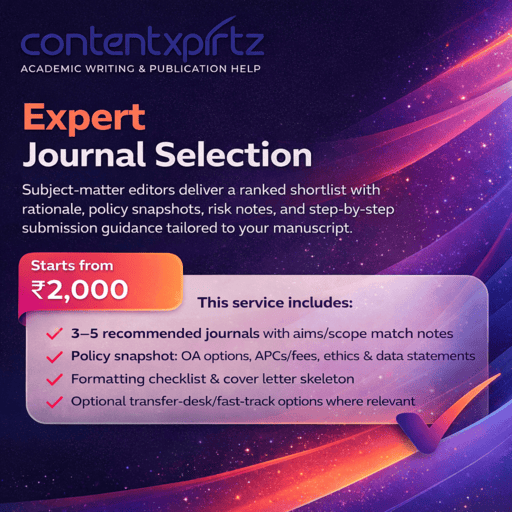
- Publication support may help: journal-fit uncertainty, complex submission files, cover-letter preparation, or reviewer-response organisation.
Ethical Academic Editing and Author Responsibility
Editing should improve communication without replacing the authors’ scientific decisions. Authors remain responsible for originality, data integrity, calculations, interpretations, citations, authorship, disclosures, and final approval.
Do not use editing or AI tools to fabricate references, hide duplicated work, invent data, create unsupported mechanisms, or generate responses that the authors have not verified. Follow the journal’s current policies and broader principles of transparency in scholarly publishing.
Step-by-Step Guidance for an Applied Physics A Submission
Step 1: Confirm originality and contribution
Define the research gap and the specific advance. Check that all claims are supported by the actual evidence and that related work from the research group is disclosed and cited appropriately.
Step 2: Build a precise title and abstract
The title should identify the material, process, phenomenon, or device without unnecessary promotional terms. The abstract should state the problem, approach, main quantitative or qualitative result, physical interpretation, and significance.
Step 3: Strengthen the introduction
Move from the field-level problem to the specific unresolved issue. Avoid a long catalogue of studies. End with the study objective, approach, and contribution.
Step 4: Make methods reproducible
Report materials, equipment, settings, sample preparation, controls, analysis methods, uncertainty, and software where relevant. Explain any non-standard procedure.
Step 5: Organise results around questions
Group results logically rather than chronologically. Use figures to show evidence and prose to interpret it. Do not repeat every number in both a table and paragraph.
Step 6: Develop a physics-led discussion
Explain mechanisms cautiously, compare with relevant literature, address alternative interpretations, and identify limitations. Distinguish correlation from causation.
Step 7: Audit figures, equations, and units
Check axis labels, units, legends, scale bars, significant figures, symbol definitions, equation numbering, and consistency between text and graphics.
Step 8: Complete references and declarations
Verify every citation against the source. Add funding, conflicts, author contributions, data availability, ethics, and other declarations required by the journal.
Step 9: Prepare a tailored cover letter
Explain the contribution and fit briefly. Confirm originality and avoid simultaneous submission. Do not make claims that cannot be substantiated.
Step 10: Conduct a final submission audit
Open every file, check metadata, confirm author names and order, verify the corresponding author’s details, and review the final PDF generated by the submission system.
Common Mistakes to Avoid
- Choosing the journal because of one matching keyword
- Claiming novelty without explaining scientific significance
- Submitting a descriptive characterisation paper with limited physical interpretation
- Using unsupported causal language
- Repeating the same data in text, tables, and figures
- Leaving symbols, abbreviations, or equations undefined
- Uploading unreadable figures or incomplete captions
- Using references that were not checked against the original source
- Failing to align the abstract, conclusion, and actual results
- Submitting simultaneously to another journal
Practical Examples
Example 1: A PhD scholar with a thin-film manuscript
Situation: The researcher has extensive structural and optical characterisation data. Confusion: The draft describes every measurement but does not define the physical question. Correct approach: Reorganise the paper around the relationship between processing, structure, and optical behaviour, then support the proposed mechanism with evidence and limitations. Ethical guidance: An editor can improve argument flow and terminology without altering the data or scientific conclusion.
Example 2: A first-time author reporting a nanocomposite
Situation: The author claims novelty because the exact composition has not been published. Confusion: Compositional novelty is treated as sufficient. Correct approach: Explain the physical advance, quantify the improvement, compare with relevant systems, and show why the mechanism or application matters. Ethical guidance: A journal-fit review can flag overclaiming and help the author present a defensible contribution.
Example 3: An ESL research team responding to reviewers
Situation: The team has completed additional analysis but the response letter sounds defensive. Confusion: Scientific disagreement is expressed as rejection of the reviewer. Correct approach: Answer each point respectfully, cite the revised location, and justify any disagreement with evidence. Ethical guidance: Language editing can improve tone and precision while leaving all scientific decisions with the authors.
Applied Physics A Submission-Readiness Checklist
- The manuscript’s main contribution fits the current journal scope.
- The title and abstract communicate the physical problem and principal result.
- The introduction states a specific research gap.
- Methods are sufficiently detailed and reproducible.
- Results are supported by appropriate controls, uncertainty, and analysis.
- The discussion explains physical meaning without overstating conclusions.
- Figures, equations, symbols, units, and captions are consistent.
- Every in-text citation has a verified reference entry.
- Funding, conflicts, author contributions, and data statements are complete.
- All authors approve the final manuscript and author order.
- The cover letter is tailored and ethically accurate.
- The submission-system PDF has been checked before final approval.
How Contentxprtz Can Help
Contentxprtz can support researchers with ethical manuscript assessment, subject-aware editing, language polishing, journal-fit review, figure-caption checks, reference consistency, cover-letter preparation, and reviewer-response editing.
The service is most useful when a credible study is difficult to follow because of structure, language, inconsistent terminology, or submission complexity. It does not replace author judgement, peer review, or publisher decisions.
Summary: Applied Physics A
Applied Physics A is a peer-reviewed journal for research in applied physics and materials science. A successful submission begins with genuine scope fit and a clearly demonstrated physical contribution. Authors should prepare a reproducible, logically argued manuscript; present figures, equations, and references consistently; complete all declarations; and follow current Springer Nature instructions.
Self-review and free publisher guidance may be enough for an experienced team with a clear manuscript. Expert editing is more useful when language, structure, novelty framing, or submission details may obscure the science. In every case, authors remain responsible for the research and final submission.
Frequently Asked Questions
What is Applied Physics A?
Applied Physics A is a peer-reviewed Springer Nature journal focused on experimental and theoretical research in applied physics and materials science. Its scope includes work where physical principles are used to understand, design, process, characterise, or improve materials, devices, surfaces, interfaces, and related technologies. A manuscript should do more than mention an application: it should present original research, a clear physical contribution, and results that matter to the journal’s readership. Authors should compare their topic with the journal’s current aims, scope, keywords, and recently published articles before submission. Scope fit is assessed by editors, so a technically sound paper may still be unsuitable when its main contribution belongs more naturally to chemistry, engineering, optics, or another specialised field. The safest approach is to frame the research question, mechanism, material system, method, and practical relevance clearly in the title, abstract, introduction, and cover letter.
What research topics are suitable for Applied Physics A?
Suitable topics generally connect applied physics with materials science, processing, characterisation, surfaces, interfaces, nanostructures, functional materials, thin films, devices, energy-related materials, optical or electronic behaviour, and other areas listed in the journal’s current scope. The key test is not whether a paper contains physics terminology, but whether the central contribution advances understanding or application of physical phenomena in a way that is relevant to the journal. Authors should review the official aims and scope and inspect recent papers that use comparable methods or address similar material systems. A manuscript may be less suitable when it is mainly a routine synthesis report, a narrow optimisation study without physical interpretation, or an engineering performance paper with limited physics insight. Because journal coverage can evolve, authors should verify the current publisher page rather than rely on an old journal list, a third-party database, or a previous colleague’s experience.
How do I assess scope fit before submitting?
Start by writing a one-sentence statement of the manuscript’s main contribution. Then compare that statement with the journal’s aims and scope, topic keywords, and recent articles. Strong scope fit usually appears when the research question, methods, physical mechanism, and application context align with work the journal regularly publishes. Check whether your abstract makes the applied-physics contribution obvious in the first few sentences. Also identify two to five recent journal articles that are genuinely related to your study; these can help you judge audience fit and position your novelty without forced citation. If the manuscript is interdisciplinary, explain why Applied Physics A readers specifically need the findings. A pre-submission assessment can identify gaps in novelty framing, excessive disciplinary jargon, or an unclear connection between data and physical interpretation. However, no assessment can guarantee editorial acceptance, because editors also consider quality, originality, presentation, ethics, and current priorities.
What should an Applied Physics A manuscript contain?
A research manuscript should normally present a clear title, informative abstract, relevant keywords, well-structured introduction, reproducible methods, logically organised results, evidence-based discussion, concise conclusion, complete declarations, and accurate references. Figures and tables should be readable, necessary, correctly numbered, and discussed in the text. The introduction should define the problem, explain the research gap, and state the contribution without becoming a broad textbook review. Methods should provide enough detail for evaluation and, where possible, replication. Results should separate observed evidence from interpretation, while the discussion should explain mechanisms, limitations, comparison with prior work, and practical significance. Authors must follow the journal’s current submission guidelines for file preparation, declarations, data availability, supplementary information, and reference presentation. The final submission should also include any required cover letter and supporting files.
Does Applied Physics A require a specific manuscript format?
Authors should follow the journal’s current Springer Nature submission guidelines rather than assume that an old template or third-party format remains valid. The publisher may allow flexible initial submission in some situations, but required components, declarations, figure standards, file types, and reference information still need careful attention. Use consistent headings, symbols, units, abbreviations, equations, and citation formatting throughout the manuscript. Prepare figures at publication-quality resolution, ensure labels remain legible after reduction, and explain all symbols in captions. Tables should present data efficiently rather than duplicate figures or prose. Before uploading, check the submission system for mandatory fields and separate-file requirements. Formatting support is useful when a technically strong manuscript has inconsistent notation, incomplete declarations, poor figure captions, or reference-list errors, but the author remains responsible for scientific accuracy and compliance.
How important are novelty and physical interpretation?
Novelty and physical interpretation are central because the journal expects original research that adds meaningful information. A paper that reports only a new material composition, a small performance increase, or another routine characterisation set may appear incremental unless the authors explain the underlying physics and significance. The manuscript should identify what was unknown, what the study demonstrates, how the evidence supports the proposed mechanism, and why the result matters beyond the immediate experiment. Avoid claiming novelty solely because a precise combination of variables has not been reported before. Instead, show conceptual, methodological, mechanistic, or application-level advancement. Compare results fairly with the most relevant literature, acknowledge limitations, and avoid overstating causality. Strong editing can improve the visibility of a genuine contribution, but it cannot manufacture novelty that the research does not contain.
What should the cover letter include?
A useful cover letter identifies the manuscript title and article type, states the central contribution in plain language, explains why the paper fits Applied Physics A, and confirms important ethical points such as originality and absence of simultaneous submission. It should be concise and tailored to the journal. Mention the material system, physical problem, principal finding, and relevance to the journal’s readers. Avoid repeating the full abstract, making exaggerated claims, listing every experimental result, or using generic praise of the journal. Where appropriate, disclose related manuscripts, preprints, conflicts of interest, or other information requested by the publisher. Suggested or opposed reviewers should be handled only according to the journal’s policy and must not involve fabricated identities or inappropriate relationships. A strong cover letter helps editors understand fit quickly, but it does not replace a clear title, abstract, and manuscript.
How should authors respond to peer-review comments?
Respond point by point in a calm, evidence-based document. Copy or paraphrase each reviewer comment, then explain exactly what was changed and where it appears in the revised manuscript. When you agree, make the revision fully rather than responding only with thanks. When you disagree, provide a respectful scientific reason supported by data, analysis, literature, or scope limitations. Distinguish between changes to the manuscript and explanations that belong only in the response letter. Highlight revisions if the journal requests this, and check that new text does not create contradictions elsewhere. Do not dismiss reviewers, conceal unresolved issues, or promise experiments that were not performed. Reviewer-response editing can improve clarity and tone, while authors must make all scientific decisions and approve the final response.
What publication ethics rules should authors follow?
Authors should submit original work, avoid simultaneous submission, report data honestly, cite sources accurately, disclose relevant funding and conflicts, and assign authorship only to people who meet accepted contribution criteria. Image manipulation, duplicate publication, fabricated data, hidden text reuse, invented references, and false reviewer identities are serious concerns. All authors should approve the manuscript and author order before submission. Any use of AI tools should comply with current publisher and institutional policies, and generated text, references, calculations, or interpretations must be carefully verified. Editing may improve language and presentation, but it should not replace the authors’ scientific reasoning or hide unreliable research practices. Authors remain responsible for the accuracy of every claim, dataset, figure, citation, declaration, and uploaded file.
When is professional editing useful before submission?
Professional editing is useful when the research is complete but the manuscript’s language, structure, argument, figures, references, or journal alignment may obscure its contribution. It can be especially valuable for interdisciplinary teams, first-time corresponding authors, and researchers writing in an additional language. A subject-aware editor can flag unclear methods, inconsistent terminology, weak transitions, unsupported claims, figure-caption gaps, or mismatches between the abstract and results. Journal-readiness support may also help organise declarations, references, cover letters, and reviewer responses. Ethical support does not guarantee acceptance and should not invent data, citations, novelty, or scientific conclusions. The authors must review every change, preserve the intended meaning, and take final responsibility for the submitted work.
Conclusion
The central challenge is not simply formatting a paper for Applied Physics A. It is demonstrating that the study belongs in the journal, makes an original and relevant contribution, and communicates its evidence with precision. Free self-checking is often sufficient for straightforward corrections. Expert-assisted editing or publication support is safer when unclear language, weak structure, inconsistent figures, or journal-fit uncertainty could interfere with editorial assessment.
Contentxprtz helps researchers improve clarity, coherence, ethics, and publication readiness without replacing the author’s scientific responsibility. Academic integrity remains essential because every claim, dataset, citation, and conclusion must be authentic and approved by the authors.
Need a structured journal-readiness review? Explore publication-ready manuscript support for ethical assistance with journal fit, editing, formatting, and submission preparation.
“At Contentxprtz, we don’t just edit; we help ideas reach their fullest potential.”