Academic Paper: How to Plan, Write, Edit and Submit Research
An academic paper is more than a formal document with citations. It is a structured piece of scholarly communication in which a student, researcher, or professional defines a focused problem, uses appropriate evidence, explains a line of reasoning, and allows readers to trace how the conclusion was reached. Depending on the context, the paper may report original research, synthesize a body of literature, defend a theoretical position, analyze a case, evaluate a method, or answer a university assignment question. The exact format changes by discipline and destination, but the underlying standard is consistent: claims need evidence, evidence needs interpretation, borrowed ideas need attribution, and the author remains responsible for the final work.
That sounds straightforward until the writing begins. Many papers become difficult because the real problem appears before sentence-level writing: the topic is too broad, the research question is unstable, the evidence has not been organized, the outline reflects headings rather than an argument, or the author starts polishing paragraphs before deciding what the paper actually needs to prove. PhD scholars may also be carrying several years of reading into one chapter or article. Early-career researchers may be adapting a thesis into a journal manuscript for the first time. Authors writing in an additional language can understand their subject deeply yet still struggle to present that expertise with the clarity and compression expected by reviewers.
A practical academic writing process therefore moves in stages. First, define the purpose and destination. Next, identify the evidence required, build a defensible structure, draft from an outline, and keep interpretation close to the evidence that supports it. Only after the intellectual structure is stable should the paper move through substantive editing, language editing, reference checks, formatting, and final proofreading. For empirical studies, reporting guidelines may shape what information must be presented. For assessed work, the university rubric and academic-integrity policy take priority. For journal manuscripts, the target journal's author instructions should be consulted early rather than treated as a last-minute formatting checklist.
This guide takes a people-first approach to the full process: understanding what an academic paper is, choosing a structure, writing each major section, using citations responsibly, avoiding common mistakes, preparing examples and checklists, and deciding when self-editing is enough. Where professional support is useful, Contentxprtz research paper support is presented as an ethical assistance option, not as a substitute for the researcher's ideas, data, analysis, or authorship responsibilities.
Quick Answer: What Is an Academic Paper?
An academic paper is a formal scholarly document that communicates a reasoned response to a research question, problem, or intellectual task. It normally combines a clear purpose, relevant evidence, explicit analysis, appropriate citation, and a structure suited to the discipline or publication venue.
To write one well, begin with the requirements and research question rather than the introduction. Build an evidence map, choose a structure that fits the paper type, draft the argument section by section, and revise first for logic and evidence before polishing grammar. The safest final check is against the destination: university rubric for assessed work, author instructions for a journal, and relevant reporting or ethics guidance where applicable.
The most important caution is that polished language cannot repair weak evidence or unclear reasoning. Academic editing should improve communication without replacing the author's intellectual contribution, and every citation, claim, table, figure, and conclusion must remain traceable and defensible.
Key Takeaways
- An academic paper is defined by evidence, reasoning, transparency, and attribution—not by complicated vocabulary.
- The research question or purpose should determine the paper's structure, evidence, and level of detail.
- Different paper types require different formats; IMRAD is common for original empirical research but is not universal.
- Drafting becomes easier when sources, data, claims, and counterarguments are organized before prose is polished.
- Citations must support specific claims and should be verified against original, traceable sources.
- Editing should move from content and logic to language, formatting, and final proofreading.
- Authors remain responsible for research integrity, AI-assisted material, citations, analysis, and final submission.
What This Page Covers
- What academic papers are and how they differ from other forms of writing
- How to move from a broad topic to a focused research question and outline
- Common structures for empirical, review, theoretical, and analytical papers
- A step-by-step academic paper writing and revision workflow
- Citation, source evaluation, AI-use, and academic-integrity considerations
- Practical examples, mistakes to avoid, and a submission-readiness checklist
- When self-editing is enough and when ethical professional editing may help
Table of Contents
Methodology and Academic Sources
This article reflects common academic writing, editing, and publication-readiness workflows and uses established scholarly guidance as reference points. The ICMJE manuscript-preparation recommendations describe the widely used IMRAD pattern for original research while emphasizing that other article types need different formats. The EQUATOR Network maintains reporting guidelines designed to improve transparent research reporting, particularly in health research. Writers who use APA should consult the APA Style and Grammar Guidelines, while bibliographic metadata can be checked through authoritative records such as Crossref metadata services.
These sources do not replace local rules. University policies, assignment rubrics, journal author instructions, discipline-specific reporting standards, ethics requirements, and publisher policies may differ. Before submission, the author should verify the requirements that apply to the exact document being prepared.
What an Academic Paper Means in Practice
An academic paper is a piece of scholarly communication built so another reader can understand not only what you claim but why the claim is reasonable. That makes it different from promotional writing, informal opinion, or a simple summary of sources. The paper must establish a question or purpose, select relevant evidence, explain the method of interpretation, and show how the conclusion follows from the material presented.
The word academic does not mean every sentence should sound complex. In fact, dense wording often hides weak reasoning. Effective scholarly prose is precise: it uses technical terms where they are necessary, defines concepts where ambiguity would matter, distinguishes correlation from causation, separates findings from speculation, and signals the limits of the evidence.
The word paper is also broad. A first-year student essay, a doctoral literature review, an empirical journal article, a theoretical critique, and a conference paper can all be academic documents, yet they should not be written from one universal template. The destination determines the appropriate conventions.
Why Students, PhD Scholars, and Researchers Struggle with Academic Papers
The most difficult part is usually not grammar. It is managing several intellectual tasks at once: reading critically, deciding what matters, designing a defensible argument, handling contradictory evidence, meeting methodological expectations, and explaining the contribution without overstating it. Deadlines intensify those pressures.
Students often begin with a topic instead of a question. Doctoral researchers may have too much material and find it hard to decide what belongs in one paper. Early-career authors may write a manuscript like a thesis chapter, giving extensive background before reaching the contribution. Experienced researchers can also struggle when writing for a different discipline, adapting to an unfamiliar journal, or responding to reviewers who expect a clearer explanation of decisions already obvious to the authors.
Writers working in an additional language face a separate challenge: the research can be strong even when sentence-level expression makes the argument appear less confident or coherent. Ethical academic editing can improve clarity in such cases, but it should never fabricate intellectual content or obscure who is responsible for the work.
How to Choose the Right Academic Paper Structure
The right structure is the one that lets a reader follow the research logic with the least friction. Start by identifying the document type and destination, then map required sections before drafting.
| Paper type | Typical organizing logic | What the reader needs to see |
|---|---|---|
| Original empirical research | Introduction, Methods, Results, Discussion, plus journal-required front/back matter | Research problem, transparent method, findings, interpretation, limitations |
| Literature review | Purpose, search/selection approach where relevant, thematic or methodological synthesis, gaps, conclusion | How literature was selected, where studies agree or conflict, what remains unresolved |
| Theoretical or conceptual paper | Problem framing, concepts, propositions or critique, implications | Logical development, engagement with existing theory, clear contribution |
| Analytical university paper | Thesis, evidence-based sections, counterargument/evaluation, conclusion | Direct response to the task, use of course literature, independent analysis |
| Case study | Context, case description, analytical framework, evidence, interpretation, lessons | Why the case matters and how conclusions are supported |
IMRAD is useful because it mirrors a common empirical logic: why the study was needed, what was done, what was found, and what the findings mean. But forcing IMRAD onto a theoretical essay or humanities analysis can make the writing artificial. Likewise, a narrative literature review and a systematic review should not be reported as though their source-selection methods are equivalent.
How to Write an Academic Paper Step by Step
1. Read the destination requirements first
For university work, extract the task verb, word limit, marking criteria, source expectations, citation style, and permitted forms of assistance. For journal work, identify the article type, scope, word limit, abstract format, heading rules, reference style, figure requirements, declarations, reporting checklist, and submission files. This prevents avoidable rewriting later.
2. Convert the topic into a research question or purpose
A broad topic such as “AI in education” is not yet a paper. Narrow it by population, setting, outcome, mechanism, theoretical lens, time period, or controversy. A focused question gives the paper boundaries and helps determine what evidence is relevant.
3. Build a source and evidence map
Do not collect PDFs without a system. For each source, record the full citation, research design, sample or material, main finding, limitation, and the claim in your paper it may support or challenge. Distinguish primary research from reviews, commentary, policy, and grey literature. Verify important references against the original source.
4. Create a claim-based outline
Weak outlines contain topic labels such as “Background,” “Benefits,” and “Challenges.” Stronger outlines state what each section will establish. Ask: what claim does this section make, what evidence supports it, what qualification is needed, and how does it advance the answer to the research question?
5. Draft the central analysis before polishing the opening
Many writers spend too long perfecting an introduction that will change once the argument develops. Draft the analytical core first if that helps you clarify the paper's actual contribution. Use temporary wording where necessary and keep moving until the evidence-to-claim chain is visible.
6. Write an introduction that sets up the paper's logic
A useful introduction establishes context without becoming a textbook chapter. It identifies the problem, shows why the problem matters, indicates what is missing or contested, states the paper's objective or question, and briefly signals the approach or contribution.
7. Report methods and evidence transparently
Where methods apply, readers should have enough information to evaluate what was done. Reporting detail depends on the design. Discipline-specific reporting guidance can help authors identify required information, but it does not replace good study design.
8. Separate results from interpretation when the format requires it
In empirical work, the results section should report findings clearly, while the discussion explains their meaning, comparison with prior work, implications, and limitations. Avoid repeating every table value in prose or turning the discussion into a second literature review.
9. Revise for logic before language
Ask whether the conclusion is actually supported by the evidence presented. Remove sections that are interesting but do not help answer the question. Strengthen transitions where the reasoning jumps. Only then invest heavily in sentence-level editing.
10. Complete a submission audit
Check the final document against the rubric or author instructions. Confirm references, tables, figures, file names, declarations, permissions, ethics information, data statements, supplementary files, and any required cover letter or checklist.
Evidence, Citations, and Academic Integrity
A citation is not decoration. It creates a traceable link between a claim and the source that supports, contextualizes, or challenges it. Good citation practice therefore begins with reading quality and note-taking rather than reference formatting.
When making a factual or interpretive claim, ask what kind of source can reasonably support it. A broad causal claim may need stronger evidence than a descriptive statement. A methodology choice should be justified with methods literature or disciplinary standards. A claim about a specific study should cite that study rather than a secondary source that merely mentions it.
Academic integrity also requires accurate representation. Do not cite a paper based only on its abstract if the argument depends on details in the methods or results. Do not quote a source out of context. Do not cite a review as though it conducted an experiment reported in one of its references. If a source is a preprint, corrected article, or retracted work, represent its status accurately.
Authors using AI-assisted technologies should verify every factual statement, reference, and paraphrase. The ICMJE guidance on AI use by authors emphasizes human responsibility and disclosure where required. Publisher and university rules can differ, so check the policy that applies to your submission.
Free, Low-Cost, and Professional Support Options
Most academic papers should begin with the resources already available to the author. University writing centers, librarians, supervisors, journal author resources, reporting guidelines, reference managers, institutional language support, and peer feedback can solve many problems without paid assistance.
| Support route | Best for | Main limitation |
|---|---|---|
| Self-editing | Clear drafts with manageable language and formatting issues | Authors may overlook gaps because they know the material too well |
| Supervisor or peer feedback | Argument, disciplinary fit, research decisions | Availability and response time may be limited |
| Writing center or librarian | Academic writing strategies, source discovery, citation help | May not provide detailed manuscript-level editing |
| Professional academic editor | Language, structure feedback, consistency, journal formatting, proofreading | Must remain within ethical and institutional boundaries |
Professional support is most useful when the need is clearly defined. A manuscript with unresolved methods or unsupported conclusions requires researcher action, not cosmetic editing. A conceptually sound paper with unclear language, inconsistent terminology, awkward transitions, or reference-format problems may benefit substantially from a qualified editor.
How to Edit and Proofread an Academic Paper
Editing should happen in descending order of importance. First fix the argument; then fix the paragraphs; then fix the sentences; finally fix the punctuation and formatting. Reversing that order wastes time because beautifully proofread paragraphs may later be deleted.
Content and argument edit
Check whether the title, abstract, introduction, analysis, and conclusion describe the same paper. Confirm that major claims are supported and that evidence is not stronger or weaker than the language used to describe it. Identify unanswered objections and unexplained assumptions.
Structural edit
Review section order, paragraph purpose, headings, transitions, and the placement of tables and figures. Each paragraph should have a job. If two adjacent paragraphs perform the same job, combine them or clarify the distinction.
Language edit
Reduce unnecessary nominalizations, vague pronouns, inflated phrases, and long noun strings. Prefer precise verbs. Keep terminology consistent. Define abbreviations at first use unless the target venue states otherwise. For authors seeking a final language-focused review, scholarly proofreading support can be appropriate once substantive revisions are complete.
Reference and formatting audit
Cross-check every in-text citation against the reference list and every reference-list entry against the text. Confirm DOI, author names, year, title, journal or book details, and page information where required. Apply the exact requested citation style rather than a generic approximation.
Final proof
Proofread the rendered submission file, not only the editable document. Look for split tables, missing figure labels, inconsistent heading levels, page-number problems, formatting introduced during conversion, and unresolved comments or tracked changes.
Common Academic Paper Mistakes to Avoid
- Starting with a broad topic instead of a research question. A topic gives subject matter; a question gives direction.
- Treating the literature review as a source-by-source summary. Synthesize patterns, conflicts, methods, and gaps instead.
- Using citations to replace analysis. A paragraph should explain why the cited evidence matters to your argument.
- Overclaiming. Match the strength of your wording to the design and evidence.
- Hiding limitations. Transparent limitations improve interpretability and credibility.
- Editing grammar before resolving logic. Structural revision should come first.
- Relying on generated references without verification. Every reference must be authentic and traceable.
- Ignoring the destination until the end. Journal and university requirements should shape the paper from the beginning.
- Using one writing template for every discipline. Conventions vary across fields and article types.
- Assuming a low similarity score proves originality. Academic integrity depends on attribution and genuine authorship, not a single percentage.
Practical Examples: From Weak Draft to Stronger Academic Paper
Example 1: Broad master's topic becomes a focused question
A student begins with “social media and mental health.” The topic produces hundreds of unrelated sources. After preliminary reading, the student narrows the paper to how passive social-media use is associated with self-reported anxiety among first-year university students. The new question creates boundaries for population, behavior, and outcome, making the literature review and argument more coherent.
Example 2: PhD chapter becomes a journal article
A doctoral researcher has a 14,000-word thesis chapter containing extensive history, theory, methods detail, and several findings. The target journal allows 7,000 words. Instead of trimming every paragraph equally, the researcher defines one central contribution, keeps the methods necessary to evaluate that contribution, moves peripheral analysis out, and rewrites the introduction around the journal audience. The result is not a shortened thesis chapter; it is a redesigned article.
Example 3: ESL researcher separates editing from authorship
An engineering researcher has strong data but reviewers repeatedly comment that the manuscript is hard to follow. The author completes all technical revisions, then uses professional manuscript editing for sentence clarity, terminology consistency, transitions, and formatting. The editor does not invent claims or alter results. The author reviews every change and remains responsible for the manuscript.
Example 4: Citation problem caught before submission
A literature review cites a secondary review for a numerical result originally reported in a primary study. During the reference audit, the writer returns to the original study, confirms the value and study context, corrects the citation, and adjusts the sentence because the secondary review had summarized the finding too broadly. One verification step prevents a misleading claim.
Academic Paper Submission-Readiness Checklist
Research purpose and argument
- The research question, objective, or thesis is explicit.
- Every major section contributes to the paper's purpose.
- Claims are proportionate to the available evidence.
- Counterevidence and limitations are handled honestly.
Sources and citations
- Sources are relevant, traceable, and appropriate for the claims they support.
- Direct quotations and paraphrases are attributed correctly.
- In-text citations match the reference list.
- Bibliographic details have been verified against reliable records or original sources.
Structure and reporting
- The structure fits the paper type and destination.
- Methods are transparent where applicable.
- Tables and figures are necessary, labeled, cited, and interpretable.
- Applicable reporting checklists have been reviewed.
Language and presentation
- Terminology is consistent.
- Paragraphs have clear purposes and logical transitions.
- Grammar and punctuation have been proofread after substantive revision.
- The final PDF or submission file has been visually checked.
Submission requirements
- Word count, abstract, headings, reference style, and file formats comply with instructions.
- Required ethics, funding, conflict-of-interest, author-contribution, data, and AI-use statements are complete where applicable.
- All authors or contributors have reviewed the final version according to the relevant policy.
How Contentxprtz Can Help with an Academic Paper
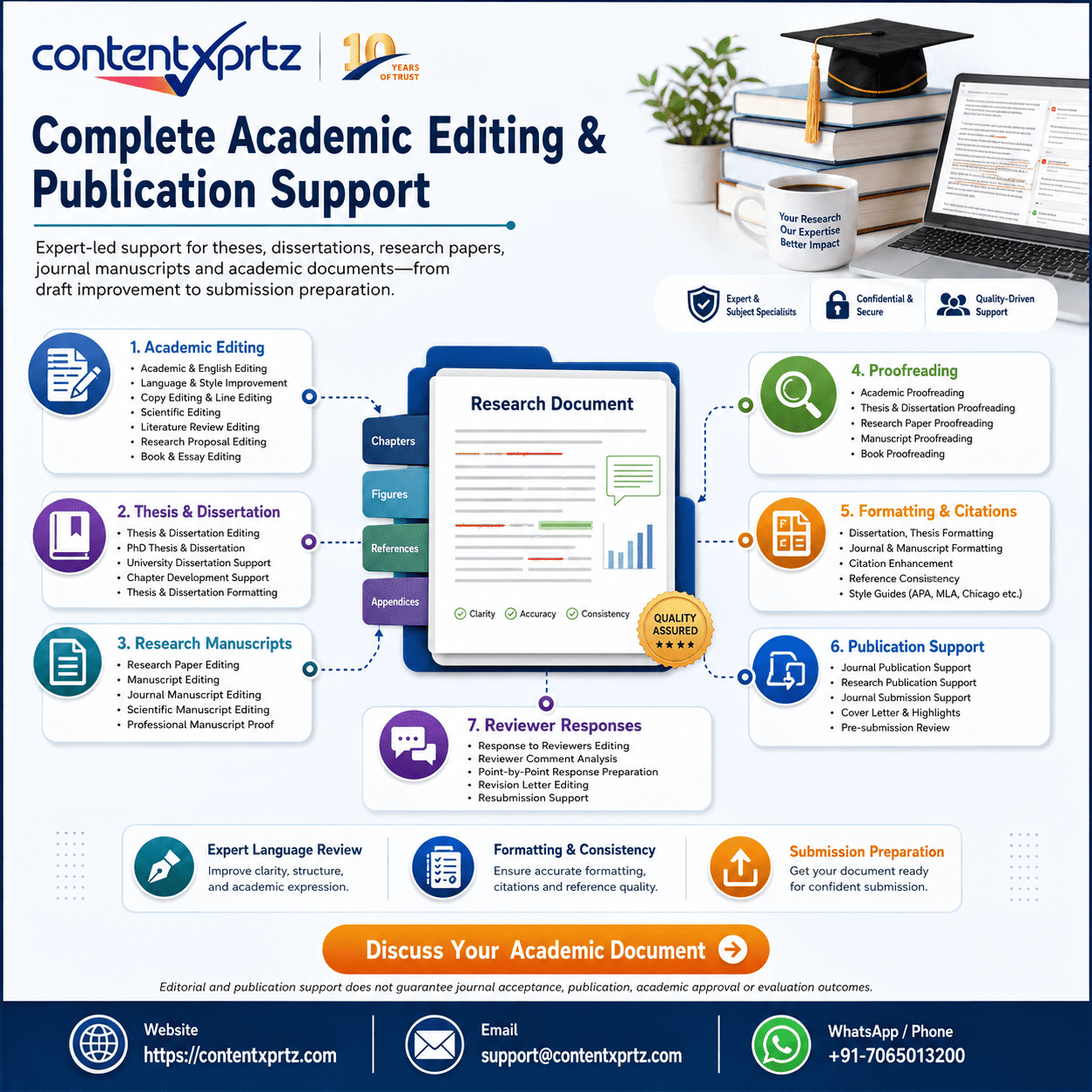
Contentxprtz can support researchers when the scholarly work is theirs but the manuscript needs clearer communication, stronger organization, language refinement, consistency checks, or publication preparation. Relevant assistance may include research paper editing, proofreading, structural feedback, reference-format review, manuscript assessment, and journal-readiness support.
The appropriate service depends on the problem. A paper with a stable argument but language issues may need editing or proofreading. A paper that feels repetitive, unfocused, or difficult to navigate may need a deeper structural assessment before sentence-level work. A journal manuscript approaching submission may need a final check against author instructions. Contentxprtz should not be used to fabricate research, create false citations, or replace the author's responsibility for analysis and conclusions.
Researchers who want document-specific assistance can use the research paper writing and support service to discuss an ethical level of help aligned with the document type and destination.
Summary: Academic Paper Writing
An academic paper is a structured scholarly argument or research report built from a clear purpose, appropriate evidence, transparent reasoning, and accurate attribution. Good papers begin with the destination requirements and a focused question, not with decorative academic language. Structure should follow the paper type: empirical research may use IMRAD, while reviews, theoretical papers, humanities analyses, and university assignments need formats suited to their purpose.
The most reliable workflow is to organize evidence first, create a claim-based outline, draft the analytical core, revise for logic, and only then complete language editing, citation checks, formatting, and proofreading. Academic integrity requires authentic sources, accurate paraphrasing, honest limitations, responsible AI use, and continued author control over the work. Self-service support is often enough for a strong draft; professional editing is most useful when the research is sound but communication or submission readiness needs an independent expert review.
Frequently Asked Questions
What is an academic paper?
An academic paper is a structured piece of scholarly writing that develops a focused question, claim, analysis, or report of research using evidence that readers can examine and trace. Depending on the assignment or publication venue, it may be an empirical research article, literature review, theoretical paper, analytical essay, case study, methodological paper, or another discipline-specific format. What makes it academic is not simply formal language. The paper must make its purpose clear, use appropriate sources or data, explain how conclusions were reached, distinguish evidence from interpretation, and cite borrowed ideas accurately. For journal submission, the target journal's author instructions and relevant reporting standards should guide the final structure. For university work, the module brief, rubric, supervisor guidance, and institutional academic-integrity rules take priority. A strong academic paper therefore combines a defensible intellectual contribution with transparent evidence, clear organization, accurate referencing, and careful revision.
How do I start writing an academic paper when I have only a broad topic?
Start by turning the broad topic into a manageable research problem rather than immediately drafting the introduction. Write down the population, phenomenon, concept, debate, time period, setting, or relationship you actually want to understand. Then conduct a focused preliminary search to learn the vocabulary of the field and identify what is already established, disputed, or underexplored. From that reading, frame a question or purpose statement that is narrow enough to answer with the evidence and time available. Build a working outline around the logic required to answer that question. For an empirical study, the outline may follow introduction, methods, results, and discussion; for a literature-based paper, it may be organized by themes, theories, methods, or competing explanations. Keep notes that separate your own ideas from source material. This reduces accidental citation problems and makes the first draft a process of developing an argument rather than filling pages.
What structure should an academic paper follow?
The correct structure depends on the paper type, discipline, and destination. Original empirical research in many scientific and health fields often follows an Introduction, Methods, Results, and Discussion pattern, commonly called IMRAD. A literature review may instead use an introduction, search or selection approach where relevant, thematic or methodological synthesis, critical discussion, gaps, and conclusion. Humanities papers may build a thesis through sections of textual, historical, theoretical, or comparative analysis. Business and social-science assignments may combine theory, evidence, application, and evaluation. Regardless of format, readers should be able to identify the paper's question or purpose, the basis of the evidence, the reasoning that connects evidence to claims, the limitations of the analysis, and the main conclusion. Before finalizing headings, check the university rubric or target journal instructions because word limits, abstract format, reference style, reporting checklists, data statements, declarations, and supplementary-file requirements can change the expected structure.
How is an academic paper different from a research paper?
The terms often overlap, but academic paper is the broader label. An academic paper can include a research article, literature review, theoretical essay, critical analysis, case study, methodological discussion, conference paper, or assessed university paper. A research paper usually implies a more explicit investigation of a research question using primary data, secondary evidence, or a systematic analysis of existing scholarship. In everyday university use, however, instructors may use the terms interchangeably. The practical response is to identify the actual task rather than rely on the label alone. Check whether you are expected to collect data, synthesize literature, defend a thesis, compare theories, evaluate a case, or report an experiment. Then identify the required evidence, section structure, citation style, and assessment criteria. If the destination is a journal, read the article-type description and author guidelines before drafting because a journal's definition of an original article, review, brief report, or perspective will determine what belongs in the manuscript.
How many sources should an academic paper include?
There is no universal number of sources that makes an academic paper strong. The appropriate amount depends on the research question, paper length, discipline, article type, evidence base, and the purpose of each citation. A short analytical assignment may need a smaller set of highly relevant sources, while a dissertation chapter or systematic review may require extensive coverage. Quality and relevance matter more than accumulating references. Each citation should perform a clear function: establish context, support a factual claim, define a concept, justify a method, compare findings, identify disagreement, or position your contribution. Avoid padding the bibliography with sources that are never meaningfully used. Prefer original and authoritative sources where appropriate, verify bibliographic details, and check whether cited work has been corrected or retracted. For journal work, follow the venue's reference limits and style. For university assignments, use the marking criteria and supervisor expectations rather than aiming for an arbitrary citation count.
Can I use AI to help write an academic paper?
AI tools may be useful for limited support tasks, but their use must follow your university, funder, publisher, or journal rules and must never replace author responsibility. Human authors remain responsible for the accuracy, originality, evidence, citations, interpretation, and final wording they submit. AI output can contain invented references, unsupported claims, distorted paraphrases, biased framing, or confident factual errors. Do not list an AI system as an author, and do not cite AI-generated text as though it were primary evidence. If your institution or journal requires disclosure of AI-assisted writing, editing, translation, coding, image generation, or analysis, follow that requirement exactly. A safer workflow is to use verified sources as the evidence base, draft from your own analysis, treat AI suggestions as untrusted material that requires checking, and retain control over every claim. When in doubt, ask your supervisor or consult the target journal's current AI-use policy before submission.
How can I avoid plagiarism in an academic paper?
Avoiding plagiarism requires source control, accurate citation, genuine paraphrasing, and clear separation between your contribution and material derived from others. Record full source details while reading, and mark direct quotations immediately so they are never confused with your notes. When paraphrasing, first understand the idea, then restate it in your own structure and wording without merely replacing a few words with synonyms. Cite the source whenever the underlying idea, data, interpretation, wording, image, table, or distinctive framework is not your own. Use quotation marks or block quotation formatting when reproducing exact language according to the required style. Check all references against the original source and ensure in-text citations match the bibliography. Similarity software can flag text overlap, but a percentage alone does not determine plagiarism. Ethical originality depends on authorship, attribution, transparent use of sources, and compliance with institutional or publisher rules, not on manipulating a similarity score.
What should I edit before submitting an academic paper?
Edit in layers rather than trying to correct everything in one reading. First perform a content edit: confirm that the research question, thesis, or objective is explicit and that every major section contributes to it. Next check argument and evidence: claims should be supported, counterevidence handled fairly, results distinguished from interpretation, and limitations stated honestly. Then review structure and paragraph flow so topic sentences, transitions, tables, and figures guide the reader through the reasoning. After that, complete a language edit for clarity, concision, academic tone, grammar, terminology, and consistency. Finally, proofread formatting details such as headings, numbering, abbreviations, citations, references, table notes, figure captions, supplementary files, and declarations. For journal submission, compare the manuscript line by line with the author instructions and any reporting checklist. For university work, compare it with the rubric. A final read of the rendered PDF often reveals spacing, pagination, or cross-reference problems that are easy to miss in the editable file.
When is professional academic editing appropriate?
Professional academic editing is appropriate when it improves communication while preserving the author's intellectual ownership and complying with the rules that govern the work. Useful support can include language editing, copyediting, proofreading, consistency checks, reference-format review, structural feedback, manuscript assessment, and guidance on journal formatting or reviewer-response presentation. The editor should not invent data, fabricate citations, conceal unsupported claims, impersonate the author, or make substantive research decisions that the author is responsible for defending. Students should check university policies because permitted assistance can vary across courses, institutions, and assessment types. Journal authors should also follow publisher disclosure requirements where applicable. Editing is particularly useful for complex manuscripts, multidisciplinary papers, authors writing in an additional language, or documents that have already undergone multiple revisions and need an independent quality check. The safest arrangement keeps the researcher responsible for facts, methods, analysis, conclusions, citations, and final approval.
How do I know an academic paper is ready for journal or university submission?
A paper is ready when it is complete against the requirements of its destination, not merely when the writing sounds polished. Confirm that the question or objective is clear, the evidence is sufficient for the claims, methods are reported transparently where applicable, results are accurate, the discussion does not overstate the findings, and limitations are acknowledged. Check that every table and figure is cited in the text, every in-text citation has a matching reference, and every reference supports the statement attached to it. Verify the required citation style, word limit, abstract format, title-page information, declarations, ethics information, data availability statement, author contributions, supplementary files, and reporting checklist. For a university submission, review the rubric, learning outcomes, formatting rules, permitted assistance, and file requirements. Then proofread the final rendered version. If major changes are still being made to arguments or evidence, the paper is not yet at the proofreading stage; it needs another substantive revision first.
Conclusion: Build the Paper Around Evidence, Not Appearance
The strongest academic paper is not the one that sounds most complicated. It is the one that makes its intellectual work visible. The reader can identify the question, understand why the evidence is relevant, follow the reasoning, check the sources, recognize the limitations, and see exactly what the author is contributing.
Free and self-service resources are often enough when the paper is conceptually stable and the author has time to revise carefully. When the argument is strong but language, structure, consistency, referencing, or journal formatting is obscuring that strength, ethical expert assistance can provide a valuable independent review. The boundary is important: support should improve clarity and publication readiness without replacing authorship, inventing evidence, or making decisions the researcher must defend.
For document-specific support, Contentxprtz can help with academic editing, proofreading, manuscript assessment, and research paper preparation while keeping the author responsible for the research, claims, data, citations, and final submission. “At Contentxprtz, we don’t just edit; we help ideas reach their fullest potential.”