Steps in Research Process: From Question to Research Report
The steps in research process give researchers a disciplined way to move from a broad area of curiosity to a defensible question, appropriate evidence, careful analysis, and a clearly written conclusion. The sequence matters because each later decision depends on earlier ones: a vague problem produces a vague question; a poorly framed question leads to a mismatched method; weak data collection limits analysis; and overstated interpretation can undermine otherwise careful work. For students and first-time researchers, the process is also a practical project-management tool. It shows what to decide, what to document, and what to check before moving forward.
Academic research is rarely a perfectly straight path. A literature review may reveal that a proposed question has already been answered, that a key concept needs a different definition, or that the intended population is impractical to access. Pilot work may expose ambiguous survey items. Data quality checks may require researchers to revisit assumptions or explain missingness. These are not signs that the process has failed. They are part of responsible research when changes are justified, documented, and consistent with ethics approval, protocols, preregistration, supervisory guidance, and disciplinary standards where those apply.
The practical challenge is to preserve a clear line of reasoning from problem → question → design → evidence → analysis → interpretation → communication. That line helps a supervisor, examiner, reviewer, or reader understand why the study was conducted, how the evidence was generated, what the results show, and where the conclusions should stop. It also helps the researcher distinguish between activities that sound academic and decisions that actually improve validity, transparency, reproducibility, or interpretive depth.
This guide explains the research process in an academic context, with attention to literature searching, research questions, methodology, ethics, sampling, data collection, analysis, writing, revision, and publication readiness. It is designed for undergraduate and postgraduate students, PhD scholars, early-career researchers, and academic authors. Where professional support becomes useful, Contentxprtz is introduced as an ethical option for academic editing and manuscript clarity—not as a substitute for the researcher's own intellectual responsibility.
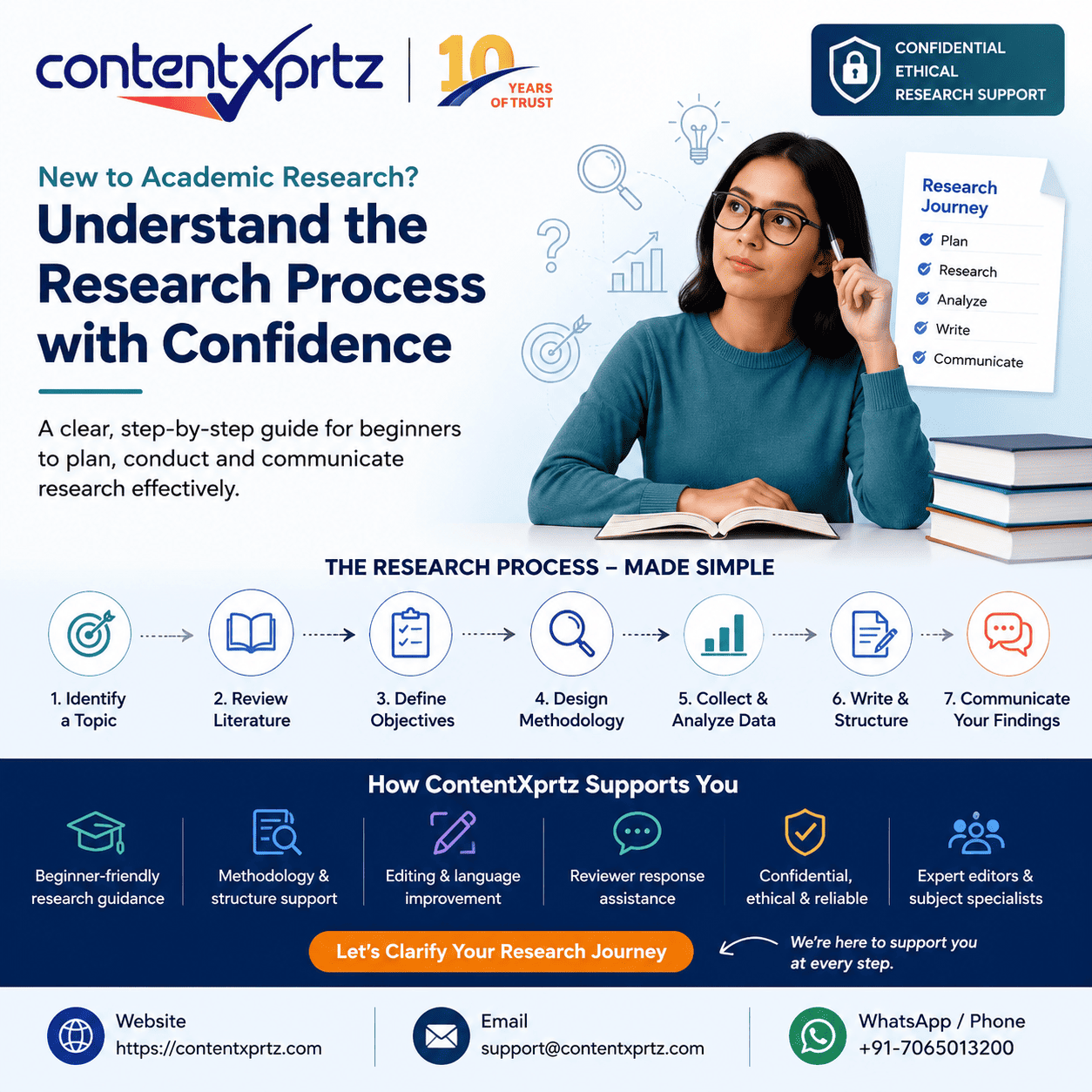
Quick Answer: What Are the Steps in Research Process?
The research process normally begins by identifying and defining a meaningful problem. The researcher then reviews existing knowledge, develops a focused research question or hypothesis, selects a design and methodology, addresses ethics and permissions, plans sampling and data collection, gathers evidence systematically, analyzes the data, interprets the results, and writes and revises the final research report.
For most academic projects, a useful working sequence is: define the problem; review the literature; formulate the question; choose the design; plan ethics, sample, and data; collect evidence; analyze; interpret; write; revise; communicate. The stages are connected rather than isolated. If a later stage exposes a weakness in an earlier decision, responsible researchers may revisit it while documenting any changes.
The most important caution is not to treat the process as a checklist that guarantees a good study. Quality depends on the fit between the question, the method, the evidence, and the claim. Discipline-specific rules, university requirements, ethics procedures, reporting guidelines, and target-journal instructions may change how individual steps are carried out.
Key Takeaways
- The research process is a logical chain from a defined problem to evidence-based communication.
- Literature review and question formulation are usually iterative; each should refine the other.
- Research design should be chosen because it answers the question, not because it is convenient or familiar.
- Ethics, data management, sampling, and documentation should be planned before data collection begins.
- Analysis describes patterns in the evidence; interpretation explains what those patterns mean and how far conclusions can go.
- Academic writing should begin early and continue throughout the project rather than being postponed until the end.
- Editing can improve clarity and consistency, but authors remain responsible for research decisions, data, citations, interpretations, and claims.
What This Page Covers
- A practical sequence of the major research process steps
- How to move from a broad topic to a researchable problem and question
- How literature review, methodology, sampling, and ethics fit together
- How to plan data collection, analysis, interpretation, and reporting
- Common beginner mistakes and ways to prevent them
- Examples from quantitative, qualitative, mixed-methods, and literature-based projects
- When self-service work is enough and when academic editing or research communication support may help
Table of Contents
Methodology and Academic Sources
This guide synthesizes common academic research workflows rather than imposing one universal methodology. Research practices differ across disciplines, study types, institutions, and jurisdictions. Researchers should therefore use this article as a planning framework and check the specific rules that apply to their project.
For projects involving human participants, researchers should follow institutional review requirements and applicable ethics guidance; the U.S. Office for Human Research Protections is one authoritative example of formal human-research guidance. For transparent reporting, researchers can consult the EQUATOR Network to identify reporting guidelines suited to different study designs. Systematic-review authors may need PRISMA, while publication-ethics questions can be checked against guidance from the Committee on Publication Ethics (COPE).
University regulations, supervisor instructions, funder requirements, data-protection rules, and the target journal's author instructions take priority when they are more specific. Contentxprtz can support ethical editing, proofreading, formatting, and research communication, but it does not replace institutional approval or researcher responsibility.
What the Research Process Means in Academic Context
The research process is the organized set of decisions and activities used to answer a defined question using appropriate evidence. Its purpose is not simply to produce a long document. It is to make the relationship between the problem, method, data, reasoning, and conclusion visible and defensible.
A strong process creates traceability. A reader should be able to see why the question matters, how concepts were defined, why participants or sources were selected, how data were generated, how analysis was conducted, what limitations exist, and why the conclusion is proportionate to the evidence. Traceability is particularly important in a thesis, dissertation, research article, grant-funded project, or evidence synthesis because independent readers must evaluate the credibility of the work.
The process also supports feasibility. Researchers often begin with questions that are interesting but impossible to answer within the available time, access, expertise, sample, budget, or data. A structured workflow forces these constraints into the open early enough to redesign the project responsibly.
Why Students, PhD Scholars, and Researchers Need a Research Workflow
A research workflow reduces avoidable rework. Without one, students may collect information before deciding what evidence they need, PhD scholars may accumulate hundreds of papers without a clear synthesis question, and authors may begin statistical analysis without documenting assumptions or exclusions.
For undergraduate and master's students, the workflow helps transform an assignment topic into manageable tasks. For doctoral researchers, it creates an audit trail that supports proposal defense, supervisory review, ethics applications, fieldwork, analysis, and thesis writing. For journal authors, it improves alignment between the research question, methods, results, and discussion and makes it easier to satisfy a reporting guideline.
Just as importantly, a workflow makes it easier to identify where a problem occurred. If the results are inconclusive, the researcher can ask whether the issue lies in measurement, sample size, recruitment, missing data, conceptualization, or the original question rather than rewriting the conclusion until it sounds stronger.
Free, Low-Cost, and Professional Research Support Options
Different stages require different kinds of support. Many tasks can be completed with university resources and careful self-study, while high-stakes manuscripts may benefit from specialist review.
| Option | Best use | Main caution |
|---|---|---|
| Supervisor, instructor, or committee | Question scope, disciplinary expectations, research design, thesis requirements | Prepare specific questions and document decisions |
| Academic librarian | Database selection, search strategy, controlled vocabulary, source discovery | Search support does not replace critical appraisal |
| Research methods texts and university resources | Learning study designs, sampling, analysis logic, reporting conventions | Methods must still be adapted to the actual research question |
| Statistical or qualitative-methods consultation | Complex analysis planning, assumptions, software choices, interpretation boundaries | Consult before collection when design affects later analysis |
| Professional academic editing | Language, structure, consistency, presentation, journal or thesis readiness | Editing must not replace authorship, data analysis, or researcher judgment |
Contentxprtz is most relevant at the communication and manuscript-readiness stages. Researchers who have completed their substantive work can use professional academic editing to improve clarity, consistency, organization, and presentation while retaining responsibility for the research.
When Self-Service Research Is Enough and When Expert Help Is Useful
Self-service research is often enough for coursework, exploratory literature searches, small classroom projects, and straightforward analyses when the researcher understands the method and has access to good institutional guidance. University writing centers, libraries, methods courses, supervisor feedback, and official style resources can resolve many problems without paid support.
Expert input becomes more useful when a project is methodologically complex, involves high-stakes decisions, uses unfamiliar analysis, must follow formal reporting standards, or is being prepared for thesis examination or journal submission. The relevant expert depends on the problem. A statistician should not be replaced by a copyeditor; an ethics question should not be resolved by citation software; and a language editor should not be asked to invent a research rationale.
Use support selectively. The goal is to strengthen the researcher's own decisions and communication, not to transfer authorship or conceal uncertainty.
Steps in Research Process: A Step-by-Step Academic Workflow
1. Identify and define the research problem
Begin with a problem that is meaningful, researchable, and appropriately bounded. A broad topic such as student stress, renewable energy, or brand trust is not yet a research problem. Define the population, setting, phenomenon, relationship, process, or unresolved issue that requires investigation. Explain why the issue matters academically or practically.
Avoid manufacturing a gap by claiming that no study exists in one city or institution. A location-specific study can be valuable, but the rationale should explain why the context is theoretically, practically, culturally, clinically, economically, or methodologically important.
2. Conduct an exploratory literature review
Search enough literature to understand the field's vocabulary, major theories, recurring methods, established findings, unresolved disagreements, and recent directions. Start broad, then refine. Use discipline-appropriate databases, library catalogues, publisher platforms, citation trails, and scholarly search tools. For a substantial review, record databases, search strings, dates, filters, and inclusion decisions so the process can be explained later.
The aim at this stage is not to collect the largest possible number of PDFs. It is to understand what is already known and where the proposed study can make a credible contribution.
3. Formulate a focused research question, objective, or hypothesis
Convert the problem into a question that can actually be answered with evidence. Qualitative questions often explore how or why people experience a phenomenon. Quantitative questions may estimate a value, compare groups, test an association, evaluate an intervention, or model a relationship. Mixed-methods questions should make clear why both numerical and contextual evidence are needed.
Objectives should align directly with the question. Hypotheses, when appropriate, should be specified before examining outcome patterns to reduce the risk of presenting post hoc explanations as if they had been predicted.
4. Build the conceptual or theoretical framework
Not every project requires a formal theory, but every project benefits from conceptual clarity. Define the central constructs, explain how they relate, and identify assumptions that affect measurement or interpretation. A framework can help determine which variables, experiences, mechanisms, or contexts should be studied and can prevent the analysis from becoming a collection of unrelated observations.
5. Choose the research design and methodology
Select the design that best fits the question. Experimental and quasi-experimental designs can support certain causal questions when their assumptions are met. Observational designs can describe populations and examine associations. Qualitative designs can investigate meanings, experiences, practices, and contexts. Case studies can examine bounded systems in depth. Mixed-methods designs integrate different forms of evidence for a defined reason.
Describe why the design is appropriate, not merely what it is called. The methodology should explain the logic of the study, the source of evidence, and the limitations created by the design.
6. Plan ethics, permissions, and data governance
Determine whether the project needs ethics review, institutional approval, site permission, informed consent, assent, data-use agreements, or other authorization. Plan how personal or sensitive data will be minimized, stored, protected, retained, shared, and eventually disposed of. Consider participant burden, risks, incentives, conflicts of interest, and vulnerable populations.
If the research uses secondary data, check the licence, consent scope, de-identification status, and institutional rules rather than assuming that existing data are automatically free to use.
7. Define the population, sample, and recruitment strategy
Specify who or what the study concerns and how observations will be selected. Quantitative studies may require a sample-size or power rationale; qualitative studies may justify purposive, theoretical, maximum-variation, snowball, or other sampling strategies. Literature-based studies need explicit source-selection criteria. Explain inclusion and exclusion criteria and how recruitment or selection could affect generalizability or transferability.
8. Design or select data-collection instruments
Choose measures, surveys, interview guides, observation protocols, laboratory procedures, datasets, extraction forms, or document-analysis frameworks that fit the constructs and question. Established instruments may offer evidence of reliability or validity, but they still need to be appropriate for the population and context. New instruments should be piloted or tested where feasible.
Create a data dictionary or codebook early. Define variable names, response options, units, missing-value conventions, file structure, and version control before collection becomes complicated.
9. Pilot the procedure where appropriate
A pilot can identify practical failures that are invisible on paper: confusing consent language, ambiguous questions, unrealistic completion time, unreliable equipment, recruitment obstacles, software problems, or coding categories that do not work. A pilot is not always required, but when it is feasible it can save substantial time and reduce avoidable data-quality problems.
10. Collect data systematically
Follow the approved protocol consistently. Record deviations, recruitment outcomes, nonresponse, exclusions, technical failures, and changes to instruments or procedures. Train data collectors where applicable and use quality checks throughout the process rather than discovering problems only after collection closes.
Good data management is part of data collection. Keep secure backups, clear filenames, access controls, documentation, and version history. Separate identifying information from research data when required by the approved plan.
11. Clean, organize, and prepare the data
Before formal analysis, inspect completeness, duplicates, impossible values, coding inconsistencies, transcription quality, missing data, outliers, and file integrity. Document every transformation. Researchers should be able to explain how raw evidence became the analytic dataset or qualitative corpus.
Do not delete inconvenient observations without a defensible rule. Predefined exclusion criteria, sensitivity analyses, and transparent reporting help prevent selective handling of the data.
12. Analyze the evidence using an appropriate method
Apply the analysis plan that matches the design and question. Quantitative analysis may involve descriptive statistics, confidence intervals, regression models, hypothesis tests, effect sizes, model diagnostics, or sensitivity analyses. Qualitative analysis may involve coding, thematic analysis, grounded theory procedures, narrative analysis, discourse analysis, framework analysis, or another explicit method. Mixed-methods research should explain where and how the evidence streams are integrated.
13. Interpret findings in context
Ask what the results mean rather than merely restating them. Compare findings with prior research, theory, context, and plausible alternative explanations. Discuss uncertainty and limitations. Distinguish statistical significance from practical or theoretical importance, and avoid causal language when the design supports only association.
Unexpected findings should not be hidden. They can be valuable when reported transparently and interpreted cautiously.
14. Write the research report, thesis, or manuscript
Write for traceability. The introduction should establish the problem and question. The methods should allow readers to understand how the study was conducted. The results should report the evidence clearly. The discussion should interpret the findings without overstating them. Tables and figures should add information rather than duplicate paragraphs.
For journal manuscripts, follow the target journal's author instructions and any relevant reporting guideline. For theses and dissertations, use institutional requirements for chapter structure, formatting, declarations, and submission.
15. Revise, edit, and verify the scholarly record
Revision should check logic before language. Confirm that the question matches the method, all reported analyses correspond to the described procedure, tables agree with the text, citations support the claims attributed to them, and conclusions stay within the evidence. Then improve organization, grammar, terminology, referencing, and formatting.
Professional manuscript and academic editing can help at this stage when the author needs a more independent review of clarity and consistency.
16. Communicate, archive, and respond to feedback
Submission is not the end of the process. Researchers may need to respond to examiners, peer reviewers, editors, conference audiences, collaborators, or stakeholders. Maintain a clear record of revisions and explain how comments were addressed. Archive data, code, instruments, and documentation according to ethics approval, institutional policy, funder rules, and consent conditions.
How to Match the Research Question With the Research Design
The simplest design rule is: start with the type of claim you need to make. A descriptive question needs evidence that accurately characterizes a population or phenomenon. A causal question requires a design capable of supporting causal inference. An exploratory question may need depth and context rather than numerical representativeness.
| Question type | Typical evidence | Possible design | Key caution |
|---|---|---|---|
| What is happening? | Counts, measures, records, observations | Descriptive survey, cross-sectional study, audit | Description does not automatically explain causes |
| Is X associated with Y? | Measured variables | Observational quantitative study | Association can be affected by confounding and bias |
| Does an intervention change an outcome? | Comparative outcome data | Experimental or quasi-experimental design | Design, allocation, adherence, and missing data affect inference |
| How do people experience a phenomenon? | Interviews, observations, texts | Qualitative study | Depth and contextual interpretation matter more than simple counts |
| Why do numerical patterns occur? | Quantitative plus qualitative evidence | Mixed-methods design | The integration logic must be specified, not merely two parallel studies |
When the design is uncertain, write the research question at the top of a page and list the evidence needed to answer every part of it. Then ask whether the proposed method actually produces that evidence. This simple check often reveals mismatches before data collection begins.
From Data Analysis to Interpretation: Do Not Skip the Reasoning Step
Analysis and interpretation are related but different. Analysis organizes and examines the evidence. Interpretation explains what the resulting patterns mean and what conclusions are justified. Confusing the two can lead researchers to report software output without answering the research question.
For quantitative work, begin with data quality and descriptive patterns before complex modelling. Check assumptions, uncertainty, missingness, influential observations, and whether the statistical method matches the scale and structure of the data. Report effect sizes and confidence intervals where appropriate rather than relying only on p-values.
For qualitative work, document how coding or interpretive categories were developed, how contradictory cases were handled, and how the researcher moved from raw material to themes or claims. Rich quotations can illustrate a theme, but the argument should come from the analytic process, not from selecting the most dramatic sentence.
Interpretation should return to the original question and literature. Ask: What changed in our understanding? What remained uncertain? Which findings are robust? What alternative explanations exist? What limitation most affects the conclusion? A responsible discussion can be valuable even when findings are null, mixed, or unexpected.
Ethical Academic Editing and Author Responsibility
Research support is ethical when it strengthens communication without disguising who made the intellectual decisions. Researchers are responsible for the study question, design, data, analysis, interpretation, citations, authorship declarations, and final submission. An editor can improve clarity and flag inconsistencies, but should not fabricate evidence, invent references, produce undisclosed ghost research, or manipulate claims to appear stronger.
Students should check university rules on outside assistance. Authors should check journal disclosure and authorship policies, particularly when support includes substantive language or structural editing. COPE guidance is useful for publication-ethics questions, but the target journal's own instructions still matter.
A practical standard is transparency: if assistance changes how the work is communicated, make sure the underlying ideas remain the author's, all citations can be verified, and required acknowledgements or disclosures are made.
Common Research Process Mistakes to Avoid
- Starting with data instead of a question: available data can inspire research, but the final question and analysis should be explicit rather than invented after seeing interesting patterns.
- Calling any absence of prior studies a research gap: a defensible gap explains why the missing knowledge matters.
- Using only convenient sources: a literature review should use credible, relevant, and appropriately comprehensive search routes.
- Choosing methods by habit: software familiarity is not a methodological rationale.
- Collecting before ethics approval: when approval is required, retrospective permission may not solve the problem.
- Under-documenting decisions: undocumented exclusions, recoding, instrument changes, or analytic choices weaken transparency.
- Overstating causality: observational evidence usually requires cautious causal language.
- Ignoring contradictory evidence: inconvenient studies and unexpected findings belong in a balanced interpretation.
- Leaving writing until the end: early writing exposes conceptual gaps while they can still be addressed.
- Treating editing as a repair for weak research: clear prose cannot correct an unanswerable question or invalid design.
Practical Examples: How the Research Process Changes by Project
Example 1: Quantitative survey on postgraduate burnout
A master's student begins with the broad topic of postgraduate stress. The literature review shows that burnout is a more clearly defined construct and identifies validated measures. The student narrows the question to whether workload and supervisor support are associated with burnout among postgraduate students in a defined faculty. The design becomes cross-sectional, the sampling frame is specified, ethics approval is obtained, and the survey is piloted. Analysis estimates associations while acknowledging that the design cannot establish causation. The discussion compares the findings with previous studies and explains limits created by self-report and sampling.
Example 2: Qualitative study of first-time peer reviewers
A PhD scholar wants to understand why early-career researchers find peer review difficult. Rather than measuring a predefined score, the scholar asks how first-time reviewers experience uncertainty, responsibility, and editorial expectations. Semi-structured interviews are selected because the goal is interpretive depth. Purposive sampling seeks participants with direct experience. The interview guide is piloted, transcripts are coded using an explicit thematic approach, and reflexive notes document analytic decisions. The final report uses quotations as evidence while explaining how themes were developed.
Example 3: Mixed-methods evaluation of a teaching intervention
A university team evaluates a new statistics workshop. Test scores can show whether performance changed, but they cannot fully explain why some students benefited and others did not. The team therefore combines pre/post quantitative outcomes with interviews about barriers, confidence, and teaching experiences. Integration occurs in the interpretation stage: qualitative themes are used to explain quantitative patterns rather than appearing as an unrelated appendix.
Example 4: Literature-based dissertation
A student conducting a literature-based dissertation does not recruit participants, but still needs a research process. The student defines a review question, selects databases, develops search terms, sets inclusion criteria, records screening decisions, appraises source quality, extracts evidence into a structured matrix, and synthesizes findings thematically. The methodology explains how the literature was identified and analyzed. The conclusion reflects the limits of the available evidence rather than presenting the review as if it generated primary data.
Research Process and Academic Writing Checklist
- The problem is specific, meaningful, and feasible.
- The literature review establishes what is known and why the new question matters.
- The research question, objectives, and hypotheses are aligned.
- Key concepts and theoretical assumptions are defined.
- The design and methodology fit the type of claim the project aims to make.
- Required ethics review, permissions, consent, and data-governance steps are complete before collection.
- The population, sample, recruitment, and inclusion criteria are justified.
- Instruments or data sources are appropriate and piloted where useful.
- Collection procedures and deviations are documented.
- Raw data are organized, secured, backed up, and versioned appropriately.
- Cleaning and exclusion rules are transparent.
- The analysis method fits the data and question.
- Interpretation distinguishes evidence from speculation.
- Limitations are specific and connected to their likely effect on conclusions.
- Citations have been checked against the original sources.
- Tables, figures, text, and supplementary materials agree with one another.
- The manuscript follows university or target-journal requirements.
- Authorship, acknowledgements, conflicts, funding, and required disclosures are accurate.
- Language editing preserves the author's meaning and does not introduce unsupported claims.
- The final conclusion answers the research question without exceeding the evidence.
How Contentxprtz Can Help at the Manuscript-Readiness Stage
Once the research decisions, evidence, and analysis are in place, the next difficulty is often communication. A thesis may contain sound research but inconsistent terminology, repetitive literature synthesis, unclear transitions, tables that do not match the text, or a discussion that mixes findings with speculation. Journal manuscripts can face similar problems when authors must compress a complex study into a strict word limit and reporting structure.
Contentxprtz provides academic editing support for researchers who want clearer, more consistent, publication-ready communication. Appropriate support may include grammar and style editing, thesis or manuscript structure, terminology consistency, citation-format review, table and caption clarity, and checks for internal inconsistencies that the author should resolve.
The service is not a substitute for ethics review, statistical analysis, supervision, or author judgment. The researcher remains responsible for the intellectual content and final submission.
Summary: Steps in Research Process
The steps in research process form a connected academic workflow: define the problem, understand the literature, formulate a focused question, choose a suitable design, plan ethics and sampling, collect evidence systematically, prepare and analyze the data, interpret findings in context, write the report, revise carefully, and communicate the work responsibly.
The sequence is best treated as iterative. Researchers may revisit earlier decisions when new evidence, pilot findings, feasibility constraints, or supervisory feedback reveal a better approach. What matters is that changes are justified and documented and that the final claims remain aligned with the actual evidence.
For students and researchers, the most useful habit is to maintain traceability from question to conclusion. Every major section of a thesis or paper should help a reader understand how the study moved through that chain.
Frequently Asked Questions
What are the main steps in research process?
The main steps in research process are to define the problem, review existing literature, formulate a focused research question or hypothesis, choose an appropriate research design, address ethics and permissions, define the sample and data plan, collect data systematically, analyze the data, interpret the findings in relation to the question and prior evidence, write the research report, and revise and communicate the work. The sequence is useful for planning, but real research is often iterative. A literature review may reveal that the original question is too broad; a pilot study may require changes to an instrument; unexpected data patterns may send the researcher back to the literature. The important principle is traceability: each major decision should be justified by the research question, disciplinary expectations, and available evidence. For a thesis or journal article, researchers should also document methods clearly enough that a reader can understand how conclusions were reached. Editing and publication support can improve clarity and consistency, but the researcher remains responsible for the study design, data, analysis, interpretation, and final claims.
Does the research process always follow a straight line?
No. Research is usually presented as a sequence because a sequence is easier to learn and manage, but strong research often moves back and forth between stages. A preliminary literature search can refine the problem. Feedback from a supervisor can narrow the research question. A pilot study can reveal that a survey item is ambiguous. Early analysis can expose missing contextual information that needs to be considered during interpretation. What should remain stable is the logic connecting the question, method, evidence, and conclusion. Changes should be documented rather than hidden. Researchers should also distinguish legitimate refinement from changing the study simply to obtain a preferred result. If a protocol, ethics approval, preregistration, or journal reporting standard applies, amendments may need to be recorded formally. Treat the research process as an organized cycle with checkpoints, not as an inflexible conveyor belt.
How do I choose a research topic and turn it into a research problem?
Start with an area that is relevant to your discipline, feasible within your time and resources, and specific enough to investigate. Then move from a broad topic to a research problem by asking what is unknown, inconsistent, underexplored, practically difficult, theoretically unresolved, or important for a defined population or setting. A topic such as digital learning is too broad; a problem might concern how first-year nursing students experience feedback in a specific type of online simulation. Use an initial literature review to test whether the problem has already been answered, whether important concepts are defined consistently, and whether suitable methods exist. A useful research problem explains the context, the gap or tension, why it matters, and what kind of evidence could address it. Avoid inventing a gap simply because a study has not been conducted in one location. The problem should be intellectually or practically meaningful, not merely geographically new.
What comes first: literature review or research question?
Usually they develop together. Researchers often begin with a provisional question, conduct an exploratory literature search, and then refine the question as they learn the terminology, theories, methods, and gaps in the field. In many undergraduate projects, the question may be set before the full literature review. In a PhD proposal, the review is often central to demonstrating why the question is original and worthwhile. The key is not to treat the literature review as a decorative chapter added after the question has been fixed. It should help define concepts, identify prior findings, reveal contradictions, show common research designs, and establish what contribution the new study may make. Once the question is focused, the researcher can conduct a more systematic and reproducible search appropriate to the project. Record databases, search terms, dates, eligibility decisions, and important source trails when the project requires transparency.
How do I know whether to use qualitative, quantitative, or mixed methods?
Choose the approach that best answers the research question. Quantitative methods are appropriate when the study needs numerical measurement, estimation, comparison, association, prediction, or testing of specified hypotheses. Qualitative methods are appropriate when the goal is to understand experiences, meanings, processes, contexts, language, or how participants interpret a phenomenon. Mixed methods combine qualitative and quantitative evidence when one form of data alone would leave an important part of the question unanswered. Do not select a method only because it is familiar or because software is available. Consider the unit of analysis, type of claim, sampling strategy, data quality, feasibility, ethics, and disciplinary norms. A good methodology section explains not only what method was used but why it fits the question and how the design controls or acknowledges important limitations.
Where do ethics fit into the steps in research process?
Ethics should be considered from the beginning, not added just before data collection. Researchers should think about consent, privacy, confidentiality, potential harms, vulnerable participants, data security, conflicts of interest, authorship, and responsible reporting while the study is being designed. Human-participant or animal research may require formal review or approval before recruitment or data collection, depending on the institution and jurisdiction. Secondary data can also raise ethical and legal questions if the data are sensitive, identifiable, restricted, or used beyond the original consent or licence. Ethical practice continues after collection: researchers should not fabricate or manipulate data, selectively report only convenient findings, misrepresent limitations, or assign authorship without an appropriate contribution. University policies, funder requirements, professional codes, and journal guidance should be checked for the specific project.
What is the difference between data analysis and interpretation?
Data analysis is the organized process used to examine the collected evidence; interpretation explains what the resulting patterns mean in relation to the research question, theory, context, and prior literature. In quantitative research, analysis may include data cleaning, descriptive statistics, estimation, modelling, hypothesis tests, uncertainty measures, and sensitivity checks. In qualitative research, analysis may involve coding, categorization, thematic development, narrative analysis, discourse analysis, or another explicit approach. Interpretation comes afterward and asks whether the findings support, complicate, or challenge expectations; what alternative explanations exist; how limitations affect confidence; and what conclusions are justified. A statistically significant result is not automatically important, and a compelling interview quotation does not by itself establish a general pattern. Good interpretation respects the strength and boundaries of the evidence.
When should I start writing the research paper or thesis?
Start writing early. Researchers do not need to wait until all data have been collected and analyzed. Draft the problem statement, definitions, literature notes, rationale, method decisions, search records, and ethics documentation while those decisions are fresh. Early writing often exposes unclear logic before it becomes expensive to fix. After analysis, revise the introduction and literature review so they align with the final question and contribution, then write results without mixing them prematurely with interpretation unless the discipline uses a combined structure. The discussion should connect the findings with prior research, limitations, implications, and appropriate next questions. Writing early does not mean locking the manuscript early; expect major revision. For a thesis, follow university chapter requirements. For a journal paper, use the target journal's author instructions and relevant reporting guideline where applicable.
What are common mistakes beginners make during the research process?
Common mistakes include choosing a topic that is too broad, calling any absence of local studies a research gap, relying on a few convenient web sources, writing a question that the chosen method cannot answer, collecting data before obtaining required approval, using a convenience sample without acknowledging its limits, changing hypotheses after seeing results without transparency, confusing analysis with interpretation, overstating causality from observational data, ignoring contradictory findings, and leaving writing until the end. Beginners also sometimes treat citation software as a guarantee of accurate references or assume language polishing can fix weaknesses in design. A better approach is to use checkpoints: verify the question before designing the study, pilot instruments where appropriate, document procedures, keep a decision log, review analysis assumptions, and compare every major claim with the evidence that supports it.
When can professional academic editing help in the research process?
Professional academic editing is most useful after the researcher has made the substantive decisions and needs help communicating them clearly. An editor can improve grammar, sentence structure, terminology consistency, organization, transitions, tables, figure captions, citation-style consistency, and alignment with journal or university formatting requirements. Depending on the permitted scope, an editor may also flag unclear logic, unsupported claims, missing definitions, inconsistency between methods and results, or places where the discussion overreaches. Ethical editing should not invent data, fabricate references, perform undisclosed authorship, or replace the researcher's intellectual responsibility. Students should check institutional rules about permitted assistance, and journal authors should follow disclosure requirements where relevant. Contentxprtz can support academic editing, thesis editing, manuscript editing, and publication-readiness review while preserving author responsibility for the research itself.
Conclusion: Build a Research Process You Can Explain and Defend
A strong research project is not defined by the number of sources, the complexity of the statistics, or the length of the final document. It is defined by the coherence of its reasoning. A reader should be able to move from the research problem to the question, from the question to the method, from the method to the evidence, and from the evidence to a conclusion that is appropriately cautious and useful.
Use the research process as a series of decision checkpoints rather than a rigid sequence. Stop when the question is unclear, when the method does not generate the needed evidence, when ethics or permissions are unresolved, or when the conclusion reaches beyond the data. Correcting those issues early is usually easier than trying to repair them during final writing.
If the research is complete but the thesis, dissertation, or manuscript needs clearer academic communication, Contentxprtz can assist with ethical academic editing and manuscript refinement. At Contentxprtz, we don’t just edit; we help ideas reach their fullest potential.