Step by Step Research Process: A Practical Guide for Students and Researchers
A step by step research process gives academic work a defensible path from an initial idea to a clear, evidence-based conclusion. It is not simply a sequence of boxes to tick. Each stage changes what becomes possible at the next stage: the research question shapes the literature search, the literature shapes the design, the design determines what data can answer the question, and the analysis determines which conclusions are justified.
Students and first-time researchers often feel pressure to begin with writing or data collection because those activities look like visible progress. In practice, weak projects commonly start earlier: the topic is too broad, the question is not researchable, the literature review is treated as a list of summaries, the method does not fit the question, or data are collected before ethics and analysis plans are clear. A structured workflow helps prevent these problems while leaving room for the normal iteration that research requires.
This guide explains the academic research process from problem definition to literature review, methodology, ethics, data collection, analysis, interpretation, writing, revision, and dissemination. It is designed for coursework, dissertations, theses, research papers, journal manuscripts, and professional research projects. Because disciplinary practices differ, the stages should be adapted to your field, institutional rules, and the specific kind of evidence you need.
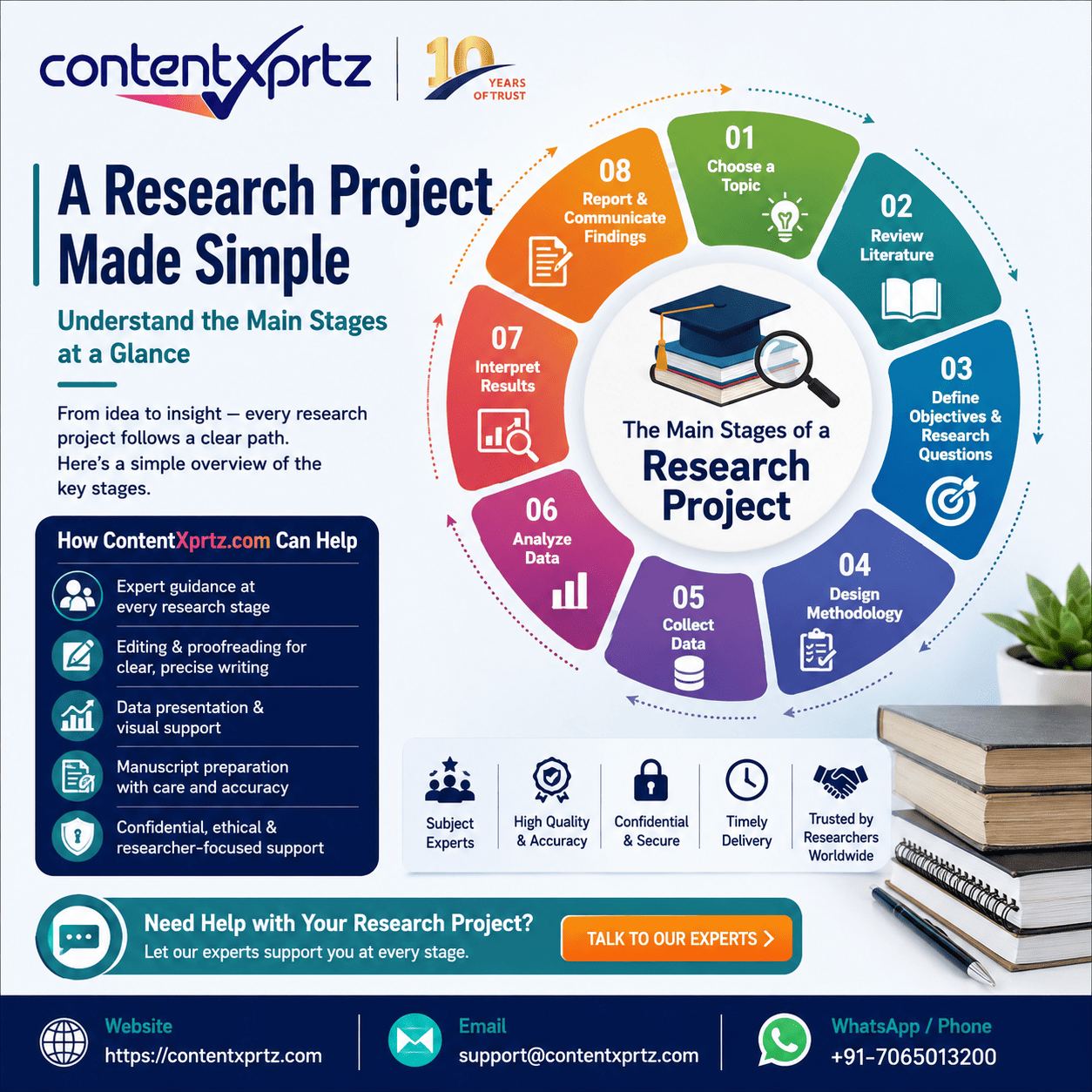
Quick Answer: What Is the Step by Step Research Process?
The research process usually begins by defining a problem and turning it into a focused research question. Next, review the literature to understand what is already known, identify useful theories and methods, and clarify the gap your project can address. Then choose a research design, define the population or sources, plan data collection, obtain any required ethics approval, and decide how the data will be analysed before collection begins.
After data collection, clean and organise the evidence, perform the planned analysis, interpret the findings in relation to the question and previous research, and write the report, paper, thesis, or dissertation. Revise the argument, methods description, tables, figures, references, and language before submission. Finally, share the work responsibly and preserve the data or documentation required by your institution, funder, or publisher.
The sequence is iterative rather than perfectly linear. A literature search may reveal that the question needs revision; pilot data may expose a problem with an instrument; analysis may require a return to the literature. The important principle is that changes should be justified, documented, and consistent with ethical research practice.
Key Takeaways
- Start with a researchable question, not with a pile of articles or an assumed answer.
- Use the literature review to map what is known, how it was studied, where evidence conflicts, and what remains uncertain.
- Choose methodology and methods that directly match the research question and type of evidence required.
- Plan ethics, sampling, data management, and analysis before collecting data whenever possible.
- Separate results from interpretation so readers can see what the evidence shows and how you explain it.
- Write throughout the project instead of waiting until the end; early drafting reveals gaps in logic and documentation.
- Revise for argument, evidence, structure, citation accuracy, and language before treating proofreading as the final check.
What This Page Covers
- How to define a research problem and formulate a focused question
- How to conduct and organise a purposeful literature review
- How to choose research methodology, methods, sampling, and data sources
- How to plan research ethics, data management, collection, and analysis
- How to interpret findings without overstating what the evidence can support
- How to write, revise, edit, and proofread a research paper or thesis
- Practical examples, mistake-prevention guidance, and a research-process checklist
Table of Contents
- What the research process means
- Why a structured process matters
- Step-by-step research workflow
- Literature-search and evidence strategy
- Methodology, sampling, and data planning
- Analysis and interpretation
- Common research mistakes
- Practical examples
- Research-process checklist
- Frequently asked questions
Methodology and Academic Sources
This guide reflects widely used academic research, writing, reporting, and publication-ethics practices rather than a single universal methodology. Research requirements vary by discipline, institution, funder, study design, and publication venue. Researchers should therefore check supervisor guidance, university regulations, ethics requirements, and the author instructions or reporting standards that apply to their project.
For responsible research conduct and reporting, useful reference points include the Committee on Publication Ethics guidance, the EQUATOR Network reporting guidelines, the Nature Portfolio reporting standards, and the Taylor & Francis author services resources. These sources are most useful when read alongside the rules of your own discipline and institution.
Contentxprtz can assist with ethical academic editing, proofreading, and research support. Such support should improve clarity, organisation, and presentation without replacing the researcher’s responsibility for the question, evidence, analysis, citations, and conclusions.
What the Academic Research Process Actually Means
The academic research process is a connected system of decisions used to answer a question with evidence that other readers can inspect. Good research is not defined by complexity. It is defined by alignment: the question, theory, sources, sampling, data collection, analysis, and claims should fit together.
For a quantitative study, alignment may mean defining variables precisely, selecting a sample that supports the intended inference, choosing valid measures, and using an analysis that matches the design. For qualitative work, it may mean selecting participants or texts that can illuminate the phenomenon, documenting how data were generated, explaining the analytic approach, and showing how interpretations were developed. For humanities research, it may involve archival selection, textual interpretation, source criticism, historiography, or theoretical argument. The stages differ, but the need for transparent reasoning remains.
Research is iterative, not mechanically linear
A common diagram shows research as a straight line. Real projects loop backward and forward. You may refine the question after reading a stronger body of literature, adjust a sampling plan after a feasibility check, or return to theory when unexpected findings appear. Iteration is not a failure if changes are made transparently and for defensible reasons.
Research process versus research paper structure
The process of doing research is not identical to the order in which the final paper is written or presented. You might draft the method while preparing ethics materials, keep a running literature synthesis during data collection, and write parts of the discussion before the introduction is final. The published paper may use a conventional sequence such as introduction, methods, results, and discussion, but the work behind those sections develops across the whole project.
Why a Structured Research Workflow Matters
A structured workflow reduces avoidable uncertainty. It gives you checkpoints where you can ask whether the project still answers the original question, whether the evidence is sufficient, and whether methodological or ethical problems need attention before they become expensive to fix.
It improves feasibility
Early planning forces practical questions: Can you access the population, archive, dataset, laboratory, software, or equipment? Is the project possible within the time available? Can the sample size or corpus support the analysis? Does the institution require approval before data collection?
It improves traceability
Research logs, versioned files, decision notes, search histories, and analysis scripts make it easier to explain how conclusions were reached. Traceability is especially valuable when supervisors, co-authors, reviewers, or future researchers need to understand changes.
It improves writing
When research decisions are documented, the methods section becomes easier to write, the literature review becomes more coherent, and limitations can be described honestly. Good writing is partly the product of good research organisation.
| Stage | Main question | Useful output | Common risk |
|---|---|---|---|
| Problem definition | What exactly needs to be understood? | Problem statement and scope | Topic remains too broad |
| Literature review | What is already known and disputed? | Evidence map and research gap | Source summaries replace synthesis |
| Research design | What evidence can answer the question? | Methodology and protocol | Method chosen for convenience only |
| Data collection | How will evidence be generated consistently? | Dataset, transcripts, documents, observations | Procedures change without documentation |
| Analysis | What patterns, relationships, or meanings are present? | Analytic outputs and audit trail | Analysis does not match design |
| Interpretation | What do findings mean within the limits of the study? | Discussion and limitations | Claims exceed the evidence |
| Writing and revision | Can readers follow and verify the argument? | Submission-ready manuscript | Editing is left until the last minute |
Step by Step Research Process: From Idea to Final Manuscript
1. Define the research problem
Start with the situation that requires investigation. A useful problem statement explains the context, identifies what is uncertain or unsatisfactory, and shows why the issue deserves research. Avoid starting with a preferred conclusion. Your role is to define a question that evidence can genuinely test, explore, interpret, or explain.
2. Narrow the topic into a research question
Turn the broad topic into one primary question. Ask whether it is clear, researchable, ethically feasible, appropriately scoped, and connected to an identifiable form of evidence. Quantitative questions often focus on association, difference, prediction, or effect. Qualitative questions may focus on experience, process, meaning, interpretation, or context. Humanities questions may examine texts, events, ideas, representations, or historical relationships.
3. Set objectives and, where appropriate, hypotheses
Objectives translate the main question into tasks. Keep them specific enough to guide data collection and analysis. If the study is confirmatory and theory supports directional expectations, state hypotheses before testing them. Exploratory or interpretive research may use questions rather than hypotheses.
4. Conduct an orientation search
Before attempting a comprehensive review, learn the vocabulary of the field. Search broad concepts, identify major authors and theories, note recurring methods, and collect a few strong seed papers. This stage helps you discover synonyms and technical terms that a first-time researcher may not know.
5. Build a literature-search strategy
Create concept groups and synonyms, choose suitable databases, document search strings, and decide how you will screen results. For a thesis or formal review, keep a search log with database names, dates, terms, filters, and reasons for including or excluding important sources. Use citation chaining to move backward through reference lists and forward through later papers that cite key studies.
6. Synthesize the literature and refine the gap
Do not write one paragraph per source. Group evidence by concept, method, population, theory, finding, or disagreement. Ask where studies converge, where they conflict, what limitations recur, and which questions remain unresolved. The research gap should emerge from this synthesis rather than being declared simply because you did not find an identical study.
7. Choose the research design and methodology
Select the approach that can answer the question. A survey may be appropriate for patterns across many respondents, interviews for detailed experiences, experiments for controlled causal questions, archival research for historical evidence, and mixed methods when different forms of evidence are genuinely needed. Explain the methodological logic, not just the technique.
8. Define the population, sample, corpus, or data source
State what or whom the study concerns and how cases will be selected. Probability sampling can support certain forms of statistical inference; purposive sampling may be more appropriate when qualitative depth or specialised expertise is required. For document-based research, define the corpus and inclusion criteria. Your claims later must match the boundaries of this selection.
9. Plan measures, instruments, and data-collection procedures
Specify exactly what will be measured or observed and how. If using a questionnaire, define variables and scales. If interviewing, prepare a guide that supports the question without forcing answers. If coding documents, define the unit of analysis. Pilot instruments when possible so ambiguous questions, technical problems, or unrealistic procedures can be corrected early.
10. Address ethics and data management
Identify consent requirements, privacy risks, sensitive data, vulnerable participants, conflicts of interest, storage arrangements, retention periods, and access controls. Obtain formal ethics approval where required before collecting data. Create a file-naming and backup system, separate identifiable information from analytic files when appropriate, and document who can access the data.
11. Pre-plan the analysis
Decide how each objective will be answered. Quantitative projects should connect variables and hypotheses to statistical tests or models. Qualitative projects should describe the analytic approach, such as thematic, content, discourse, narrative, or grounded analysis, and how coding or interpretation will be conducted. Pre-planning reduces the temptation to search the data for a convenient story after collection.
12. Collect the data consistently
Follow the protocol and record deviations. Keep field notes, instrument versions, recruitment records, lab logs, or source notes as appropriate. Quality checks during collection can detect missing values, duplicate records, device errors, inconsistent coding, or recruitment problems while they are still correctable.
13. Clean, organise, and analyse the evidence
Prepare the data systematically before interpretation. In quantitative work this may include checking missingness, coding, outliers, assumptions, and reproducibility of scripts. In qualitative work it may include transcription, familiarisation, coding, memoing, category development, and comparison across cases. Preserve the distinction between raw material and transformed analytic files.
14. Interpret the findings in context
Ask what the results mean, how they relate to the research question, whether they agree with previous studies, and what plausible alternative explanations remain. Interpretation should be bounded by design limitations. Cross-sectional association does not automatically establish causation; a small purposive sample may illuminate experiences without representing an entire population.
15. Write the paper, thesis, or dissertation
Build a clear argument around the question and evidence. The introduction should establish the problem and purpose; the literature review should synthesise relevant knowledge; the methods should allow readers to understand what was done; the results should report the evidence; and the discussion should explain meaning, limitations, and implications. Follow your university or journal structure when it differs.
16. Revise, edit, and proofread
Revise in layers. First test the logic and completeness of the argument. Next check evidence, tables, figures, and references. Then improve paragraph structure, transitions, terminology, and academic tone. Proofread last for grammar, spelling, formatting, numbering, captions, citations, and consistency. If you need external help, professional academic editing should preserve your meaning and authorship.
17. Submit, respond, and preserve the research record
Before submission, check every required file and declaration. For journal manuscripts, verify author instructions rather than relying on an old template. If reviewers request changes, respond point by point and distinguish revisions you made from requests you cannot follow. Preserve appropriate records, data, code, approvals, and versions according to institutional or publisher requirements.
How to Build the Literature Review Into the Research Process
The literature review is not a preliminary hurdle that ends when data collection begins. It helps define the question, informs the method, supports interpretation, and should be refreshed when the project runs over a long period.
Search by concepts, not full sentences
Identify two to four concepts from the question and develop synonyms, abbreviations, spelling variants, related terms, and controlled vocabulary where databases provide it. Use phrase searching and Boolean operators according to the database. Test several versions and keep the best-performing strings.
Choose sources that match the discipline
Google Scholar can be useful for broad discovery and citation chasing, but major projects should use relevant library databases and discipline-specific indexes. The right mix depends on the field and project type. A systematic review requires more formal reproducibility than an exploratory seminar paper.
Create an evidence matrix
For each important source, record the research question, theory, design, sample, methods, findings, limitations, and relevance to your project. This makes comparison easier and reduces the tendency to write a chronological list of article summaries.
Verify every reference
Reference-manager imports and generated citations can contain errors. Check author names, year, title, journal or book details, volume, issue, pages, DOI, edition, and version against the source itself. Never cite a paper solely because another paper cited it if the original source is central to your claim.
How to Choose Methodology, Sampling, and Data Collection
Methodology should follow the question. The strongest-looking method is not automatically the best method; suitability matters more than complexity.
| Research purpose | Possible approach | Typical evidence | Key caution |
|---|---|---|---|
| Estimate prevalence or describe a population | Survey or secondary-data analysis | Structured quantitative data | Sampling quality affects generalisation |
| Test an intervention or causal mechanism | Experimental or quasi-experimental design | Outcome measures across conditions | Control, allocation, and confounding matter |
| Understand lived experience or process | Interviews, focus groups, observation | Qualitative narratives and field data | Depth does not equal population representativeness |
| Examine documents, media, or policy | Content, discourse, textual, or document analysis | Selected texts or records | Corpus-selection criteria must be explicit |
| Combine breadth and depth | Mixed-methods design | Quantitative and qualitative evidence | Integration must be planned, not added as an afterthought |
Before collecting anything, connect each objective to an evidence source and an analysis step. If an objective has no data source, the design is incomplete. If data are being collected without a clear role in the question, reconsider whether they are needed.
Sampling should match the claim
Researchers sometimes focus on reaching a certain number without asking what kind of inference the sample supports. Define the target population or relevant source universe, explain how cases are selected, and acknowledge who or what may be missing. For statistical studies, sample-size planning should consider the intended analysis and uncertainty. For qualitative work, justify selection in relation to the phenomenon and analytic purpose.
Pilot before full collection
A small pilot can reveal confusing survey items, inaccessible recruitment channels, technical failures, excessive interview length, missing response options, or coding ambiguities. Treat the pilot as a learning stage and document any changes before the main study.
From Data Analysis to Defensible Interpretation
Analysis turns collected material into organised evidence; interpretation explains what that evidence means. Keeping these activities conceptually separate makes the final argument more transparent.
Quantitative analysis
Begin with data quality and descriptive understanding before advanced modelling. Check coding, missingness, distributions, assumptions, and whether variables were defined consistently. Report effect sizes and uncertainty where appropriate instead of relying only on whether a statistical threshold was crossed. If you conduct analyses that were not planned, label them as exploratory rather than presenting them as if they had been specified from the beginning.
Qualitative analysis
Qualitative rigour depends on a clear analytic process. Explain how material was prepared, coded, compared, grouped, and interpreted. Keep analytic memos or an audit trail when appropriate. Use quotations or examples to demonstrate the basis of themes, but do not treat frequency alone as the only indicator of importance.
Interpret within limits
Good discussion sections answer three questions: What did the study find? How does that finding relate to previous knowledge or theory? What can and cannot reasonably be concluded? Limitations are not a ritual list at the end; they help define the boundary of the claim.
How to Write the Research Paper While the Study Is Still in Progress
Waiting until data analysis is complete to begin writing creates unnecessary pressure. Keep a living document throughout the project. Draft the problem statement and question early, update the literature synthesis as evidence develops, write the methods while procedures are fresh, and create table shells before analysis so you know which outputs are actually needed.
This approach also makes supervision more productive. A supervisor can respond to a concrete paragraph, table, or method description more effectively than to a vague statement that the work is “still in progress.” Early writing exposes missing definitions, unsupported assumptions, and unclear transitions while there is still time to fix them.
Use a claim-evidence-explanation test
For each major paragraph, identify the claim, the evidence that supports it, and the explanation that connects the evidence to your research question. If a paragraph contains citations but no clear claim, it may be descriptive rather than analytical. If it contains a strong claim without evidence, it needs support or qualification.
Keep results and discussion distinct where the format requires it
Results report what the analysis produced. Discussion explains what those results mean. Combining interpretation with results can be appropriate in some disciplines and qualitative formats, but follow the conventions of your target journal or university rather than assuming one structure fits every project.
Common Research Process Mistakes to Avoid
Starting with the answer
Research designed to prove a preferred conclusion is vulnerable to selective searching, selective analysis, and overstatement. Frame a question that leaves room for findings you did not expect.
Using the literature review as a bibliography with paragraphs
A literature review should compare, organise, and interpret evidence. If each paragraph begins with a different author and ends with a summary of that paper, the review may lack synthesis.
Choosing a method because it is familiar
A survey is not automatically suitable because it is easy to distribute. Interviews are not automatically suitable because they feel detailed. Every method should have a reason grounded in the research question and the type of evidence required.
Collecting data before ethics and analysis are clear
Premature data collection can create unusable evidence, regulatory problems, or consent issues. Finish approvals and core planning first.
Changing procedures without recording the change
Research evolves, but undocumented changes make the study difficult to interpret. Record what changed, when, why, and how the change affects the analysis or limitations.
Overinterpreting statistical significance or qualitative themes
A small p-value does not establish practical importance, and a vivid quotation does not prove that an experience is universal. Interpret findings according to design, sample, uncertainty, and context.
Editing only at sentence level
Grammar correction cannot repair a missing research question, contradictory method, weak synthesis, or unsupported conclusion. Revise argument and evidence first; proofread later.
Practical Examples of the Research Process
Example 1: A postgraduate survey project
A student wants to study remote-work stress. The initial topic is too broad, so she narrows it to the relationship between perceived manager support and self-reported burnout among remote employees in a defined sector. She reviews measurement literature, chooses validated scales, plans a cross-sectional survey, calculates a feasible sample target, secures ethics approval, predefines the regression analysis, and pilots the survey. During writing, she avoids claiming that manager support causes lower burnout because the design is observational.
Example 2: A PhD interview study
A doctoral researcher wants to understand why first-generation PhD students consider leaving their programmes. He reviews retention theory and existing qualitative work, then develops a purposive sampling strategy and semi-structured interview guide. After ethics approval, he records and transcribes interviews, keeps analytic memos, develops themes iteratively, and compares cases. In the discussion, he presents the findings as contextual insights rather than estimates for all doctoral students.
Example 3: A laboratory research project
A research team studies whether a modified protocol improves assay reliability. The question becomes a comparison between the existing and modified protocol under controlled conditions. The team defines outcome measures, randomises run order where possible, documents equipment and reagent lots, plans statistical comparisons, and records deviations. When one batch fails quality checks, the team documents the exclusion rather than quietly removing the data.
Example 4: A literature-based humanities paper
A student studying representations of migration in contemporary fiction begins with a very large topic. She narrows the corpus to three novels published within a justified period and develops a theoretical framework around memory and displacement. Her research process emphasises corpus selection, close reading, source criticism, comparison with scholarly interpretations, and transparent explanation of how textual evidence supports each claim.
Example 5: A journal manuscript revised after peer review
An early-career researcher receives reviewer comments requesting clearer sampling justification, an additional sensitivity analysis, and a shorter discussion. He creates a response table, handles each comment separately, runs the additional analysis, updates the methods and results, and explains one request he cannot implement because the required variable was not collected. The revision improves transparency without pretending the original design included evidence that was never gathered.
Step-by-Step Research Process Checklist
- Write the problem in two or three sentences without assuming the answer.
- Formulate one primary research question and supporting objectives.
- Check scope, feasibility, access, timeline, and institutional requirements.
- Run an orientation search and identify field-specific terminology.
- Build and document a literature-search strategy.
- Synthesise literature into themes, debates, methods, and gaps.
- Choose a methodology that can answer the question.
- Define population, sample, corpus, or data sources and justify selection.
- Plan instruments, measures, procedures, and pilot testing.
- Complete ethics review and data-management planning where required.
- Connect each objective to a data source and analysis method.
- Collect data consistently and record deviations.
- Clean and organise evidence before interpretation.
- Analyse according to the design and label exploratory work honestly.
- Interpret findings in relation to prior research and study limitations.
- Draft throughout the project and maintain accurate citations.
- Revise argument and structure before sentence-level proofreading.
- Check journal, university, or funder requirements before submission.
- Preserve appropriate records, data, code, and approvals.
When Professional Academic Support Is Useful
Most core research decisions must remain with the student, scholar, or research team. External support is most appropriate when it improves process clarity or communication without taking over the intellectual work.
An academic editor can help when a thesis chapter has a sound argument but the structure is difficult to follow, when an ESL researcher wants clearer scholarly language, when a manuscript needs consistency with a journal style, or when references, tables, and captions require careful checking. A research-support specialist may help organise a literature matrix, improve search-term planning, or review whether the written method is clear enough for readers to understand.
Contentxprtz provides academic editing services, scholarly proofreading, and manuscript editing support. The relevant service should be chosen only after the research need is clear. Editing cannot compensate for fabricated data, inaccessible sources, missing ethics approval, or a design that does not answer the question.
Summary: Step by Step Research Process
A reliable research process begins with a defined problem and researchable question, then builds a literature review that explains what is known and why the new project is necessary. Methodology, sampling, instruments, ethics, and analysis should be planned as an aligned system rather than separate administrative tasks. Data collection should follow documented procedures, while analysis should remain consistent with the design and distinguish planned from exploratory work.
The final stages are equally important. Interpretation should respect limitations, writing should make the reasoning visible, references should be verified, and revision should address argument and evidence before grammar. Research is rarely perfectly linear, so iteration is expected. What matters is that important changes are justified, documented, and ethically defensible.
Frequently Asked Questions
What is the step by step research process?
A practical step by step research process usually moves through a connected sequence: define the problem, narrow the research question, review existing literature, set objectives or hypotheses, choose an appropriate design, plan sampling and data collection, address ethics, collect and manage data, analyse the evidence, interpret the findings, write the paper or thesis, revise and proofread it, and then submit or share the work. The exact sequence varies by discipline. Qualitative, quantitative, mixed-methods, laboratory, archival, humanities, and practice-based projects may organise these stages differently, but each stage should logically support the research question and be documented clearly enough for another reader to understand what was done and why.
What should I do first when starting academic research?
Begin by defining the problem rather than immediately searching for sources. Write a short problem statement that explains the issue, who or what it affects, what is already known, and what is still uncertain. Then convert that statement into one primary research question and a small set of objectives. Early searching is useful for learning the vocabulary of the field, but the question should guide the search rather than letting random articles determine the entire project. If you are working within a degree programme or funded project, also check scope, ethics, supervisor expectations, available data, timeline, and feasibility before committing to a design.
How do I turn a broad topic into a research question?
Break the broad topic into a population or context, a central phenomenon or variable, and the relationship, comparison, experience, mechanism, or outcome you want to understand. For example, 'social media and students' is broad, while 'How is late-night short-form video use associated with self-reported concentration among first-year university students?' is more researchable. A useful question is specific enough to guide methods and searching but not so narrow that meaningful evidence becomes impossible to collect. Test the question against feasibility, ethics, available time, access to participants or data, and the type of contribution expected in your discipline.
How long should the literature review stage take?
There is no universal duration because the literature-review stage depends on project size, field, database access, and the type of review. A short class paper may require several focused sessions, while a thesis, dissertation, systematic review, or grant proposal can require weeks or months of searching, screening, reading, and synthesis. The better planning question is whether the search is sufficiently broad, documented, and current for the purpose. Keep a search log, record databases and terms, save inclusion decisions, and update the search before final submission if the project runs for a long period.
What is the difference between research methodology and research methods?
Research methodology is the overall logic and rationale that connects the research question to the way evidence will be generated and interpreted. Research methods are the specific techniques used, such as surveys, interviews, experiments, observations, document analysis, statistical modelling, or thematic analysis. A strong methods section does more than list tools: it explains why the chosen approach is suitable, how participants or sources were selected, how variables or concepts were operationalised, what procedures were followed, how data quality was protected, and what limitations remain.
Do all research projects need a hypothesis?
No. Hypotheses are common in confirmatory quantitative research when a study tests expected relationships or differences, but many projects use research questions instead. Exploratory qualitative studies, interpretive humanities research, descriptive studies, theory-building work, and some mixed-methods designs may not require formal hypotheses. The choice should follow the research purpose and disciplinary conventions. Do not invent a hypothesis simply because it sounds academic; use one when it can be justified from theory or prior evidence and when the design can actually test it.
How can I keep my research process ethical?
Build ethics into the design from the beginning. Identify risks to participants, privacy, confidentiality, consent, vulnerable groups, data security, conflicts of interest, authorship, and responsible citation. Obtain institutional ethics approval when required before collecting data. Use only the data you are authorised to access, describe limitations honestly, avoid fabricating or manipulating evidence, and keep a clear record of decisions. For writing support, follow university or publisher policies on editing and AI-assisted tools, and ensure that the researcher retains responsibility for the ideas, evidence, analysis, citations, and final submission.
What should a research plan or research workflow contain?
A practical research plan should connect the research question to tasks, evidence, people, and dates. Include the problem statement, objectives, key concepts, literature-search plan, proposed design, sampling or source-selection strategy, data-collection procedures, ethics requirements, analysis plan, file-management rules, milestones, dependencies, and expected outputs. Add decision points for likely problems, such as low recruitment, unavailable data, instrument failure, or a need to revise the search strategy. A research plan is useful only if it is updated when the project changes.
How do I know when I have enough evidence to start writing?
You can usually start drafting before every source has been found. Begin when you understand the main concepts, can identify the strongest evidence and major disagreements, and have enough methodological detail to explain your approach. Writing early often exposes gaps that require additional searching or analysis. For a literature review, look for conceptual saturation rather than a magic number of references: new sources should increasingly confirm, refine, or challenge themes you already recognise. For systematic or scoping reviews, follow the protocol and reporting standard rather than relying on a subjective sense of sufficiency.
When can professional academic editing help in the research process?
Professional editing is most useful after the researcher has developed the question, evidence, analysis, and core argument. An editor can improve structure, clarity, grammar, academic tone, logical transitions, consistency, tables, captions, references, and conformity with journal or university requirements. Ethical editing should not fabricate data, invent references, conceal authorship, or replace the researcher's intellectual contribution. Contentxprtz can support academic editing, thesis editing, proofreading, and manuscript preparation while the author remains responsible for the research decisions, source interpretation, findings, and final submission.
Conclusion: Use the Research Process to Make Every Decision Traceable
The value of a step-by-step workflow is not that every study will follow the same order. Its value is that each decision has a reason and can be connected to the research question. When the question, literature, method, evidence, analysis, and claims align, the project becomes easier to defend and easier for readers to trust.
If your evidence and analysis are complete but the manuscript needs clearer structure, stronger academic language, or publication-ready consistency, Contentxprtz can provide ethical academic editing support. The aim is to help your own research communicate more clearly without changing authorship or responsibility for the work.