Research Method Steps: A Practical Guide for Researchers
Research method steps give a study its working logic: they connect a meaningful problem to a focused question, an appropriate design, trustworthy evidence, a defensible analysis, and a conclusion that does not claim more than the data can support. For a student writing a first dissertation, a PhD scholar planning fieldwork, or a researcher preparing a journal article, the difficulty is rarely memorising a numbered sequence. The real challenge is making the steps fit together so that each decision strengthens the next one.
A weak project often becomes difficult long before data collection begins. A topic may be too broad, the literature review may describe prior work without identifying a real problem, the research question may not match the proposed sample, or a favourite method may be chosen before anyone asks what evidence is actually needed. These misalignments create practical consequences: instruments collect the wrong information, sample sizes or cases are unsuitable, analysis becomes improvised, and the final discussion struggles to explain what the findings mean. Good research methods therefore begin with planning, not software or statistical tests.
The research process also differs across disciplines. A randomized experiment, ethnographic study, archival analysis, qualitative interview project, systematic review, mixed-methods dissertation, and engineering prototype do not use identical procedures. Even so, most rigorous projects share a common backbone: define the problem, understand the existing evidence, formulate the question, select a design, plan ethics and data management, collect evidence consistently, analyze it appropriately, interpret it cautiously, and report it transparently. The sequence may loop backward as the researcher learns more, but the logic of alignment remains stable.
This guide explains that backbone in practical terms. It shows what to decide at each stage, what mistakes to prevent, how quantitative and qualitative approaches differ, and how to document choices so the methods section can later be written accurately. It also explains where self-service planning is usually enough and where a supervisor, librarian, statistician, subject specialist, or ethical research support service can help. Contentxprtz is relevant where researchers need clearer methodology writing, literature-review organisation, academic editing, or manuscript preparation without replacing the author’s intellectual responsibility.
Quick Answer: What Are the Research Method Steps?
The core research method steps are: identify the research problem, review the literature, define the research question or hypothesis, choose the research design, plan sampling and measurement, address ethics and data management, collect data, analyze the data, interpret findings, and report the study transparently. Some projects add stages such as pilot testing, preregistration, protocol review, validation, replication, or dissemination.
The sequence is not purely linear. Literature searching may continue while the question is refined, analysis planning should occur before data collection, and pilot findings may require changes to an instrument or protocol. The crucial requirement is alignment: the evidence you collect and the way you analyze it must be capable of answering the question you actually asked.
For high-stakes work such as a thesis, funded study, clinical project, or journal manuscript, document each methodological decision and check the rules that apply to your institution, discipline, ethics body, funder, and target journal.
Key Takeaways
- A good research process starts with a specific problem and answerable question, not with a preferred tool or method.
- Literature review, design, sampling, measurement, and analysis must be aligned with the intended inference.
- Quantitative, qualitative, and mixed methods answer different kinds of questions; none is automatically superior.
- Ethics, consent, privacy, permissions, and data management should be planned before data collection where applicable.
- An analysis plan created early reduces missing-variable, unusable-data, and post-hoc decision problems.
- Interpretation must distinguish what the evidence shows from what the researcher hopes it means.
- Transparent reporting includes limitations, deviations from the plan, and enough methodological detail for readers to evaluate the study.
What This Page Covers
- The step-by-step research process from problem definition to reporting
- How to move from a broad topic to a focused research question
- How to select quantitative, qualitative, or mixed-methods designs
- Sampling, measurement, ethics, data management, and analysis planning
- Common design and interpretation mistakes that weaken research
- Practical examples for PhD, student, and early-career research projects
- A research-method checklist and exactly ten detailed FAQs
Table of Contents
Methodology and Academic Sources
This guide synthesizes widely used academic research practices rather than presenting one universal protocol. The exact order and terminology of research steps vary by discipline and design. A focused research question provides the foundation for study design and, where appropriate, a testable hypothesis; an open-access research methods article indexed by the U.S. National Library of Medicine describes this relationship and discusses frameworks such as FINER and PICO for refining questions.
Responsible research also requires attention to data integrity and transparent reporting. The U.S. Office of Research Integrity guidance on conducting research emphasizes data collection, storage, protection, sharing, and accuracy, while its data-management introduction explains why meaningful study design and careful data practices are connected. For reporting, the APA Journal Article Reporting Standards overview highlights transparency about hypotheses, participant characteristics, inclusion and exclusion criteria, preregistration, and analytical strategy.
Researchers should treat these sources as general guidance and still follow the specific rules of their university, ethics committee, discipline, funder, and target journal. Methodological decisions must be justified for the actual study rather than copied mechanically from another paper.
Research Method Steps at a Glance
A practical research workflow can be summarized as a chain of decisions. Each stage should make the next stage more precise. If the chain breaks—for example, if the question asks about causal effects but the design only provides a one-time descriptive survey—the final conclusion becomes difficult to defend.
| Step | Main question | Typical output | Risk if skipped |
|---|---|---|---|
| 1. Define the problem | What needs to be understood, tested, explained, or improved? | Problem statement and scope | Vague or unmanageable project |
| 2. Review literature | What is known, disputed, missing, or methodologically weak? | Evidence map or synthesis | Duplicated or poorly justified study |
| 3. Formulate question | What exactly will the study answer? | Research question, aims, hypotheses where relevant | Misaligned methods and analysis |
| 4. Choose design | What type of evidence can answer the question? | Study design and protocol | Invalid or weak inference |
| 5. Plan sample and measures | Who or what will provide evidence, and how will concepts be observed? | Sampling and measurement plan | Bias, missing constructs, low precision |
| 6. Ethics and data plan | What approvals, consent, privacy, permissions, storage, and security are required? | Ethics and data-management documentation | Participant harm, compliance problems, unusable data |
| 7. Collect data | How will procedures remain consistent and documented? | Research dataset, transcripts, observations, records, or corpus | Inconsistency and poor traceability |
| 8. Analyze data | Which analysis answers each question? | Statistical results, codes, themes, models, or interpretations | Post-hoc or inappropriate analysis |
| 9. Interpret findings | What do the results mean within the design's limits? | Discussion and implications | Overclaiming or unsupported conclusions |
| 10. Report transparently | Can readers evaluate what was done and why? | Thesis, article, report, repository record, presentation | Low reproducibility and weak credibility |
This framework is deliberately broad. A systematic review will add protocol registration, database searching, screening, and risk-of-bias assessment. An experiment may add randomization and blinding. A qualitative study may include reflexivity, iterative sampling, field notes, and member-oriented validation strategies. The framework helps by showing where those design-specific activities belong.
Research Method Steps in Detail
Step 1: Define the research problem before choosing the method
The first task is to identify a problem worth investigating. A topic such as “social media and students” is not yet a research problem. A researchable problem states what is uncertain, contested, inefficient, unexplained, or insufficiently measured. It also establishes a boundary: a population, setting, time period, phenomenon, dataset, theory, or practical decision.
Write the problem in plain language before adding academic terminology. Ask: What decision would be better informed if this study succeeded? What observation makes the problem credible? What would count as new evidence? This prevents the common error of turning a broad interest into an oversized thesis.
Step 2: Conduct a literature review that informs decisions
A literature review should help design the study, not simply decorate the introduction with citations. Search for foundational work, recent evidence, competing explanations, established measures, common samples, known limitations, and methodological debates. Record search terms and databases when the review needs to be reproducible.
As you read, build an evidence matrix with the study question, sample or corpus, design, measures, analysis, main findings, and limitations. Patterns become easier to see when papers are compared on the same dimensions. This is also where academic writing support can be useful for organisation and synthesis, provided the researcher verifies every source and remains responsible for the interpretation.
Step 3: Formulate the research question, aims, and hypothesis where relevant
A strong research question is specific enough to guide methods but broad enough to matter. It should identify the phenomenon or variables of interest and, when relevant, the population, comparison, context, or outcome. Clinical and applied researchers sometimes use PICO-style structures, while broader feasibility can be checked using criteria such as whether the question is feasible, interesting, novel, ethical, and relevant.
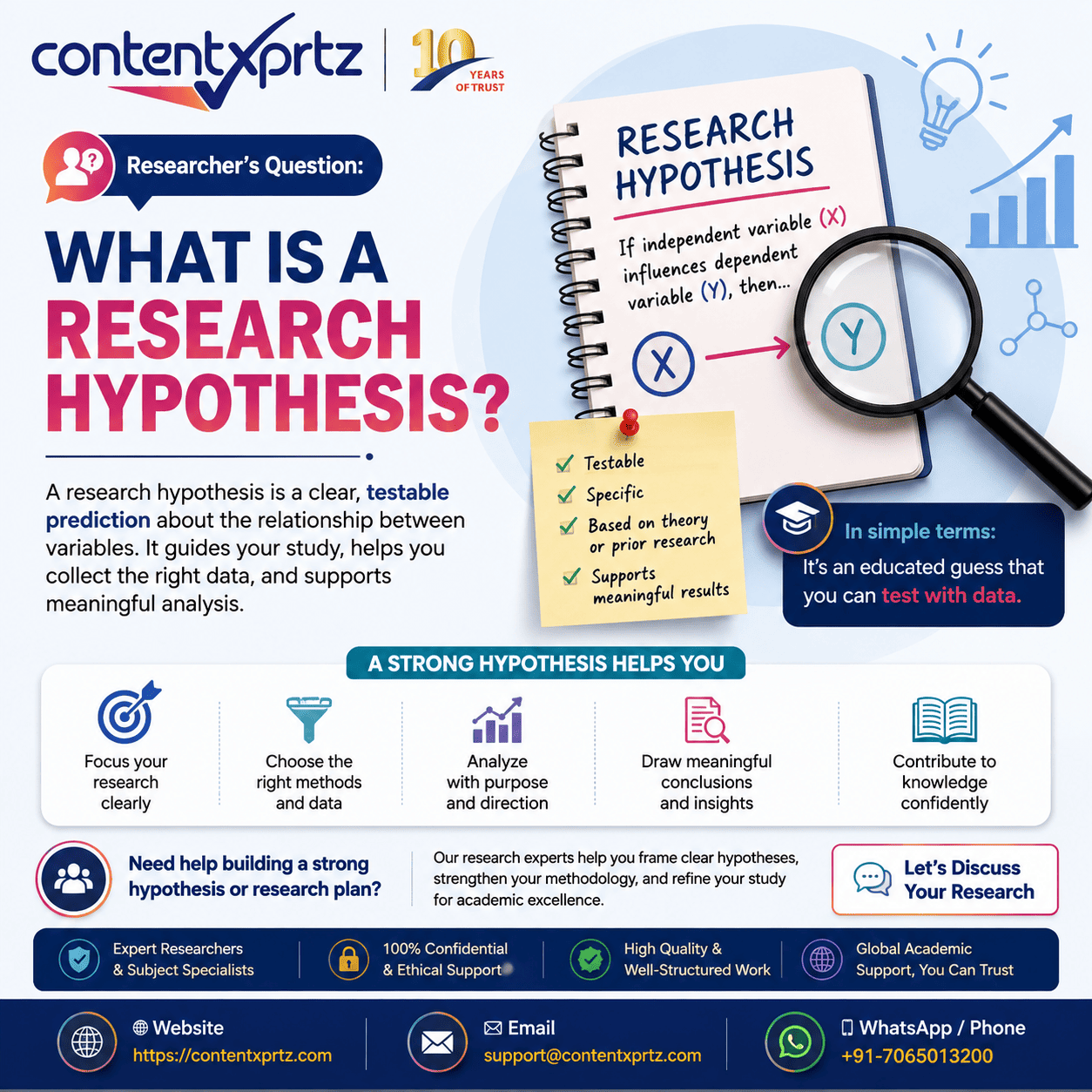
Hypotheses are useful when the study tests a defined expectation. They are not mandatory in every design. Qualitative, exploratory, descriptive, or interpretive projects may use open questions instead. Do not force a hypothesis into a design where it does not serve the research logic.
Step 4: Choose a design that can answer the question
Study design is the architecture of the research. It determines what kind of evidence can be produced and what claims can reasonably follow. Experimental designs may be needed for some causal questions; observational designs may estimate associations or describe patterns; qualitative designs can explain experiences, meanings, and processes; mixed methods can integrate breadth with depth when both are genuinely required.
Before finalizing the design, write one sentence beginning, “This design allows us to answer the question because…” If the sentence is difficult to complete without vague language, the fit needs more work. Also write what the design cannot establish. This creates a realistic boundary for later interpretation.
Step 5: Plan sampling, cases, participants, or source selection
Sampling is not only about number. It is about the relationship between the evidence you gather and the inference you intend to make. Quantitative studies may require probability sampling, power considerations, comparison groups, or stratification. Qualitative studies may use purposive, theoretical, maximum-variation, criterion, or snowball approaches depending on the goal. Document-based research needs transparent inclusion rules for records, archives, media, datasets, or texts.
Define inclusion and exclusion criteria before selection where feasible. Anticipate nonresponse, attrition, missing documents, inaccessible populations, and imbalanced groups. If the sample changes during the project, record the reason rather than quietly presenting the final sample as if it had always been planned.
Step 6: Operationalize concepts and select measures or instruments
Every abstract concept must be connected to observable evidence. If the study refers to engagement, trust, performance, stress, innovation, or learning, explain how that concept will be recognized or measured. Existing validated instruments can be useful, but they must fit the population, language, context, licensing conditions, and research purpose.
For researcher-developed surveys or coding schemes, pilot testing can reveal ambiguous items, ceiling effects, missing response options, poor instructions, and excessive burden. For qualitative interviews, test whether prompts elicit experiences and explanations rather than short confirmations. In laboratory or computational work, document settings, versions, calibration, parameters, and decision rules.
Step 7: Address ethics, consent, permissions, and data management
Ethics is part of method design, not an administrative add-on. Human-participant research may require ethics or institutional review, informed consent, safeguards for vulnerable populations, privacy protections, and clear handling of withdrawal or adverse events. Other projects may require permissions for datasets, archives, proprietary instruments, copyrighted material, biological samples, or confidential organizational records.
Create a data-management plan that addresses file naming, storage location, access permissions, backups, de-identification, version control, retention, sharing, and destruction where applicable. The ORI data-management resource treats selection, collection, handling, analysis, publication, and ownership as connected integrity issues.
Step 8: Pilot the procedure when uncertainty is high
A pilot is a small-scale test of feasibility, not a miniature study that automatically validates the final design. It can test recruitment, timing, instructions, equipment, survey flow, interview prompts, coding procedures, data formats, and operational definitions. Decide in advance what the pilot is supposed to reveal and what changes would follow specific problems.
Not every project requires a formal pilot, but some form of procedural testing is usually valuable. A spreadsheet with three sample records can expose coding problems; a mock interview can reveal leading questions; a dry run of an experiment can uncover timing errors; and a small set of documents can show that inclusion criteria are too vague.
Step 9: Collect data consistently and preserve an audit trail
During data collection, consistency matters. Use the approved protocol, record deviations, monitor missingness, and preserve enough metadata to understand when, where, and how evidence was produced. Avoid changing procedures simply because early results appear inconvenient. If a change is necessary, document it and consider whether earlier cases need to be treated differently in analysis.
Keep raw data separate from cleaned or transformed data when feasible. Maintain version history for code, coding frameworks, questionnaires, and datasets. For qualitative projects, reflexive notes can record how the researcher’s role, assumptions, or interactions may have shaped the evidence.
Step 10: Analyze data according to a documented plan
Analysis should be designed to answer the research question, not to search endlessly for a favorable result. Quantitative analysis may include descriptive statistics, model estimation, assumption checks, uncertainty intervals, effect sizes, robustness analyses, and missing-data procedures. Qualitative analysis may involve transcription, coding, category development, thematic interpretation, memo writing, negative-case examination, or other discipline-specific approaches.
Keep primary, secondary, and exploratory analyses distinguishable. The APA’s reporting guidance highlights the value of transparent analytical strategy and separating planned from exploratory work. Exploratory findings can be important, but readers should not be led to believe they were prespecified if they emerged after inspecting the data.
Step 11: Interpret findings in proportion to the evidence
Interpretation connects the result back to the question and literature. Explain what changed in your understanding after seeing the evidence. Consider uncertainty and competing explanations. Distinguish statistical significance from practical importance, and distinguish participant accounts from population estimates.
A strong discussion includes limitations that actually affect interpretation. Generic statements such as “more research is needed” are less useful than explaining how sampling, measurement, confounding, context, researcher influence, or missing data may shift the conclusion. Limitations are not a confession of failure; they tell readers where the evidence is strong and where caution is needed.
Step 12: Report the method and results transparently
The final report should allow a knowledgeable reader to understand what was done, why it was done, and how the conclusion was reached. Include enough detail about participants or cases, recruitment or selection, instruments, procedures, exclusions, analysis, software or tools where relevant, and deviations from the plan. Follow the reporting standard appropriate to the design and target outlet.
Before submission, check consistency between the abstract, methods, results, tables, figures, discussion, and references. If a manuscript contains complicated methodology or is written in a second language, academic editing services can improve clarity and internal consistency while leaving data interpretation and author decisions with the researcher.
How to Choose the Right Research Design
Choose a design by asking what type of answer the question requires. A prevalence question needs different evidence from a causal question. A question about how people experience a policy is different from a question about whether the policy changes measured outcomes. A mixed-methods design is justified only when both forms of evidence are needed and will be integrated.
| Research purpose | Often suitable approaches | Main caution |
|---|---|---|
| Describe frequency, level, or distribution | Survey, descriptive observational study, administrative-data analysis | Representativeness and measurement quality |
| Estimate associations | Cross-sectional, cohort, case-control, correlational designs | Confounding and directionality |
| Estimate causal effects | Randomized experiment or strong quasi-experimental design where feasible | Implementation, assumptions, external validity |
| Understand experience or meaning | Interviews, focus groups, ethnography, qualitative case study | Reflexivity, sampling logic, evidentiary transparency |
| Understand both pattern and explanation | Mixed methods with explicit integration | Running two disconnected studies adds workload without integration |
| Analyze existing texts or records | Content analysis, archival research, document analysis, computational text analysis | Selection bias, provenance, missing context |
A design should be evaluated for validity, feasibility, ethics, access, cost, time, and competence. Convenience matters, but convenience alone is not a methodological justification.
Why Planning Analysis Before Data Collection Matters
Researchers sometimes postpone analysis decisions until the dataset exists. That is risky because analysis requirements determine what must be collected. If the planned model requires repeated measurements, a comparison group, a baseline value, or a clearly defined outcome, those elements cannot be recreated after the study ends.
Write a simple analysis map before collection: list each research question in one column, the evidence needed in the second, the variables or codes in the third, and the planned analysis in the fourth. For qualitative work, the map can specify which data sources address each question and how coding or interpretive comparison will be conducted. For mixed methods, add a fifth column explaining how the qualitative and quantitative strands will be connected.
Early analysis planning also supports transparency. It makes it easier to explain which analyses were planned and which were exploratory. That distinction matters because an unexpected pattern discovered after many comparisons should not be represented as if it were the original hypothesis.
Common Research Method Mistakes to Avoid
- Choosing the method before the question: starting with “I want to use a questionnaire” instead of asking what evidence the problem requires.
- Treating the literature review as a summary: listing studies without comparing their questions, designs, findings, and limitations.
- Using vague constructs: discussing concepts such as quality, trust, effectiveness, or engagement without defining how they will be observed.
- Sampling for convenience while claiming broad generalization: the intended inference should match how cases or participants were selected.
- Collecting data before ethics or permissions are resolved: this can create risks for participants and jeopardize whether data may be used.
- Planning analysis after seeing results: this increases the temptation to select analyses that support a preferred story.
- Ignoring missing, excluded, or failed observations: these often contain information about bias and feasibility.
- Reporting software instead of method: naming SPSS, R, NVivo, Python, or another tool does not explain the analytical logic.
- Confusing association with causation: conclusions must remain within the inferential limits of the design.
- Hiding deviations from the original plan: transparent changes are more credible than pretending the plan never changed.
Practical Examples of Research Method Steps
Example 1: A PhD scholar studying remote-work productivity
Situation: A doctoral researcher begins with the topic “remote work and productivity.” The first draft proposes a general employee survey because it seems easy to distribute.
Common mistake: The topic mixes at least three possible problems: how employees perceive productivity, whether measured output changes, and how managers implement remote-work policies. A single convenience survey cannot answer all three.
Better approach: The scholar reviews prior measures of productivity, defines the specific population and work setting, and narrows the question to the relationship between remote-work intensity and self-reported task productivity while explicitly stating the limits of self-report. If causal impact is the real goal, the design must change accordingly.
Where ethical support helps: A supervisor or research consultant can challenge question-design alignment, and academic editing can later clarify the methods chapter. The scholar remains responsible for design choice, data, analysis, and conclusions.
Example 2: An ESL researcher preparing a qualitative health-services paper
Situation: A researcher has completed interviews about patient experiences but the methods section says only that “themes were identified from responses.”
Common mistake: The analysis may have been careful, but the reporting is too vague for readers to evaluate how transcripts were coded, how categories developed, how disagreements were handled, or how interpretations were supported.
Better approach: The author reconstructs the analytical workflow from notes and version history, describes coding stages honestly, reports reflexive or team procedures used, and connects representative evidence to each theme. If some details were not documented at the time, the paper should not invent them later.
Where ethical support helps: Professional editing can make the explanation precise and readable without changing the author’s methodology or fabricating procedural detail.
Example 3: A first-time researcher comparing two teaching approaches
Situation: A postgraduate student wants to compare two teaching methods using scores from two existing classes.
Common mistake: The student plans to compare final scores and conclude that one method “caused” better performance, although the classes were not randomly assigned and may differ at baseline.
Better approach: The researcher checks available baseline information, documents class differences, reframes the study as an observational comparison if causal assumptions cannot be supported, and discusses alternative explanations. The analysis and language of the conclusion are adjusted to match the design.
Where ethical support helps: A statistician or methods adviser can help select an appropriate model and explain assumptions. The result may be less dramatic, but it is more defensible.
Example 4: A mixed-methods dissertation with two disconnected datasets
Situation: A doctoral candidate collects a large survey and twenty interviews because mixed methods appears more comprehensive.
Common mistake: The survey and interviews answer different questions, use unrelated constructs, and are discussed in separate chapters without integration.
Better approach: The candidate identifies one overarching question that requires both breadth and explanation, aligns interview prompts with key survey constructs, and specifies where qualitative findings will explain, contrast with, or extend quantitative results.
Where ethical support helps: Methodological review can help build the integration logic before analysis. This is more valuable than adding complexity simply to label the project “mixed methods.”
Research Method and Publication-Readiness Checklist
- Can the research problem be stated in one clear paragraph?
- Does the literature review show what is known and why the new study is needed?
- Can every method decision be traced back to a research question or aim?
- Does the design support the type of inference the conclusion intends to make?
- Are sampling or source-selection criteria explicit and justified?
- Are concepts, variables, instruments, or coding units defined clearly?
- Have ethics, consent, permissions, confidentiality, and data security been addressed where required?
- Has the procedure been piloted or tested enough to identify obvious workflow problems?
- Is there a documented analysis plan linked to each research question?
- Are deviations, exclusions, missing data, and exploratory analyses recorded transparently?
- Do interpretations remain within the limitations of the design and sample?
- Does the methods section contain enough detail for a knowledgeable reader to evaluate the work?
- Are references authentic, traceable, and formatted according to the required style?
- Do the abstract, methods, results, discussion, tables, and figures tell the same methodological story?
When Self-Service Research Planning Is Enough—and When Expert Support Helps
Self-service planning is often enough for a small classroom project, exploratory assignment, early concept note, or well-supported study using a familiar design. University methods courses, supervisors, librarians, reporting guidelines, and credible research-method resources can answer many routine questions.
Expert support becomes more useful when the project contains complex sampling, unfamiliar statistical or qualitative analysis, mixed-method integration, publication-level reporting requirements, difficult literature synthesis, or a large language gap between the researcher’s ideas and the clarity required in the manuscript. The safest form of support strengthens the author’s process without becoming a hidden substitute for the author.
Contentxprtz can assist with research support, ethical academic editing, and manuscript assessment when those services match the actual problem. Authors remain responsible for the research question, design, approvals, evidence, analyses, interpretations, citations, and submission decisions.
Summary: Research Method Steps
Research method steps are best understood as a connected decision system rather than a checklist to complete mechanically. The process begins by defining a specific problem and learning what existing evidence can and cannot explain. A focused research question then guides the choice of design, sampling approach, measurement strategy, ethical safeguards, data-management plan, and analysis.
The strongest projects plan analysis before collection, document deviations, preserve traceable data or source records, distinguish planned from exploratory work, and interpret findings within the limits of the design. Transparent reporting then allows readers, supervisors, examiners, editors, or reviewers to evaluate the logic of the study.
The practical standard is alignment: the question should determine the evidence needed; the design should produce that evidence; the analysis should answer the question; and the conclusion should not go beyond what the evidence supports.
Frequently Asked Questions About Research Method Steps
What are the main research method steps?
The main research method steps are to define the research problem, review relevant literature, formulate a focused research question or hypothesis, choose an appropriate research design, plan sampling and measurement, address ethics and data-management requirements, collect data consistently, analyze the data using methods suited to the design, interpret the findings in relation to the question and prior evidence, and report the study transparently. The exact sequence can vary across quantitative, qualitative, mixed-methods, experimental, observational, and humanities projects, so these steps should be treated as a disciplined framework rather than a rigid formula. Some activities also overlap: a literature review may continue while the protocol is refined, and analysis planning should begin before data collection rather than after it. The most important principle is alignment. The question, design, sample, instruments, analysis, and conclusions should fit one another. A technically sophisticated analysis cannot rescue a vague question or unsuitable design. Researchers should document decisions as they proceed so the final methods section accurately reflects what was planned, what changed, and why.
How do I start the research process if I only have a broad topic?
Start by turning the broad topic into a specific problem that can be investigated with available evidence, time, access, and skills. Write down what is already known, what appears uncertain, who or what population is affected, and what decision or explanation the study should support. Then conduct a focused exploratory literature search to learn the terminology used in the field and identify recurring debates, variables, methods, and gaps. From there, draft a question that names the core phenomenon, population or context, and relationship you want to examine. Depending on the discipline, frameworks such as PICO or FINER can help test whether a question is feasible, focused, ethical, relevant, and answerable. Avoid choosing methods before the question is clear. For example, deciding to run a survey because it seems convenient can lead to weak evidence if the real problem requires interviews, archival analysis, experimentation, or longitudinal observation. A supervisor, librarian, or ethical research-support specialist can help refine scope without replacing the researcher’s intellectual responsibility.
What comes first: the literature review or the research question?
A preliminary question usually comes first, but the literature review and question development are iterative. Researchers often begin with a broad problem or tentative question, search the literature to understand what has already been studied, and then refine the question so it is specific, justified, and methodologically workable. A strong literature review does more than summarize previous papers. It helps define concepts, identify established measures, reveal contradictory findings, locate methodological weaknesses, and show where new evidence could add value. In some exploratory qualitative traditions, researchers intentionally keep early questions broad so that concepts can develop from the data; in confirmatory quantitative work, the question and hypothesis may need to be more tightly specified before data collection. The key is to document how the final question emerged and ensure that the study does not simply repeat known work without justification. Researchers should also avoid manufacturing a superficial “gap” merely to make a project sound novel. The gap should be connected to a meaningful theoretical, empirical, methodological, or practical problem.
How do I choose between quantitative, qualitative, and mixed methods?
Choose the approach that best answers the research question, not the one that is most familiar or easiest to execute. Quantitative methods are useful when the study needs numerical estimates, comparisons, relationships, prediction, or tests of predefined hypotheses. Qualitative methods are useful when the goal is to understand experiences, meanings, processes, context, language, or mechanisms in depth. Mixed methods are appropriate when a credible answer genuinely requires both numerical patterns and contextual explanation, and when the researcher can integrate the two forms of evidence rather than running parallel studies that never connect. Practical constraints matter, but they should be considered after conceptual fit. Ask what kind of evidence would make the conclusion convincing, what data can be obtained ethically, how participants or documents will be selected, and what analysis can be performed competently. The design should also match the time dimension and causal ambition of the question. If unsure, compare two or three candidate designs in a table showing question fit, sampling needs, data type, analysis, limitations, and resources before committing.
Why should data analysis be planned before data collection?
Data analysis should be planned before data collection because the analysis determines what information must be measured, at what level of detail, from whom or what, and in what format. Planning early reduces the risk of collecting data that cannot answer the research question or discovering too late that key variables, comparison groups, timestamps, coding fields, or sample characteristics are missing. In quantitative research, an analysis plan can specify primary outcomes, statistical tests, assumptions, treatment of missing data, subgroup analyses, and sensitivity checks. In qualitative research, planning can clarify the unit of analysis, coding approach, transcription needs, reflexive procedures, and how interpretations will be supported by evidence. Mixed-methods projects also need an integration plan that explains when and how datasets will be connected. Early planning does not mean the researcher must ignore unexpected findings. Exploratory analyses can be valuable, but they should be distinguished from prespecified analyses. Clear separation between planned and exploratory work supports transparent reporting and helps readers understand how strongly a conclusion is supported.
What is the difference between research methods and research methodology?
Research methods are the specific techniques used to gather and analyze evidence, while research methodology is the reasoning that explains why those techniques are appropriate for the research problem. Methods include activities such as surveys, interviews, experiments, observations, document analysis, laboratory procedures, statistical models, coding frameworks, or thematic analysis. Methodology sits at a broader level: it connects the research question, assumptions about knowledge or evidence, study design, sampling strategy, measurement choices, analytical logic, and limitations. In everyday academic writing, the terms are sometimes used interchangeably, but a strong methods chapter or section should usually show both. It should tell the reader exactly what was done and explain why the chosen design can produce evidence relevant to the stated question. Merely listing software, questionnaires, or statistical tests is not a methodology. Likewise, abstract philosophical discussion without enough procedural detail prevents replication or evaluation. The balance depends on the discipline, degree requirements, and target journal, so researchers should follow their institutional or publisher guidelines.
How can I avoid common mistakes in research design?
Avoid common research-design mistakes by checking alignment before collecting data. Confirm that every major decision can be traced back to the research question: the population or corpus should be relevant, the sampling strategy should support the intended inference, the measures should represent the concepts being studied, and the analysis should match the data structure. Pilot instruments or procedures when feasible, especially if questions, coding schemes, laboratory protocols, or digital workflows are new. Separate primary aims from secondary or exploratory aims so the project does not become overloaded. Record inclusion and exclusion criteria in advance, anticipate missing or unusable data, and identify sources of bias such as self-selection, confounding, measurement error, researcher influence, or selective reporting. Ethical approval, consent, privacy, data security, and permissions should be resolved before recruitment or data access where required. Finally, ask a supervisor or methodologically experienced colleague to challenge the design. Early critique is usually easier to address than structural flaws discovered during analysis or peer review.
Do all studies need a hypothesis?
No. A hypothesis is important when the study is designed to test a specific, directional or nondirectional expectation, but not every research approach requires one. Confirmatory quantitative studies often use hypotheses because they translate a research question into testable expectations about variables or groups. Exploratory studies may instead use research questions, especially when the evidence base is too limited to justify a precise prediction. Many qualitative studies are organized around open research questions rather than hypotheses because the aim is to understand meaning, experience, processes, or context without forcing data into a predetermined claim. Descriptive studies may focus on estimating characteristics or patterns rather than testing causal expectations. The important requirement is clarity: readers should understand what the study is trying to discover or test and how the design addresses that purpose. Researchers should not add a hypothesis merely because they think every thesis or paper must have one. University rules, disciplinary conventions, and journal author guidance should be checked before finalizing the protocol.
How should research findings be interpreted after analysis?
Interpretation should answer the original research question while staying within the limits of the design and data. Start with the primary result, then ask what it means substantively rather than reporting only statistical significance, themes, model coefficients, or coded frequencies. Compare the finding with relevant prior research, explain plausible reasons for agreement or disagreement, and consider alternative interpretations. Distinguish association from causation unless the design supports causal inference. Discuss uncertainty, measurement limitations, sampling constraints, missing data, researcher influence, and context that may affect transferability or generalizability. Unexpected or null findings deserve careful treatment rather than being hidden or reframed as if they were predicted. Interpretation is also where overclaiming commonly occurs: a small convenience sample should not be presented as representative of an entire population, and a qualitative account should not be converted into population prevalence. The conclusion should be proportional to the evidence. A useful final check is to compare each major conclusion with the exact result or quotation that supports it and remove claims that go beyond the study.
When is professional research or academic editing support useful?
Professional support is useful when the researcher has a sound idea or draft but needs help improving methodological clarity, structure, language, consistency, or reporting without transferring authorship responsibility. A research-support specialist can help the author organize a literature review, clarify whether the question and design align, improve the explanation of sampling and analysis, identify missing methodological details, or prepare a document for supervisor or journal review. Academic editing can also help ESL researchers communicate complex methods and findings more precisely while preserving the original meaning. Ethical support should not fabricate data, invent references, choose conclusions without the researcher’s involvement, conceal substantial third-party authorship, or promise guaranteed approval or publication. Students should check university policies on permitted assistance, and journal authors should follow disclosure and authorship requirements. Contentxprtz can provide research support and academic editing where those services fit the problem, but the author remains responsible for the research question, data, analysis, claims, citations, and final submission.
Conclusion: Build the Method Around the Question
The purpose of a research method is not to make a project look technical. It is to create a trustworthy path from a real problem to evidence that can answer a clearly stated question. Free tools, university guidance, templates, reference managers, statistical software, and AI-assisted drafting can help with parts of that process, but none can compensate for a question, design, or inference that does not align.
For routine projects, careful self-service planning and supervisor feedback may be sufficient. For a dissertation, complex study, or publication-ready manuscript, expert-assisted research review or academic editing can be useful when it improves clarity, structure, methodological transparency, and reporting while preserving authorship and research integrity. Contentxprtz supports researchers in that ethical role without promising approval, grades, journal acceptance, or publication.
“At Contentxprtz, we don’t just edit; we help ideas reach their fullest potential.”