What Is Plagiarism? Types, Examples and How to Avoid It
What is plagiarism? In academic and professional writing, plagiarism occurs when a person presents another creator’s words, ideas, methods, data, structure, images, code, or other intellectual contribution without appropriate acknowledgement. The problem is not limited to copying an entire page. It can appear in a sentence with missing quotation marks, a paraphrase that follows the source too closely, an uncited theory, a translated passage, a reused figure, or an earlier assignment submitted again without permission. For students, PhD scholars, researchers, authors, and professionals, understanding these distinctions is essential because attribution tells readers which contribution is original and which comes from existing work.
Many writers encounter plagiarism risk while trying to do legitimate research. They collect notes from dozens of sources, revise under deadline pressure, move between citation styles, write in a second language, collaborate with co-authors, or use digital tools that blur the boundary between source text and draft text. A similarity report may add further confusion by highlighting matches without explaining whether they are properly quoted, routine technical language, references, or genuine misappropriation. The result is anxiety about percentages rather than a clear understanding of academic integrity.
A reliable approach begins with source transparency. Exact language needs quotation formatting and citation. Paraphrased ideas still need acknowledgement. Images, tables, datasets, code, and translated material require credit and, in some cases, permission. Reuse of your own previous work may require citation, disclosure, or editorial approval. Policies differ by institution, discipline, publisher, assignment, and document type, so the governing rules should always be checked before submission.
This guide explains the meaning and types of plagiarism, shows practical examples, clarifies the difference between plagiarism and text similarity, and provides a step-by-step prevention workflow. It also explains when self-review is enough and when ethical plagiarism and AI-integrity support or academic editing services may help. Contentxprtz support is designed to improve clarity, attribution, citation consistency, and document readiness while preserving the author’s responsibility for ideas, evidence, and final submission.
Quick Answer: What Is Plagiarism?
Plagiarism is the misleading presentation of borrowed language, ideas, evidence, methods, or creative material as original work. It can be intentional or accidental, and it can involve text, data, images, code, translations, arguments, or previously submitted work.
To avoid it, distinguish your contribution from the source at every stage. Quote exact wording, cite paraphrased ideas, record complete references, disclose reuse, and follow the policy that applies to your course, university, journal, publisher, or workplace. A citation alone does not make a copied sentence acceptable if quotation marks are missing, and changing a few words does not create a genuine paraphrase.
The safest principle is simple: readers should always be able to tell what came from you, what came from another source, and how they can trace that source.
Key Takeaways
- Plagiarism concerns the honest attribution of words, ideas, methods, data, images, code, and other intellectual contributions.
- Direct copying is only one form; patchwriting, uncited paraphrasing, idea plagiarism, source misuse, and undisclosed reuse also matter.
- A similarity report highlights matches but does not determine intent, policy violations, or academic misconduct by itself.
- Paraphrased material normally still requires citation because the underlying idea belongs to the source.
- Self-plagiarism and text recycling depend on context, disclosure, prior publication, assessment rules, and publisher policy.
- AI-assisted writing must be verified, disclosed when required, and used within applicable academic or publication rules.
- Authors remain responsible for every source, claim, citation, disclosure, and final submission.
What This Page Covers
- A plain-language definition of plagiarism in academic and professional contexts
- Common types of plagiarism with realistic examples
- The difference between plagiarism, copyright infringement, and text similarity
- A practical citation and paraphrasing workflow
- How to interpret similarity reports responsibly
- Three mini case studies for students and researchers
- A final originality and source-use checklist
Table of Contents
Methodology and Academic Sources
This article is based on established academic-integrity, research-misconduct, source-use, and publication-ethics principles. The U.S. Office of Research Integrity definition of research misconduct identifies plagiarism as the appropriation of another person’s ideas, processes, results, or words without appropriate credit. Publication decisions may also draw on Committee on Publication Ethics guidance on plagiarism and its separate consideration of text recycling.
For practical writing, the University of Wisconsin–Madison guidance on quoting and paraphrasing explains why both exact language and borrowed ideas need appropriate documentation. The Purdue Online Writing Lab plagiarism resources provide additional educational guidance. Definitions, permitted assistance, sanctions, and similarity-review procedures vary, so writers should always check their own institution or target journal.
What Plagiarism Means in an Academic Context
Plagiarism is fundamentally an attribution problem: the submitted work creates a false or unclear impression about who contributed the language, reasoning, evidence, or creative material. Academic writing is expected to build on earlier scholarship, so using sources is not the problem. The problem arises when the relationship between the source and the new work is hidden, inaccurate, or misleading.
Three elements help clarify the concept. First, the material is borrowed: words, ideas, methods, results, structure, images, code, or another contribution came from elsewhere. Second, the acknowledgement is missing or inadequate: the source is not cited, direct language is not quoted, or the credit does not allow the reader to identify the contribution. Third, the presentation implies originality: readers could reasonably believe the borrowed material was created by the current author.
Plagiarism is related to, but not identical with, copyright infringement. Plagiarism is an ethical and academic issue about attribution. Copyright is a legal framework governing protected expression and permitted use. A writer can plagiarize material that is not protected by copyright, and a writer can infringe copyright even while naming the source. Because legal rules differ by jurisdiction and use case, permission questions should be handled separately from citation questions.
Why Students, PhD Scholars, and Researchers Encounter Plagiarism Risk
Most writers do not begin a project intending to mislead. Risk often grows from ordinary workflow failures: copied notes lose their quotation marks, a temporary citation is never completed, a co-author assumes another person checked the references, or repeated revision makes source language difficult to distinguish from draft language.
PhD scholars and researchers face additional complexity. Literature reviews synthesize many overlapping ideas; methods sections use established terminology; multiple papers may emerge from one project; and journal manuscripts may reuse material from theses, preprints, conference papers, or protocols. ESL authors may understand the research but remain close to a source’s syntax while trying to express a technical point accurately. None of these circumstances removes the need for attribution, but they explain why prevention requires organized processes and discipline-aware judgment.
Digital tools can also create false confidence. Citation managers may import incomplete metadata. Grammar tools can polish copied text without identifying the source. Machine translation can hide the appearance of copying while retaining the borrowed contribution. Generative AI may produce untraceable claims or invented references. Similarity software may miss idea plagiarism or flag harmless overlap. Each tool can assist a writer, but none replaces source reading, policy awareness, and human review.
Common Types of Plagiarism and How They Appear
The categories below are practical teaching labels rather than universal legal definitions. Institutions and publishers may use different terminology or combine several behaviours under one policy.
| Type | What it looks like | Correct approach |
|---|---|---|
| Direct plagiarism | Copying exact wording without quotation marks and complete credit | Use a quotation only when the wording matters, cite it, and add the required locator |
| Mosaic plagiarism or patchwriting | Keeping the source’s phrases or sentence pattern while changing a few words | Rewrite from understanding in a new structure and cite the source |
| Paraphrasing without citation | Expressing a source idea in new words but presenting it as original | Add an in-text citation and reference |
| Idea or method plagiarism | Using a distinctive argument, interpretation, process, or unpublished insight without credit | Acknowledge the origin and respect confidentiality or permission rules |
| Source-based plagiarism | Citing a secondary source as if the original were read, fabricating a reference, or misrepresenting evidence | Read and cite the source actually consulted; verify every bibliographic record |
| Self-plagiarism or text recycling | Reusing earlier assessed or published work without required disclosure | Cite, disclose, obtain permission, and follow the applicable reuse policy |
| Image, data, table, or code plagiarism | Reusing non-text content without attribution, licence compliance, or permission | Credit the creator, cite the source, describe adaptations, and check reuse rights |
| Contract cheating or false authorship | Submitting work produced by another person or unauthorized service | Complete the work under permitted assistance rules and disclose support where required |
The correction depends on the material and context. A citation may solve an attribution problem, but it does not automatically solve missing quotation marks, copyright permissions, confidentiality breaches, false authorship, or duplicate-publication concerns.
When Self-Review Is Enough and When Expert Help Is Safer
Self-review is often sufficient for a short assignment when the writer has reliable notes, a small source list, a clear citation style, and enough time to compare the final draft with the original materials. A university writing centre, librarian, supervisor, or instructor may provide the necessary clarification without paid support.
Expert help becomes more useful when the document is long, multilingual, heavily cited, co-authored, close to submission, or affected by a complex similarity report. A thesis may contain repeated source wording across chapters. A journal manuscript may overlap with a conference paper or preprint. A book author may need permissions and source checks across hundreds of pages. In these cases, a structured review can identify patterns that isolated proofreading misses.
| Situation | Usually suitable support | Primary caution |
|---|---|---|
| Short coursework draft with a few sources | Self-audit, instructor guidance, writing centre | Check the course’s permitted-assistance policy |
| Thesis or dissertation with many chapters | Supervisor review plus ethical academic editing | University rules may limit the editor’s intervention |
| Journal manuscript with prior related outputs | Author disclosure, editor guidance, manuscript review | Text recycling and duplicate publication require context |
| High or confusing similarity report | Match-by-match analysis | Do not chase a target percentage mechanically |
| Confidential or unpublished research | Approved institutional tools and secure support | Avoid unknown upload services |
How to Avoid Plagiarism: A Step-by-Step Workflow
1. Read the governing policy before drafting
Identify the required citation style, collaboration limits, AI rules, permitted editing, reuse conditions, and submission procedures. A journal’s author instructions and a university’s academic-integrity policy may differ significantly.
2. Build a source record as soon as you find material
Save the author, title, publication, year, DOI or stable link, page range, and access details. Record whether the passage is an exact quotation, a paraphrased idea, a dataset, an image, a method, or your own observation.
3. Separate copied notes from your own prose
Use quotation marks, a distinct note field, or another unmistakable marker around every copied phrase. Never paste source text into the draft without a visible temporary citation.
4. Draft from understanding, not from the open source
Read the passage, close or hide it, explain the meaning in your own conceptual structure, and then compare the draft with the source. This reduces patchwriting and helps the new paragraph serve your argument.
5. Cite ideas as well as words
A paraphrase still carries another person’s intellectual contribution. Add the citation where the borrowed idea appears, not only at the end of a long paragraph containing several sources.
6. Treat non-text material as source material
Figures, tables, photographs, datasets, questionnaires, code, diagrams, slides, and translated passages need attribution. Check whether adaptation or republication also requires permission.
7. Review reuse and co-authorship transparently
Mark text derived from your thesis, conference paper, protocol, preprint, report, or earlier assignment. Tell co-authors and editors about related outputs, and document who contributed which sections.
8. Run a final source audit
Check every quotation, citation, reference, figure credit, and matched passage. Confirm that the final version—not an earlier draft—was reviewed. An ethical proofreading service can support consistency, but the author must validate every source and approve the final text.
How to Quote, Paraphrase, Summarize, and Cite Correctly
These source-use methods have different purposes. A quotation preserves exact wording. A paraphrase restates a specific passage in a new form. A summary condenses a larger source or argument. All three normally require attribution because the borrowed contribution remains identifiable.
Use direct quotations selectively
Quote when the exact wording is authoritative, contested, historically important, or necessary for close analysis. Reproduce the wording accurately, use the quotation format required by the citation style, include a locator where required, and explain why the passage matters. A paragraph made mostly of quotations may be cited correctly but still show insufficient synthesis.
Create a genuine paraphrase
A genuine paraphrase changes the sentence structure, emphasis, and expression while preserving the source’s meaning. It should fit the purpose of the new paragraph rather than mirror the order of the original. After writing, compare both versions for repeated distinctive phrases. Keep technical terms that cannot be replaced accurately, but quote any unique wording that remains.
Place citations where readers need them
Readers should not have to guess which sentences a citation supports. Place credit close to the relevant claim, distinguish multiple sources within the same paragraph, and avoid attaching one citation to a paragraph that blends several authors’ ideas. Check that every in-text citation appears in the reference list and every listed reference is actually cited.
A reliable paraphrasing sequence
- Read the full passage and its surrounding context.
- Identify the central claim, evidence, and limits.
- Set the source aside and explain the point for your own reader.
- Change the conceptual structure, not only individual words.
- Compare the versions and quote any unavoidable distinctive phrase.
- Add the citation and verify the reference.
- Check that your interpretation does not overstate the source.
Plagiarism Checkers and Similarity Reports: What They Can and Cannot Tell You
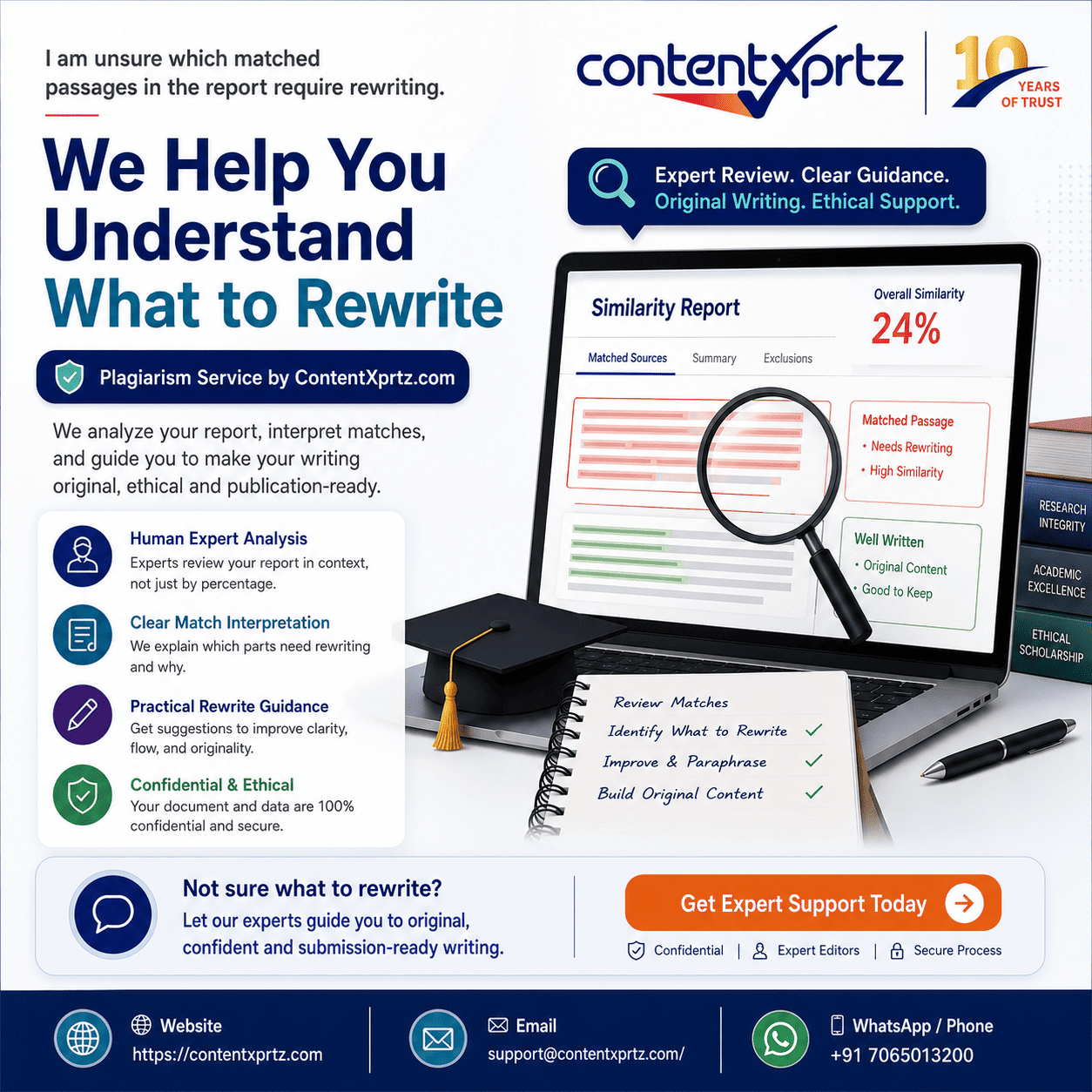
A similarity checker compares submitted text with documents available in its databases and marks overlapping strings. It may help find missed quotations, copied notes, repeated phrases, prior submissions, or unattributed overlap. It cannot reliably determine authorship, intent, common knowledge, permission, or whether a source has been used ethically.
Review the report at passage level. A bibliography match is different from a copied discussion paragraph. A standard method name is different from a distinctive interpretation. A correctly formatted quotation is different from uncited copying. Large blocks from one source may be more significant than many tiny matches spread across references and routine language.
Do not rewrite accurate technical material into awkward language merely to lower a score. Do not remove valid citations to reduce matches. Do not assume that an excluded bibliography or quotation setting makes the remaining percentage universally acceptable. The relevant institution or publisher decides how the report is interpreted.
Do I Need to Cite This? A Practical Decision Guide
When the answer is uncertain, focus on whether the material came from another identifiable contribution and whether readers could mistake it for your own.
| Situation | Typical action | Why |
|---|---|---|
| Exact sentence or distinctive phrase | Quote and cite | The wording belongs to the source |
| Paraphrased argument, finding, or method | Cite | The intellectual contribution remains borrowed |
| Your analysis based on cited evidence | Cite the evidence and identify your interpretation clearly | Readers need to distinguish source from analysis |
| Widely known fact in the intended field | Citation may not be necessary | Common knowledge is audience- and discipline-specific |
| Image, table, dataset, questionnaire, or code | Credit, cite, describe adaptation, and check permission | Non-text material also has creators and reuse conditions |
| Your previously submitted or published material | Disclose and cite as required | Originality and duplicate-use expectations may apply |
| AI-generated or AI-revised content | Follow policy, verify, and disclose where required | Permitted use and authorship representation vary |
A citation is not a substitute for understanding. Read the source, confirm that it supports the claim, and avoid citing a paper only because another author cited it. If you rely on a secondary discussion because the original cannot be accessed, identify the source actually consulted according to the required style.
Ethical Academic Editing, AI Use, and Author Responsibility
Ethical editing should improve communication without replacing the author’s scholarly contribution. An editor may correct language, flag unclear claims, identify citation inconsistencies, mark possible patchwriting, and suggest that the author verify a source. The author must still decide what the evidence means, confirm every reference, and approve the final wording.
AI assistance requires the same transparency plus additional verification. Generated citations can be fabricated, summaries can distort sources, and polished text can contain copied or untraceable language. Use AI only where the applicable rules permit it. Do not upload confidential data or unpublished manuscripts to tools without appropriate safeguards. Retain evidence of your own research and drafting process, and disclose assistance when required.
For publication, related manuscripts, preprints, conference papers, theses, and reused figures should be disclosed to the editor. For coursework, editing and collaboration must stay within the instructor’s rules. For professional work, client confidentiality, contractual authorship, and intellectual-property terms may apply. In every setting, integrity depends on accurate representation of who did the work.
Common Plagiarism Mistakes to Avoid
- Citing a source but omitting quotation marks. A citation credits the source, but exact copied wording still needs quotation formatting.
- Changing a few words in the original sentence. Synonym replacement and minor reordering often remain patchwriting.
- Putting one citation at the end of a long paragraph. Readers may not know which claims came from which source.
- Copying from a cited secondary source. Do not imply that you read the original work if you did not.
- Reusing your own earlier work without disclosure. Prior authorship does not automatically satisfy current originality rules.
- Ignoring figures, tables, code, and translated text. Attribution applies beyond prose.
- Treating a low similarity score as proof of originality. Tools can miss uncited ideas and disguised copying.
- Trying to reduce the percentage by distorting technical language. Accuracy and transparent attribution matter more than a target number.
- Using invented or incomplete references. Every source must be authentic, traceable, and relevant to the claim.
- Allowing an editor or AI tool to take over authorship. Permitted language support is different from undisclosed content creation.
Practical Examples: Plagiarism Risk in Real Academic Work
Example 1: A PhD scholar’s literature review
Situation: A doctoral researcher saves useful sentences from twenty articles in one notes document. Months later, several copied sentences enter the thesis without quotation marks because the researcher remembers the ideas but not which wording was copied.
Correct approach: The scholar returns to the original papers, marks exact language, rewrites the concepts from understanding, and adds precise citations. Where a distinctive definition is important, the scholar uses a short quotation. A chapter-level source audit finds similar problems before final submission.
How ethical guidance helps: A thesis editor can flag abrupt style shifts and close paraphrases, but the scholar must verify each source and make the intellectual decisions.
Example 2: A first-time journal author reusing a conference paper
Situation: A researcher develops a full journal article from an earlier conference paper and copies the background, method description, and one table. The new submission does not cite or disclose the conference version.
Correct approach: The author checks the journal’s policy, cites the conference paper, tells the editor about the relationship, explains what is new, and verifies whether table reuse needs permission. Standard method language is reviewed separately from reused results and interpretation.
How ethical guidance helps: A manuscript assessment can map overlap and help the author prepare a transparent explanation, without promising acceptance.
Example 3: An ESL student paraphrasing a complex source
Situation: A postgraduate student understands a source but changes only a few words because the original sentence seems technically precise. The source is cited, yet the wording and structure remain almost identical.
Correct approach: The student identifies the core claim, explains it aloud in simpler terms, drafts a new sentence without viewing the source, and then checks meaning and terminology. One unavoidable phrase is quoted; the rest is paraphrased and cited.
How ethical guidance helps: Language editing can improve grammar and clarity while preserving the student’s reasoning and showing where more independent paraphrasing is needed.
Plagiarism Prevention and Academic Integrity Checklist
Source collection
- Every source has complete bibliographic details and a stable identifier where available.
- Exact copied notes are visibly marked as quotations.
- Page numbers, figure numbers, dataset versions, and access details are recorded.
- Confidential or unpublished material is handled under the correct permissions.
Drafting
- The argument and paragraph structure reflect the author’s own purpose.
- Paraphrases were written from understanding rather than by word substitution.
- Exact phrases are quoted and cited.
- Borrowed ideas, methods, evidence, images, code, and translations are acknowledged.
Reuse and collaboration
- Earlier assignments, theses, preprints, conference papers, and publications are disclosed where required.
- Co-author contributions are clear.
- Editing, translation, and AI use comply with the applicable policy.
- Permissions and licences are checked for reused non-text material.
Final verification
- Every in-text citation has a matching reference and every reference is authentic.
- Claims accurately represent the cited sources.
- Similarity matches were reviewed in context rather than judged only by percentage.
- The final submitted version—not an earlier draft—received the source audit.
- The author has read, approved, and accepts responsibility for the complete document.
How Contentxprtz Can Help with Plagiarism-Risk Reduction
Plagiarism-risk reduction is not a mechanical rewriting exercise. It requires a document-specific review of attribution, paraphrasing, quotations, citations, references, prior overlap, and author responsibility. Contentxprtz can support writers through ethical plagiarism and AI-integrity review, academic editing, and manuscript assessment.
Support may include identifying passages that need author verification, marking overly close paraphrases, checking citation and reference consistency, improving clarity, and helping the author organize revisions. It does not include inventing sources, disguising copied material, guaranteeing plagiarism removal, or replacing the author’s research and judgment.
Before requesting support, provide the document type, citation style, institutional or journal policy, similarity report if available, source files where permitted, and any prior related work. This context helps define an ethical and useful scope.
Summary: What Is Plagiarism?
Plagiarism is the inaccurate or misleading presentation of borrowed intellectual work as original. It may involve exact text, paraphrased ideas, methods, data, images, code, translations, or reuse of one’s own earlier work. The defining concern is not a software score but whether readers receive honest, traceable information about authorship and sources.
Writers can reduce risk by building accurate source records, separating copied notes from draft prose, paraphrasing from understanding, quoting exact wording, citing ideas close to where they appear, disclosing reuse, checking permissions, and reviewing similarity matches in context. Institutional and publisher policies remain the final authority because definitions, thresholds, permitted assistance, and consequences vary.
Frequently Asked Questions
What is plagiarism in simple terms?
Plagiarism is presenting another person’s words, ideas, structure, data, images, code, or creative work as though it were your own, without giving appropriate credit. It can involve copying a sentence word for word, paraphrasing too closely, using an idea without citation, submitting another person’s work, or reusing your own previously submitted or published material without disclosure when the rules require it. The key issue is misleading the reader about where the intellectual contribution came from. Academic policies differ, so the exact definition and consequences depend on the university, course, journal, publisher, or professional body. A practical rule is to cite a source whenever a reasonable reader could mistake borrowed material for your original contribution. Use quotation marks or block formatting for exact language, provide a citation for paraphrased ideas, and include a complete reference. When unsure, check the relevant policy or ask an instructor, supervisor, editor, or librarian before submission.
What are the most common types of plagiarism?
Common types include direct plagiarism, mosaic or patchwriting, inadequate paraphrasing, idea plagiarism, source-based plagiarism, self-plagiarism, and plagiarism of data, images, tables, code, or other non-text material. Direct plagiarism copies exact language without quotation and credit. Patchwriting keeps much of the source’s wording or sentence pattern while changing a few terms. Inadequate paraphrasing may cite the source but remain too close to its expression. Idea plagiarism uses another person’s distinctive argument, method, interpretation, or organization without acknowledgement. Source-based plagiarism can involve fabricated, misleading, or secondary citations that imply the writer consulted material they did not read. Self-plagiarism or text recycling involves undisclosed reuse of one’s own earlier work where originality is expected. The labels and thresholds vary across institutions and publishers, so writers should consult the rules that govern their assignment, thesis, manuscript, grant, report, or professional document.
Is plagiarism always intentional?
No. Plagiarism can be deliberate, but it can also result from weak note-taking, confusion about citation rules, missing quotation marks, rushed drafting, language difficulties, collaborative misunderstandings, or accidental reuse of source wording. Intent may affect how an institution evaluates a case, but an unintentional mistake can still violate academic or publication rules because the submitted text may misrepresent authorship. Prevention therefore depends on process, not only good intentions. Keep source notes separate from draft prose, record page numbers and publication details as soon as you save a source, mark copied language clearly in your notes, and insert provisional citations while drafting. After revision, compare paraphrases with the originals and check that every in-text citation has a matching reference. If you discover a mistake before submission, correct it. If you discover one after submission or publication, seek guidance promptly rather than hiding it. Institutions and journals apply their own procedures, so use the relevant policy as the final authority.
Is paraphrasing without citation plagiarism?
Usually, yes. Paraphrasing changes the wording, but it does not transfer ownership of the underlying idea, evidence, interpretation, method, or finding to the new writer. A responsible paraphrase therefore needs both genuine rewriting and a citation. Read the source until you understand it, set it aside, explain the point in a new structure suited to your argument, check that the meaning remains accurate, and then cite the source. Replacing words with synonyms, moving phrases, or changing active voice to passive voice is not enough if the sentence pattern and distinctive language remain close to the original. Exact phrases that must be retained should appear in quotation marks with an appropriate locator when the citation style requires one. Common knowledge may not need citation, but what counts as common knowledge depends on the audience and discipline. When uncertain, cite cautiously and follow the guidance of the course, university, journal, or publisher.
What is self-plagiarism or text recycling?
Self-plagiarism is the undisclosed reuse of your own previously submitted, assessed, presented, or published material when the current context expects original work or transparent disclosure. It may include resubmitting an assignment, copying sections from an earlier article, republishing the same findings as though they were new, or dividing one study into overlapping papers without adequate explanation. In publishing, the term text recycling is often used because limited reuse of standard methods language may be treated differently from duplicate publication or repeated presentation of results. Acceptability depends on the amount reused, the section involved, copyright or licence terms, author instructions, and whether the earlier work is cited and disclosed. Students should obtain permission before reusing assessed work. Researchers should tell editors about related manuscripts and cite prior publications where relevant. Rewriting purely to hide overlap is not an ethical solution; transparency, accurate attribution, and compliance with the governing policy are more important than achieving an artificially low similarity score.
Does a plagiarism or similarity report prove misconduct?
No. A similarity report identifies text that matches or resembles material in the tool’s comparison database; it does not by itself decide whether plagiarism occurred. A high percentage may include correctly quoted passages, references, standard terminology, assignment templates, legal wording, methods language, or legitimate overlap with the writer’s earlier work. A low percentage may still conceal uncited ideas, translated copying, contract cheating, copied images, manipulated data, or paraphrasing that the software did not detect. Each match must be reviewed in context. Ask whether the wording is exact, whether quotation formatting is present, whether the source is cited, whether the match reflects common language, and whether the borrowed contribution is represented honestly. Instructors, supervisors, editors, and research-integrity staff normally apply policy and disciplinary judgment rather than relying on one number. Writers should use reports as diagnostic aids for revision, not as certificates of originality or automatic evidence of guilt.
What similarity percentage is acceptable in academic writing?
There is no universal acceptable similarity percentage. Universities, departments, journals, and publishers may use different screening systems, exclusions, thresholds, and review procedures, and many do not treat a single percentage as a pass-or-fail rule. The meaning of a score also depends on document type. A literature review may contain many cited terms and titles, a methods section may use established language, and a short assignment can show a large percentage from one small match. Instead of aiming for a particular number, review the matched passages. Correct uncited copying, add quotation marks where exact wording is necessary, rewrite overly close paraphrases, verify citations, and remove unnecessary repetition. Do not alter accurate technical terms or distort meaning merely to lower the score. If a submission portal displays a threshold, read the institution’s full policy because exclusions for references, quotations, small matches, and prior submissions may change the result. Ethical originality is demonstrated by transparent source use and genuine authorship, not by a number alone.
Can AI-generated text cause plagiarism or academic-integrity problems?
Yes. AI-generated text can create plagiarism and broader integrity risks even when it does not reproduce a clearly identifiable source. A model may generate language that resembles training material, invent citations, blend unattributed ideas, misstate evidence, or produce text that violates a course or journal policy on permitted assistance. Submitting AI output as fully original work can also misrepresent authorship. Before using any AI system, check the applicable institutional, publisher, employer, funder, or client rules. Verify every factual claim and reference against authentic sources, rewrite from your own understanding, document or disclose AI assistance when required, and never use a tool to conceal copied material. Keep records of prompts and revisions if the policy asks for them. Human authors remain responsible for accuracy, originality, confidentiality, citations, data, and final submission. AI can support brainstorming or language review where permitted, but it should not replace source reading, critical thinking, or transparent authorship.
How can I check my paper for plagiarism before submission?
Begin with a manual source audit. Confirm that every quotation is clearly marked, every paraphrase is genuinely rewritten, every borrowed idea has an in-text citation, and every citation has a complete reference. Compare high-risk passages with the original sources, especially notes copied during early research. Check tables, figures, images, code, translated material, appendices, and reused text from your own earlier work. Then use the similarity tool approved by your institution or publisher, if available, and review each match rather than focusing only on the percentage. Correct missing attribution, overly close wording, inaccurate citations, and duplicated material. Do not use untrusted upload sites for confidential theses, unpublished manuscripts, client documents, or sensitive research because their storage and reuse practices may be unclear. Finally, read the relevant policy and ask for guidance when rules are uncertain. Ethical academic editing can help identify citation, paraphrasing, and consistency problems, but the author must verify sources and approve every revision.
When can professional editing help reduce plagiarism risk?
Professional editing can help when a thesis, dissertation, research paper, journal manuscript, book chapter, or professional report contains inconsistent citations, overly close paraphrases, unclear source boundaries, extensive language issues, or complex reuse of earlier material. An ethical editor can flag passages that need quotation, citation, restructuring, or author verification; check reference consistency; improve clarity without replacing the author’s ideas; and explain why a passage may create attribution risk. The editor should not fabricate sources, disguise copied text, guarantee a particular similarity score, or rewrite work in a way that conceals authorship. Authors remain responsible for reading the sources, validating every citation, following institutional or journal rules, disclosing assistance when required, and approving the final document. Contentxprtz offers contextual plagiarism and AI-integrity support, academic editing, and proofreading for writers who need a structured review. The appropriate service depends on the document, deadline, policy, and level of intervention permitted.
Conclusion: Build Original Work Through Transparent Source Use
The most effective way to avoid plagiarism is not to chase a perfect similarity score. It is to build a writing process in which sources are traceable, exact language is clearly marked, paraphrases reflect real understanding, citations are complete, reuse is disclosed, and the author’s contribution remains visible.
Self-review and institutional guidance may be enough for a short, well-organized paper. Expert-assisted review becomes safer when a thesis, manuscript, book, or professional document has extensive source use, complex overlap, language challenges, or a confusing similarity report. Ethical support can improve clarity, structure, citation consistency, and publication readiness, but the author remains responsible for claims, data, sources, disclosures, and final submission.
Contentxprtz helps students, researchers, authors, and professionals strengthen source transparency and academic communication without promising guaranteed outcomes. “At Contentxprtz, we don’t just edit; we help ideas reach their fullest potential.”