Why “Free Correction” Needs Academic Judgment
Searching for a plagiarism corrector free option usually means you have found a similarity warning, a sentence that looks too close to a source, or a draft that you want to check before submission. The immediate temptation is to paste the passage into a rewriter and accept whatever comes back. That can make a sentence look different without fixing the underlying academic problem. If the idea came from a source, the source still needs acknowledgement. If the new wording distorts the original meaning, the correction has made the scholarship worse. If the tool invents a reference, you now have a traceability problem as well.
A better way to think about plagiarism correction is as a source-use review. First identify why the passage was flagged or why it concerns you. Is it an exact quotation, a common technical phrase, a close paraphrase, missing quotation marks, an absent citation, copied notes that entered the draft, or text reused from your own earlier work? Each cause needs a different response. A correct quotation may need no rewriting at all. A patchwritten sentence needs to be reconstructed from your understanding. An uncited idea needs attribution. A bibliographic match may simply need contextual interpretation.
This distinction matters for students, PhD scholars, researchers, first-time authors, and ESL writers because similarity and plagiarism are not identical. Turnitin’s current guidance explains that its Similarity Report highlights matching text and that the percentage itself does not determine whether plagiarism occurred. University rules also vary. The University of Oxford, for example, frames plagiarism around presenting another source’s work or ideas as your own without full acknowledgement, including relevant forms of AI-generated material under its rules. Your own institution’s definition and assessment policy should therefore guide the final decision.
Free tools can still be useful. A checker can point you toward passages to inspect, a citation manager can reduce reference inconsistency, and a grammar or language tool can help you polish your own wording. The key is to keep intellectual control. Read the source, decide what it contributes, write the passage yourself, verify the citation, and check the final version for meaning and accuracy. When a document has widespread source-integration problems, professional academic editing services or focused ethical academic integrity support may provide a more systematic review without replacing the author’s responsibility.
Quick Answer: How to Use a Plagiarism Corrector Free
Use a free plagiarism corrector as a review aid, not an automatic plagiarism remover. Identify the matched or questionable passage, open the original source, decide whether you need a quotation, paraphrase, or summary, rewrite from your understanding, and add the required citation.
Then verify the revised wording against the source. A sound paraphrase changes both expression and sentence structure while preserving the source’s meaning. It still needs attribution. Do not chase a zero similarity score, because legitimate quotations, references, standard terms, and correctly cited material may still match.
For unpublished research, check privacy and data-retention terms before using any free website. If your institution restricts external tools or AI-assisted rewriting, follow that policy even when the tool is technically available.
Key Takeaways
- Similarity is evidence of text overlap; it is not, by itself, a plagiarism verdict.
- Changing synonyms without changing structure or acknowledging the source can leave the core problem unresolved.
- A genuine paraphrase preserves meaning, uses independent wording and structure, and includes the required citation.
- Correct quotations can legitimately appear as matches and should not be distorted merely to lower a percentage.
- Free tools may create privacy, confidentiality, accuracy, or fabricated-reference risks, especially for unpublished research.
- Your university, supervisor, instructor, or target journal policy takes priority over generic online advice.
- Human editing is most useful when source integration, citation consistency, language clarity, and argument structure need review together.
What This Page Covers
- What plagiarism correction really means
- Free tools and their limits
- Ethical paraphrasing workflow
- Citation and quotation decisions
- Similarity-report interpretation
- Privacy and AI-tool risks
- When expert editing helps
Methodology and Academic Sources
This article combines established academic-writing practice with current guidance from institutional and product sources. It treats plagiarism correction as a question of authorship, attribution, paraphrasing, quotation, citation, and source integration rather than as a numerical similarity-score problem.
For definitions and practical standards, consult the University of Oxford plagiarism guidance and the Purdue Online Writing Lab resources on avoiding plagiarism. For similarity reports, Turnitin’s student similarity-score guidance explains that matched text must be interpreted rather than treated as an automatic finding. Rules differ by institution, discipline, assignment, publisher, and research context, so always check the instructions that govern your work.
What Does “Plagiarism Corrector Free” Mean in Academic Context?
In academic writing, a plagiarism corrector should be understood as a workflow for finding and repairing source-use problems. A free service may perform only one part of that workflow. Some tools compare text against web pages or databases. Some paraphrase. Some check citations or grammar. Others combine several functions. The tool category therefore matters less than the decision you make after a warning appears.
Text matching
Software identifies wording that resembles material in its comparison sources. A match tells you where to look, not what ethical conclusion to reach.
Plagiarism
Plagiarism concerns unattributed use of another person’s words, ideas, data, or other material under the rules that govern the work.
Paraphrasing
Paraphrasing restates a source idea in independently constructed language while preserving meaning and giving attribution.
Patchwriting
Patchwriting stays too close to the source’s wording or syntax, often through word-by-word substitution, and may signal incomplete source integration.
The most important shift is from “How do I make this match disappear?” to “What is the academically correct way to use this source?” That question protects meaning, attribution, and author responsibility. It also produces better writing because the revised paragraph is built around your argument rather than around a software score.
| What you see | Likely issue | Better response | What not to do |
|---|---|---|---|
| Exact sentence from a source | Quotation or copied wording | Quote and cite if wording is necessary, or paraphrase from understanding and cite | Swap synonyms while keeping the same sentence |
| Close wording with a citation | Possible patchwriting | Rebuild the passage with a new structure and preserve the citation | Delete the citation because words changed |
| Correctly quoted material | Legitimate textual match | Verify quotation marks, locator, and reference | Distort the quote to lower similarity |
| Reference-list entries | Expected bibliographic overlap | Check formatting and interpretation of the report | Remove references to reduce a score |
| Your earlier published wording | Possible self-reuse issue | Check policy, cite prior work where required, and rewrite when appropriate | Assume your own earlier text never needs acknowledgement |
This table is deliberately decision-oriented. It shows why “correction” is contextual: the same visual match can be legitimate in one passage and problematic in another.
Free, Low-Cost, and Professional Options: Which Is Enough?
Free support is enough when the problem is small, understandable, and within your own ability to verify. Professional support becomes more useful when the same source-use problem repeats across a long document or when language, structure, and citations interact in ways that require sustained judgment.
| Option | Best for | Main advantage | Main limitation |
|---|---|---|---|
| Manual source review | A few suspicious sentences or missing citations | Highest author control and source awareness | Time intensive in long documents |
| Free similarity checker | Finding possible text overlap | Fast initial screening | Database coverage, privacy, and interpretation vary |
| Free paraphrasing or language tool | Exploring wording after you understand the source | Can suggest alternative phrasing | May change meaning or encourage patchwriting |
| University writing centre or supervisor | Learning citation and paraphrasing conventions | Aligned with local academic expectations | Availability and response time vary |
| Professional academic editing | Long, high-stakes documents with recurring issues | Integrated review of clarity, language, and source use | Must remain within institutional editing rules |
A free checker is particularly useful as a triage tool. It can help you decide where to spend your attention. However, you should never assume that an unflagged passage is automatically original or that a flagged passage is automatically wrong. Database coverage differs, source metadata can be incomplete, and academic judgment still matters.
For students who need help with language rather than source use, scholarly proofreading may be more relevant than a plagiarism-focused service. For manuscripts with broader structure, clarity, and citation issues, professional editing can address the document as a whole.
Step-by-Step: Correct a Flagged Passage Without Hiding the Source
The safest correction method is deliberately slower than one-click rewriting because it separates understanding from wording. That separation is what helps you avoid patchwriting.
- Locate the exact passage. Use a similarity report, your notes, or manual review to identify the sentence or paragraph that needs attention. Do not start by rewriting the whole document blindly.
- Open the original source. Confirm the author, publication, page or section, and the exact idea you intended to use. If you cannot trace the source, do not invent a citation.
- Classify the use. Decide whether you need an exact quotation, a paraphrase, a summary, or no source material at all. The purpose of the passage determines the right form.
- Close or look away from the source. Explain the idea in your own conceptual language, as if you were telling a knowledgeable colleague what the source contributes to your argument.
- Rebuild the sentence structure. Change the organization of the idea, not just individual words. Combine or split sentences when that better reflects your reasoning.
- Add attribution immediately. Insert the in-text citation, footnote, or other acknowledgement required by your style. Do not postpone citation until the end of drafting.
- Compare meaning and wording. Reopen the source and check that your version is accurate, not misleading, and sufficiently independent in expression.
- Add your scholarly contribution. Explain why the source matters, how it compares with other evidence, or what limitation it has. This turns source reporting into analysis.
- Verify the reference entry. Make sure the author, year, title, journal or publisher, DOI or URL where relevant, and style formatting match the source you actually used.
- Recheck the paragraph in context. Confirm that the revised passage still supports your thesis, research question, or analytical point and does not read like an isolated patch.
When quotation is better than paraphrase
Paraphrasing is not automatically superior. Quote when the exact wording is the object of analysis, when a definition is unusually precise, or when changing the language would weaken the evidence. Keep quotations proportionate and integrate them with your own explanation. If an assignment discourages quotation, follow that instruction and seek guidance when exact wording is essential.
When summary is better than sentence-level rewriting
If a source contributes a broad pattern rather than one precise claim, summarizing may be more efficient. A summary compresses the main point into your own framing and still requires citation. It is often better than paraphrasing several consecutive sentences because it reduces dependence on the source’s original organization.
Common Plagiarism-Correction Mistakes to Avoid
Most failed corrections share one problem: they focus on the appearance of originality instead of the scholarly relationship between the new text and its source.
1. Synonym swapping
Replacing “important” with “significant” or moving a few phrases does not create an independent paraphrase if the sentence still follows the same conceptual and grammatical path. This approach can also produce awkward or technically inaccurate prose.
2. Removing citations after paraphrasing
A citation acknowledges the origin of the idea, not only the original wording. If the intellectual contribution came from another source, the citation usually remains necessary even after complete rewriting.
3. Treating the overall similarity percentage as a grade
Turnitin’s current guidance states that the similarity score reflects matched text. Different assignments and institutions can interpret matches differently. Review the sources and the nature of each match rather than optimizing a single number.
4. Deleting useful quotations or references
Reference entries, properly quoted evidence, titles, and fixed terminology can generate legitimate matches. Removing them to lower a score can weaken scholarly transparency.
5. Letting AI invent references
Any reference suggested by an AI system must be independently verified. A plausible-looking citation that cannot be traced is not a valid source. Use library databases, DOI records, publisher pages, or the original article to confirm bibliographic details.
6. Uploading confidential drafts to unknown services
Free does not mean risk-free. Check whether a service stores submissions, reuses text, or creates a repository. For sensitive material, use an institutionally approved service or review only non-confidential excerpts.
7. Ignoring self-plagiarism or text recycling
Reusing your own prior writing may still require disclosure or citation depending on the context. Journal and university policies differ, especially when previous conference papers, thesis chapters, preprints, or published articles overlap.
Before Submission: Review the Document, Not Just the Score
A final originality review should move from individual matches to document-level quality. Ask whether each source is traceable, whether citations are consistently formatted, whether quotations are marked, and whether paraphrases preserve meaning. Then ask a broader question: does your own argument remain visible?
In a strong research paper, sources support your reasoning rather than replace it. Paragraphs should show why evidence matters, how studies relate, where findings disagree, and what conclusion you draw. If the literature review becomes a sequence of one-source paraphrases, the problem is not only similarity risk; it is also weak synthesis.
Also check the practical submission rules. Some universities permit students to see similarity reports before final submission; others do not. Some assignments allow resubmission and some delay report generation. Do not assume that a commercial free checker replicates the same database, exclusions, or settings as your institutional system.
If your target is a journal, read its author instructions and publication-ethics policies. Publisher expectations can differ for text recycling, preprints, methods wording, AI assistance, and disclosure. For broader manuscript readiness, manuscript assessment can help identify structural and presentation issues that a similarity tool cannot evaluate.
Ethical Academic Editing and Author Responsibility
Editing should improve communication without replacing the author’s intellectual work. That principle is especially important when correcting source use. An editor can flag a citation gap, explain why a paraphrase is too close, improve grammar, and help you apply a citation style consistently. The editor should not fabricate evidence, invent sources, rewrite a copied passage to conceal its origin, or make claims that the author cannot verify.
Authors remain responsible for their research questions, data, interpretations, citations, and final submission. The Committee on Publication Ethics provides publication-ethics resources for editors, journals, and researchers, while universities and journals apply their own detailed rules. When policies differ, the rules attached to your assessment or publication venue are the ones you must follow.
AI assistance adds another layer. If you use a generative system to suggest language, verify all claims and citations, check whether disclosure is required, and make sure the final wording represents your intended meaning. AI-generated paraphrases can sound fluent while subtly changing causality, certainty, sample characteristics, or methodological details. That risk is particularly serious in scientific and technical writing.
Ethical plagiarism-risk reduction therefore depends on four habits: original thinking, careful note-taking, accurate attribution, and deliberate source integration. No correction tool can replace those habits.
Practical Examples: What Ethical Correction Looks Like
These mini cases show how different causes of similarity require different fixes.
Close paraphrase with citation
A student cites the source but changes only a few words. The correction is to read the source, close it, explain the idea from understanding, reorganize the sentence, and keep the citation. The aim is independent expression, not citation removal.
Standard methods wording
A methods section matches established terminology and a previously published protocol. The researcher checks whether exact language is necessary, cites the protocol, follows university rules on text reuse, and rewrites explanatory material where original wording is not required.
Paraphraser changes technical meaning
An AI suggestion replaces a discipline-specific term with a broad synonym. The author rejects the change, restores the technically correct term, rewrites the surrounding sentence manually, and verifies the citation and claim.
Too many one-source paragraphs
The similarity score is not the only problem. The writer reorganizes the section by themes, compares multiple studies in each paragraph, adds synthesis, and cites each source where its specific contribution is discussed.
Self-reuse from earlier work
An author notices overlap with a conference paper. Instead of assuming ownership makes reuse harmless, the author checks the target journal’s policy, cites the prior output where appropriate, and rewrites reused exposition when required.
Legitimate match remains
A quotation is correctly marked and cited but still appears as a match. The writer keeps it because the exact wording is analytically important and reviews the report in context rather than editing solely for a lower percentage.
Academic Editing and Plagiarism-Correction Checklist
Before using a tool
- Check your institution’s rules on plagiarism checkers, AI tools, and external editing.
- Remove confidential or personally identifiable information from material you do not need to upload.
- Confirm the tool’s privacy, storage, and repository terms.
For every flagged passage
- Open and verify the original source.
- Decide whether quotation, paraphrase, or summary is appropriate.
- Rewrite from understanding, not by synonym substitution.
- Add or repair the citation immediately.
- Compare the final text with the source for both accuracy and independence.
Before submission
- Match every in-text citation to a real reference entry.
- Check quotations, page numbers, and locators where required.
- Review self-reuse and AI disclosure requirements.
- Read paragraphs for synthesis and your own analytical voice.
- Keep a clean source record so every claim can be traced.
How Contentxprtz Can Help When Free Correction Is Not Enough
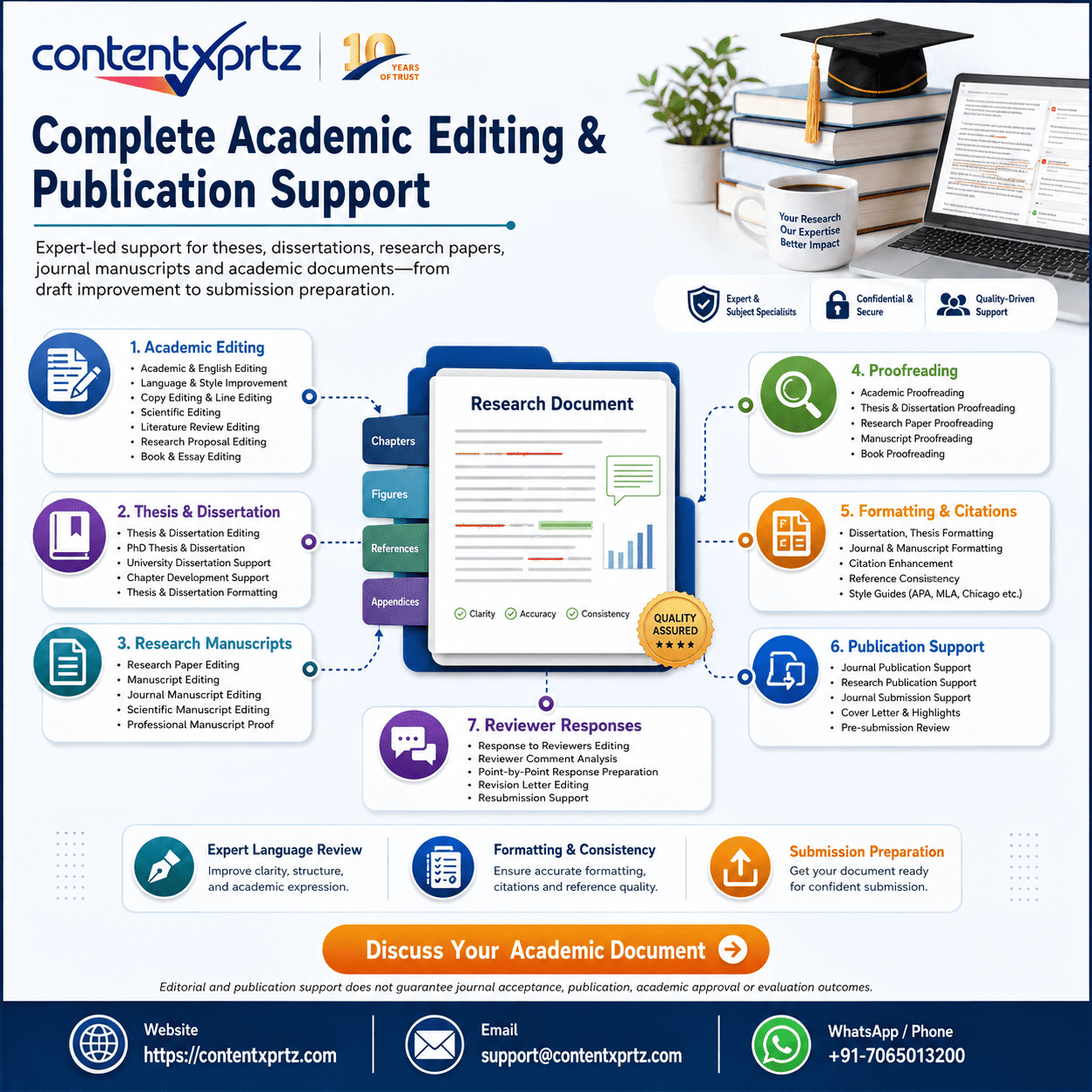
A free plagiarism corrector can help with isolated passages, but a long thesis, dissertation, or manuscript may need a joined-up review. Contentxprtz supports ethical correction by looking at language, source integration, citation consistency, and readability together. The goal is to help authors communicate their own work clearly—not to disguise copied material or manufacture a target similarity percentage.
For a document with recurring source-use problems, the most relevant option is plagiarism and publication support. When the main problem is academic language, structure, or consistency, academic editing may be the better fit. Researchers preparing a journal submission can also use publication support for formatting and submission-readiness tasks that fall within ethical authorship boundaries.
Need a human review of source use and academic clarity?
Get support with citation consistency, paraphrasing quality, language, and publication readiness while keeping authorship and academic responsibility with you.
Summary: Plagiarism Corrector Free
A plagiarism corrector free tool is most useful when it helps you locate passages that deserve human review. Ethical correction means identifying the source-use problem, checking the original source, choosing quotation, paraphrase, or summary deliberately, rewriting from understanding, and citing accurately.
Do not treat similarity as a pass-or-fail percentage. Legitimate text can match, and problematic source use can exist even when a score is low. Protect unpublished work by checking privacy terms, verify AI-generated suggestions and references, and follow your institution or journal policy. If problems are widespread across a high-stakes document, expert editing can support clarity and citation consistency without replacing author responsibility.
Frequently Asked Questions
These answers focus on the decisions students and researchers most often face when trying to correct similarity and source-use problems responsibly.
What does a plagiarism corrector free tool actually do?
A free plagiarism corrector usually helps you review text that may be too close to a source, but the exact function depends on the tool. Some services only flag matching phrases. Others suggest paraphrases, grammar changes, or citation reminders. None of these functions can decide academic integrity for you. A match may be a correctly quoted passage, a reference entry, a technical phrase, or text that genuinely needs rewriting and citation. The useful approach is to treat the tool as a diagnostic assistant rather than an automatic repair button. Open the original source, identify the idea you are using, decide whether quotation, paraphrase, or summary is appropriate, and add the citation required by your institution or journal. Then compare your revised sentence with the source again to make sure you have changed both wording and sentence structure while preserving the meaning. If a free tool rewrites text in a way that changes the claim, introduces a false citation, or hides copied wording without attribution, reject that suggestion. The author remains responsible for accuracy, source acknowledgement, and the final submitted text.
Can I use a plagiarism corrector free for a thesis or dissertation?
Yes, a free checker or correction aid can be useful during a thesis or dissertation draft, provided your university permits the tool and you use it for ethical review. It can help you notice repeated wording, citation gaps, patchwriting, and passages that deserve closer source checking. However, doctoral work often contains specialist terminology, methodology language, standard instrument descriptions, and previously published material that require contextual judgment. A tool may flag these without understanding whether the overlap is legitimate. For a thesis, work section by section. Keep the sources open, verify every quotation, make sure paraphrases genuinely reflect your own synthesis, and check whether self-reuse from earlier papers must be cited. Also review your university’s rules for third-party editing and generative AI. Do not upload confidential participant data, unpublished results, restricted manuscripts, or proprietary material to an unknown free website. If the document is high stakes, a human academic editor can review language and citation consistency while preserving your ideas, but the author and supervisor remain responsible for compliance with institutional policy.
Will a free plagiarism corrector make my similarity score zero?
No, and a zero similarity score should not be treated as the objective. Similarity systems identify matching text; they do not produce a universal plagiarism verdict. Correct quotations, references, article titles, standard phrases, and discipline-specific terminology can all create legitimate matches. Turnitin itself explains that the similarity score reflects matching text and must be interpreted in context. Trying to force the score to zero can damage writing quality by replacing precise academic language with awkward synonyms, deleting necessary quotations, or distorting established terminology. Instead, review the largest and most meaningful matches. Ask whether the source is acknowledged, whether quotation marks are required, whether the paraphrase is genuinely independent in wording and structure, and whether the citation points to the correct source. Follow your instructor, university, or journal guidance on acceptable use of sources. The best outcome is not a particular percentage; it is a document in which borrowed ideas and words are transparent, traceable, accurately represented, and integrated into your own argument.
How can I correct plagiarism without simply changing words?
Correcting source-use problems requires more than synonym replacement. First, read the source until you understand the claim. Then look away from the original and write the idea from your own conceptual understanding, using the structure that best serves your argument. Compare the new version with the source afterward. If distinctive wording or sentence structure remains too close, revise again. Add a citation because paraphrasing does not remove the obligation to acknowledge the source. Use quotation marks when the original wording itself is important and your rules permit quotation. You should also add your own analytical connection: explain why the source matters, how it relates to another study, or what limitation it has. This changes the passage from disguised copying into genuine scholarly synthesis. Avoid word spinners that mechanically swap vocabulary while preserving the original grammar. That pattern can still amount to patchwriting and may change technical meaning. For difficult passages, a writing centre, supervisor, or ethical academic editor can help you understand how to paraphrase without taking over authorship.
Is paraphrasing enough to avoid plagiarism?
Paraphrasing is only one part of avoiding plagiarism. A legitimate paraphrase expresses a source idea in genuinely new wording and structure, preserves the source’s meaning, and includes the required citation. Merely replacing several words, rearranging clauses, or using an AI rewriter while keeping the source’s underlying sentence pattern may still be too close. Citation is also essential because the idea originated elsewhere even when none of the original wording remains. Good academic practice therefore combines three tasks: accurate source understanding, independent expression, and transparent attribution. In literature reviews, you often need a fourth task—synthesis—because the goal is to connect findings from multiple sources rather than paraphrase one article at a time. Check the exact citation style required by your institution or journal, and verify that the reference list entry matches the in-text citation. If you use AI or language tools, follow local disclosure rules and verify every factual claim and reference they produce.
Are free plagiarism correction websites safe for unpublished research?
Not automatically. Before uploading unpublished academic work, review the service’s privacy policy, data-retention terms, repository rules, and whether submitted text may be used to train systems or be stored for future comparison. This matters for theses under examination, embargoed manuscripts, confidential peer-review documents, patent-sensitive material, participant information, and commercial research. A free service may be convenient but still be inappropriate for restricted content. If the policy is unclear, do not upload the full document. You can instead review short non-sensitive passages, use institutionally approved software, or ask your university library, research office, supervisor, or IT team which services are authorized. Remove names, participant identifiers, confidential tables, and unpublished data when possible. Remember that academic integrity and data protection are separate issues: a tool can be useful for writing but unsuitable for your information-security obligations. For journal manuscripts, also check publisher rules and any confidentiality terms connected to peer review or co-author agreements.
What should I do when a checker flags a correctly cited quotation?
A correctly cited quotation may still appear as a text match because the wording is intentionally identical to the source. Do not rewrite a quotation merely to reduce a percentage. Instead, confirm that the quotation marks or block-quote formatting are correct, the citation is complete, the page or locator is included when required, and the quotation is necessary for your argument. Then check the relevant assignment, university, or journal rules. Some similarity systems allow instructors to exclude quotations or bibliographies when interpreting a report, but those settings do not change the underlying scholarly requirement to cite correctly. If a long quotation dominates a section, consider whether a concise paraphrase would better demonstrate your understanding, but make that decision for academic quality rather than score manipulation. The same principle applies to standard definitions and legally or technically precise wording: use the most appropriate scholarly form and attribute the source transparently.
Can an AI paraphraser be used as a plagiarism corrector?
An AI paraphraser can suggest alternative wording, but it should not be treated as an automatic plagiarism solution. AI can alter meaning, remove necessary qualifications, invent details, change technical terminology, or produce prose that remains structurally too close to the source. It can also generate references that do not exist. If your institution permits AI-assisted language work, use it only within those rules and verify every revision against the original source and your own intended meaning. Keep the citation even after paraphrasing because the idea still came from the source. For assessed work, check whether AI use must be declared. A safer workflow is to draft your own paraphrase first, use the tool as a secondary language aid if permitted, and then manually review the final text. Never use paraphrasing technology to disguise copied material, fabricate authorship, or bypass an academic-integrity review.
How do I review a high-similarity section before submission?
Start with the actual matched passages rather than the overall percentage. Open the source linked to each important match and classify the overlap: quotation, bibliography, standard phrase, close paraphrase, uncited idea, reused text from your own earlier work, or another category. Correct each passage according to its cause. Add quotation marks where exact words are needed, rewrite patchwriting from understanding rather than from the source sentence, add or repair citations, and check whether self-citation is required. Then read the paragraph as part of your argument. A technically corrected sentence can still be weak if it simply reports a source without analysis. Add synthesis, comparison, or interpretation where appropriate. Finally, verify the reference list and any institutional rules about similarity reports. If a passage involves complex source integration, a supervisor, writing centre, or academic editor can provide guidance, but the author should make the intellectual decisions and approve every change.
When should I choose professional editing instead of a free tool?
Professional editing is most useful when the problem is broader than isolated wording. A free tool may be enough to identify a few phrases, check grammar, or prompt a citation review. Human academic editing becomes more valuable when a thesis, dissertation, research paper, or manuscript contains recurring patchwriting, unclear argument flow, inconsistent citations, ESL language issues, discipline-specific terminology, or difficult paraphrasing across many sources. An ethical editor should improve clarity, explain recurring problems, preserve your meaning, and avoid inventing evidence or replacing your scholarly contribution. Before using any service, check your university or journal policy on editing and AI assistance. Contentxprtz offers plagiarism and publication services for authors who want a structured integrity review alongside language and citation support, but no editor can guarantee a particular similarity score, grade, acceptance decision, or plagiarism outcome. Those results depend on the document, source use, institutional rules, and academic judgment.
Correct the Scholarship, Not Just the Surface Wording
The central problem behind most plagiarism-correction searches is uncertainty: you want to know whether a passage is too close to a source and how to fix it without damaging the paper. Free tools can help identify where to look, and self-service correction is often enough when the source is clear and the issue is limited.
For difficult passages, the academically sound response is to understand the source, choose the right form of use, rewrite independently, cite transparently, and verify the result. For long or high-stakes documents, expert-assisted editing may be safer when language, source integration, citation consistency, and manuscript structure all need attention. Contentxprtz can support those tasks while the author retains responsibility for research, claims, data, citations, and the final submission.
Academic integrity matters because readers must be able to distinguish your contribution from the work you are building on. That transparency is more valuable than any attempt to engineer a particular similarity percentage.
“At Contentxprtz, we don’t just edit; we help ideas reach their fullest potential.”