Why a free plagiarism check needs more than a percentage
Searching for a plagiarism checker free of charge is usually a practical response to a real academic concern: you want to know whether a thesis chapter, dissertation, research paper, assignment, manuscript, or professional report contains wording that is too close to existing sources before you submit it. Free tools can be useful at this stage because they may highlight exact or near-exact text matches, forgotten quotations, duplicated web wording, and passages that deserve closer attention. For students and researchers working under tight budgets, they can provide a first screening layer without requiring an institutional account.
The difficulty is that a similarity percentage is easy to misunderstand. A checker identifies text that resembles material in sources it can access; it does not automatically establish why the similarity exists, whether the source was cited correctly, whether the wording is a legitimate quotation, whether a method description uses unavoidable standard language, or whether an idea was borrowed without a close textual match. Turnitin’s current guidance explicitly distinguishes similarity from plagiarism and explains that the report requires academic judgment. The U.S. Office of Research Integrity likewise defines plagiarism around appropriation without appropriate credit, not around a universal numerical threshold.
This distinction matters for PhD scholars, postgraduate students, early-career researchers, ESL authors, and first-time journal contributors. A high score can include references, correctly quoted material, common disciplinary phrases, or earlier versions of your own work. A low score can still hide weak paraphrasing, uncited ideas, translated copying, or source misuse that the checker did not detect. The right question is therefore not “How do I get the score down?” but “What does each meaningful match tell me about my source practice?”
There is also a privacy issue. Uploading an unpublished thesis, patent-sensitive manuscript, participant-derived text, client report, or embargoed paper to an unknown free service may expose material to retention or reuse terms you have not reviewed. Before uploading, check the service’s privacy, storage, repository, deletion, and licensing rules. For high-stakes work, an institution-approved system is usually safer because it sits within an academic policy framework.
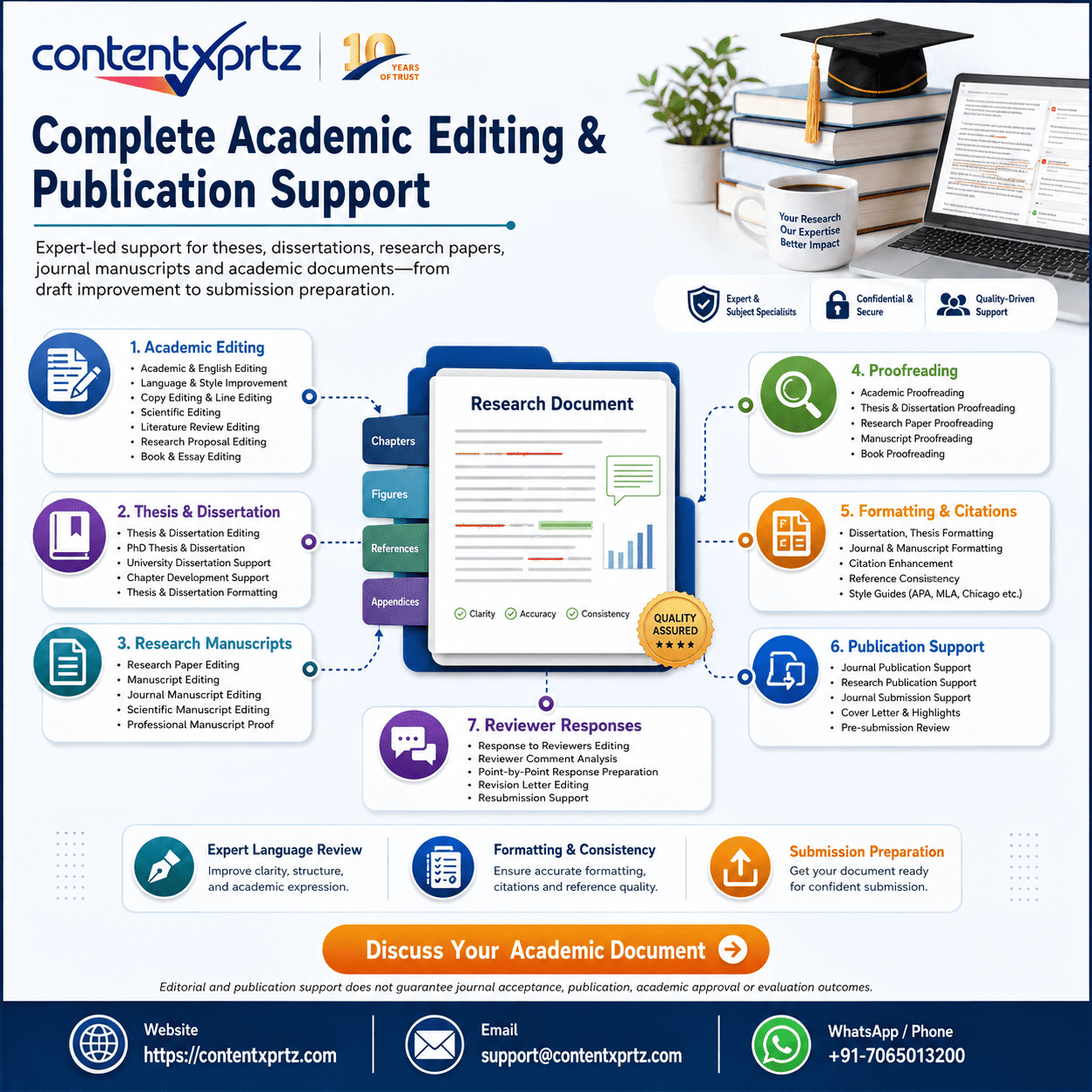
Contentxprtz approaches plagiarism-risk review as an academic-integrity and editing problem rather than a score-reduction exercise. Ethical support can help an author identify close paraphrasing, citation gaps, source-boundary problems, and language that needs clearer attribution while preserving the author’s ideas and responsibility. The sections below show how to use free checking intelligently, what to verify manually, and when deeper academic editing support may be useful.
Quick Answer: Can you use a plagiarism checker free of cost?
Yes. A free plagiarism checker can be useful for an early originality review, especially when you want to locate obvious copied wording, uncited quotations, or passages that need stronger paraphrasing. It is best used as a screening tool, not as proof that a document is plagiarism-free.
After the scan, inspect matches individually. Confirm whether each passage is quoted, cited, paraphrased, or independently written; check that references are authentic and traceable; and follow your university or journal’s rules. Do not chase a universal “safe” percentage, because similarity policies and database coverage differ.
For unpublished or sensitive research, read the checker’s privacy and retention terms before uploading. If the paper is high stakes, use your institution’s approved system where available and combine the report with human review.
Key Takeaways
- A free checker can identify text matches, but matching text is not the same as a finding of plagiarism.
- There is no universal similarity percentage that automatically makes a paper acceptable.
- Review each meaningful match in context: quotation, citation, paraphrase, common wording, reference entry, or genuine attribution problem.
- A low score does not prove originality if the checker cannot access the source or the reuse is idea-level rather than text-level.
- Check privacy and retention terms before uploading unpublished, confidential, embargoed, or commercially sensitive material.
- Ethical revision means improving attribution and independent expression, not mechanically replacing words to reduce a score.
- For high-stakes theses and journal manuscripts, combine software screening with institutional policy, source auditing, and expert human judgment.
What This Page Covers
- What free plagiarism checkers actually detect
- How similarity differs from plagiarism
- Free versus institution-approved checking
- How to review a report step by step
- Privacy and unpublished manuscript risks
- Ethical paraphrasing and citation repair
Methodology and Academic Sources
This guide is based on common academic integrity, source-use, proofreading, and manuscript-review workflows. It treats software output as evidence to be interpreted rather than as a verdict. The approach is consistent with Turnitin’s guidance on similarity versus plagiarism, the U.S. Office of Research Integrity definition of plagiarism, and Purdue OWL’s plagiarism guidance.
Academic policies vary. A university may specify a particular submission system, similarity threshold, exclusion rule, or process for thesis checking. A journal may focus on duplicate publication, text recycling, citation quality, permissions, or editorial judgment rather than a single score. Always check the rules that apply to your document before treating any checker output as final.
What “Plagiarism Checker Free” Means in Academic Practice
A free plagiarism checker is typically a web-based service that compares your submitted text with a collection of indexed web pages, documents, publications, or other material and reports overlaps. The quality of the result depends on what the service can search, how it matches language, what file length it accepts, and how clearly it shows sources and passages.
Similarity detection is not the same as plagiarism detection. Plagiarism concerns unattributed use of another person’s words, ideas, processes, or results. Similarity tools work primarily by identifying textual relationships. That distinction explains why a properly quoted sentence can match heavily without being plagiarized and why an uncited idea can be plagiarized without producing an obvious phrase match.
Similarity
Textual overlap between your document and content available to the checker. It is a signal for review, not a final academic judgment.
Plagiarism
Using another person’s words, ideas, results, or processes without appropriate credit, assessed in context under the relevant academic policy.
Paraphrasing
Restating a source’s meaning in genuinely independent wording and structure while still citing the source when the idea is borrowed.
Text recycling
Reusing your own previously disseminated wording. Whether it is acceptable depends on context, disclosure, copyright, and institutional or publisher rules.
For that reason, “free” should describe the cost of the software, not the standard of academic judgment. A useful free scan helps you ask better questions. It should not tempt you to treat a percentage as a pass/fail mark.
Free, Institution-Approved, and Professional Options
The right checking route depends on the stakes of the document, the sensitivity of the content, and the rules of the institution or publisher. A short class reflection and a final doctoral thesis do not carry the same risk.
| Option | Best use | Strengths | Limitations and cautions | Good next step |
|---|---|---|---|---|
| Free online checker | Early draft screening | Low cost, quick, useful for obvious web matches | Database coverage may be limited; privacy and retention terms vary | Review every important match manually |
| University-approved system | Coursework, thesis, dissertation, institutional submission | Connected to institutional workflow and policy | Access and report visibility may be restricted; settings differ by assignment | Follow supervisor, instructor, or graduate-school guidance |
| Publisher or journal screening | Manuscript submission | Used within editorial assessment | Authors may not control settings or receive the full report | Check journal instructions and revise source use before submission |
| Professional academic-integrity review | Complex citation, paraphrasing, language, or source-boundary problems | Human interpretation plus editing context | Should never replace authorship or promise a guaranteed score | Use ethical support that preserves your ideas and verifies citations |
Free checking is often enough for low-risk preliminary review. For a high-stakes thesis or journal paper, institutional checking plus a source audit is safer. If the underlying problem is unclear paraphrasing, inconsistent citations, or language that too closely follows source structure, scholarly proofreading or academic-integrity review can address the writing problem rather than merely the percentage.
How to Check a Paper for Plagiarism Responsibly
The most reliable process starts before you upload the document. Your aim is to create a traceable relationship between each borrowed idea and its source, then use similarity software to locate passages that deserve another look.
- Confirm the rules. Check your course, department, graduate school, funder, or journal instructions. Find out whether a specific checker is required and whether draft submissions enter a repository.
- Clean your source list. Make sure every in-text citation has a corresponding reference and every reference cited in the text is real, retrievable, and used accurately.
- Protect sensitive material. Read the checker’s privacy and retention terms before uploading unpublished research, participant-derived material, patentable findings, client documents, or confidential data.
- Run the scan without chasing a target. Record the report and focus first on the largest or most meaningful matches, not simply the total percentage.
- Classify each match. Is it a quotation, reference entry, common phrase, methods wording, properly attributed text, weak paraphrase, missing citation, or copied wording?
- Revise the underlying problem. Add citation where an idea is borrowed, use quotation marks for exact wording, or rewrite a paraphrase from understanding rather than swapping synonyms.
- Recheck source fidelity. Ensure your revision still represents the original source correctly and has not introduced a stronger claim than the source supports.
- Perform a human audit. Review figures, tables, translated material, definitions, methods, literature synthesis, and self-reused text that may not be captured cleanly by the report.
- Keep version evidence. Save your draft, report, corrected file, and source notes where appropriate. This helps you explain your revision process if questions arise.
Common Mistakes When Using a Free Plagiarism Checker
Most checking errors come from treating the tool as a grading device rather than a diagnostic aid. Avoid these patterns:
- Assuming 0% means perfect originality. A checker can only compare against material available to it and may miss idea-level or translated reuse.
- Assuming a high score means misconduct. References, quotations, templates, standard wording, and prior drafts can raise similarity legitimately.
- Deleting citations to reduce similarity. This can make the academic problem worse because correct attribution is more important than cosmetic score reduction.
- Uploading the same draft repeatedly without understanding repository behavior. Some systems may later match a document against an earlier stored version.
- Using multiple free tools and comparing percentages as if they are equivalent. Databases, algorithms, exclusions, and document handling differ.
- Ignoring single-source concentration. A modest overall score can conceal a long passage copied from one source.
- Trusting automated paraphrasing as a cure. It can preserve source structure, alter meaning, and create awkward or inaccurate academic prose.
- Ignoring references and figures. Text similarity is only one part of attribution; tables, images, datasets, and adapted figures may require citation or permission.
When a result seems surprising, compare the highlighted passage with the original source directly. Ask what intellectual work is yours and what came from the source. The Turnitin guide to interpreting similarity scores is useful precisely because it emphasizes scenario-based interpretation rather than a universal pass mark.
Privacy, Confidentiality, and Pre-Submission Decisions
Before uploading an unpublished document to any free checker, evaluate the data risk as carefully as the similarity risk. An academic draft can contain intellectual property, confidential interviews, unpublished results, embargoed findings, or material governed by research agreements. A “free” service is not automatically appropriate for such content.
Read the terms for storage duration, repository inclusion, deletion rights, third-party processing, model training, and licenses granted over uploaded text. If those terms are vague, do not assume your document will disappear after the scan. For confidential research, use an institution-approved platform or seek guidance from your supervisor, research office, or library.
| Question | If yes | Safer action |
|---|---|---|
| Does the file contain confidential participant or client information? | High privacy risk | Do not upload to an unknown public checker; use approved institutional processes |
| Is the manuscript unpublished, embargoed, or patent-sensitive? | Potential intellectual-property risk | Review retention and licensing terms or use a controlled service |
| Does the tool add submissions to a searchable repository? | Future self-match may occur | Understand repository policy before submitting drafts |
| Can the provider reuse uploaded text for training or service improvement? | Possible secondary use | Choose a service whose terms align with your institution and consent obligations |
| Is the assignment explicitly required to use a university platform? | Policy requirement | Follow that workflow rather than substituting a public checker |
Privacy due diligence is especially important for doctoral research and journal manuscripts because the academic cost of an avoidable data or repository problem can exceed the convenience of a free scan.
Academic Integrity, Paraphrasing, and Author Responsibility
Ethical originality is built through source use, not through score manipulation. The author remains responsible for the research, argument, citations, quotations, data, and final submission. Editing can improve clarity and flag risks, but it should not invent evidence or replace the author’s intellectual contribution.
Paraphrase from understanding, not from the sentence surface
A weak paraphrase often keeps the source’s structure while changing a few words. A stronger paraphrase starts with comprehension. Read the source, identify the claim you need, close or set aside the text, explain the idea in your own reasoning structure, then compare your version against the source for accuracy. Cite the source because the idea is still borrowed even when the language is fully your own.
Use quotations when exact wording matters
Quotations can legitimately generate similarity. If the exact wording is distinctive or analytically important, quote it according to your style guide and explain why it matters. Do not remove quotation marks simply to reduce the score.
Audit self-reuse and overlapping publications
Researchers sometimes reuse descriptions of methods, background text, or material from conference papers, preprints, theses, and earlier articles. Acceptability depends on discipline, publisher policy, copyright, disclosure, and the relationship between the outputs. Do not assume that because you wrote the earlier text, unrestricted reuse is always acceptable.
For research-integrity context, the ORI policy on plagiarism explains that plagiarism involves misappropriation or substantial unattributed copying. That reinforces an important point: software is most useful when it prompts better attribution decisions.
Practical Examples: What the Score Does Not Tell You
These examples show why interpretation matters more than the headline number.
A 24% report dominated by methods and references
Situation: A PhD scholar runs a thesis chapter through a checker and sees 24% similarity.
Common confusion: The scholar assumes anything above 20% must be unacceptable and starts rewriting standard terminology and deleting references.
Better approach: Review the report by source and passage. If much of the match comes from references, properly quoted definitions, a standardized instrument, or conventional methods language, the score may not reflect plagiarism. The scholar should focus on any long uncited matches and close paraphrases.
Ethical support: Thesis editing can help identify citation inconsistencies and overly source-dependent prose while keeping the scholar responsible for the research and final wording.
A 7% score hiding one serious copied paragraph
Situation: A first-time researcher receives a low overall score and assumes the manuscript is safe.
Common confusion: The researcher looks only at the percentage and misses a long passage in the literature review that closely reproduces one article.
Better approach: Inspect concentrated matches even when the total is low. Rewrite the synthesis from the underlying evidence, cite the source, and show how the paper’s interpretation differs or builds on prior work.
Ethical support: A manuscript review can flag passages where source boundaries are unclear and help improve scholarly synthesis without creating new research claims.
Paraphrasing that is accurate but too close in structure
Situation: An ESL researcher understands the source but mirrors its sentence pattern while replacing several words.
Common confusion: The writer believes changing vocabulary is enough to make the passage original.
Better approach: Rebuild the sentence from the writer’s own conceptual organization, preserve the source meaning, and retain the citation.
Ethical support: Academic editing can improve language and flag close phrasing while preserving the researcher’s argument and authorship.
Academic Originality and Citation Checklist
Before you run the checker
- I know which originality-checking system my university, instructor, or journal expects.
- I have checked the privacy implications of uploading this document.
- Every in-text citation has a matching reference entry.
- Every direct quotation is clearly marked and cited.
- My paraphrases are written from understanding rather than synonym substitution.
After you receive the report
- I reviewed the largest and most concentrated matches first.
- I did not delete correct citations or references merely to lower the percentage.
- I checked tables, figures, methods, definitions, and reused text separately.
- I verified that revised paraphrases still represent the source accurately.
- I checked my institution or journal policy before deciding whether the result is acceptable.
When Free Checking Is Enough—and When Expert Review Helps
Free checking is often enough when you have a short, low-risk draft, the sources are straightforward, the service terms are acceptable, and you are comfortable interpreting matches yourself. It can also be useful during early drafting to catch copied notes that accidentally moved into prose.
Expert review becomes more valuable when the manuscript contains dense literature synthesis, many citations, self-reused material, translated sources, complex disciplinary terminology, or extensive close paraphrasing. It may also help when a supervisor or journal has already raised originality concerns and you need to understand the pattern rather than simply reduce a number.
Need help reviewing plagiarism risk without changing your authorship?
Contentxprtz can support ethical source review, citation consistency, paraphrasing clarity, and academic language while keeping the research, ideas, and final decisions with you.
If the main issue is language rather than source attribution, a narrower proofreading service may be more appropriate. If the manuscript needs deeper organization, argument flow, or scholarly presentation, an editing service can be considered separately. The right level of support should match the actual problem.
Summary: Plagiarism Checker Free
A free plagiarism checker can be a practical first step for students, PhD scholars, researchers, and authors who want to find matching text before submission. Its most useful role is diagnostic: it highlights passages that deserve source-level review.
Do not treat the percentage as a verdict. Similarity can come from legitimate quotations, references, standard language, or earlier versions of a document, while weak source use can sometimes produce little or no match. Review context, follow institutional or journal rules, verify citations and paraphrases manually, and protect unpublished work by checking privacy and repository terms before uploading.
The strongest originality workflow combines careful note-taking, independent writing, accurate citation, responsible software use, and human judgment. When the source-use problem is complex, ethical academic support can help clarify attribution and language without taking over the author’s intellectual responsibility.
Frequently Asked Questions
These answers focus on the decisions that matter most when using free plagiarism checking for academic work.
Is a free plagiarism checker accurate enough for a thesis or dissertation?
A free plagiarism checker can be useful for an early self-check, but it should not be treated as definitive evidence that a thesis or dissertation is plagiarism-free. Free tools differ in the sources they can compare, the size of their databases, file limits, language handling, and how clearly they show matched passages. A low percentage may simply mean the checker did not have access to a relevant source.
For high-stakes academic work, use a free checker as a screening step: inspect every highlighted passage, verify quotations, confirm citations, and compare paraphrases with the original source. Then follow your university’s submission policy and, where available, use the institution-approved similarity system. A similarity report still requires human judgment because matching text is not automatically plagiarism. If your document contains complex paraphrasing, many sources, or inconsistent citations, ethical academic editing can help you review attribution and wording without replacing your authorship.
What is the best way to use a plagiarism checker free of cost?
Use a free checker before final formatting as a diagnostic tool, not as a target-score machine. First save a clean copy of your draft. Check the tool’s privacy terms and avoid uploading confidential, unpublished, patent-sensitive, or contract-restricted material unless you understand how the service stores and reuses text. If the tool allows smaller sections only, test representative passages rather than repeatedly uploading the whole manuscript.
After the scan, review matches one by one. Ask whether the wording is a direct quotation, a correctly cited standard phrase, an inadequately paraphrased passage, or an uncited borrowed idea. Correct the underlying writing issue: add attribution, quote accurately, paraphrase from understanding, or rewrite your own synthesis. Re-run only after meaningful revisions. The goal is not zero similarity; the goal is transparent, traceable use of sources and compliance with your institution or journal’s rules.
Does a 0% similarity score mean there is no plagiarism?
No. A 0% similarity score does not prove that a document contains no plagiarism. Similarity software compares submitted text with sources available to its databases and matching methods. A source that is not indexed, a translated passage, an idea copied without similar wording, or a heavily disguised paraphrase may not produce a text match. Even Turnitin explains that similarity and plagiarism are not the same judgment.
Treat 0% as one data point rather than a certificate of originality. Review whether every borrowed idea, quotation, table, figure, method description, and distinctive phrase is attributed appropriately. Check the reference list against in-text citations and confirm that each cited source is real and supports the claim. For academic integrity, the strength of your source practice matters more than achieving a particular percentage.
What similarity percentage is acceptable for a research paper?
There is no universal similarity percentage that automatically makes a research paper acceptable. Universities, departments, journals, instructors, and publishers may apply different policies, and the meaning of a score depends on what is matching. A paper can have legitimate similarity from references, quotations, standard terminology, or a methods section. Conversely, a low overall percentage can still hide one serious uncited passage.
Instead of chasing a fixed number, inspect the match locations and context. Follow the specific threshold or review process stated by your university or target journal, if one exists. Exclude references or quoted material only when the authorized system and policy permit it, and do not manipulate wording merely to lower the number. Your objective should be accurate attribution, independent synthesis, and faithful representation of sources.
Can free plagiarism checkers detect paraphrased plagiarism?
Some free plagiarism checkers may detect close paraphrases, but their ability to identify paraphrased or idea-level reuse varies widely. Exact or near-exact phrase matching is generally easier than identifying the same idea expressed with substantially different wording. This is why a clean report cannot replace careful source review.
When paraphrasing, read the source, set it aside, explain the idea in your own conceptual structure, then compare your version with the original. Cite the source even when no words are copied if the idea, evidence, method, or interpretation came from that source. If your paraphrase still follows the original sentence structure or substitutes synonyms line by line, rewrite it more substantially while preserving the source’s meaning. Purdue OWL’s plagiarism and paraphrasing resources are useful for developing this skill.
Is it safe to upload an unpublished manuscript to a free plagiarism checker?
It may not be safe unless you have reviewed the checker’s privacy, retention, ownership, and data-use terms. Unpublished manuscripts can contain original research, confidential participant information, patent-sensitive findings, client material, or content governed by journal and institutional policies. A free service may store uploads, use them to improve systems, or process them through third parties; practices differ by provider.
Before uploading, check whether the service states how long files are retained, whether text is added to a searchable repository, whether you can delete it, and whether the provider claims any license over uploaded content. When the material is sensitive, use the system approved by your university, employer, journal, or research team. You can also check small non-sensitive excerpts rather than the full document. Protecting unpublished work is part of responsible research practice.
Can I remove plagiarism by changing a few words or using a paraphrasing tool?
No. Replacing a few words, rearranging sentences, or running text through a paraphrasing tool does not resolve plagiarism if the underlying ideas or expression are still borrowed without appropriate credit. Patchwriting can preserve the original source’s structure while disguising surface wording, and automated rewriting can introduce meaning changes, fabricated details, or awkward academic language.
A better process is to return to the source, identify exactly what evidence or idea you need, write your interpretation from understanding, and cite the source according to the required style. Use direct quotation when the exact wording matters and your discipline permits it. Then review the paragraph for your own analytical contribution. If extensive sections are too close to sources, an editor can flag attribution and language risks, but the author must make and verify the substantive changes.
Do references, quotations, and common phrases increase similarity scores?
Yes, they can. Similarity systems may match reference entries, quoted passages, standard declarations, common technical wording, assignment prompts, or methods language. Depending on the platform and instructor settings, some categories may be excluded from the calculated score, but exclusions should be used only in accordance with institutional or journal policy.
The presence of a match is not automatically a problem. A correctly quoted and cited passage may legitimately match a published source. What matters is whether the reader can see where the material came from and whether your use follows the relevant academic convention. Review the report at passage level rather than judging the document from the headline percentage alone. This is also why comparing scores across different tools can be misleading: the databases and exclusion settings may not be the same.
How should PhD scholars check plagiarism before final thesis submission?
PhD scholars should combine a similarity check with a structured source audit. Start with your university’s thesis policy and confirm which checker or institutional workflow is authorized. Before the final scan, make sure every in-text citation has a corresponding reference, quotations are marked correctly, permissions are handled where required, and reused material from your own earlier publications is disclosed according to university rules.
When you receive a similarity report, examine the largest and most meaningful matches first. Check literature-review synthesis, definitions, methods wording, copied tables or figures, and any text reused from conference papers or published articles. Keep version records of your revisions. If language editing is permitted, ask the editor to preserve your ideas and flag source-attribution concerns rather than rewriting the research for you. The final responsibility for originality, citations, data, and compliance remains with the scholar.
When should I use professional plagiarism and academic-integrity support?
Professional support is most useful when the problem is not simply finding matching text but understanding how to revise ethically. Consider expert assistance when a thesis or manuscript has extensive citation inconsistencies, close paraphrasing, unclear source boundaries, self-reuse across publications, ESL language issues that make paraphrasing difficult, or a journal or supervisor has raised originality concerns.
Ethical support should not promise to “beat” detection software or guarantee a particular score. It should help you identify risky passages, improve paraphrasing and citation clarity, check reference consistency, and preserve your original argument. Contentxprtz’s plagiarism and academic-integrity support is positioned for that type of review. You should still verify every suggested change, retain control of the manuscript, and follow your institution’s or journal’s policies because authorship and submission responsibility cannot be transferred to an editor.
Use the Checker to Improve Source Practice, Not Just the Score
The core problem behind most searches for a free plagiarism checker is uncertainty: you want confidence that your academic work uses sources responsibly before a supervisor, instructor, examiner, or journal reviews it. A free tool can help, but only when you interpret matches in context and correct the underlying citation or paraphrasing issue.
For routine drafts, self-review may be enough. For a doctoral thesis, research manuscript, or document with complex source use, institution-approved checking and ethical expert review may provide a more reliable path. Contentxprtz can assist with source-boundary review, language editing, citation consistency, and publication-readiness support without promising a particular similarity score or replacing the author’s judgment.
“At Contentxprtz, we don’t just edit; we help ideas reach their fullest potential.”