Good Plagiarism Checker Free: How to Choose and Use One Safely
Searching for a good plagiarism checker free is usually less about finding a magic percentage and more about answering a practical question: “Is my use of sources transparent, original, and properly cited before I submit this work?” Students, PhD scholars, researchers, first-time authors, and professionals often want a free plagiarism check because institutional software may not be available during drafting, budgets are tight, or a quick self-review is useful before sending work to a supervisor, journal, client, or editor.
A free plagiarism checker can be helpful, but only when you understand what it actually measures. Most plagiarism checkers identify textual similarity between your document and material in their comparison sources. They do not independently decide whether a match is ethical, permitted, correctly quoted, or academically misleading. A bibliography can create matches. A standard methods phrase can create matches. A correctly quoted sentence can create a match. On the other hand, an idea can be poorly attributed even when the wording is different enough to avoid detection.
That distinction matters in academic writing because the purpose of originality checking is not to chase the lowest possible number. The purpose is to identify places where source use needs human review. A useful checker should help you see matched passages, trace likely sources, understand what was compared, and make sensible revisions. You should then verify citations, improve close paraphrasing, use quotation marks where required, and check your institution or journal’s rules.
This guide explains how to evaluate free plagiarism-checking options without relying on brand hype, how to read a similarity report, what free tools can and cannot tell you, how to protect unpublished work, and when expert academic editing or plagiarism and AI integrity support can provide a deeper review. The focus throughout is ethical authorship: preserving your ideas while making every borrowed idea, phrase, data point, table, figure, or definition appropriately traceable.
Quick Answer: What Makes a Good Plagiarism Checker Free?
A good free plagiarism checker should make it easy to identify where text overlaps with other sources, show enough context to investigate the match, and explain any limits on word count, source coverage, report detail, or data handling. The best choice is not necessarily the checker that reports the lowest similarity score; it is the one that helps you review source use responsibly.
Use free checking during drafting to locate obvious copied wording, missing quotation marks, patchwriting, citation gaps, and accidental repetition. Then inspect the original source and revise based on academic standards. For a thesis, dissertation, journal manuscript, or confidential document, also check whether the platform stores uploaded text or uses it for other purposes before submitting the file.
Most important: similarity is evidence to review, not a verdict. Your university, publisher, supervisor, or research-integrity office may apply different databases, settings, and policies, so a free score should never be treated as a guaranteed preview of a formal submission result.
Key Takeaways
- A free plagiarism checker is best used as an early screening tool, not a final academic-integrity decision.
- Similarity percentage and plagiarism are not the same thing; the matched passages and attribution matter more than the number alone.
- Check privacy and data-retention terms before uploading unpublished, sensitive, or confidential research.
- Different checkers can produce different results because their databases and matching settings differ.
- Ethical revision means quoting, citing, paraphrasing, and synthesising correctly—not merely reducing a score.
- For high-stakes academic work, combine software review with your institution’s rules and careful human judgement.
What This Page Covers
- How to judge whether a free plagiarism checker is useful for academic work.
- What a similarity report can and cannot prove.
- How to compare free, institutional, and expert-assisted checking.
- How to review matches step by step without damaging meaning or citations.
- Privacy and confidentiality questions to ask before uploading research.
- Common plagiarism-checking mistakes made by students and researchers.
- When professional support can help with a complex report or manuscript.
Table of Contents
- Methodology and academic sources
- What “good plagiarism checker free” should mean
- Features that matter in a free checker
- Free vs institutional vs expert review
- Step-by-step checking workflow
- Mistakes to avoid
- Practical examples
- Academic integrity checklist
- How Contentxprtz can help
- Summary and FAQs
Methodology and Academic Sources
This article follows common academic-writing, source-attribution, editing, and research-integrity principles rather than treating any software percentage as a universal standard. Institutional policies vary, so the final authority for a student is usually the relevant university or department; for journal authors, it is the target publisher or journal.
For broader ethical context, authors can consult the Committee on Publication Ethics (COPE), the ICMJE Recommendations for research and authorship responsibilities, APA guidance on citations, and Purdue OWL guidance on quoting, paraphrasing, and summarising. These resources reinforce a central principle: authors remain responsible for accurate attribution and for the integrity of the final work.
What “Good Plagiarism Checker Free” Should Mean in Academic Context
For academic writers, “good” should mean useful enough to support a responsible review, not “guaranteed to detect everything.” A plagiarism checker is essentially a text-comparison system. It identifies overlaps between your text and material available to its database or index. Some tools have broad web coverage; others may compare against publications, repositories, or previously submitted papers. Free versions often disclose less detail or impose tighter limits.
That means a checker can miss sources it does not contain, and it can flag text that is perfectly legitimate. The academic task begins after the scan: you must interpret each meaningful match and decide whether the writing is quoted, paraphrased, cited, synthesised, or reproduced appropriately.
Seven Features That Matter in a Free Plagiarism Checker
The strongest free checker for academic drafting is the one that gives you enough information to make a reasoned decision. Evaluate these features before trusting the output.
1. Match-level source visibility
You should be able to see which phrase was flagged and, ideally, the likely source. A percentage without source context is of limited academic value because you cannot distinguish a legitimate quotation from an unattributed copy.
2. Clear explanation of database coverage
Look for a transparent description of what the tool compares: public webpages, publications, repositories, student papers, or another collection. If the service does not explain its source coverage, interpret the result cautiously.
3. Practical document limits
Free tools often limit words, pages, scans, or file size. This matters particularly for dissertations and theses. A checker that scans only the first section of a long document cannot meaningfully represent the whole manuscript.
4. Privacy and retention terms
Before uploading unpublished research, ask whether the document is stored, indexed, used to improve a system, or shared with third parties. Research data, interview transcripts, unpublished findings, and co-authored manuscripts may involve obligations beyond your own convenience.
5. Report readability
A useful report separates sources, highlights matched wording, and lets you review one overlap at a time. Dense highlighting without source mapping can encourage unproductive rewriting.
6. Sensible handling of citations and quotations
Some systems can distinguish quotation marks, references, or small matches; others cannot. You should know whether these elements contribute to the displayed score.
7. No claim that a score equals an academic verdict
Be cautious with tools that promise to certify a paper as “plagiarism-free.” No checker can replace your institution’s policy, human judgement, or source verification.
Free Checker vs Institutional Report vs Expert Review
These three options solve different parts of the problem. A free checker helps with drafting, an institutional system supports formal review under local settings, and human expertise helps interpret complicated overlaps and improve the writing ethically.
| Option | Best use | Main strength | Main limitation |
|---|---|---|---|
| Free plagiarism checker | Early drafting and spot checks | Fast, accessible, low-cost screening | Database, report, privacy, and length limits may apply |
| University or institutional system | Coursework, thesis, or formal submission workflow | Uses institution-approved settings and process | Access may be restricted and the report still needs interpretation |
| Expert academic review | Complex theses, manuscripts, literature reviews, or difficult reports | Can interpret context, citations, paraphrasing, and language together | Requires time and professional fees; cannot ethically guarantee a score |
The best workflow is often layered: self-check during writing, institution-approved review when required, and expert support when the document is complex or the author is unsure how to revise without changing meaning.
How to Use a Free Plagiarism Checker Step by Step
Use the checker as a diagnostic tool and investigate each meaningful match before editing. The following process helps protect both academic integrity and the accuracy of your work.
- Prepare a clean draft. Keep your working references available and, if possible, remove confidential material that does not need to be scanned.
- Review the platform’s privacy terms. Do not upload sensitive research if retention or reuse is unclear.
- Run a manageable section first. A chapter, literature-review subsection, or introduction can reveal repeated patterns before you scan a full document.
- Open each substantial match. Compare your wording with the original source rather than relying only on coloured highlights.
- Classify the match. Is it a quotation, reference entry, standard phrase, close paraphrase, uncited idea, table text, or genuinely original wording that happens to overlap?
- Fix the underlying issue. Quote exactly where appropriate, paraphrase from understanding, synthesise multiple sources, or add the missing citation.
- Verify every reference. Check author, year, title, DOI or publication details, and make sure the cited source really supports the claim.
- Re-read for meaning. Do not damage technical accuracy just to reduce similarity.
- Use the relevant formal process. For a thesis or journal paper, follow the institution or publisher’s requirements after your self-check.
How to Interpret Similarity Without Chasing a Number
The most common mistake is to look at the total percentage first and assume it represents the quality of the writing. Instead, start with the largest and most meaningful matches. A single long passage copied too closely can be more serious than dozens of small, legitimate overlaps.
Ask four questions for each match: Is the source acknowledged? Is any exact wording clearly quoted? Is the paraphrase genuinely different in wording and structure? Does the citation support the statement? If the answer to all four is yes, the match may be acceptable even if the software still highlights it.
For literature reviews, pay special attention to patchwriting—sentences that preserve the source’s structure while changing only a few words. For methods sections, distinguish necessary technical phrasing from unnecessarily copied narrative. For definitions, quote or cite the authoritative source when the exact wording matters.
Common Mistakes to Avoid
- Trying to reach “0% similarity.” References, legitimate quotations, and standard terminology can create unavoidable matches.
- Replacing words with synonyms mechanically. This can distort meaning and still leave the source structure intact.
- Removing citations to lower the score. Citations make source use more transparent; deleting them can create a more serious integrity problem.
- Uploading confidential research without reading privacy terms. Free convenience may not be worth the data risk.
- Assuming the checker has searched every source. No database is complete.
- Trusting a generated reference without verification. A citation must be authentic, traceable, and relevant to the claim.
- Rewriting technical language until it becomes inaccurate. Preserve scientific meaning and use citation or quotation appropriately.
Three Practical Examples
Example 1: A PhD scholar checks a literature review
A doctoral candidate runs a free scan and sees several long matches in the literature review. The initial reaction is to rewrite every highlighted sentence. That would be the wrong priority. On inspection, two matches are correctly quoted definitions, three are reference entries, and one paragraph closely follows the structure of a source despite having citations. The correct response is to leave legitimate quotations properly formatted, ignore bibliography overlap for interpretive purposes, and rewrite the close paraphrase from conceptual understanding. An expert editor can then review whether the new paragraph preserves the original scientific meaning while improving synthesis and citation flow.
Example 2: An ESL researcher sees a low score but weak attribution
An early-career researcher receives a low similarity percentage and assumes the manuscript is safe. However, several ideas are summarised without clear citations because the author believed paraphrasing removed the need to reference the source. The score therefore creates false confidence. The correct approach is to trace the claims back to the literature and add appropriate citations even when the wording is fully original. This is where ethical academic editing can help separate language improvement from source-attribution decisions.
Example 3: A student uploads a confidential project to a free site
A postgraduate student has a company-sponsored dissertation containing non-public data. A free checker seems convenient, but its retention policy is unclear. Rather than uploading the whole file, the student uses the university-approved system for the full document and manually checks selected non-sensitive passages during drafting. This protects confidentiality while still supporting source review. The lesson is simple: privacy is part of responsible plagiarism checking, especially when the document contains data you do not own outright.
Ethical Paraphrasing: What to Change and What Not to Change
Ethical paraphrasing is not a word-replacement exercise. Read the source, understand the idea, set the source aside, explain the concept in the logic of your own argument, and then verify that you have represented the source accurately. Cite the source even though the wording is yours because the underlying idea is borrowed.
For specialised terminology, do not force awkward synonyms merely to avoid a text match. Terms of art, established names, statistical procedures, instruments, and technical concepts may need to remain unchanged. If a distinctive definition must be reproduced exactly, use quotation formatting and citation according to the relevant style.
Academic Integrity Checklist Before Submission
- Every borrowed idea, result, definition, dataset, image, or framework has appropriate attribution.
- Exact wording is clearly marked as a quotation where required.
- Paraphrases are rewritten from understanding, not produced by synonym substitution.
- In-text citations and reference-list entries match each other.
- Every reference is authentic and has been checked against the original source.
- Tables, figures, scales, questionnaires, and adapted frameworks have the required acknowledgements or permissions.
- The similarity report has been reviewed at match level rather than judged only by the overall percentage.
- Your use of editing, AI, or external support complies with institutional or publisher rules.
- Confidential or sensitive material has not been uploaded to an unapproved third-party platform.
- You have retained responsibility for the final wording, claims, analysis, and submission.
How Contentxprtz Can Help After a Free Plagiarism Check
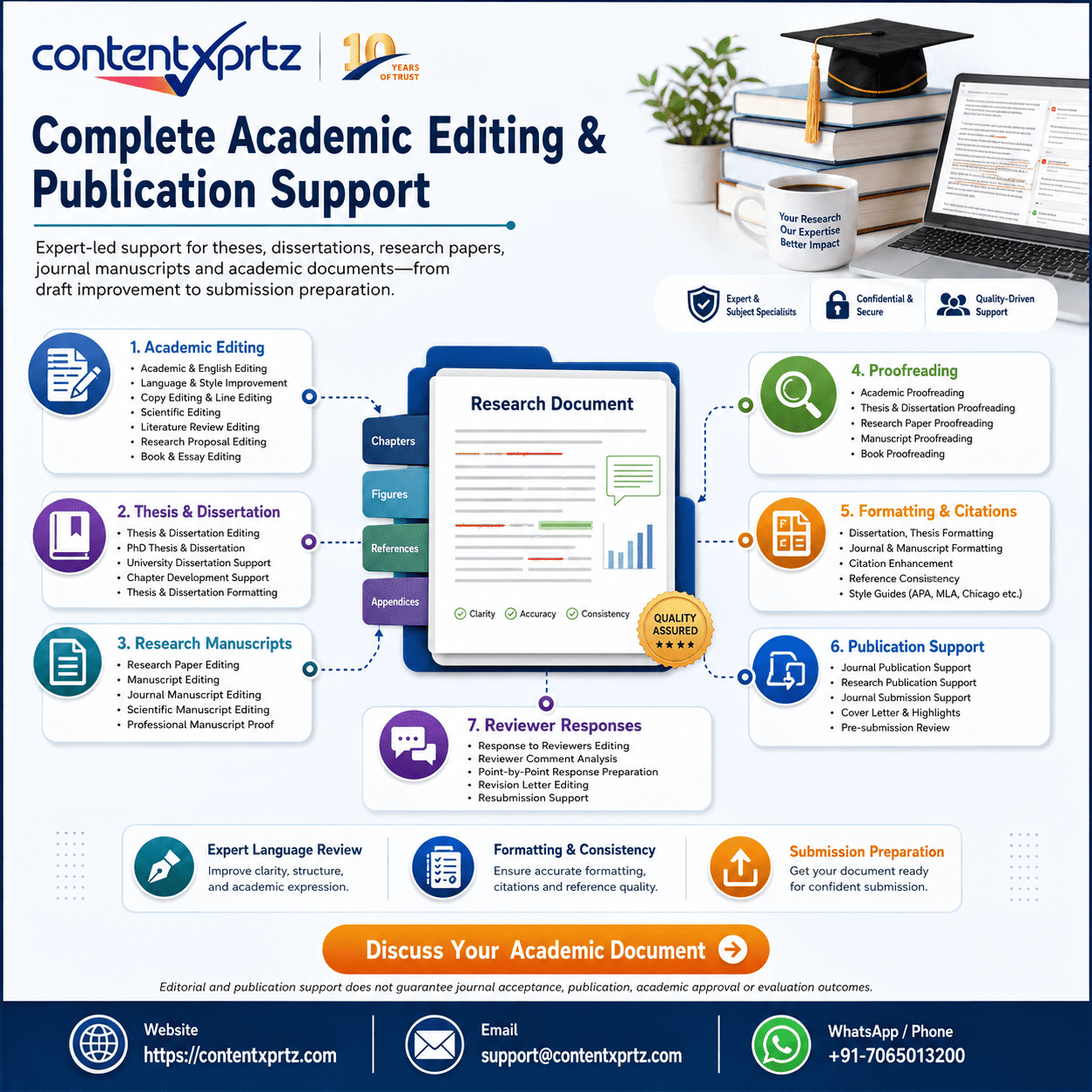
A free checker is often enough to identify obvious overlaps. The harder task is deciding what each match means and how to revise without weakening the argument. Contentxprtz can support researchers with human review focused on source-overlap patterns, paraphrasing quality, citation consistency, language clarity, and manuscript readiness.
For a thesis, dissertation, or research manuscript, the aim is not to “beat” software. It is to produce writing whose relationship to its sources is clear and defensible. Depending on the document, this may involve scholarly proofreading, academic editing, or plagiarism-risk review. The author remains responsible for the research, claims, data, citations, and final submission.
Explore plagiarism and publication support from Contentxprtz if a self-service scan has raised questions that need careful academic interpretation.
Summary: Good Plagiarism Checker Free
A good plagiarism checker free should help you find text overlaps, investigate sources, and improve attribution during drafting. It should not be treated as a certificate of originality or as a substitute for your institution’s academic-integrity process. Different tools search different source collections and use different settings, so their percentages can vary.
The safest approach is to focus on the matched passages. Verify the source, decide whether the text is quoted or paraphrased correctly, add or correct citations, and preserve technical accuracy. Check privacy terms before uploading unpublished research. For a high-stakes thesis or manuscript, use formal institutional guidance and consider expert review when the report is complex.
Frequently Asked Questions
What is a good plagiarism checker free for students?
A good plagiarism checker free for students is one that clearly explains what it compares, shows enough matching text to let you investigate the source, and does not present a similarity percentage as automatic proof of plagiarism. For academic work, the most useful free option is usually a first-pass screening tool rather than a final integrity decision. Use it to spot copied phrases, missing quotation marks, over-close paraphrasing, repeated wording, or references that need checking. Then open the original sources and review each match manually. A high similarity score can contain properly quoted material, references, common technical phrases, or template text, while a low score can still hide poor attribution. Free tools may also have limits on database coverage, word count, file size, privacy terms, or the number of scans. Before uploading a thesis, unpublished paper, or confidential document, read the tool’s privacy and data-retention policy. For formal submission, follow your university or journal process because institutional similarity systems may use different databases and settings.
Can I trust a free plagiarism checker for a thesis or dissertation?
You can use a free plagiarism checker as an early diagnostic step, but it should not be the only basis for judging a thesis or dissertation. Doctoral and postgraduate documents are long, citation-heavy, and often contain standard terminology, methods language, references, appendices, questionnaires, and previously presented material. A free checker may scan only part of the document, compare against a narrower source collection, or provide limited match context. That means its percentage may differ substantially from the system used by your university. A safer workflow is to scan sections during drafting, inspect every meaningful match, improve paraphrasing where the language is too close, add quotation marks where wording is copied verbatim, and verify citations against the original source. Before final submission, check your institution’s academic-integrity and thesis-editing rules. If you need help interpreting patterns across a long document, ethical expert review can focus on citation consistency, paraphrasing quality, source traceability, and language clarity without changing your research claims or pretending to guarantee a particular similarity score.
Is a similarity score the same as plagiarism?
No. A similarity score is not the same as plagiarism. Similarity software identifies text that resembles material in its comparison sources; plagiarism is an academic-integrity judgement about whether words, ideas, data, images, or other material have been used without appropriate acknowledgement. A similarity report can include legitimate quotations, bibliography entries, common phrases, standard methods wording, institutional templates, titles, and correctly cited passages. Conversely, a low percentage does not prove that the document is ethically sound. Ideas can be inadequately attributed even when wording has been heavily changed, and fabricated or inaccurate references may not trigger text matching at all. The correct approach is to review the report match by match. Ask whether the source is cited, whether exact wording is in quotation marks when required, whether the paraphrase is genuinely written in your own language and structure, and whether the citation supports the claim being made. Treat the score as a signal for review rather than a pass/fail number.
What percentage of plagiarism is acceptable in academic writing?
There is no universal percentage that automatically makes academic writing acceptable. Universities, departments, journals, supervisors, and publishers can apply different similarity settings and different rules for quotations, references, methods text, preprints, thesis repositories, and previously published material. A single number therefore cannot replace a match-level review. For example, a document may show a noticeable percentage because its reference list and standard terminology are included, while a much lower score could still contain one serious unattributed passage. Instead of aiming for an arbitrary target, aim for traceable authorship: cite every borrowed idea appropriately, quote exact wording where needed, paraphrase from understanding rather than by swapping synonyms, and check that each reference is authentic and supports the sentence it is attached to. If your institution provides a threshold or report-setting policy, follow that local rule. If it does not, ask the supervisor, research office, or journal editorial guidance rather than relying on a number from a free checker.
How do I check plagiarism for free without uploading confidential research?
If confidentiality matters, start with methods that minimise data exposure. First, read the privacy, retention, training-use, and deletion terms of any free checker before uploading unpublished research. If the policy is unclear, avoid submitting the full thesis, manuscript, client report, patent-related material, sensitive interview transcript, or commercially confidential document. You can instead test short non-sensitive passages, compare suspicious wording manually with the cited source, search distinctive phrases in a general search engine, and use your university’s approved similarity system when available. Keep a local list of sources used in each section so you can verify attribution without sending the whole document to a third party. If you work with an editor or research-support provider, ask how files are handled and whether the service has a defined confidentiality process. The key principle is that convenience should not override your obligations to participants, co-authors, employers, funders, or publishers. A free scan is useful only when the document can be shared under the tool’s terms.
What should I do when a plagiarism checker flags properly cited text?
When properly cited text is flagged, do not automatically rewrite it just to lower the score. First identify why the match appears. If the wording is an exact quotation, confirm that quotation marks or block-quote formatting are correct and that the citation is complete. If the text is a standard definition or a technical phrase, check whether the wording must remain precise and whether attribution is still appropriate. If the passage is a paraphrase, compare it with the source to ensure that both vocabulary and sentence structure are sufficiently original while preserving the meaning. Also check whether the tool is counting references, headings, templates, or common phrases. Some institutional systems allow authorised users to exclude bibliography or quoted material for interpretation, but students should not manipulate settings unless their institution permits it. The goal is not to make every match disappear; it is to make the relationship between your writing and your sources transparent, accurate, and academically defensible.
Can a free plagiarism checker detect AI-generated text?
Plagiarism detection and AI-text detection are different tasks. A plagiarism checker primarily looks for textual similarity with content in its comparison sources, whereas an AI detector attempts to estimate whether language patterns resemble machine-generated text. A passage can be original in wording yet AI-generated, or human-written yet similar to a published source. Likewise, an AI detector can produce false positives and false negatives, especially with edited text, formulaic academic prose, non-native English, short samples, or specialised technical writing. For academic work, follow your institution or journal’s current policy on permitted AI assistance and disclosure. Independently verify every factual claim and reference, and remain responsible for the final wording and argument. If you use AI for permitted language support, keep records of how it was used when required. A free plagiarism checker should therefore not be treated as an AI-authorship certificate; it is one tool for source-overlap review, not a complete research-integrity system.
How can I reduce plagiarism risk ethically after a free scan?
Reduce plagiarism risk by fixing the underlying writing and citation issue rather than trying to game the percentage. Start with each meaningful match. If you copied exact language because the wording matters, quote it and cite it correctly. If the idea can be expressed in your own words, close the source, explain the concept from your understanding, and then reopen the source to confirm accuracy and add the citation. Break dependence on the original sentence structure instead of replacing a few words with synonyms. For literature reviews, synthesise multiple sources around a theme instead of summarising one paper sentence by sentence. Check that every in-text citation has a matching reference entry and that every reference is genuine and accessible. Review tables, figures, definitions, scales, survey items, and adapted frameworks separately because attribution rules may differ. Finally, read the paragraph for logic and voice. Ethical plagiarism-risk reduction preserves your authorship while making source use more transparent.
Why do different plagiarism checkers give different results?
Different plagiarism checkers can give different results because they may search different databases, crawl the web at different times, include or exclude student-paper repositories, handle quotations and references differently, use different minimum-match lengths, and apply different algorithms for grouping overlaps. File type, language, formatting, and scan length can also change what is detected. That is why comparing percentages across tools is often misleading. A 12% result in one system and a 22% result in another does not necessarily mean one checker is wrong; they may be measuring different source coverage and applying different filters. Compare the actual matched passages and sources instead. For academic submission, the institution or journal’s authorised system and policy are more relevant than an external free score. Use a free checker for drafting feedback, then treat the formal report as a separate review that must be interpreted under the applicable rules.
When should I use professional plagiarism and publication support?
Professional support is useful when the document is high-stakes, long, citation-dense, written across many sources, or difficult to interpret after a similarity scan. Examples include a PhD thesis with repeated methods language, a literature review with close paraphrasing, a manuscript prepared by multiple authors, or an ESL paper where attempts to paraphrase have changed the scientific meaning. Ethical support should not promise to “beat” a checker or guarantee a particular percentage. Instead, it can help identify source-overlap patterns, improve paraphrasing while preserving meaning, correct citation and reference inconsistencies, flag quotations that need clearer treatment, and polish the language around properly attributed content. The author remains responsible for research claims, sources, data, and final submission. Contentxprtz offers plagiarism-risk and publication-readiness support for researchers who want a human review after self-service checks, especially when the report needs careful academic interpretation rather than simple score reduction.
Conclusion: Use the Checker to Improve Source Practice, Not Just the Score
A free plagiarism checker can be a practical starting point for students and researchers, especially during drafting. Its real value is not the final percentage; it is the chance to identify passages that deserve a closer look before submission.
Use free tools when the document can be uploaded safely and the scan provides meaningful source context. For formal academic work, follow university or journal rules and interpret similarity carefully. When a thesis, dissertation, or manuscript contains complex overlap, inconsistent citation, or difficult paraphrasing, expert-assisted review can help improve clarity and source transparency without replacing the author’s ideas.
At Contentxprtz, we don’t just edit; we help ideas reach their fullest potential.