Free Plagiarism Checker Online: How to Check Similarity Responsibly
Searching for a free plagiarism checker online usually means you want a quick answer before submitting an assignment, thesis chapter, research paper, manuscript, proposal, or professional document: Does any part of my writing look too similar to material that already exists? A free checker can be useful for an early similarity scan, but it should be treated as a screening aid rather than a final verdict on plagiarism.
That distinction matters. Similarity software compares text against the sources available to its system and highlights matching or closely overlapping passages. It does not automatically know whether a match is an acceptable quotation, a correctly cited definition, unavoidable technical wording, common methodological language, poorly paraphrased text, unattributed copying, or legitimate reuse that requires disclosure. Turnitin’s own guidance makes this point clearly: its Similarity Report identifies text matches, while academic judgment is required to decide what those matches mean.
For students, PhD scholars, researchers, and authors, the safest workflow is therefore not “get the lowest possible percentage.” It is to review every meaningful match, return to the original source, check quotation and citation practices, rewrite weak paraphrases in your own scholarly voice, and follow the rules of your university, supervisor, journal, publisher, or professional body.
This guide explains how free plagiarism and similarity checkers work, what they can and cannot tell you, how to interpret a similarity percentage, how to use them without compromising confidential work, and what to do when a report reveals problematic overlap. It also shows when self-checking is sufficient and when ethical plagiarism and publication support may be useful.
Quick Answer: What Should a Free Plagiarism Checker Online Actually Do?
A useful free plagiarism checker online should compare your text with material available to its database or web index, identify matching passages, show the likely source where possible, and help you inspect whether quotation, paraphrasing, and attribution need attention. It should make the evidence easier to review rather than simply display a percentage without context.
The percentage is a similarity score, not a plagiarism score. A high percentage can include properly quoted or referenced material, while a low percentage can still hide a serious uncited passage. The report matters more than the headline number.
Before uploading a thesis, unpublished manuscript, confidential report, or research data, read the checker’s privacy, storage, retention, and reuse terms. Free tools can differ widely in coverage and data practices. For high-stakes academic or publication work, use a trusted institutional or publisher-approved system whenever available.
Key Takeaways
- A plagiarism checker detects text similarity; it does not independently prove plagiarism.
- Free checkers can be useful for early screening, but their source coverage may be more limited than institutional or publisher systems.
- The similarity percentage should never be interpreted without opening and reviewing the matched passages.
- Correct quotation, citation, paraphrasing, and source acknowledgement matter more than chasing an arbitrary “safe” percentage.
- A 0% or very low score does not automatically prove that a document is original or academically compliant.
- Do not upload confidential, unpublished, sensitive, or commercially valuable material before checking the service’s data-use terms.
- When overlap is complex, revise ethically rather than using superficial word substitution to manipulate the score.
What This Page Covers
- How online plagiarism and similarity checkers compare text
- The difference between plagiarism, similarity, quotation, paraphrasing, and text recycling
- How to evaluate free tools before uploading academic work
- How to read a similarity report and prioritise meaningful matches
- A step-by-step method to reduce plagiarism risk ethically
- Common mistakes students and researchers make after seeing a percentage
- When professional editing or publication support can help
Table of Contents
- What a plagiarism checker actually checks
- Similarity versus plagiarism
- Free versus institutional tools
- How to choose a free checker
- Step-by-step checking workflow
- How to interpret a similarity score
- How to fix problematic matches
- Common mistakes to avoid
- Pre-submission checklist
- Frequently asked questions
Methodology and Academic Sources
This guide follows common academic-integrity, editing, and publication-readiness workflows and uses official guidance from established similarity-checking and scholarly publishing organisations. Turnitin explains that its Similarity Report compares submissions with sources in its database and highlights matching text; the report itself does not make the academic judgment that plagiarism has occurred. Crossref similarly explains that its Similarity Check service, powered by iThenticate, is designed to detect text overlap and support editorial review.
Academic and publisher rules vary. Students should check their university’s academic-integrity policy and assignment instructions. Journal authors should check the target journal’s author guidelines and editorial policies. A checker can support this process, but the author remains responsible for the originality, accuracy, citation, and ethical presentation of the final work.
Useful official references include Turnitin guidance on similarity scores, Crossref Similarity Check documentation, and COPE guidance on plagiarism in submitted manuscripts.
What Does an Online Plagiarism Checker Actually Check?
An online plagiarism checker usually performs text comparison. It breaks the submitted document into searchable text patterns and compares those patterns with sources available to the service. Depending on the platform, those sources may include public web pages, academic articles, books, repositories, previously submitted student papers, publisher databases, or other licensed collections.
When the system detects similar wording, it highlights the relevant passage and may link it to a source. Some systems then calculate an overall similarity percentage based on how much of the document overlaps with detected material.
What a checker can help you find
- Long phrases copied from a web page without quotation or attribution
- Close paraphrases that retain too much of the original wording or sentence structure
- Repeated passages from your own previously published or submitted work
- Quoted material that is not clearly marked as a quotation
- References, standard definitions, templates, and common phrases that create legitimate matches
- Sources you may have forgotten to cite during drafting
What a checker cannot decide by itself
A checker cannot reliably decide intent, authorship responsibility, whether a particular form of reuse is permitted, whether a paraphrase fairly represents the source, or whether a citation meets the exact academic standard required by your institution. It can show evidence of textual overlap; a human must interpret that evidence in context.
Similarity Is Not the Same as Plagiarism
Similarity describes textual overlap; plagiarism is an academic-integrity judgment about inappropriate use or representation of another source’s work or ideas. This is the most important concept to understand before using any checker.
| Situation | May create similarity? | Automatically plagiarism? | What to review |
|---|---|---|---|
| Correctly quoted sentence with citation | Yes | No | Quotation marks, citation, and permitted quotation length |
| Reference list entry | Yes | No | Reference accuracy and style |
| Standard method or technical phrase | Yes | Usually not by itself | Whether wording is genuinely conventional and whether citation is still expected |
| Close paraphrase with source cited | Yes | Potentially problematic | Whether wording and structure remain too dependent on the source |
| Copied paragraph without attribution | Yes | Potentially serious | Source, extent, context, and institutional policy |
| Reuse of your own published wording | Yes | Depends on context | Text-recycling, copyright, disclosure, and publisher rules |
This is why a single target such as “below 10%” or “below 15%” is not universally meaningful. A methods-heavy scientific paper may legitimately repeat terminology. A short essay with one uncited copied paragraph may have a low overall percentage but a major integrity problem. The correct question is not “How low is my score?” but “Are the matches properly used, acknowledged, and justified?”
Free Plagiarism Checker Online vs Institutional Similarity Software
Free and institutional tools can serve different purposes. A free checker is often useful during drafting, while institutional systems may provide broader databases, assignment-level controls, private repositories, or workflows designed for academic assessment and publishing.
| Feature | Free online checker | Institutional or publisher system |
|---|---|---|
| Best use | Early self-checking and obvious overlap review | Formal coursework, thesis, editorial, or publication workflows |
| Source coverage | Varies widely by service | May include licensed, scholarly, or submission repositories |
| Document limits | Often limited by words, pages, or daily scans | Usually governed by institutional subscription |
| Match detail | Can range from basic percentage to source-level highlighting | Often provides richer filtering and source review |
| Privacy | Must be checked carefully in terms of service | Usually governed by institutional contracts and policies |
| Final decision | Still requires human judgment | Still requires human judgment |
A free tool can therefore answer “Where might I need to look again?” It may not answer “Will my university or journal report the same percentage?” Different systems can search different databases, apply different matching rules, and calculate scores differently.
How to Choose a Free Plagiarism Checker Online Safely
Choose a checker by examining transparency, privacy, source visibility, and usefulness of the report rather than only the promise of a free percentage.
1. Read the privacy and retention terms
Before uploading unpublished work, find out whether the service stores your document, uses it to improve its systems, adds it to a searchable database, shares it with third parties, or deletes it after processing. This is especially important for theses, manuscripts under peer review, patent-related material, confidential company documents, clinical information, or research containing personal data.
2. Check what sources the tool compares against
A checker that scans only publicly indexed web pages may miss journal articles behind paywalls, books, institutional repositories, or prior student submissions. If source coverage is unclear, treat the result as a preliminary scan rather than a comprehensive originality assessment.
3. Prefer reports that show the matched text and source
A bare percentage gives little educational value. You need to see the passage, the likely source, and enough surrounding context to judge whether the match is legitimate.
4. Check document and language support
Word limits, supported file types, reference handling, language coverage, and formatting preservation can vary. For long theses or manuscripts, a tool that checks only a small excerpt may give a misleading impression of the full document.
5. Avoid services that promise to “make plagiarism zero” automatically
Academic integrity is not achieved through synonym substitution or mechanical rewriting. Ethical revision requires understanding the source, writing the idea independently, citing it where appropriate, and preserving the technical meaning.
How to Use a Free Plagiarism Checker Online: Step by Step
The strongest workflow combines similarity screening with source verification and careful revision.
- Finish a meaningful draft first. Do not use the checker as a substitute for note-taking, citation management, or source reading.
- Verify your references. Make sure every source cited in the text appears in the reference list and that every reference corresponds to a source you actually consulted.
- Check the service’s privacy terms. Remove confidential or sensitive material if the platform is not appropriate for it.
- Upload or paste the permitted text. If the free tool has a word limit, check coherent sections rather than random fragments.
- Open the detailed matches. Start with long or distinctive matching passages rather than obsessing over the overall percentage.
- Classify each important match. Is it a quotation, common phrase, reference, properly paraphrased idea, weak paraphrase, or uncited copied text?
- Return to the original source. Do not revise only from the checker’s highlighted snippet; read the source in context.
- Correct the academic practice. Add quotation marks, citations, page numbers, attribution, or a fresh paraphrase where required.
- Recheck the revised section. Confirm that you improved both originality and clarity rather than merely changing vocabulary.
- Apply institutional rules. If your university or journal provides its own similarity system, regard that system and its policy as the authoritative submission workflow.
How Do You Interpret a Similarity Score Correctly?
Interpret a similarity score by reviewing where the overlap occurs, how much comes from each source, and whether the matched text is used appropriately. The percentage is only a navigation signal.
Start with the largest individual matches
A document showing 18% overall similarity could contain eighteen harmless 1% matches, one serious 12% copied section plus small reference matches, or a large amount of correctly quoted material. Those scenarios require different responses.
Look at the type of matched text
- Bibliography: references often match other documents because citation formats are standard.
- Direct quotation: correctly marked and cited quotations can legitimately match.
- Technical terminology: some phrases cannot be rewritten meaningfully without losing precision.
- Boilerplate or templates: ethics statements, declarations, or required wording may be standard.
- Core argument or analysis: close overlap here deserves much more attention.
- Long uncited passages: these should be investigated immediately.
Do not treat a low score as a certificate
Turnitin notes that a low score does not automatically show that plagiarism is absent. A single unattributed idea or passage can still be significant. Conversely, a high score can arise from legitimate quoted or formulaic text. Human review is essential in both directions.
How to Reduce Plagiarism Risk Without “Gaming” the Checker
Reduce plagiarism risk by improving scholarship, not by manipulating surface wording. The goal is clear authorship and accurate attribution.
Use genuine paraphrasing
Read the source until you understand the idea, close or move away from the original wording, explain the point in a structure that fits your own argument, and then compare your version with the source. Cite the source even when the wording is entirely yours if the idea, evidence, or interpretation comes from that source.
Quote when the exact wording matters
Use quotation marks or a block quotation according to the required style when the original wording is distinctive, authoritative, or necessary to analyse. Add the appropriate citation and locator such as a page number when required.
Synthesise multiple sources
A literature review should not become a sequence of lightly rewritten abstracts. Compare findings, methods, disagreements, limitations, and patterns across sources. Synthesis naturally strengthens the author’s analytical voice and reduces dependence on any one source’s phrasing.
Handle your own previous writing carefully
Reusing your own text can still create ethical, copyright, or disclosure issues depending on the context. Journals may have policies on text recycling and duplicate publication. A thesis chapter adapted into a journal article may require transparency and appropriate citation even though you are the original author.
Correct the reference trail
If the checker leads you to a source you had not recorded, verify that source directly before citing it. Never cite a secondary reference as though you read the original work when you did not.
Practical Similarity Examples for Students and Researchers
Real academic decisions become easier when you look beyond the number and ask what kind of match you are seeing.
| Example | Why it may be flagged | Better response |
|---|---|---|
| A definition copied exactly and followed only by a citation | Exact wording matches the source | Use quotation marks if exact wording is necessary, or paraphrase genuinely and retain the citation |
| A methods sentence similar to many papers | Standard disciplinary phrasing | Check whether the language is conventional; rewrite only where precision is preserved and cite the method source if required |
| A paragraph with synonyms substituted word by word | Structure remains too close to the source | Rebuild the explanation from your understanding and connect it to your own argument |
| A literature-review sentence combining three papers | Small fragments may match source terminology | Ensure each claim is traceable to the correct citation and the synthesis is your own |
| A paragraph copied from your earlier publication | The system recognises previously published text | Check text-recycling and copyright policies; cite or disclose reuse where appropriate |
Common Mistakes When Using a Free Plagiarism Checker
The most common mistakes happen after the report appears, when users try to optimise the number rather than improve the academic practice.
- Chasing an arbitrary threshold. No universal similarity percentage is automatically “safe” for every university, journal, discipline, or document type.
- Deleting citations to lower the score. Removing legitimate references makes academic integrity worse, not better.
- Replacing words with synonyms mechanically. Patchwriting can remain too close to the source and can damage technical accuracy.
- Ignoring a small but serious match. A low overall percentage can still contain one important unattributed passage.
- Assuming all highlighted text is wrong. Correct quotations, references, names, and standard expressions can be legitimate matches.
- Uploading confidential work anywhere. Free access should never override privacy, intellectual-property, research-ethics, or contractual obligations.
- Trusting only one checker. Different databases can produce different results; formal assessment should follow the system and policy specified by the institution or publisher.
Does a Plagiarism Checker Detect AI-Written Text?
Plagiarism detection and AI-writing detection are different functions. A similarity system looks for overlap with known sources. AI-writing detection attempts to estimate whether language may have been generated by an AI system. A document can therefore have low similarity and still raise separate AI-use questions, or it can be entirely human-written and still contain problematic copied material.
Students and researchers should follow the exact AI-use and disclosure policy of their university, funder, employer, conference, or journal. Do not assume that passing a plagiarism scan means the work complies with rules on generative AI, authorship, research integrity, data confidentiality, or disclosure.
Using Similarity Checking for a Thesis, Dissertation, or Research Paper
For long academic documents, similarity checking should be integrated into the writing workflow rather than left until the final hour. Thesis chapters often contain recurring terminology, standard methods, extensive citations, and material developed over several years, so interpretation requires context.
For a thesis or dissertation
Check your university’s policy on permitted similarity thresholds, pre-submission checking, repository storage, and previously published chapters. If part of the thesis has appeared in a journal, clearly document the relationship between the publication and thesis chapter.
For a journal manuscript
Publishers may screen submissions with tools such as iThenticate or Crossref Similarity Check. Editors may look at the location and nature of overlap rather than a single universal percentage. Duplicate publication, unattributed reuse, and substantial text recycling can be more significant than scattered standard phrases.
For coursework
Use similarity feedback as a learning tool. Review the passages that depend too closely on sources, strengthen your paraphrasing and synthesis, and ask your instructor or academic-skills team when the policy is unclear.
Pre-Submission Plagiarism-Risk Checklist
Before you submit an assignment, thesis, dissertation, research paper, or manuscript, use this checklist to review academic integrity rather than relying only on a score.
- I can identify the source behind every borrowed idea, statistic, quotation, table, figure, and distinctive argument.
- Direct quotations are clearly marked and cited according to the required style.
- Paraphrases use genuinely independent wording and structure rather than word-for-word synonym replacement.
- Every in-text citation has a matching reference, and every reference is accurate and traceable.
- I reviewed the largest and most meaningful similarity matches rather than only the total percentage.
- I checked whether reused material from my own previous work needs citation, disclosure, or permission.
- I did not upload confidential or unpublished material to a service without understanding its data terms.
- I followed the specific academic-integrity and AI-use rules of my university, journal, or publisher.
- I kept my own analytical voice clear in the literature review, discussion, and conclusions.
- If a match is difficult to resolve, I will ask an instructor, supervisor, editor, librarian, or qualified academic-support professional rather than hide it mechanically.
When Professional Plagiarism-Risk and Publication Support Can Help
Self-checking is usually enough when the document is short, the matches are easy to interpret, and you understand the citation requirements. Professional support becomes more useful when a long thesis or manuscript contains repeated overlap, extensive source-dependent writing, inconsistent citations, translated material, publication reuse, or a similarity report that you cannot confidently interpret.
Ethical support should not disguise copied text or manufacture artificial originality. It should help the author understand the matches, strengthen paraphrasing and synthesis, correct citations, improve scholarly language, and prepare the document according to institutional or publisher expectations while preserving the author’s ideas and responsibility.
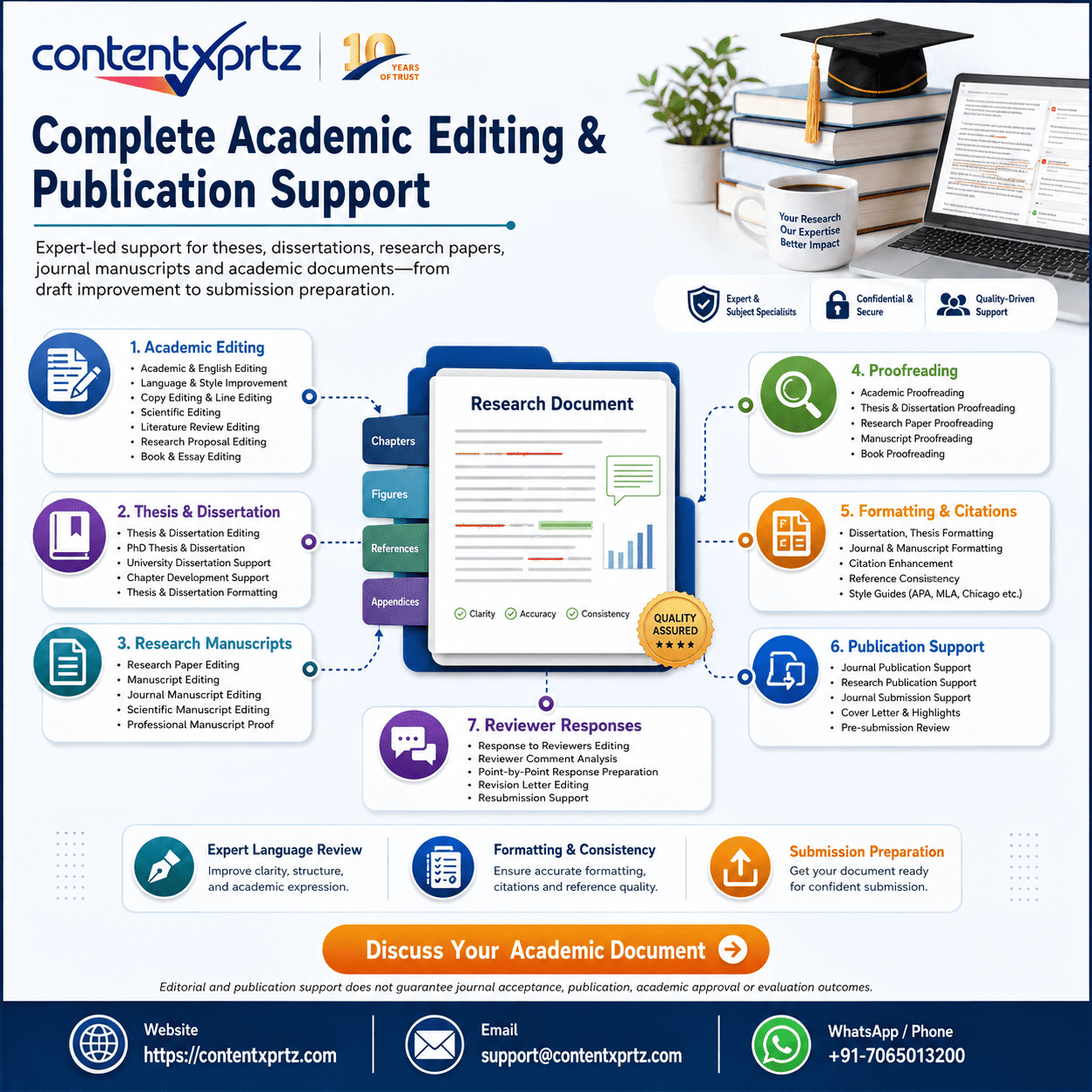
Contentxprtz can assist with plagiarism-risk reduction and publication support, academic editing, citation review, and manuscript clarity. The aim is not to promise a particular similarity percentage; it is to help authors make defensible, transparent, and academically responsible revisions.
Summary: Free Plagiarism Checker Online
A free plagiarism checker online can be valuable when you use it for what it actually does: finding text that resembles sources available to the checker. It cannot independently decide whether your work is plagiarism-free, academically acceptable, or ready for submission.
Use the report to inspect substantial or distinctive matches, verify the original sources, fix quotation and citation problems, rewrite weak paraphrases from genuine understanding, and review any reuse of your own earlier work. Protect confidential documents by checking data policies before uploading them.
The best outcome is not simply a smaller number. It is a document in which borrowed material is transparent, citations are accurate, your scholarly voice is clear, and the final submission meets the rules that actually govern your work.
Frequently Asked Questions
Is there a completely free plagiarism checker online?
Many services offer free similarity checks, but “free” can involve word limits, restricted reports, limited source coverage, account requirements, or other conditions. Check the tool’s current terms, source database, privacy policy, and report detail before relying on it. For high-stakes work, an institutional or publisher-approved checker is usually more appropriate if you have access to one.
Can a free plagiarism checker tell me if my paper is plagiarism-free?
No checker can provide a universal guarantee that a paper is plagiarism-free. Similarity software detects text overlap with sources available to its system. Plagiarism requires interpretation of quotation, paraphrasing, attribution, authorship, context, and applicable academic rules.
What is a good plagiarism or similarity percentage?
There is no universal percentage that is automatically good or bad. Acceptable similarity depends on the document type, discipline, institutional policy, matched sources, quotations, references, technical wording, and location of the overlap. Review the report itself and follow the specific threshold or guidance issued by your university or journal.
Does 0% similarity mean there is no plagiarism?
Not necessarily. A checker may not have access to every source, and plagiarism can involve ideas or material that the system does not detect as matching text. A very low score should still be accompanied by careful citation, source verification, and academic-integrity review.
Why does properly cited text appear as a match?
Similarity systems compare wording, so correctly quoted text, bibliographic references, titles, definitions, and standard phrases can still appear as matches. The key question is whether the material is used and acknowledged correctly, not whether it is highlighted.
How can I reduce similarity without changing the meaning?
First identify why the passage matches. If it is a required quotation or technical phrase, it may not need rewriting. If it is a weak paraphrase, return to the source, understand the idea, explain it independently in the context of your own argument, and retain the appropriate citation. Avoid mechanical synonym replacement.
Can I upload my thesis to any free plagiarism checker?
Do not upload an unpublished thesis automatically. Read the checker’s terms on storage, retention, database indexing, reuse, confidentiality, and third-party processing. If your university provides an approved similarity system, use that route for formal thesis checking.
Do plagiarism checkers detect paraphrasing?
Some systems can identify close textual similarity even when a few words have changed, but detection varies by tool and database. The correct academic approach is not to evade detection. Paraphrase from understanding, use your own structure and emphasis, and cite the source when the idea or evidence comes from it.
Is plagiarism checking the same as AI detection?
No. Similarity checking compares text with known sources, while AI-writing detection estimates whether text may have been produced by an AI system. These are separate analyses, and compliance with one does not prove compliance with the other. Follow your institution’s or journal’s AI policy independently.
When should I get professional help with a similarity report?
Professional support can help when a long thesis, dissertation, or manuscript contains complex overlap, repeated patchwriting, translated material, self-reuse, inconsistent citations, or publisher-specific concerns. Ethical support should improve attribution, paraphrasing, synthesis, referencing, and clarity rather than hide copied material or promise a guaranteed score.
Conclusion: Use Similarity Checking as a Learning and Quality-Control Tool
A plagiarism checker is most useful when it directs your attention to passages that deserve review. It becomes less useful when the only objective is to force the percentage below an arbitrary number. Academic integrity depends on transparent source use, genuine authorship, accurate citation, responsible paraphrasing, and compliance with the rules that apply to your work.
Start with a reputable free checker when you need a preliminary scan and the document is appropriate to upload. For a thesis, dissertation, journal article, or confidential manuscript, prefer an approved institutional or publication workflow when available. Then interpret the matches carefully and revise the scholarship, not merely the surface wording.
If you need structured assistance with difficult similarity matches, citation consistency, academic language, or publication preparation, Contentxprtz offers ethical support designed to strengthen the manuscript while keeping the author responsible for the ideas, evidence, and final submission. “At Contentxprtz, we don’t just edit; we help ideas reach their fullest potential.”